
21 Days in Vietnam and Cambodia gives you time for more than an extended highlights tour. The third week should create depth: either northern mountain communities and a Mekong journey into Cambodia, or a broader Cambodian chapter with Battambang and Phnom Penh. The two routes below use those extra days differently, then compare entry steps, weather, country-specific costs and the pacing decisions that keep a three-week journey enjoyable.
How Should You Spend 21 Days in Vietnam and Cambodia?
- Fantastic Vietnam and Cambodia in 19 Days
- Discover Best of Cambodia and Vietnam in 20 Days
- Explore Highlights of Vietnam and Cambodia in 21 Days
- Wonders of Vietnam and Cambodia in 21 Days
- Explore the Majestic Beauty of Vietnam – Cambodia – Thailand in 21 Days
- Treasure of Vietnam, Cambodia, and Myanmar in 21 Days
Use the third week either for Sapa and a Mekong journey into Cambodia or for a deeper Cambodian route through Siem Reap, Battambang and Phnom Penh. Both itineraries include Vietnam’s main cultural regions and Angkor, but they use the additional days for different types of depth rather than adding more airports.
Itinerary 1: An amazing cross-border journey through Vietnam and Cambodia
- Route: Hanoi – Sapa – Ha Long Bay – Da Nang – Ho Chi Minh City – Can Tho – Chau Doc – Phnom Penh – Siem Reap
- Best for: Active travellers who want northern mountains, hands-on culture, food and a geographical journey along the Mekong.
- Strengths: Sapa receives two useful days, the central and southern regions remain coherent, and the Chau Doc to Phnom Penh sector connects the countries through the river corridor.
- Weekness: A night train or long mountain transfer plus several internal flights makes the route operationally complex. Cambodia is focused on the capital and Angkor, with no Battambang.
- Best time: February to March often balances northern walking conditions, central Vietnam’s improving weather and Cambodia’s drier season.
- Think twice if: You need minimal stairs and walking, dislike night travel or want a longer Cambodia section.
Day 1 | Arrive in Hanoi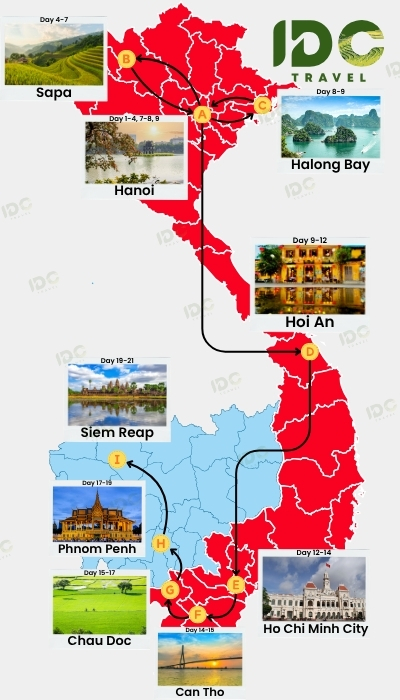
Check in and recover. Use the evening for a short lakeside walk and a meal near the hotel.
Day 2 | Hanoi History and Street Food
Combine selected historic sites with a neighbourhood food walk. Try bun cha (grilled pork with rice noodles and herbs) and learn how northern flavours differ from those later in the route.
Day 3 | Hanoi Craft or Cooking Experience
Choose a pottery village, market-led cooking class or focused museum visit. Keep the programme within one area so the hands-on experience receives enough time.
Day 4 | Hanoi at Leisure and Travel to Lao Cai
Use the morning for rest, shopping or a cafe before the overnight train or confirmed mountain transfer. Keep valuables and sleep essentials in a small bag.
Day 5 | Lao Cai to Sapa
Transfer to Sapa, leave luggage and take a short acclimatisation walk. Mountain visibility changes quickly, so prioritise the experience over a fixed photo checklist.
Day 6 | Sapa Landscape and Community Walk
Follow a guided route matched to weather, trail conditions and mobility. Ask how local visits are arranged and choose responsible, respectful interaction.
Day 7 | Sapa to Hanoi
Use the morning for a viewpoint or market, then return to Hanoi. Keep the evening free and prepare a small bag for the cruise.
Day 8 | Hanoi to Ha Long Bay
Board an overnight cruise and enjoy the limestone landscape. Confirm the current port, vessel and safety instructions before departure.
Day 9 | Ha Long Bay to Da Nang
Complete the morning cruise, return toward Hanoi and fly to Da Nang. This is a long travel day, so avoid adding an evening attraction in Hoi An.
Day 10 | Hoi An Ancient Town
Explore the old town, merchant houses and market area. Add one craft workshop rather than several short demonstrations.
Day 11 | Hoi An Countryside or Beach
Choose a village cycle ride, cooking class, beach time or a free day. This pause separates the northern travel from the southern section.
Day 12 | Da Nang and Fly to Ho Chi Minh City
Use the morning for one Da Nang-area experience if flight timing allows, then fly south. Settle near the next day’s activities.
Day 13 | Ho Chi Minh City and Cu Chi
Choose a detailed city programme or combine selected central sights with Cu Chi. Do not attempt every museum and tunnel stop in one day.
Day 14 | Ho Chi Minh City to Can Tho
Travel into the Mekong Delta through selected waterways or communities. Stay in Can Tho to begin the next day close to the river.
Day 15 | Can Tho to Chau Doc
Start early for river activity, then continue to Chau Doc. Organise passports, entry documents and a small amount of cash for the border journey.
Day 16 | Chau Doc and the Border Landscape
Keep the sightseeing light and use the afternoon to reconfirm the speedboat departure point, passport requirements, Cambodia e-Arrival confirmation, visa-on-arrival eligibility, luggage rules and the amount of cash requested by the operator. Keep digital and printed copies of the documents in separate places.
Day 17 | Chau Doc to Phnom Penh
Board the confirmed speedboat service from Chau Doc to Phnom Penh and allow approximately six hours, including immigration formalities. The river checkpoint does not currently accept a Cambodian eVisa, so complete the correct visa-on-arrival preparation for your passport before departure.
Day 18 | Phnom Penh History and Architecture
Pair the Royal Palace area with either the National Museum or a carefully paced modern-history visit. A guide helps families decide how to approach sensitive sites.
Day 19 | Phnom Penh to Siem Reap
Travel by road or air according to the current schedule. Arrive, rest and prepare for Angkor rather than adding a rushed sunset tour.
Day 20 | Angkor Wat and Angkor Thom
Give the principal temple circuit a complete day with a licensed guide. Begin early, pause during the hottest hours and select only one smaller temple if time allows.
Day 21 | Depart Siem Reap
Keep the final morning gentle and leave generous time for airport formalities. Protect onward connections when tickets are booked separately.
>>> See the full itinerary: Wonders of Vietnam and Cambodia in 21 Days. IDC Travel can adjust the Sapa transfer, workshops, river border journey and guiding according to your interests.
Why the third week matters: The additional days allow this route to keep two meaningful days around Sapa and two nights in Chau Doc before the river crossing. That time creates a genuine contrast between Vietnam’s northern highlands, the Mekong Delta and Angkor rather than turning them into short transport stops. If the itinerary must be shortened, remove an optional workshop or secondary city activity before cutting Sapa, the border buffer or the full Angkor day.
Itinerary 2: The essence of Vietnam and a deeper of Cambodia
- Route: Hanoi – Ninh Binh – Ha Long Bay – Hue – Da Nang – Ho Chi Minh City – Mekong Delta – Siem Reap – Battambang – Phnom Penh
- Best for: Travellers who prefer limestone landscapes, heritage cities and a broader understanding of Cambodia to mountain trekking.
- Strengths: Cambodia receives a complete week across three distinct bases. Battambang adds art, countryside and colonial-era character rather than another major temple circuit.
- Weekness: Sapa is omitted and Cambodia requires two overland transfers after Angkor. The route ends in Phnom Penh, so international flight options should be checked before booking.
- Best time: January to March is often the easiest overall period, with generally drier Cambodia conditions and improving weather through central Vietnam.
- Think twice if: Sapa is a lifetime priority, you want a beach ending or your group dislikes consecutive road sectors in Cambodia.
Day 1 | Arrive in Hanoi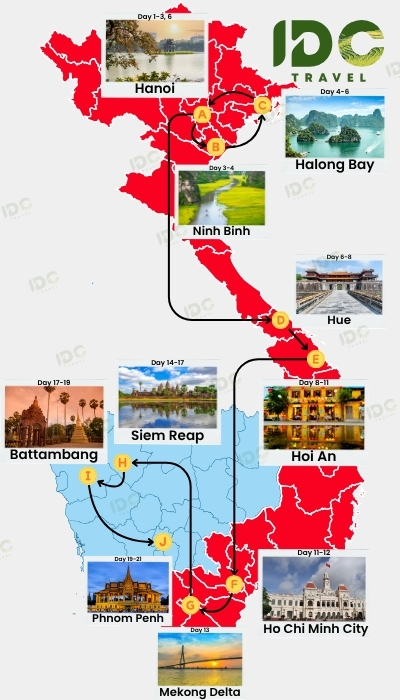
Check in and recover with a short walk near Hoan Kiem Lake. Save formal sightseeing for the next morning.
Day 2 | Hanoi History and Neighbourhoods
Combine the Old Quarter, Temple of Literature and one museum or market. Use a guide to connect the sites without wasting time in traffic.
Day 3 | Hanoi to Ninh Binh
Leave Hanoi early and spend the day exploring Ninh Binh. Choose one principal boat route, such as Trang An or Tam Coc, and combine it with a nearby cultural or landscape stop. Stay overnight in Ninh Binh so the day does not end with another long return journey.
Day 4 | Ninh Binh to Ha Long Bay
Depart Ninh Binh early and travel directly to the cruise port in time for embarkation. Do not add another morning boat ride in Ninh Binh because cruise check-in normally requires passengers to reach the port before lunch.
Day 5 | Ha Long Bay Cruise
Use the full day for the cruise program, which may include caves, kayaking, floating communities or quieter parts of the bay depending on the selected vessel and weather conditions.
Day 6 | Ha Long Bay to Hue
Complete the cruise’s final morning activities, disembark and transfer toward the airport for the flight to Hue. Leave a realistic buffer between the scheduled cruise return and the flight rather than booking the shortest possible connection.
Day 7 | Hue Imperial Heritage
Explore the Imperial City and one royal tomb or pagoda. Limit outdoor time around midday during hotter months.
Day 8 | Hue to Hoi An
Cross the Hai Van Pass with selective coastal stops. Reach Hoi An early enough for a relaxed evening walk.
Day 9 | Hoi An Ancient Town
Visit merchant houses, assembly halls and the market, then try cao lau (Hoi An-style noodles with pork, herbs and crisp toppings).
Day 10 | Hoi An Countryside and Craft
Choose a cycle ride, cooking class or craft workshop. Keep the evening free for rest, laundry or tailoring appointments.
Day 11 | Da Nang and Fly to Ho Chi Minh City
Add one Da Nang-area stop only if the flight schedule allows it without rushing. Fly south and settle near the city centre.
Day 12 | Ho Chi Minh City and Cu Chi
Choose a focused city history day or combine central landmarks with Cu Chi. Travellers who prefer museums should remain in the city.
Day 13 | Mekong Delta Excursion
Explore waterways, orchards and rural communities on a day trip or one-night extension. Confirm the amount of driving, boating and walking before selecting the programme.
Day 14 | Fly to Siem Reap
Complete the country change and immigration formalities. Keep the evening free so Angkor starts with energy.
Day 15 | Angkor Wat and Angkor Thom
Visit the principal monuments with a licensed guide. Begin early, carry water and dress appropriately for religious sites.
Day 16 | Siem Reap Beyond the Main Circuit
Choose Banteay Srei, Tonle Sap or a village and craft experience. One coherent programme is more rewarding than three rushed excursions.
Day 17 | Siem Reap to Battambang
Travel overland and settle into Battambang. Use the late afternoon for architecture, a local gallery or a short riverside walk.
Day 18 | Battambang Countryside and Creative Life
Explore selected villages, farms or art spaces with a local guide. Avoid reducing the day to a single novelty ride; the region’s value lies in its wider cultural context.
Day 19 | Battambang to Phnom Penh
Travel to the capital with planned comfort stops. Keep the evening unstructured after the road journey.
Day 20 | Phnom Penh with Context
Combine the Royal Palace area with the National Museum or a carefully planned modern-history route. Match sensitive content to the group’s age and interests.
Day 21 | Depart Phnom Penh
Use any spare time for a riverside breakfast or final shopping. Allow extra airport time and confirm baggage rules for the onward journey.
>>> See the full itinerary: Explore Highlights of Vietnam and Cambodia in 21 Days. IDC Travel can tailor the Cambodia split, guides, hotel level and flight gateways for your preferred pace.
Why the third week matters: This route uses its final week to see more of Cambodia after Angkor instead of adding another country or airport. Retain Battambang when local arts, countryside and slower provincial life are priorities. If those experiences matter less, move that night to Hoi An, Siem Reap or Phnom Penh rather than adding a new destination.
Plan Daily Costs Separately for 21 Days in Vietnam and Cambodia
These are planning ranges per person, based on two travellers sharing a room. They are not quotations. International and regional flights, visas, insurance, shopping, premium nightlife, Ha Long cruise packages, major temple passes and special private transport are excluded.
Vietnam Daily Planning Range
| Cost category | Budget | Mid-range | Luxury |
| Accommodation per person per night | USD 20-45 | USD 55-120 | USD 150-350 |
| Meals and drinks per day | USD 15-30 | USD 35-60 | USD 70-130 |
| Local transport per day | USD 8-25 | USD 25-60 | USD 70-180 |
| Guides, entrances and activities per day | USD 20-60 | USD 70-150 | USD 180-400 |
| Indicative daily total | USD 63-160 | USD 185-390 | USD 470-1,060 |
Cambodia Daily Planning Range
| Cost category | Budget | Mid-range | Luxury |
| Accommodation per person per night | USD 18-40 | USD 50-110 | USD 140-320 |
| Meals and drinks per day | USD 12-25 | USD 30-55 | USD 65-120 |
| Local transport per day | USD 8-22 | USD 25-55 | USD 65-150 |
| Guides, entrances and activities per day | USD 20-55 | USD 65-140 | USD 160-350 |
| Indicative daily total | USD 58-142 | USD 170-360 | USD 430-940 |
- Itinerary 1 usually uses about sixteen Vietnam nights and four Cambodia nights.
- Itinerary 2 moves closer to thirteen Vietnam nights and seven Cambodia nights.
Multiply accommodation by the actual nights in each country, calculate daily spending from the relevant table, then add route-specific transport. Check whether a proposal includes train cabin, checked baggage, cruise cabin, border transfer, Angkor guide, entrance passes and hotel taxes before comparing totals.
Complete Entry and Payment Steps Country by Country
Treat entry preparation as two separate checklists. A visa, eVisa or arrival declaration issued for one country has no effect on entry to the other.
Vietnam
- Visa or eVisa: Check exemption eligibility or apply through the official Vietnam eVisa portal. Confirm the approved dates, number of entries and airport or border point.
- PAI: PAI is a separate pre-arrival declaration and does not replace a visa or eVisa. Complete it through the official pre-arrival portal when applicable and save the confirmation. IDC Travel’s Vietnam PAI guide explains the process.
- Cash and cards: Vietnam uses Vietnamese dong. Cards are convenient in many city hotels and established restaurants, while cash remains important in markets, villages, Sapa and Mekong stops. Review IDC Travel’s Vietnam currency guide.
Cambodia
- Visa: Check nationality and entry-point eligibility through the official Cambodia eVisa portal. Confirm the exact passport and border before relying on an eVisa or visa on arrival.
- Cambodia e-Arrival: Cambodia e-Arrival is a separate arrival declaration, not a visa. Follow the current instructions on the official Cambodia e-Arrival portal.
- Cash and cards: The Khmer riel is the national currency, while US dollars are also commonly used. Carry clean notes in modest denominations and expect some change in riel. IDC Travel’s Cambodian currency guide explains denominations, USD use, exchange and ATM planning.
Crossing from Chau Doc to Phnom Penh by Speedboat
The Chau Doc to Phnom Penh speedboat can be a practical and scenic border crossing, but its visa procedure differs from arriving at a major airport. The current Hang Chau speedboat information states that:
- The journey takes approximately six hours, including time for immigration formalities.
- The route uses the Vinh Xuong or Song Tien checkpoint in Vietnam and Kaam Samnor in Cambodia.
- A Cambodian eVisa is not accepted at this river crossing.
- Eligible passengers can use the operator’s assisted visa-on-arrival process, but the charge includes a service component and may change.
- Payment at the pier is currently cash only, in US dollars or Vietnamese dong.
Before travel, confirm that your nationality qualifies for visa on arrival, that your passport has sufficient validity and blank pages, and that the operator is running on the intended date. Carry a recent passport photo as a precaution even if the operator says it can complete the form without one.
A traveler who is not eligible for visa on arrival must change the border plan rather than assume an eVisa will be accepted. A road crossing may follow different rules, so its exact checkpoint must be checked separately.
Which Airports and Border Gateways Fit a Three-Week Itinerary?
The most efficient gateway plan is to enter Vietnam through Hanoi and leave Cambodia through the airport nearest the final city. Vietnam’s principal gateways for these routes are Noi Bai International Airport (HAN), Da Nang International Airport (DAD) and Tan Son Nhat International Airport (SGN). Cambodia uses Siem Reap Angkor International Airport (SAI) for Angkor and Techo International Airport (KTI) for Phnom Penh.
- Itinerary 1: Arrive in Hanoi, travel overland through Vietnam, cross from Chau Doc to Phnom Penh by speedboat and depart from Siem Reap Angkor International Airport.
- Itinerary 2: Arrive in Hanoi, continue through Central and Southern Vietnam, fly from Ho Chi Minh City to Siem Reap, and depart through Techo International Airport after Phnom Penh.
- For both routes: An open-jaw international ticket avoids returning to the first city. Leave a recovery buffer after the border crossing or international flight before scheduling a major excursion.
Techo International Airport replaced the former Techo International Airport (KTI) as the capital’s operating gateway in September 2025. Review all existing flight references and booking screenshots so that the outdated KTI code does not remain elsewhere in the article.
Travelers who need help matching current flights, border services and private transfers can contact IDC Travel before confirming the route.
When Is the Best Time for Vietnam and Cambodia in 21 Days?
February and March offer the most practical overall weather compromise for these routes. No single month gives perfect conditions in Sapa, Central Vietnam, the Mekong Delta and Cambodia at the same time, so the best choice depends on which landscapes and activities have the highest priority.
Weather in Vietnam
- Hanoi, Ninh Binh and Sapa: Northern Vietnam is cooler from December to March, while the mountains may be misty or cold. April to May and September to October generally provide clearer conditions for Sapa walks and scenery.
- Ha Long Bay: Spring and autumn usually offer more comfortable cruise conditions, but sailings can still change because of storms, fog or instructions from local authorities.
- Hue, Hoi An and Da Nang: February to August is generally the easier period for Central Vietnam. Heavy rain, storms and flooding become greater concerns from approximately September into the final months of the year.
- Ho Chi Minh City and the Mekong Delta: November to April is the drier period. The wetter months bring greener landscapes and higher river levels, but afternoon rain can disrupt outdoor timing.
Weather in Cambodia
November to February generally brings the most comfortable combination of lower rainfall and manageable heat in Siem Reap, Battambang and Phnom Penh. March is still practical but hotter, while April can make long temple days tiring. From May to October, rain creates greener countryside and fuller waterways, but travelers need more flexibility for roads and outdoor visits.
How the Seasons Affect These Two Routes
- For Itinerary 1, February or March provides a workable balance for Central and Southern Vietnam and Cambodia, although Sapa may still be cool or misty. Travelers whose main priority is clear mountain scenery may prefer late September or October but should then monitor weather risks in Central Vietnam.
- For Itinerary 2, January to March is the easiest overall window because Cambodia is relatively dry and Central Vietnam is moving into more favorable conditions. Regardless of the month, keep a buffer before flights that follow a cruise, long road transfer or border crossing.
For further regional detail, see IDC Travel’s guides to the best time to visit Vietnam and the best time to visit Cambodia.
Top Vietnamese and Cambodian Dishes to Try in Three Weeks
The journey crosses several food regions, so the most useful tasting list is organized by country rather than mixing dishes into one undifferentiated checklist.
Vietnam Must-Tries
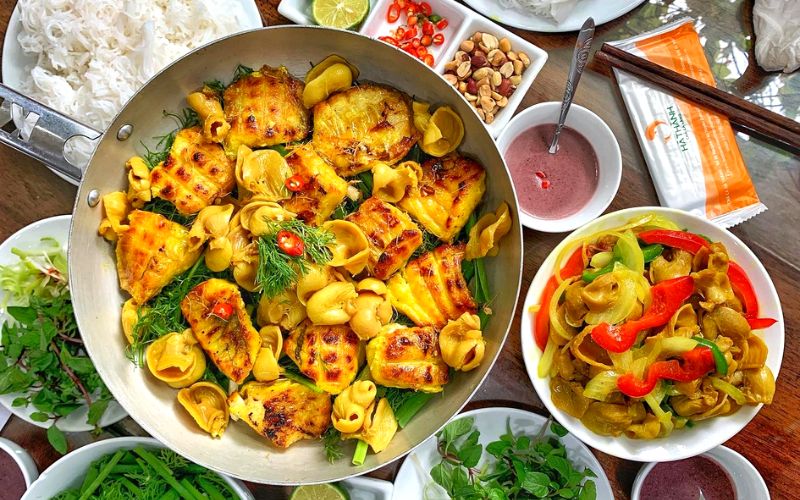
- Cha ca (turmeric fish with dill): Hanoi-style fish cooked with turmeric, dill and spring onion, commonly served with noodles, herbs and peanuts.

Cha ca (turmeric fish with dill)
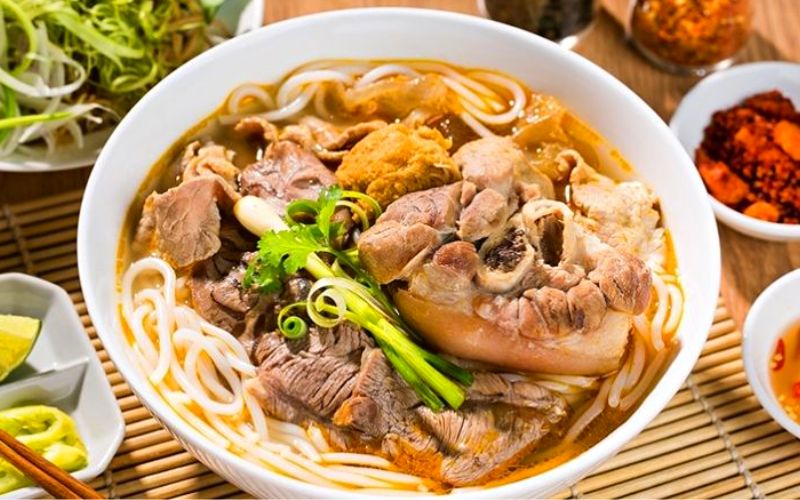
- Bun bo Hue (Hue-style beef noodle soup): A fragrant Central Vietnamese noodle soup with beef, lemongrass and a rich savory broth.
Bun bo Hue (Hue-style beef noodle soup)
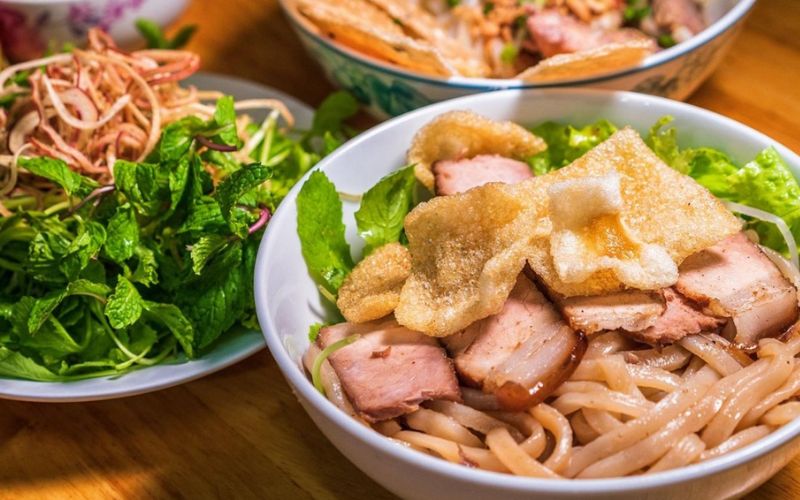
- Cao lau (Hoi An-style pork noodles): Hoi An noodles served with pork, greens, herbs and crisp toppings.
Cao lau (Hoi An-style pork noodles)
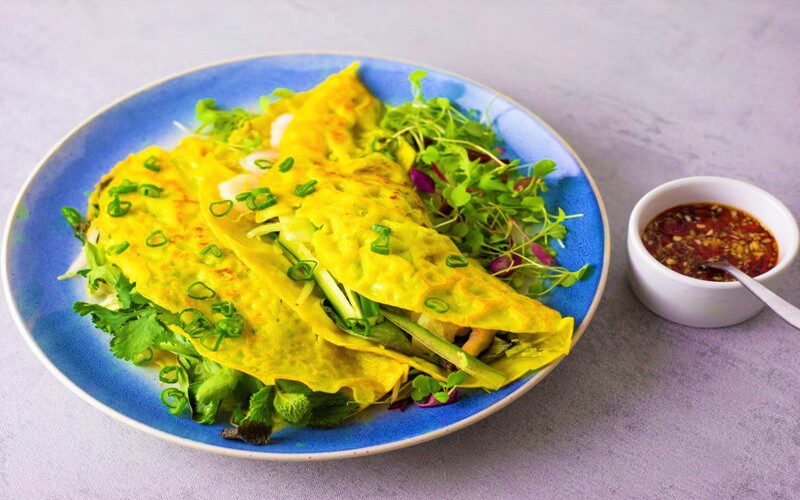
- Banh xeo (crispy savory pancake): A crisp pancake filled with ingredients such as pork, shrimp and bean sprouts.
Banh xeo (crispy savory pancake)
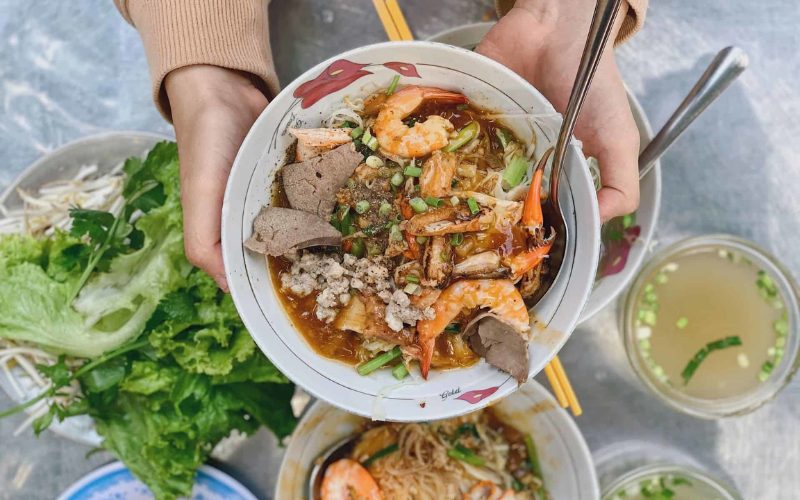
- Hu tieu (southern noodle soup): A southern noodle dish served with broth or dry, with toppings varying by region and vendor.
Hu tieu (southern noodle soup)
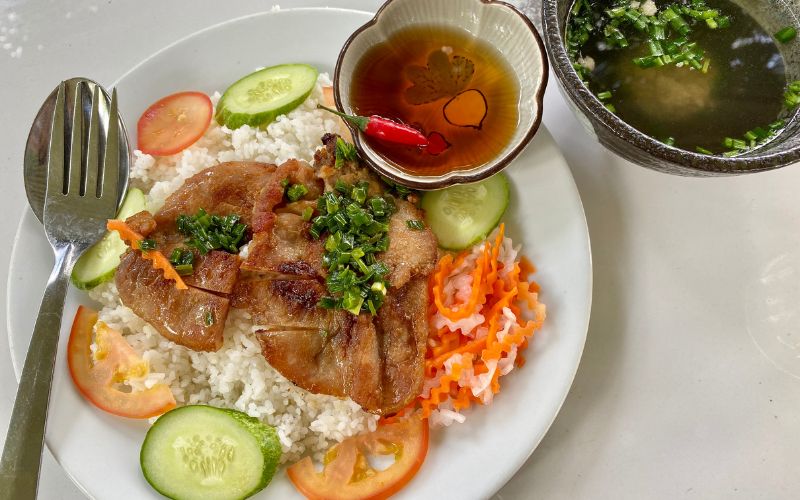
- Com tam (broken rice): Broken rice with grilled meat, pickles and fish-sauce dressing, widely associated with Ho Chi Minh City.
Com tam (broken rice)
If you want to explore more Vietnamese dishes, come read Top 30 Popular Vietnamese Dishes beyond Pho.
Cambodia Must-Tries
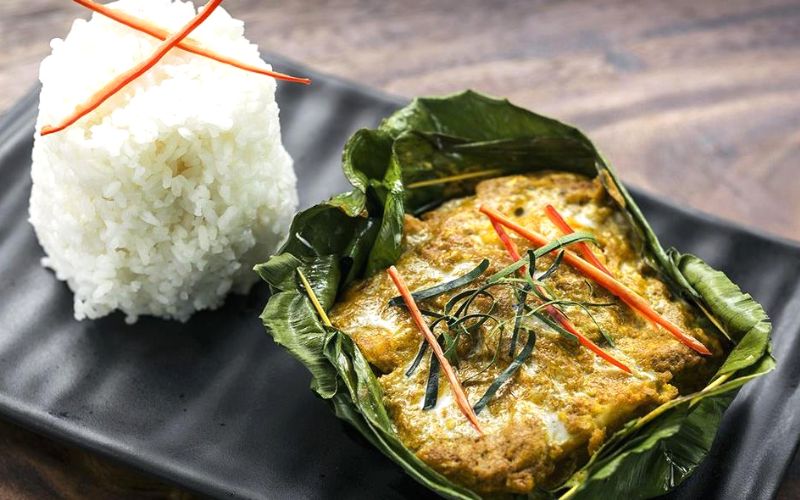
- Fish amok (steamed coconut fish curry): Fish cooked with coconut milk, herbs and kroeung spice paste, often steamed in a banana-leaf container.
Fish amok (steamed coconut fish curry)
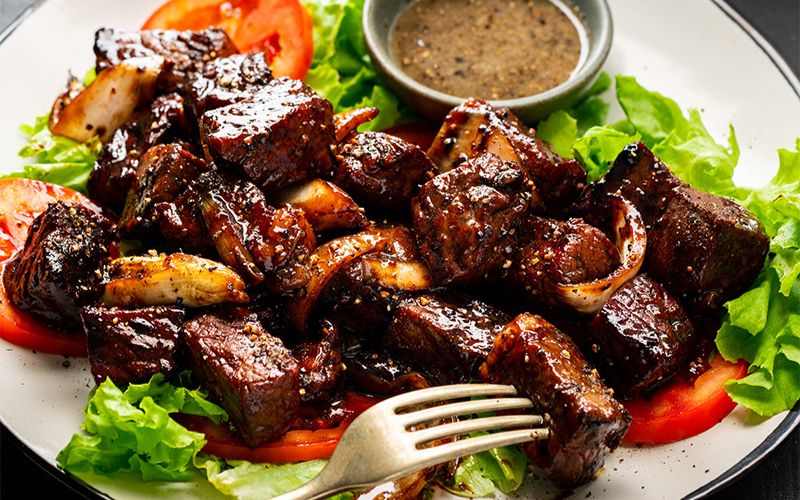
- Beef lok lak (shaking beef): Stir-fried beef commonly served with rice, salad and a lime-pepper dipping sauce.
Beef lok lak (shaking beef)
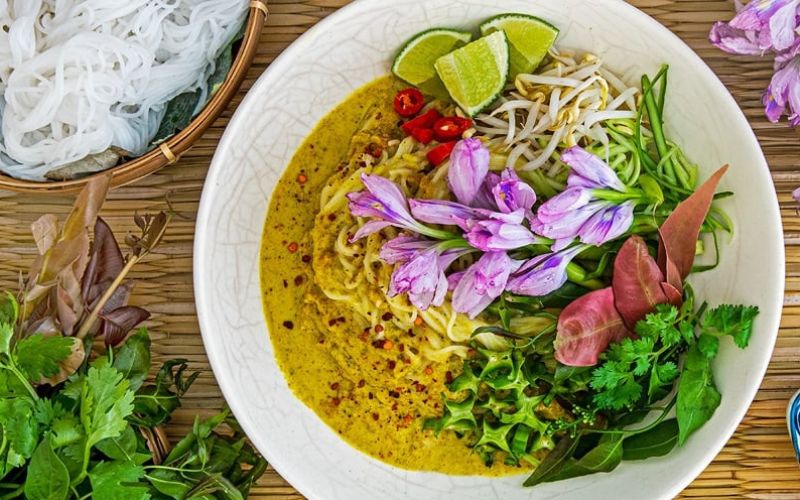
- Nom banh chok (Khmer curry noodles): Rice noodles served with an aromatic fish-based curry and fresh vegetables.
Nom banh chok (Khmer curry noodle)
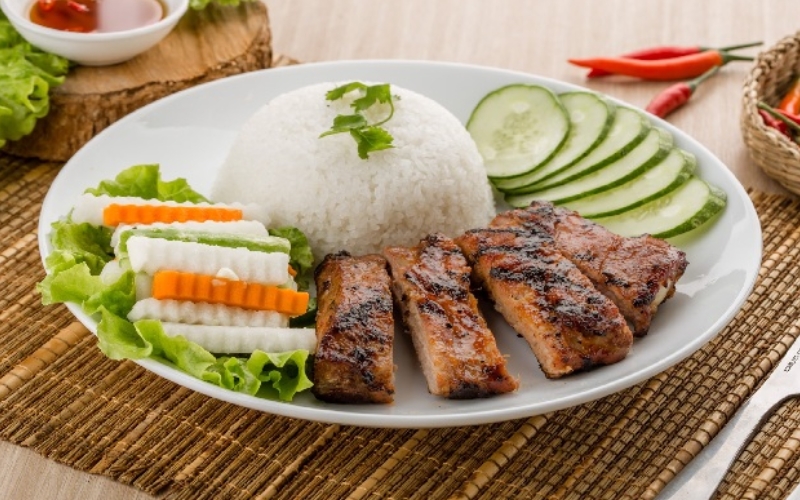
- Bai sach chrouk (grilled pork with rice): Grilled pork with rice, pickled vegetables and a light broth, commonly eaten for breakfast.
Bai sach chrouk (grilled pork with rice)
Travelers with allergies should carry translated cards in both Vietnamese and Khmer. Ask specifically about fish sauce, shrimp paste, peanuts, coconut milk and shared cooking oil.
Plan to Travel to Vietnam and Cambodia in 21 Days with IDC Travel
Twenty-one days creates enough room to connect two countries without reducing every destination to a quick photograph. The journey can include mountain communities, historic capitals, Central Vietnam’s heritage, the Mekong Delta, Angkor and a deeper look at Cambodian life beyond Siem Reap.
These routes are starting points rather than limits. Travelers may exchange Sapa for Ha Long Bay, spend longer in Hoi An, add more time around Angkor or simplify the Cambodia portion according to the season and preferred pace. IDC Travel can create a personalized Vietnam and Cambodia holiday around your flights, interests, mobility and accommodation style.
Read more:


Hi, I’m Lily. Me and my friend are going to visit Vietnam and Cambodia this April. How’s the weather in both countries in April? I’m wondering what kind of clothes I should pack, is it super hot and humid the whole time, or are there cooler spots like in the north of Vietnam? Please let me know. Thank you so much.
Hi Lily! That sounds like an amazing trip. April is a vibrant time to visit both Vietnam and Cambodia. Just a heads-up though, the weather can be quite hot and humid in most regions during this time. In southern Vietnam and Cambodia, temperatures often reach around 35°C (95°F), with a mix of sunshine and some humidity, so it’s best to wear light, breathable clothing and stay well-hydrated. Central Vietnam is a bit more moderate but still warm, while the north, especially mountainous areas like Sapa, can be noticeably cooler, especially in the evenings. If you’re planning to visit the north, packing a light sweater or jacket is a good idea. For the rest of your trip, stick to cotton or linen clothes, comfy walking shoes, sunscreen, and maybe a small umbrella or poncho just in case. You’ll be just fine, and the scenery this time of year is beautiful. Have a fantastic journey!
Yours faithfully,
IDC Travel Team.