
A Vietnam Cambodia itinerary in 18 days is enough for a rewarding 2-country trip if you decide early how much of Cambodia you want: about 3 nights cover Angkor Wat and Siem Reap, while around a week adds Phnom Penh, Kampot or Battambang. The rest of the 18-day itinerary can follow Vietnam’s main corridor from Hanoi to the Mekong Delta, with rural valleys, a Ha Long Bay cruise or a beach to vary the pace. Below, compare 2 sample itineraries, then see what the trip costs, when to go, how to prepare for entry, money and connections, and which dishes to try in each country.
How to Plan a Vietnam Cambodia Itinerary in 18 Days
Plan a Vietnam Cambodia itinerary in 18 days by deciding first how much of Cambodia you want: Angkor alone needs about 3 nights, which leaves around 14 nights for Vietnam, while Phnom Penh, Kampot or Battambang take Cambodia to 5-7 nights. Either split works if each country gets a clear theme rather than a quick stop in every famous town.
| Your priority | Vietnam | Cambodia | What the split allows |
| Vietnam north to south, plus Angkor | 14 nights | 3 nights in Siem Reap | Hanoi, Ha Long Bay, Hue, Hoi An, Ho Chi Minh City, the Mekong Delta and a beach or mountain extension |
| Angkor and Phnom Penh | 12 nights | 5 nights | One fewer Vietnam region, usually the far north or a beach stay |
| Cambodia beyond Angkor | 10 nights | 7 nights | Vietnam’s main corridor without extensions, plus Phnom Penh, Kampot, Battambang and Siem Reap |
A few rules make any Indochina itinerary easier to plan:
- Fly open-jaw: arrive in one country and leave from the other, so you never backtrack to your arrival city.
- Give Siem Reap at least 2 nights, ideally 3: 1 full day covers only the main Angkor circuit.
- Count transfer days honestly: each country change, overnight train or long road journey takes most of a day, so an 18-day itinerary has fewer full sightseeing days than the number suggests.
Each sample Vietnam and Cambodia itinerary below uses the 14-and-3 split but spends it differently. Itinerary 1 gives Vietnam rural valleys and a 3-night Mekong chapter before finishing at Angkor. Itinerary 2 starts at Angkor and finishes with 3 nights on Phu Quoc.
| Decision | Itinerary 1: Valleys, Mekong and Angkor | Itinerary 2: Angkor First and Phu Quoc Finish |
| Stops | Hanoi – Mai Chau – Pu Luong – Ninh Binh – Ha Long Bay – Hue – Hoi An – Ho Chi Minh City – Ben Tre – Can Tho – Chau Doc – Siem Reap | Siem Reap – Hanoi – Ha Long Bay – Hue – Hoi An – Ho Chi Minh City – Mekong Delta – Phu Quoc |
| Best for | Active travellers, rural landscapes, river life and a gradual change from mountains to Mekong | Couples, families and first-time visitors wanting culture followed by beach recovery |
| Cambodia position | Final 3 nights | First 3 nights |
| Country change | Chau Doc back to Ho Chi Minh City, then the Ho Chi Minh City to Siem Reap flight | Direct SAI-HAN flight |
| Vietnam emphasis | Northern valleys and a multi-night Mekong journey | Heritage cities plus a longer Phu Quoc finish |
| Main sacrifice | No beach block and no Phnom Penh | No Mai Chau, Pu Luong, Ninh Binh or overnight Mekong Delta stays |
| Physical demand | Higher | Moderate |
| Choose this itinerary if… | The journey itself matters as much as the headline attractions | Angkor and downtime matter more than rural northern Vietnam |
A key planning point: Itinerary 1 is not a Chau Doc-Siem Reap border-crossing itinerary. The matching programme keeps Chau Doc as part of the Vietnamese Mekong experience, then returns to Ho Chi Minh City for the flight to Siem Reap. Travellers specifically wanting a river or land border crossing need a different sequence, usually involving Phnom Penh or additional transfer time.
Itinerary 1: Vietnam’s Valleys, Heritage Coast and Angkor
- Route: Hanoi – Mai Chau – Pu Luong – Ninh Binh – Ha Long Bay – Hue – Hoi An – Ho Chi Minh City – Ben Tre – Can Tho – Chau Doc – Siem Reap
- Best for: Travellers who want the Vietnam section to feel like a journey through changing landscapes rather than a sequence of major cities, with mountain communities in the north, heritage in Central Vietnam, a substantial Mekong Delta chapter and Angkor as the final climax.
- Strengths: Mai Chau and Pu Luong give rural northern Vietnam real time rather than turning it into a day trip. Ninh Binh and Ha Long Bay then shift the landscape from valleys to limestone waterways. The southern section includes Can Tho, Chau Doc and Tra Su instead of treating the Mekong as a quick excursion from Ho Chi Minh City. Cambodia is deliberately focused on Siem Reap, allowing 2 developed Angkor days after the Vietnam journey.
- Weaknesses: The route has frequent hotel changes and several demanding transfer days. There is no beach recovery block, Phnom Penh is omitted, and Day 15 requires a long overland return from Chau Doc towards Ho Chi Minh City before the international flight to Siem Reap.
- Best time: February to March offers the strongest overall compromise. Northern Vietnam is generally comfortable for walking, Central Vietnam is moving into more favourable weather, southern Vietnam remains in its drier period and Cambodia is still in the dry season. March is warmer at Angkor, so temple days should start early.
- Should avoid: October to November if Hue and Hoi An are non-negotiable because Central Vietnam faces a higher risk of heavy rain and flooding. July to August is also less suitable for travellers choosing this route mainly for mountain walking, as heat, humidity and rain can make northern trails and long road days more demanding.
- Pace note: Protect Days 3-6 as one connected northern landscape block and Days 12-14 as one connected Mekong block. If the route feels too active, remove a minor city attraction before shortening either chapter. Day 15 should remain a transfer day with no important sightseeing attached.
Day 1 | Arrive in Hanoi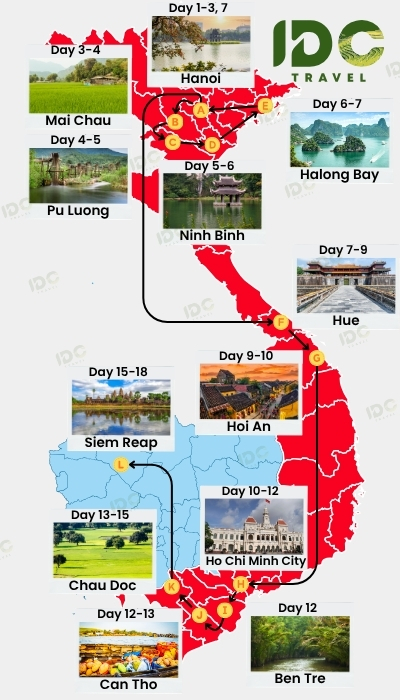
Settle in and keep the first evening gentle. A short lakeside walk and dinner near the hotel are enough after an international flight.
Day 2 | Hanoi City Tour
Your Hanoi city tour covers the Ho Chi Minh Mausoleum area, the Temple of Literature and Tran Quoc Pagoda, then the Vietnam Museum of Ethnology. End the day with a cyclo ride through the Old Quarter and a water puppet show.
Day 3 | Hanoi to Mai Chau
Drive about 4 hours to the Mai Chau valley, stopping at Thung Khe Pass for the view. Cycle through Poom Coong village, walk about 2 hours to Van and Mai Hich villages, and spend the night in a White Thai family home.
Day 4 | Mai Chau to Pu Luong
Walk for about 1.5 hours in the morning, then drive about 2.5 hours to Pu Luong. An easy 2-3 hour afternoon walk passes hillside villages, rice terraces and bamboo water wheels before a second homestay night.
Day 5 | Pu Luong to Ninh Binh
Drive about 4 hours to Ninh Binh and row through the 3 caves of Tam Coc on the Ngo Dong River in the afternoon. Lotus flowers line parts of the river in June and July.
Day 6 | Ninh Binh to the Bay Cruise
Transfer to Hon Gai port and board an overnight cruise in Bai Tu Long Bay, the quieter neighbour of Ha Long Bay. The afternoon includes Thien Canh Son Cave and swimming or kayaking at Hon Co Island when the weather allows.
Day 7 | Bay Cruise to Hanoi and Hue
Visit Vung Vieng fishing village by rowing boat, disembark around noon and transfer to Hanoi airport for the flight to Hue. Keep the evening free, because this is one of the longest travel days.
Day 8 | Hue City Tour
Start the Hue city tour with a sampan on the Perfume River to Thien Mu Pagoda and the Tomb of Tu Duc, then explore the Imperial Citadel in the afternoon. Finish at Dong Ba Market for local snacks.
Day 9 | Hue to Hoi An via Hai Van Pass
Cross the Hai Van Pass for the view over Lang Co beach, stop at the Museum of Cham Sculpture in Da Nang and reach Hoi An in time to walk the lantern-lit old town in the evening.
Day 10 | Hoi An to Ho Chi Minh City
Use the free morning for a short Hoi An city tour on foot, then transfer to Da Nang airport for the flight south. Try cao lau (Hoi An-style noodles with pork, herbs and crisp toppings) before you leave.
Day 11 | Ho Chi Minh City Tour
This Ho Chi Minh City tour visits the Independence Palace (also called Reunification Palace), the Central Post Office and Notre Dame Cathedral, then spend the afternoon in Cho Lon with Binh Tay Market and Thien Hau Pagoda.
Day 12 | Ho Chi Minh City to Ben Tre and Can Tho
Begin a 3-day Mekong Delta tour at My Tho, ride a sampan along small canals and continue by boat into Ben Tre’s coconut-shaded villages and Thoi Son islet before driving to Can Tho.
Day 13 | Cai Rang Floating Market to Chau Doc
Start early at Cai Rang floating market, drive about 3 hours to Chau Doc and visit Tay An Pagoda and Ba Chua Xu Temple at the foot of Sam Mountain in the afternoon.
Day 14 | Tra Su Cajuput Forest
Take a boat through Tra Su’s flooded cajuput forest, about 30 km from Chau Doc, for green waterways and birdlife. Prepare the documents needed for tomorrow’s flight to Cambodia.
Day 15 | Chau Doc to Ho Chi Minh City and Siem Reap
Drive back to Tan Son Nhat Airport for the Ho Chi Minh City to Siem Reap flight. Treat this as a full transfer day and place no important temple visit after arrival.
Day 16 | Angkor Thom and Angkor Wat
Explore Angkor Thom in the morning, including the Bayon, the Baphuon and the Terrace of the Elephants, then visit Angkor Wat in the afternoon with a licensed guide.
Day 17 | Banteay Srei and Kampong Khleang
See the pink sandstone carvings of Banteay Srei in the morning, then drive about 50 km to Kampong Khleang, a stilt-house village on the Tonle Sap floodplain.
Day 18 | Depart Siem Reap
Keep the morning flexible for a short Siem Reap city tour around the Old Market, or rest before the flight. Allow extra time if the international journey uses separate tickets through a regional hub.
>>> See the full itinerary: Legendary Beauty of Vietnam and Cambodia in 18 Days. IDC Travel can adjust trekking difficulty, cruise length, the Mekong transition and private guiding.
Itinerary 2: Angkor, Vietnam’s Heritage Cities and Phu Quoc
- Route: Siem Reap – Hanoi – Ha Long Bay – Hue – Hoi An – Ho Chi Minh City – Mekong Delta – Phu Quoc
- Best for: Couples, families and first-time visitors who want to see Angkor before travel fatigue builds, cover Vietnam’s best-known cultural corridor and finish with several genuinely free days beside the sea.
- Strengths: Angkor gets the traveller’s freshest days. Vietnam then moves in one broad north-to-south direction, with an overnight Ha Long Bay cruise, dedicated time in Hue and Hoi An, Ho Chi Minh City and a Mekong day. The final Phu Quoc stay is long enough to function as recovery rather than a token beach stop.
- Weaknesses: Northern rural Vietnam and the deeper Mekong overnight route are removed. The itinerary relies on 5 flight sectors in the live tour, and the final Day 18 Phu Quoc-Ho Chi Minh City-international departure needs particular attention if tickets are issued separately.
- Best time: January to March is the strongest window when the Phu Quoc finish matters. Cambodia is in the dry season, southern Vietnam and Phu Quoc are generally favourable, and Central Vietnam improves as the period progresses.
- Should avoid: May to October if predictable Phu Quoc beach weather is a major reason for choosing this itinerary. September to November also requires caution around Hue and Hoi An because Central Vietnam can experience heavy rain and storms.
- Pace note: Keep Day 11 in Hoi An and at least 1 of the 2 complete Phu Quoc days flexible. They are not empty days. They absorb delays, laundry, weather changes and the fatigue created by the itinerary’s flight sequence.
Day 1 | Arrive in Siem Reap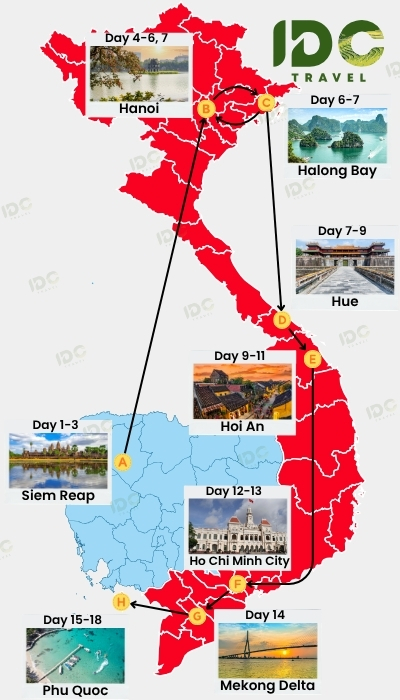
Check in and keep the evening easy. Prepare temple clothing, water and the confirmed entrance arrangements for the next morning.
Day 2 | Angkor Wat and Angkor Thom
Explore the principal monuments with a licensed guide. Start early, but do not force sunrise if the previous flight arrived late.
Day 3 | Siem Reap City Tour and Beyond
Choose a Siem Reap city tour with the Old Market and craft workshops, or head out to Banteay Srei or Tonle Sap. Select one coherent experience and leave time for a pool or spa before the next flight.
Day 4 | Fly to Hanoi
Complete departure and arrival formalities, then settle into Hanoi. A direct flight is ideal; otherwise protect the connection and avoid a non-refundable evening tour.
Day 5 | Hanoi City Tour
Your Hanoi city tour combines historic landmarks with a neighbourhood walk. Try cha ca (turmeric fish with dill and herbs) or bun cha (grilled pork with rice noodles and herbs).
Day 6 | Hanoi to Ha Long Bay
Travel to the coast and board an overnight Ha Long Bay cruise. Follow the operator’s current instructions because weather can alter ports and activities.
Day 7 | Ha Long Bay to Hue
Complete the morning cruise, return toward Hanoi and fly to Hue. Keep the evening free and arrange a practical airport transfer.
Day 8 | Hue City Tour
A Hue city tour covers the Imperial City and one carefully chosen tomb or pagoda. Limit long outdoor exposure during hot months.
Day 9 | Hue to Hoi An via Hai Van Pass
Travel south with selected coastal stops. Reach Hoi An before evening so the old town can be enjoyed without adding another formal activity.
Day 10 | Hoi An City Tour
Your Hoi An city tour covers merchant houses, assembly halls and the market, then adds one craft or cooking activity. Keep tailoring appointments realistic within the remaining nights.
Day 11 | Hoi An Free Day
Use the day for the beach, countryside, laundry or rest. It is an intentional recovery point before the southern section.
Day 12 | Fly to Ho Chi Minh City
Transfer to Da Nang airport and fly south. Settle near the sights you plan to visit rather than choosing a hotel only by room price.
Day 13 | Cu Chi Tunnels and Ho Chi Minh City Tour
Visit the Cu Chi Tunnels in the morning, then take a Ho Chi Minh City tour of the central landmarks in the afternoon. Keep the city section short so the day keeps one clear historical thread.
Day 14 | Mekong Delta Tour
Take a day-long Mekong Delta tour through the delta’s waterways and villages, returning to Ho Chi Minh City for the night before tomorrow’s flight.
Day 15 | Fly to Phu Quoc
Transfer to the airport and fly to the island. Check in, walk on the beach and avoid scheduling a boat trip on arrival day.
Day 16 | Phu Quoc Beach and Island Time
Keep one complete day for Phu Quoc beach time, a spa or a weather-appropriate excursion. Follow local marine advice and use a licensed operator for water activities.
Day 17 | Phu Quoc at Your Own Pace
Use the second free day for another Phu Quoc beach morning, a spa or a market visit, and save any island-hopping trip for the calmer of the 2 days. Confirm tomorrow’s airport transfer time before dinner.
Day 18 | Depart Phu Quoc
Allow a generous connection if the international flight continues through Ho Chi Minh City. A protected through-booking is safer than separate tickets with a narrow margin.
>>> See the full itinerary: Coastal Adventure: Vietnam and Cambodia in 18 Days. IDC Travel can tailor temple time, heritage stops, flight sectors and the number of Phu Quoc nights.
The 2 itineraries above show how 18 days can work, but they are starting points rather than fixed packages. IDC Travel can rebuild either Vietnam and Cambodia itinerary around your interests and pace: add Sapa or Phnom Penh, give Angkor another day, add a beach stay after the Mekong, reverse the country order, change hotel levels or add rest days for children and older travellers. If you are unsure which option to choose, please contact us; our consultants will provide expert advice and design an optimal itinerary that balances the experience with your budget.
How Much Does a Vietnam Cambodia Itinerary in 18 Days Cost?
A Vietnam Cambodia itinerary in 18 days costs about $1,170 – $1,900 per person at 3-star level, $2,150 – $3,850 at 4-star boutique level and $4,850 – $9,500 for 5-star luxury travel, with 2 people sharing a room. These planning ranges cover land services and regional flights. They are estimates for comparing travel styles, not package quotations.
(Calculated per person, double occupancy, land services + regional flights)
| Travel Style | Vietnam (14 Days) | Cambodia (3-4 Days) | Regional Flights
|
Total Estimated Cost (USD) |
| 3★ Standard / Comfort | $650 – $1,100 | $220 – $350 | $300 – $450 | $1,170 – $1,900 USD |
| 4★ Boutique (Recommended) | $1,400 – $2,600 | $400 – $750 | $350 – $500 | $2,150 – $3,850 USD |
| 5★ Luxury / Heritage | $3,500 – $7,000 | $900 – $1,800 | $450 – $700 | $4,850 – $9,500 USD |
How to read the table:
- Country split: the ranges assume about 14 days in Vietnam and 3-4 in Cambodia, the split both itineraries above use. Adding Phnom Penh or more Cambodia nights moves part of the cost from the Vietnam column to the Cambodia column, because daily costs at the same hotel level are broadly similar in both countries.
- Solo travelers: expect a higher total because the room cost is not shared.
- Peak dates: Christmas to New Year, Tet in Vietnam and Khmer New Year in Cambodia usually push an 18-day itinerary towards the top of each range.
- Not included: international flights, visas (see the Travel Guide below), travel insurance, tips, drinks and shopping.
How to Balance and Control Your Trip Costs
- Spend on guides where context matters: Angkor Wat, Hue’s Imperial City, the Cu Chi Tunnels and rural villages gain most from a licensed guide. Hoi An’s old town, beach days and free evenings work well on your own, so you avoid paying for guide days that add little.
- Buy a multi-day Angkor pass for 2 or more temple days: a 1-day pass costs USD 37, while a 3-day pass costs USD 62 and can be used on any 3 days within a week. Buying 2 single-day passes would cost USD 74.
- Price the whole flight sequence, not single fares: add checked baggage, which many low-cost fares exclude, and compare one ticket covering the connection with separate tickets. A missed connection on separate tickets is usually not protected, so the cheaper fare can end up costing more.
- Change hotels less often: every move costs a transfer and most of a morning. On an 18-day itinerary, staying 2-3 nights per base cuts transport spending and gives you full days you have already paid for.
- Avoid peak dates or book them first: Christmas to New Year, Vietnam’s Tet holiday (4-10 February in 2027) and Khmer New Year (expected 14-16 April 2027) raise room rates and domestic fares and fill trains and buses. If your dates are fixed, confirm flights and hotels before activities.
- Pay in local currency and withdraw less often: decline the offer to charge in your home currency at ATMs and card terminals. Withdraw fewer, larger amounts within safe limits, because each foreign withdrawal can carry both a local ATM fee and your own bank’s fee.
- Check what is already included: an overnight Ha Long Bay cruise usually includes meals and some activities, and guided days usually include entrance fees. Read the inclusions before paying for the same meal or ticket twice.
- Leave free days unbooked: prepaying activities for every free day adds cost and cancellation risk without making the trip better, and it removes the buffer you need when weather or flights change.
Essential Travel Guide for Vietnam and Cambodia in 18 Days
Vietnam and Cambodia need to be prepared as 2 separate entry and payment systems, while the country-change flight should be fixed before non-refundable hotel and activity bookings. Both featured routes use Siem Reap Angkor International Airport rather than a land border, which simplifies entry but makes flight timing important.
Vietnam Entry Documents
Visa or visa exemption: Requirements depend on nationality, passport and stay length. Travellers who need an eVisa should use the official Vietnam National Electronic Visa system. Vietnam’s Immigration Department currently states that an eVisa may be valid for up to 90 days, with single or multiple entry, and lists fees of USD 25 for single entry and USD 50 for multiple entry.
Both routes enter Vietnam through Noi Bai International Airport (HAN), although Route 1 begins there and Route 2 arrives from Siem Reap.
Pre-Arrival Information: Vietnam operates an official PAI portal, but PAI is separate from the visa and does not grant entry permission. Because rollout and airport procedures have changed during 2026, check the official Pre-Arrival Information portal shortly before travel rather than relying on an old screenshot or saved form.
For the distinction between PAI and a visa, current rollout information and preparation steps, see IDC Travel’s Vietnam Pre-Arrival Information guide.
Cambodia Visa and e-Arrival
Visa or exemption: Check the rule for the traveller’s exact nationality. Cambodia’s official eVisa portal currently lists the Tourist Visa T at USD 30, single entry, valid for 3 months from issue, with a stay of up to 1 month and a stated processing time of 3 business days. Siem Reap Angkor International Airport (SAI), used by both routes, is currently an approved eVisa entry point.
Use the official Cambodia eVisa portal rather than a commercial visa site.
Cambodia e-Arrival: This is a separate arrival declaration, not a visa. Cambodia’s General Department of Immigration states that travellers can submit the e-Arrival within 7 days before or on arrival, and submission is free. The official eVisa system also instructs visa holders to complete it before entry.
Use only the official Cambodia e-Arrival portal.
How to Pay in Vietnam
Use Vietnamese dong for everyday spending, carry some cash and keep a card as the backup for larger formal payments.
- Main currency: Vietnamese dong (VND).
- Cash is useful for: Markets, smaller restaurants, rural services, tips and the Mai Chau, Pu Luong or Mekong sections.
- Cards usually work at: Established hotels, larger restaurants, shopping centres and formal tourism businesses.
- ATMs: Prefer bank-operated machines in secure locations and read the operator charge before confirming.
- Currency conversion: If an ATM or terminal offers to charge your home currency, compare the displayed conversion with your card provider’s rate instead of accepting it automatically.
- Before rural travel: Withdraw enough VND in Hanoi or another major city before smaller mountain bases.
- Backup plan: Keep a second card and emergency cash separately from the wallet used each day.
For banknotes, exchange options, ATM use and common conversion mistakes, continue with IDC Travel’s Vietnam Currency Guide.
How to Pay in Cambodia
Use Khmer riel for everyday small purchases and expect US dollars to remain common in tourism businesses, but do not rely on USD alone.
Cambodia’s National Bank describes the economy as highly dollarised, with both USD and KHR used in payment transactions.
- Main currency: Khmer riel (KHR).
- USD use: US dollars remain widely accepted, particularly in Siem Reap and tourism businesses.
- Cash is useful for: Markets, smaller food vendors, tips and local purchases.
- Cards usually work at: Larger hotels, established restaurants and formal businesses.
- ATMs: Review the withdrawal fee, currency offered and conversion screen before confirming.
- USD note condition: Keep dollar notes clean and undamaged when carrying them because damaged notes can create acceptance problems.
- Small payments: Riel is useful for smaller transactions and change.
- Backup plan: Keep emergency cash and another card separately.
IDC Travel’s Cambodian Currency Exchange Guide explains riel, USD use, exchange and ATM planning in greater depth.
Prepare for Rural and Multi-Flight Days
Almost every Vietnam and Cambodia itinerary combines several flights with at least one rural area, such as the northern mountains, the Mekong Delta or the Cambodian countryside, so sort out mobile data, documents and hand luggage before you leave the big cities.
Mobile data
- eSIM or physical SIM: an eSIM works from the moment you land if your phone supports it. A physical SIM is usually cheaper per GB and suits longer stays or phones without eSIM support.
- Main networks: Viettel, VinaPhone and MobiFone in Vietnam, where Viettel is generally regarded as having the widest rural coverage, and Smart, Cellcard and Metfone in Cambodia.
- Registration: both countries require a passport to register a physical SIM, so buy it at the airport or an official store rather than from a street seller.
- Coverage gaps: expect weak signal in deep mountain valleys, on some rivers and around remote temples. Activate and test your SIM or eSIM before leaving Hanoi, Ho Chi Minh City, Phnom Penh or Siem Reap.
Save offline before rural days
- Maps of the areas you will visit
- Hotel addresses and phone numbers
- Flight, train and cruise confirmations
- Guide and driver contacts
- Visa, PAI and Cambodia e-Arrival confirmations
- Passport copies
Multi-flight days
- Passport on every flight: foreign visitors show their passport for domestic flights in Vietnam as well as international ones, so keep it in your hand luggage.
- Baggage: check the allowance on each ticket. Domestic and low-cost fares often include less checked baggage than your international ticket.
- Separate tickets: if flights are booked separately, allow time to collect bags, check in again and clear security, and leave a wider buffer when the connection also crosses a border.
- Power banks: since 1 July 2026, flights in Vietnam allow power banks only in carry-on bags, up to 2 per passenger and 100 Wh each (100-160 Wh with airline approval), and they may not be used or charged on board.
- Hand luggage essentials: keep medication, documents, a backup card, some cash and a change of clothes with you in case checked bags are delayed.
When Is the Best Time for Vietnam and Cambodia in 18 Days?
February to March is the best time to visit Vietnam and Cambodia on most 18-day trips, because Cambodia and southern Vietnam are dry, Hue and Hoi An are drying out and Hanoi is mild. December to April is the wider dry window for Cambodia and the south, but Tet (Vietnamese Lunar New Year) in early February and Khmer New Year in mid-April affect prices, transport and opening hours.
| Travel period | Overall | Best conditions | Main weather limits | Holidays to plan around |
| December to January | Very good | Cambodia, southern Vietnam and Phu Quoc are dry and sunny | Hanoi and Ha Long Bay are cool and often grey; Hue and Hoi An can still be wet in December | Christmas and New Year peak prices |
| February to March | Best overall | Dry in Cambodia and the south, drying in central Vietnam, mild in the north | Hanoi can be misty or drizzly; Angkor grows hotter through March | Tet: Vietnam’s official holiday runs 4-10 February 2027 |
| April | Good but hot | Central and northern Vietnam are warm and mostly dry | Cambodia and southern Vietnam reach their hottest, often above 35°C (95°F) | Khmer New Year, expected 14-16 April 2027; Vietnam’s 30 April and 1 May holidays |
| May to August | Mixed | Hoi An and Da Nang beaches are mostly dry and sunny | Rainy season in the north, the south, Phu Quoc and Cambodia; summer storms can change Ha Long Bay cruises | Vietnamese school holidays raise demand for beach hotels |
| September to November | Mixed to weak | Northern Vietnam is clear and pleasant from October; Cambodia dries out from November | Heaviest rain and flood risk in Hue and Hoi An, usually October to November | Cambodia’s Pchum Ben and Water Festival bring busy roads and closures |
For month-by-month detail by region, see IDC Travel’s guide to the best time to visit Vietnam.
How the season affects what you plan to do:
- Angkor temples: November to February is the coolest period. From March, start at sunrise and rest through the midday heat; IDC Travel’s guide to the best time to visit Cambodia explains the trade-offs month by month.
- Ha Long Bay cruise: boats sail most of the year, but summer storms, mostly from June to September, can cancel or shorten a Ha Long Bay cruise, so keep a flexible day after it.
- Northern trekking (Sapa, Pu Luong, Mai Chau): September to November and March to May usually give the clearest trails; winter mornings can be cold and damp.
- Beaches: Phu Quoc beach weather is best from November to April, while Hoi An and Da Nang are best from March to August.
- Mekong Delta tour and Tonle Sap: the dry season suits cycling and boat trips. The high-water months, around September to November, bring fuller rivers and floating villages but more rain.
Tet and Khmer New Year: Tet is Vietnam’s biggest holiday. Around the official break (4-10 February 2027), trains, flights and hotels fill up early, prices rise and many family-run restaurants and shops close for several days, although most hotels and major sights stay open. Khmer New Year (expected 14-16 April 2027) has a similar effect in Cambodia: buses out of Phnom Penh fill as people travel home, and Angkor is busier with Cambodian visitors. Travelling during either festival works well if transport and hotels are booked first, so check both dates whenever you weigh up the best time to visit Vietnam and Cambodia.
What Should You Eat During 18 Days in Vietnam and Cambodia?
Use the route to taste regional differences rather than ordering the same national favourites in every city. Vietnam’s food changes noticeably between the north, Central Vietnam and the south, while the Cambodia section introduces Khmer dishes built around rice, freshwater fish, herbs, coconut, kroeung spice pastes and fermented flavours.
Vietnamese Food Along the Journey
Northern Vietnamese cooking often uses balanced broths, fresh herbs and comparatively restrained seasoning. Central dishes become bolder and often spicier, while southern food commonly uses more sweetness, tropical produce and abundant herbs.
- Com lam (bamboo-tube sticky rice): Rice cooked inside bamboo and often eaten with grilled foods. It fits Route 1’s Mai Chau and Pu Luong chapter better than a generic city-food list.

Com lam (bamboo-tube sticky rice)
- Bun cha (grilled pork with rice noodles): Grilled pork served with noodles, herbs and a savoury dipping broth. It is an easy first introduction to northern flavours in Hanoi.
Bun cha (grilled pork with rice noodles)
- Bun bo Hue (Hue-style beef noodle soup): Rice noodles in a lemongrass-scented broth with meat and herbs. Try it in Hue rather than saving every famous dish for Hanoi or Ho Chi Minh City.
Bun bo Hue (Hue-style beef noodle soup)
- Cao lau (Hoi An-style pork noodles): Thick noodles served with pork, greens, herbs and crisp toppings, closely associated with the Hoi An section of both routes.
Cao lau (Hoi An-style pork noodles)
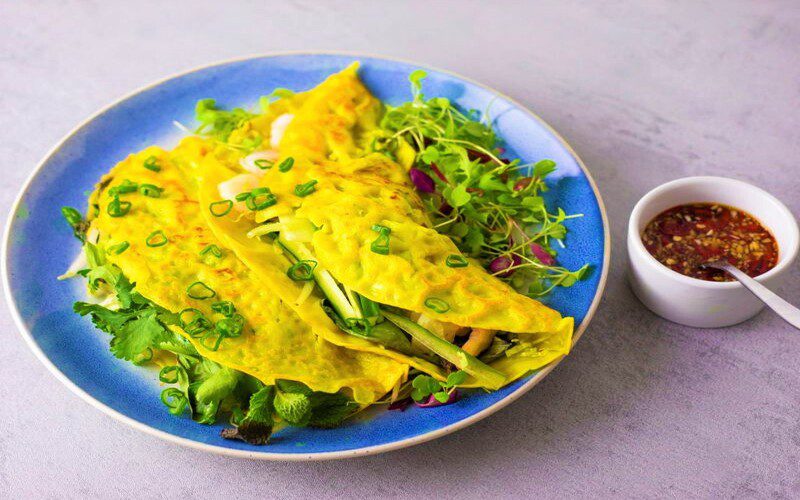
- Banh xeo (crispy savory pancake): A rice-flour pancake commonly filled with pork, shrimp and bean sprouts and eaten with herbs. It fits naturally into the southern Vietnam or Mekong part of the journey.
Banh xeo (crispy savory pancake)
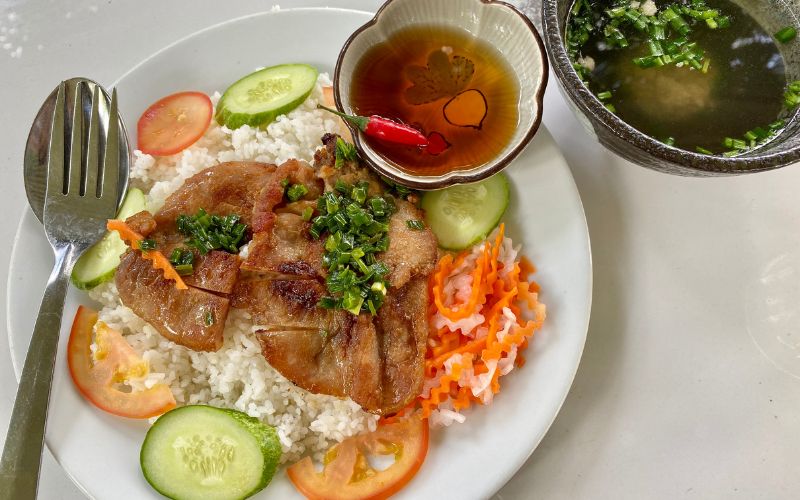
- Com tam (broken rice with grilled meat): Broken rice served with grilled pork and accompaniments, strongly associated with Ho Chi Minh City and useful on a transfer-heavy southern day when travellers want a straightforward local meal.
Com tam (broken rice with grilled meat)

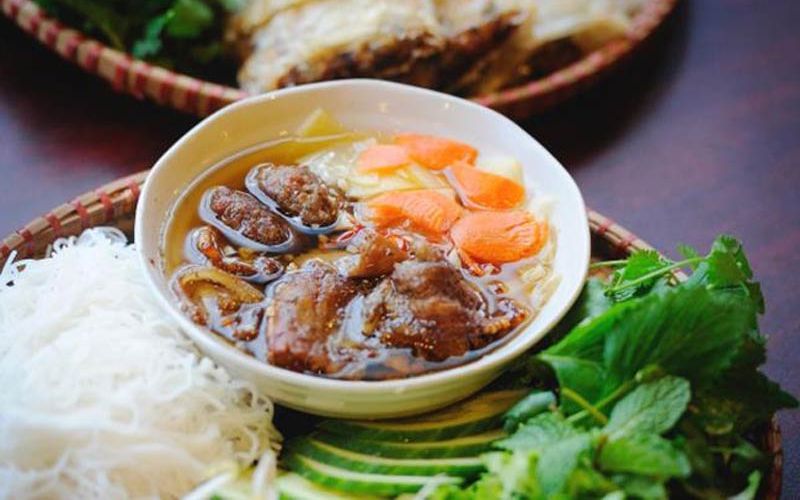
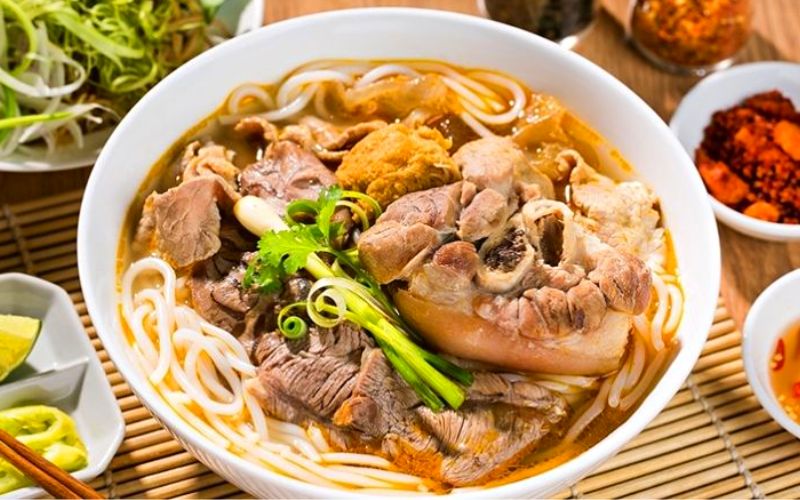
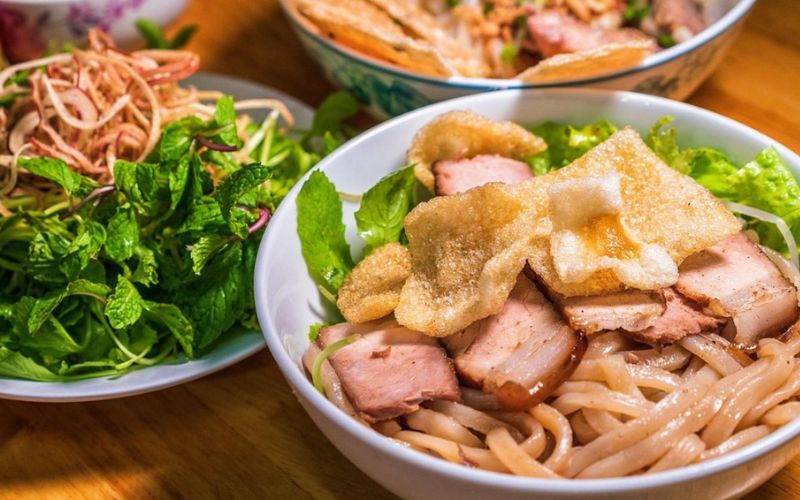
For more dishes from northern, central and southern Vietnam, continue with IDC Travel’s Top 30 Popular Vietnamese Dishes.
Cambodian Food in Siem Reap
The Cambodia chapter is geographically smaller, but 3 nights in Siem Reap still provide enough time to go beyond one tourist-menu dinner. Khmer cooking makes extensive use of rice, fish, herbs, coconut, prahok and aromatic kroeung pastes.
- Amok trey (steamed coconut fish curry): Fish cooked with coconut milk and aromatics, often steamed in a banana-leaf container. Compare versions rather than assuming every restaurant prepares it identically.
Amok trey (steamed coconut fish curry)
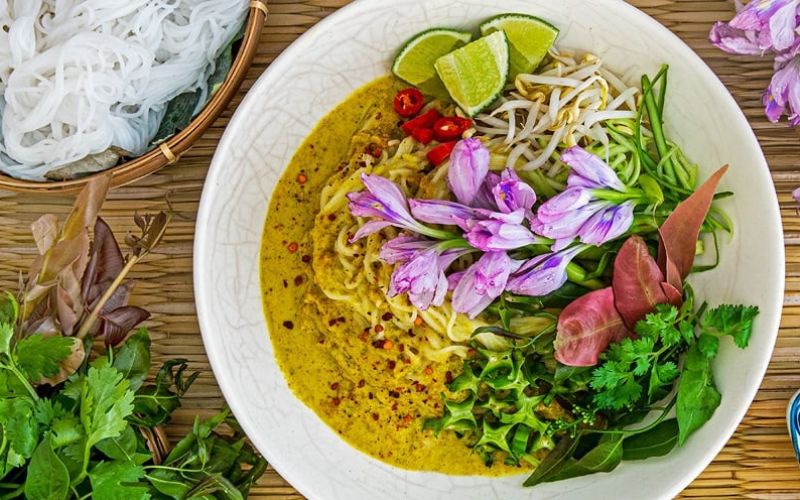
- Nom banh chok (Khmer rice noodles): Rice noodles served with a fish-based herb and curry gravy, commonly eaten in the morning. It works well before a less intensive temple or departure day.
Nom banh chok (Khmer rice noodle)
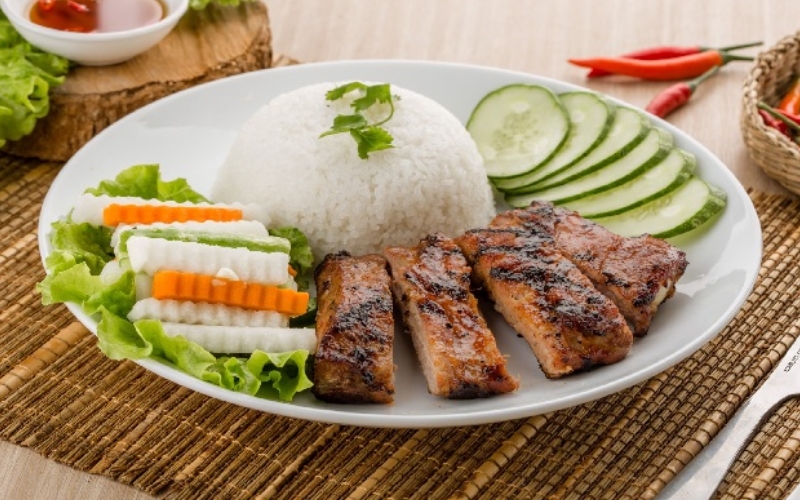
- Bai sach chrouk (grilled pork with rice): Grilled pork served with rice, pickled vegetables and broth, commonly eaten for breakfast.
Bai sach chrouk (grilled pork with rice)
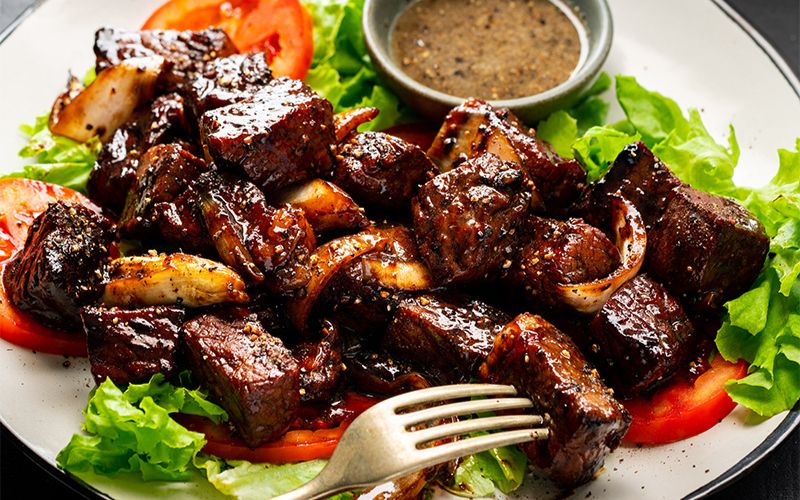
- Beef lok lak (shaking beef): Stir-fried beef generally served with salad and a lime-pepper dipping sauce. It is widely available and a useful contrast to the fish- and coconut-based dishes travellers often associate first with Cambodia.
Beef lok lak (shaking beef)

For a wider introduction to Khmer flavours and dishes, continue with IDC Travel’s Khmer Cuisine: 10 Best Dishes in Cambodia.
Travellers with allergies should carry translated allergy information in both Vietnamese and Khmer. Ask specifically about fish sauce, prahok or other fermented fish products, shrimp paste, peanuts, shellfish, coconut and shared cooking oil. A dish described simply as vegetarian may still use fish-based seasoning or stock.
Plan your tailor-made Vietnam and Cambodia in 18 Days with IDC Travel
Eighteen days works when the itinerary makes one clear trade-off. Route 1 uses the available time for rural northern Vietnam and a deeper Mekong chapter before Angkor. Route 2 exchanges those sections for Angkor at the beginning and enough Phu Quoc time to make the coast a real finish rather than another transfer.
Once your travel month, walking comfort, hotel level and preferred balance of culture, countryside and beach time are clear, start your tailor-made holiday with IDC Travel, and its planners will fit the flights, guiding and rest days around those priorities.
Read more: