

An itinerary of Vietnam and Laos in 17-20 days works best when the extra days change the journey rather than add more rushed stops. Seventeen days can connect Hanoi, the mountains of northwestern Vietnam and northern Laos by land, while 20 days can cover Vietnam from south to north before flying to Vientiane and continuing to Luang Prabang. The two routes below explain the trade-offs, entry points, daily costs and pacing choices so you can select a journey that fits your interests and travel style.
Vietnam and Laos Itinerary for 17 to 20 Days
Choosing between 17 and 20 days is not simply a question of adding 3 more days. Choose 17 days if you want a focused overland journey through northern Vietnam and northern Laos; choose 20 days if you want to see Vietnam from south to north before continuing through the classic Laos corridor. The 2 options use different gateways, transport and travel rhythms, so merging them would create a weaker trip.
| 17-Day Northern Overland Route | 20-Day Vietnam and Classic Laos Route | |
| Best for | Mountains, smaller communities, overland travel and less-visited northern landscapes | First-time visitors who want Vietnam’s main regions plus Laos’s best-known cultural stops |
| Vietnam focus | Hanoi, Ha Long Bay, Mu Cang Chai, Sapa and the northwest | Ho Chi Minh City, Mekong Delta, Nha Trang, Hoi An, Hue, Hanoi and Ha Long Bay |
| Laos focus | Muang Khua, Nong Khiaw, Luang Prabang, Vang Vieng and Vientiane | Vientiane, Vang Vieng and Luang Prabang |
| Country transition | Land crossing via Tay Trang, requiring careful visa and border planning | Flight from Vietnam to Laos |
| Travel pace | More long road sectors and smaller overnight bases | More flights, but broader geographic coverage |
| What you give up | Central and southern Vietnam | Deeper northern Laos and the gradual overland border experience |
| Choose this route if… | Sapa, the northwest mountains and Nong Khiaw are major priorities | Hoi An, Hue, the Mekong Delta and a wider Vietnam overview matter more |
The key is to protect the identity of the route. On the 17-day journey, do not add central Vietnam at the cost of reducing Mu Cang Chai, Sapa or northern Laos to one-night stops. On the 20-day journey, do not add another remote Laos region merely because there are 3 extra days. Use additional time to improve pacing, weather flexibility and the quality of the main stops.
Itinerary 1: Northern Mountains and the Nam Ou in 17 Days
Day 1 | Arrive in Hanoi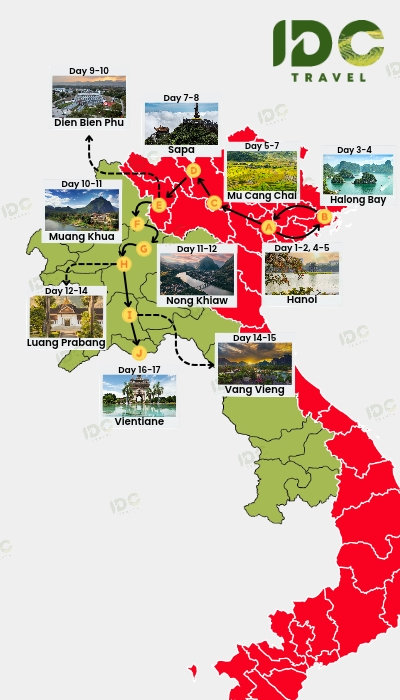
Check in and recover from the long journey. Keep the first evening limited to a short Old Quarter or Hoan Kiem Lake walk.
Day 2 | Explore Hanoi
Choose a focused city programme linking history, neighbourhoods and food. Try bun cha (grilled pork with rice noodles and herbs) without turning the day into a checklist of distant sights.
Day 3 | Hanoi to Ha Long Bay
Transfer to the bay and board an overnight cruise. Confirm the current departure port and operator instructions before leaving Hanoi.
Day 4 | Ha Long Bay to Hanoi
Complete the morning cruise and return to Hanoi. Use the evening to repack for smaller mountain hotels and homestays.
Day 5 | Hanoi to Nghia Lo
Travel west through the Red River corridor. A village walk or cycle ride works better than a late, ambitious sightseeing programme after the drive.
Day 6 | Nghia Lo to Mu Cang Chai
Cross Khau Pha Pass and explore selected terraced-field communities. A local guide should adjust walking distance to weather and trail conditions.
Day 7 | Mu Cang Chai to Sapa
Continue through the northern highlands toward Sapa. Keep the afternoon flexible because cloud and rain can change visibility quickly.
Day 8 | Sapa to Lai Chau
Walk a valley route suited to the group, then cross the Hoang Lien Son range. Avoid adding Fansipan unless the schedule and weather leave a genuine margin.
Day 9 | Lai Chau to Dien Bien
Travel toward Dien Bien and use the afternoon for selected historical sites. Rest early before the international land crossing.
Day 10 | Dien Bien to Muang Khua via Tay Trang
Cross from Vietnam into Laos at the confirmed border point. This is a transport and immigration day, so do not plan a separate afternoon excursion.
Day 11 | Muang Khua to Nong Khiaw
Continue along the Nam Ou corridor by the operating road or boat arrangement confirmed for your date. Water levels and schedules can change the practical plan.
Day 12 | Nong Khiaw to Luang Prabang
Enjoy a short village, viewpoint or river activity before travelling south. Reach Luang Prabang with enough time for a calm first evening.
Day 13 | Luang Prabang and Kuang Si
Combine key old-town temples with Kuang Si Waterfall. Dress respectfully at religious sites and follow current swimming-zone instructions at the falls.
Day 14 | Luang Prabang Experience and Train to Vang Vieng
Choose a market, craft or responsible community activity, then take the confirmed Laos-China Railway service to Vang Vieng. Keep passport details consistent with the ticket.
Day 15 | Vang Vieng to Vientiane
Select one cave, viewpoint or gentle river experience before continuing to the capital. Do not compress several outdoor activities into a transfer day.
Day 16 | Vientiane
Visit a coherent group of temples and monuments, then finish near the Mekong riverfront. Use a guide to connect the capital’s religious and modern history.
Day 17 | Depart Vientiane
Leave a generous airport margin and protect any separately ticketed onward flight. If departure is late, add only a nearby market or cafe.
>>> Follow the complete 17-day northern route. The live tour matches the mountain road, Tay Trang crossing, Nam Ou corridor and Laos city sequence described above.
Itinerary 2: Vietnam from South to North and Classic Laos in 20 Days
Day 1 | Arrive in Ho Chi Minh City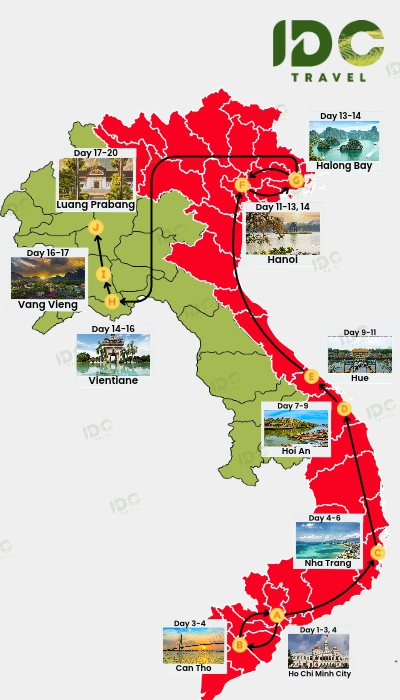
Check in and recover. A short neighbourhood walk is enough after the international journey.
Day 2 | Ho Chi Minh City and Cu Chi
Pair selected city landmarks with the Cu Chi Tunnels, or give the city a full day if museums matter more. Avoid forcing both into an overpacked schedule.
Day 3 | Ho Chi Minh City to the Mekong Delta
Travel to My Tho and Can Tho through selected waterways and communities. Stay locally so the delta is more than a same-day coach excursion.
Day 4 | Mekong Delta and Fly to Nha Trang
Begin with an early river activity, return to Ho Chi Minh City and fly to Nha Trang. Treat the evening as recovery after the multi-stage transfer.
Day 5 | Nha Trang Culture and Coast
Combine Po Nagar Cham Towers with a market or coastal walk. Leave time to enjoy the beach rather than filling the entire day with city stops.
Day 6 | Nha Trang Islands
Use a licensed operator for the confirmed island and snorkelling programme. Weather and marine conditions should determine the final stops.
Day 7 | Fly to Da Nang and Continue to Hoi An
Fly north and transfer to Hoi An. Keep the evening free for the old town instead of adding a distant Da Nang attraction.
Day 8 | Hoi An Heritage and Countryside
Explore the historic centre, then choose a cooking class, craft workshop or short countryside ride. Try cao lau (Hoi An-style noodles with pork, herbs and crisp toppings).
Day 9 | Hoi An to Hue
Cross the Hai Van Pass with selective stops and arrive in Hue. The drive should support the route, not become a string of rushed viewpoints.
Day 10 | Hue Imperial Heritage
Give the Imperial City and one royal tomb or pagoda enough time. A guide helps explain the relationship between the monuments.
Day 11 | Fly from Hue to Hanoi
Transfer to the airport and fly north. Use the remaining time for a compact Old Quarter orientation.
Day 12 | Hanoi
Build the day around one historical theme, one neighbourhood and a food experience. Try cha ca (turmeric fish with dill and noodles) at a reputable restaurant.
Day 13 | Hanoi to Ha Long Bay
Join an overnight cruise and follow the confirmed programme for caves, kayaking or village visits.
Day 14 | Ha Long Bay and Fly to Vientiane
Disembark, return toward Hanoi and fly to Laos. This day needs a protected connection margin, especially when tickets are issued separately.
Day 15 | Vientiane
Explore That Luang, Wat Sisaket, Ho Phra Keo and Patuxai in a sensible geographic order. Finish with an unhurried Mekong riverside evening.
Day 16 | Vientiane to Vang Vieng
Travel north by the confirmed rail or road service. Add one gentle cave or river activity only if arrival time allows.
Day 17 | Vang Vieng to Luang Prabang
Use the morning for one landscape experience, then continue by Laos-China Railway. Keep passport and booking details identical.
Day 18 | Luang Prabang and Kuang Si
Combine the historic centre with Kuang Si Waterfall. Reserve the evening for the night market or a quiet riverside meal.
Day 19 | Mekong and Pak Ou Caves
Take the confirmed river journey to Pak Ou Caves, with a respectful village or craft stop if it is genuinely community-led.
Day 20 | Depart Luang Prabang
Keep the final hours simple and transfer to the airport with enough time for onward formalities.
>>> See the matching Panorama 20-day tour. It follows the same south-to-north Vietnam progression and Vientiane, Vang Vieng and Luang Prabang finish.
Daily Budget in Vietnam and Laos
The following ranges are planning estimates per person per day, assuming two people share a room. They exclude international and regional flights, visas, insurance, shopping and premium cruises. Local-currency equivalents change with exchange rates.
Vietnam Daily Planning Range
| Cost category | Budget | Mid-range | Premium |
| Accommodation share | USD 12-30 | USD 40-90 | USD 110-260 |
| Meals and drinks | USD 12-25 | USD 30-55 | USD 70-130 |
| Local transport | USD 8-25 | USD 30-75 | USD 90-220 |
| Guides and activities | USD 12-45 | USD 45-120 | USD 130-320 |
| Estimated daily total | USD 44-125 | USD 145-340 | USD 400-930 |
Laos Daily Planning Range
| Cost category | Budget | Mid-range | Premium |
| Accommodation share | USD 10-25 | USD 30-75 | USD 85-190 |
| Meals and drinks | USD 8-20 | USD 22-45 | USD 55-100 |
| Local transport | USD 8-25 | USD 28-70 | USD 80-180 |
| Guides and activities | USD 10-35 | USD 40-100 | USD 110-250 |
| Estimated daily total | USD 36-105 | USD 120-290 | USD 330-720 |
Multiply each country’s daily range by the actual number of days spent there. Then add separately ticketed flights, the Ha Long Bay cruise if it is not already included, long-distance private vehicles, rail tickets and any one-off border transfer. Check inclusions first so the same hotel, meal or transfer is not counted twice.
Ways to Control Cost Without Breaking the Route
- Book the Vietnam-Laos flight as soon as the land itinerary is stable, but keep enough connection time around the Ha Long Bay return.
- Use the Laos-China Railway for Vientiane, Vang Vieng and Luang Prabang when the confirmed schedule fits, instead of paying for a long private road transfer.
- Choose one guided day in each city and keep adjacent neighbourhood time independent.
- Do not select the cheapest cruise or border transfer before checking cabin, pickup, luggage and guide coverage.
- Keep one flexible meal daily rather than paying for a full-board plan that overlaps with food tours or cruise meals.
Entry, Border Crossings and Money in Vietnam and Laos
Vietnam and Laos require separate entry preparation. A visa, eVisa or arrival declaration for one country has no effect on entry to the other, and the 17-day overland itinerary needs an additional check because its Laos entry point is different from the airports used on the 20-day route.
Vietnam Entry and Payment Preparation
- Visa or eVisa: Check passport-specific exemption rules or apply through Vietnam’s official eVisa system. Confirm the approved validity dates, number of entries and arrival point before paying for non-refundable transport.
- Pre-arrival preparation: Travellers entering through relevant Vietnamese airports should check the current Pre-Arrival Information requirements separately from the visa. PAI does not replace an eVisa or other entry permission.
For the form, required information and common submission mistakes, use IDC Travel’s Vietnam Pre-Arrival Information guide before departure.
- Currency: Vietnam uses Vietnamese dong (VND). Cards are practical at established hotels, restaurants and larger businesses, but cash remains useful in local markets, small food shops and mountain areas.
- ATM and exchange planning: Check the ATM operator fee and conversion option before confirming a withdrawal. Keep a second card separately from the main wallet and prepare smaller notes before rural road sectors.
IDC Travel’s Vietnam Currency Guide explains banknotes, card use, ATMs, exchange options and common payment mistakes in more detail.
Laos Entry and Payment Preparation
- eVisa: Check whether your passport is eligible through the official Lao eVisa system and confirm that your intended port accepts the eVisa before applying.
- Airport arrivals: The 20-day itinerary enters Laos by air, so the exact airport should be matched with the approval before tickets become non-refundable.
- Tay Trang warning for the 17-day route: Tay Trang is not currently included in the Lao government’s published list of eVisa entry ports. Travelers crossing from Dien Bien must arrange an entry document accepted at that checkpoint and reconfirm that the border and onward transport are operating for their date.
- Currency: The Lao kip (LAK) is the national currency. Cash becomes increasingly useful outside Luang Prabang, Vang Vieng and Vientiane, particularly for smaller restaurants, local transport and rural services.
- ATM planning: Withdraw or exchange money before long rural sectors rather than assuming the next village will have a suitable ATM. Carry a backup card and emergency cash separately.
For denominations, exchange, ATM use and planning a realistic cash buffer, see IDC Travel’s Laos Currency Guide.
Confirm the International Transition Before Booking
- For the 17-day itinerary, settle the Tay Trang visa arrangement and border transport before booking the hotels immediately after the crossing.
- For the 20-day itinerary, confirm the Vietnam-Laos flight before locking the Ha Long Bay return and Vientiane hotel. A scheduled flight may look convenient on a timetable but still require several hours for the road transfer, airport check-in and baggage handling.
When Is the Best Time for a Vietnam and Laos Itinerary?
October to November is one of the strongest periods for the 17-day northern route, while February to March generally gives the 20-day route a more balanced weather overlap. The best month differs because the first journey depends heavily on northern mountains and roads, while the second crosses southern, central and northern Vietnam before continuing into Laos.
| Travel period | 17-day northern route | 20-day broader route | Main consideration |
| October to November | Strong | Mixed to good | Northern Vietnam is attractive, but central Vietnam can still face heavy rain |
| December to January | Good, but colder | Good | Mountain nights can be cold and Sapa may be misty |
| February to March | Good | Strong | Useful overall compromise, with increasing haze risk in some northern areas |
| April | Possible | Less comfortable | Heat becomes more demanding, particularly in Laos |
| May to August | Challenging | Possible with flexibility | Rain can affect mountain roads, trekking, boats and visibility |
| September | Transitional | Mixed | Mountain rain and central Vietnam weather require extra margin |
Best Months for the 17-Day Northern Route
October and November work particularly well when Mu Cang Chai, Sapa and the northwestern road journey are major priorities. Cooler conditions generally make walking and long road sectors more comfortable, although mountain clouds and rain can still affect visibility.
March and early April can also work, but travellers should check haze and air-quality conditions before committing to photography, viewpoints or demanding outdoor days.
Because northern, central and southern Vietnam follow different weather patterns, fixed-date travellers should check IDC Travel’s best time to visit Vietnam guide before choosing which Vietnamese regions to include.
Best Months for the 20-Day Route
February and March generally create a better compromise for the broader route. Southern Vietnam is usually easier to explore, central conditions are improving and Hanoi remains more comfortable than during the hottest part of the year.
The Laos section still deserves a separate weather check. Luang Prabang, Vang Vieng and Vientiane are usually most comfortable during the cooler dry months, while March and April can become progressively hotter. The wet season brings greener scenery but requires more flexibility for outdoor activities and road travel.
For month-by-month conditions in Luang Prabang, Vang Vieng and the rest of the country, see IDC Travel’s best time to visit Laos guide.
When Should You Add a Weather Buffer?
Use a flexible day where weather can remove the main reason for visiting a destination:
- Sapa or Mu Cang Chai: Protect walking and mountain visibility.
- Ha Long Bay: Allow for weather-related cruise changes.
- Nong Khiaw: Keep road or river arrangements flexible.
- Luang Prabang: Move Kuang Si or river activities if rain affects the original plan.
Do not move every activity because of a poor forecast several days in advance. Instead, make one weather-sensitive activity flexible and keep the rest of the itinerary stable.
Experiences Worth Protecting in Both Countries
A 17- to 20-day trip is long enough to include variety, but not long enough to protect every destination equally. The experiences below deserve real time because shortening them usually saves less time than travellers expect while reducing much of what makes the route distinctive.
Protect One Overnight Landscape Experience in Vietnam
Ha Long Bay should remain an overnight experience on both routes rather than becoming a rushed day trip. The value comes from spending an evening and morning on the water, not simply reaching the bay, taking photographs and returning to Hanoi.
- On the 17-day itinerary, the mountain chapter also needs consecutive nights. Mu Cang Chai, Sapa, Lai Chau and Dien Bien form a geographical progression toward Laos. Removing too many of these stops changes the route from a northwestern journey into a series of long transfers.
- On the 20-day itinerary, protect the overnight Ha Long Bay cruise and at least one slower stay in central Vietnam. Hoi An is a logical place to keep a free or lightly planned half-day because it sits between several flight and road sectors.
Cut first: a secondary city attraction or an optional viewpoint.
Do not cut first: the overnight cruise, the only mountain walking day or the recovery time following a long transfer.
Give Luang Prabang Enough Time to Feel Different from Vietnam
Luang Prabang should receive at least 2 useful days rather than functioning as another one-night heritage stop. One day can focus on the historic centre and temples, while another can include Kuang Si Waterfall, the Mekong corridor, crafts or a slower local experience.
This matters because Luang Prabang is where the cultural rhythm of the journey changes most clearly. After the larger Vietnamese cities and long transport sectors, compressing the town into a few hours removes much of that contrast.
If a delay forces you to choose between another minor stop and a complete Luang Prabang day, keep Luang Prabang.
Keep Nong Khiaw on the 17-Day Route Only If You Can Experience It
Nong Khiaw earns its place through the Nam Ou landscape, nearby villages and slower northern Laos atmosphere. It should not survive in the itinerary merely as a place to sleep between Muang Khua and Luang Prabang.
Keep it when there is time for a short walk, river experience, viewpoint or community-based activity. If transport changes leave only a late arrival and early departure, reconsider the sequence rather than preserving the destination name at all costs.
This is also why current boat, road and river conditions need checking. The experience is worth protecting, but the transport method should remain flexible.
Use Vang Vieng as a Landscape Base, Not a Checklist Stop
Vang Vieng works best when travellers choose 1 outdoor experience that matches the season and their mobility, such as a cave, viewpoint, river activity or countryside route.
Trying to fit several caves, kayaking, viewpoints and another transfer into the same day turns the destination into an activity checklist. On both itineraries, one well-chosen landscape experience is enough before continuing to Vientiane or Luang Prabang.
Protect the Country-Change Day
The transition between Vietnam and Laos is part of the itinerary, not dead time.
- On the 17-day itinerary, the Tay Trang crossing needs confirmed visa compatibility, border operation and onward transport. Do not plan sightseeing on the same afternoon.
- On the 20-day itinerary, protect the Vietnam-Laos flight from an overly tight Ha Long Bay connection. When flights are separately ticketed, additional margin may be more valuable than another attraction.
A simple rule works well for both routes: when the itinerary becomes crowded, remove an optional activity before shortening the border, cruise or long-distance connection margin.
Food That Marks the Journey from Vietnam to Laos
The food should change as the itinerary moves from northern Vietnam through different Vietnamese regions and into Laos. Instead of treating cuisine as one list of famous dishes, use the route to notice how ingredients, seasoning and eating habits change between places.
Vietnamese Dishes to Try Along the Route
Northern Vietnamese cooking generally relies on balanced broths, herbs, grilled meats and comparatively restrained seasoning. Central Vietnam becomes bolder and often spicier, while southern food commonly uses more sweetness, tropical ingredients and fresh herbs.
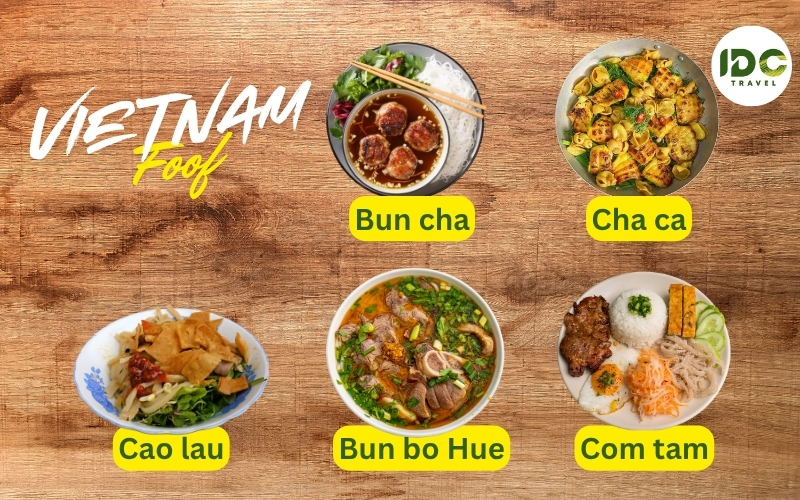
From smoky Hanoi grills to Hue’s fiery broth and Saigon’s breakfast plates, five dishes that taste like a road trip down Vietnam.
- Bun cha (Hanoi grilled pork with rice noodles): Grilled pork is served with rice noodles, herbs and a light fish-sauce dipping broth. It fits naturally into the Hanoi section of either route.
- Cha ca (turmeric fish with dill): Hanoi-style fish cooked with turmeric, dill and spring onion, usually eaten with noodles, herbs and peanuts.
- Cao lau (Hoi An-style pork noodles): Thick noodles with pork, greens, herbs and crisp toppings. This dish belongs particularly well to the 20-day route because it includes Hoi An.
- Bun bo Hue (Hue-style spicy beef noodle soup): A fragrant central Vietnamese noodle soup with lemongrass and a richer, more assertive broth than many northern noodle dishes.
- Com tam (broken rice): Broken rice with grilled meat, pickles and fish-sauce dressing, strongly associated with Ho Chi Minh City and therefore most relevant to the 20-day itinerary.
Travellers who want to explore beyond these route-specific dishes can continue with IDC Travel’s guide to popular Vietnamese dishes.
Lao Dishes to Try Along the Route
Lao meals place more emphasis on sticky rice, herbs, fermented flavours, grilled ingredients and shared dishes. Luang Prabang also has several northern specialities that make the change from Vietnam particularly noticeable.
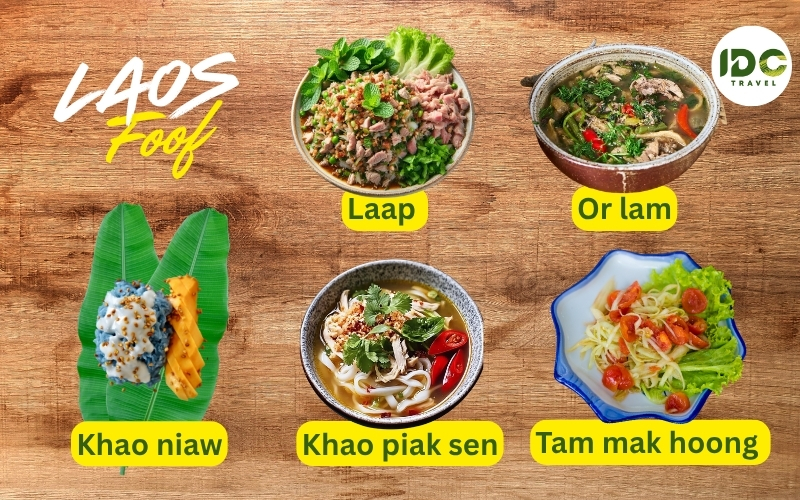
Herby, smoky, sour and fiery, five Lao dishes that prove Laos has one of Southeast Asia’s most underrated kitchens.
- Laap (minced meat or fish herb salad): Meat or fish mixed with lime, herbs and toasted rice powder, commonly eaten with sticky rice.
- Khao niaw (Lao sticky rice): A daily staple traditionally served in a woven basket and eaten alongside several shared dishes.
- Or lam (Luang Prabang-style stew): A slow-cooked northern stew with vegetables, herbs and meat that fits naturally into a Luang Prabang meal.
- Khao piak sen (Lao rice noodle soup): Thick rice noodles served in a comforting broth, especially useful after a long rail or road day.
- Tam mak hoong (Lao green papaya salad): A sour, salty and spicy salad that can include fermented fish seasoning, giving it a noticeably different profile from milder salads elsewhere in the region.
For a broader tasting list and suggestions on where to try Lao dishes, continue with IDC Travel’s 15 Must-Try Dishes in Laos.
Eating Safely on Long Transfer Days
The 17-day route contains several mountain and border sectors where meal options may be less predictable. Eat a proper breakfast before departure and carry water plus a simple backup snack rather than depending on the next roadside stop.
Travelers with allergies should carry translated allergy information in both Vietnamese and Lao. Ask specifically about fish sauce, fermented fish, shrimp paste, peanuts, shellfish and shared cooking oil rather than relying only on the words “vegetarian” or “no seafood”.
Design the Vietnam and Laos Journey Around Your Priorities
The strongest plan protects one clear purpose: a northern overland journey in 17 days or a broader national contrast in 20. For a route built around your dates, mobility, preferred hotels and entry points, create a tailor-made holiday for Vietnam and Laos.
Read more:



Hello, do I need a visa to visit Vietnam?
Hi Declan,
If you stay in Vietnam for less than 45 days, you will not need a visa for tourism or transit. For other regulations on Vietnam visa, please check here or contact us for a private consultation.
Best regards,
IDC Travel Team.