
Laos has more Buddhist temples per capita than almost any country on earth. For a landlocked nation of about 7 million people, the density of religious architecture is extraordinary – over 1,400 monasteries and temples across the country, most of them actively maintained by resident monks and lay communities who use them daily. Unlike some countries where temples have become primarily tourist destinations, Laos’s sacred sites remain genuinely alive – places of daily prayer, education, ceremony, and community gathering. This guide covers the top 9 most famous temples in Laos: what makes each one distinctive, what you’ll actually see, and how to visit respectfully.
Buddhism in Laos: Why It Matters
Theravada Buddhism has been the dominant religion in Laos since the 14th century, when King Fa Ngum established it as the state religion of the Lan Xang Kingdom. Today, approximately 67% of the population identifies as Buddhist, and the religion shapes daily life in visible, consistent ways: the dawn alms-giving ceremony (tak bat), monks who study at temple schools, families making merit through food offerings and temple donations, and a ritual calendar of festivals tied to the Buddhist lunar year.
Understanding this context changes how you experience Laos’s temples. They’re not historical monuments — they’re active religious spaces where monks wake before dawn, ceremonies happen throughout the day, and the community comes to pray. Approaching them with this in mind leads to a more meaningful experience.
Top 9 Most Famous Temples in Laos
1. Wat Xieng Thong – The Most Beautiful Temple in Laos
Wat Xieng Thong
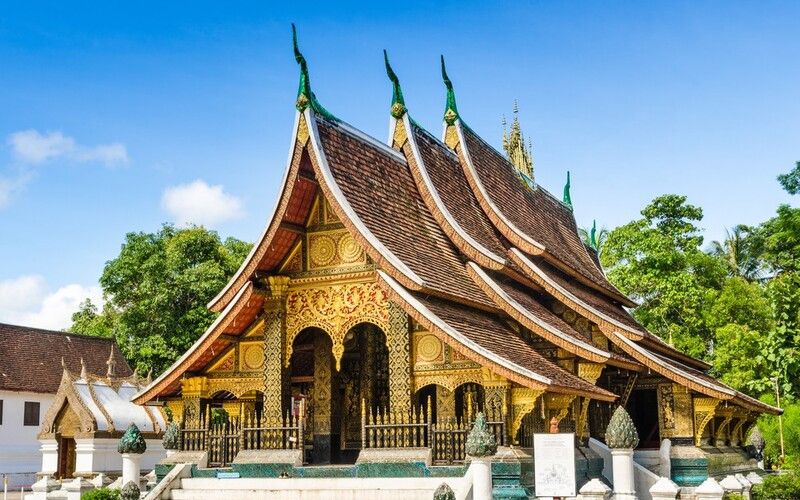
Built in 1560 by King Setthathirath, Wat Xieng Thong is widely considered the finest example of Lanna Buddhist temple architecture in existence. It sits at the northern tip of the Luang Prabang peninsula, where the Mekong and Nam Khan rivers meet, and has been in continuous use since its construction.
What sets it apart is the extraordinary attention to decorative detail: the sim (ordination hall) has a distinctive sweeping roof that nearly touches the ground, decorated with gold stenciled patterns and red lacquer walls. The rear wall features a magnificent mosaic of the “tree of life” in colored glass – one of the most celebrated works of Lao Buddhist art. The funeral carriage house, containing a ceremonial carriage decorated with naga serpents and a reclining Buddha, is housed in a separate pavilion within the grounds.
Practical details:
- Open: daily 8am–5pm. Allow 1–1.5 hours. Located at the northern tip of the peninsula. Morning visits (8–9am) are quieter and the light is better.
- Entry: 20,000 kip.
2. Wat Mai Suwannaphumaham (Wat Mai)
Wat Mai Suwannaphumaham
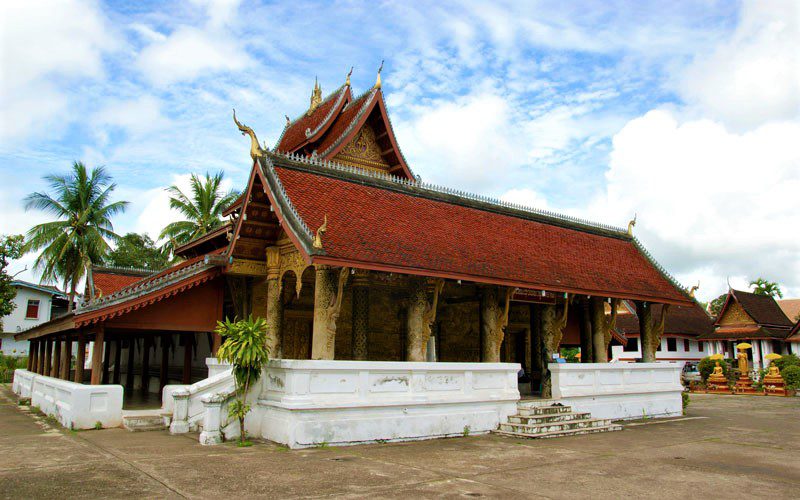
Located on Sisavangvong Road near the Royal Palace, Wat Mai was built in the early 19th century and served as the residence of the Sangha Raja (head of Laos’s Buddhist hierarchy) for many years. The front veranda (portico) is famous for its gilded bas-relief panels depicting scenes from the Ramayana epic and the story of Vesantara, the last incarnation of the Buddha before Siddhartha. The golden detailing is exceptional and among the finest decorative work in any Lao temple.
During Pi Mai Lao (Lao New Year, in April), Wat Mai hosts the ceremonies for bathing the sacred Phra Bang Buddha image – one of the most important religious events in the country. Entry 20,000 kip.
3. Wat Visoun (Wat Visounarath)
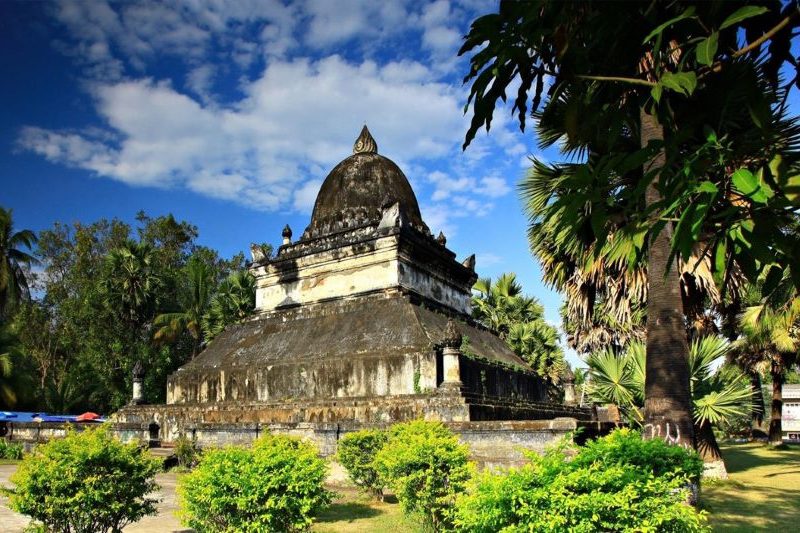
Beautiful view of Wat Visoun
One of the oldest temples in Luang Prabang, originally built in 1513. The current structures are mostly 20th-century reconstructions (the originals were destroyed in a Black Flag invasion in 1887), but the temple houses a significant collection of ancient wooden boat-shaped “calling” Buddhas and the original Phra Bang Buddha image (now replaced by a copy; the original is in the National Museum). The stupa in the temple grounds is known as “That Makmo” (Watermelon Stupa) for its distinctive round shape. Entry 20,000 kip.
4. Wat Aham
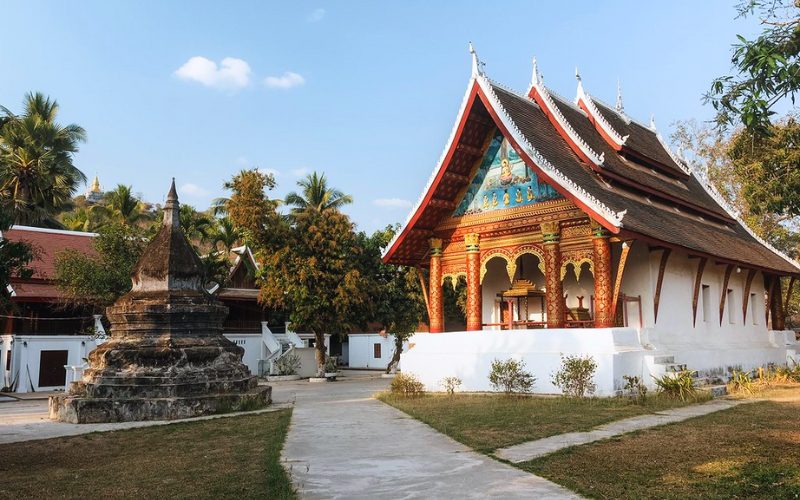
Wat Aham
Adjacent to Wat Visoun, Wat Aham is one of Luang Prabang’s most atmospheric temples. Two enormous Bodhi trees draped with spirit offerings shade the courtyard. The temple is the center of ceremonies connected with Luang Prabang’s guardian spirits (Phi) and the Pha Bang palace deity. Less visited than the headline temples but particularly interesting for understanding the syncretism of Buddhist and animist traditions in Lao religious life. Free entry.
5. Wat Sene (Wat Sene Souk Haram)
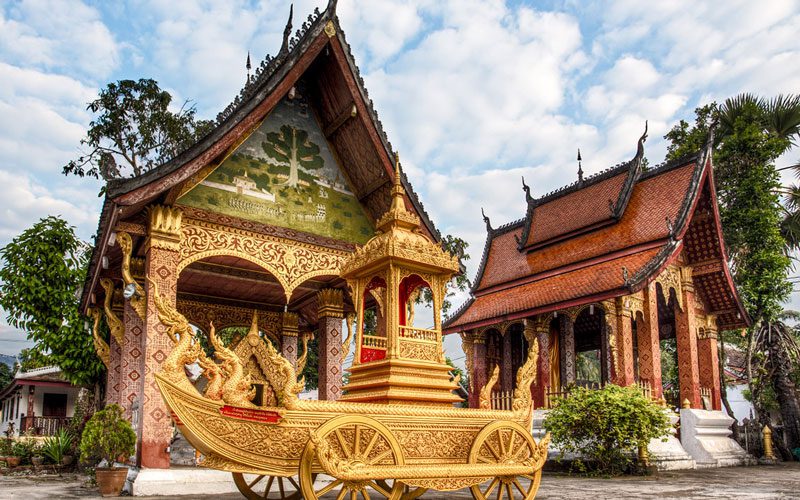
Wat Sene
Built in 1718 with donations from local residents (the name refers to 100,000 kip, the amount donated at the time), Wat Sene is notable for its bright yellow and red exterior – unusual for Luang Prabang, where most temples are white and gold. The vivid colors are Chinese-Thai influenced, reflecting the commercial community that funded its construction. Located on the main riverside road. Entry free.
6. Pha That Luang – Laos’s Most Sacred Monument
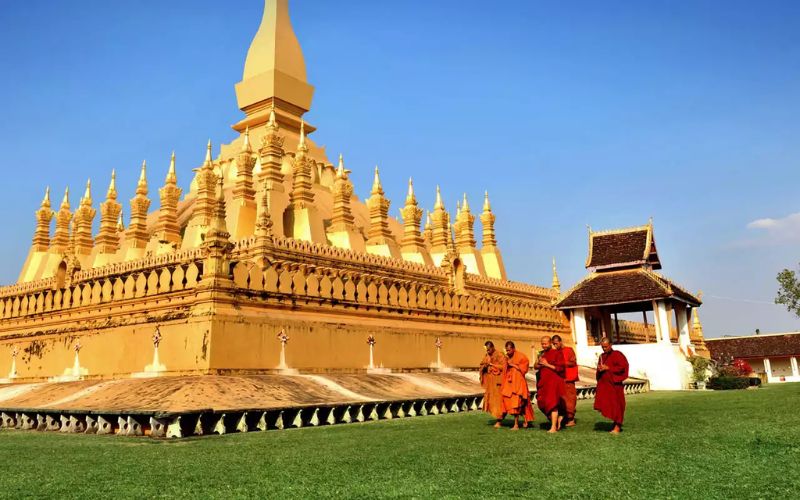
Pha That Luang
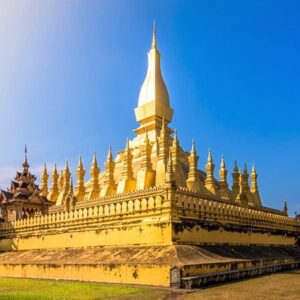
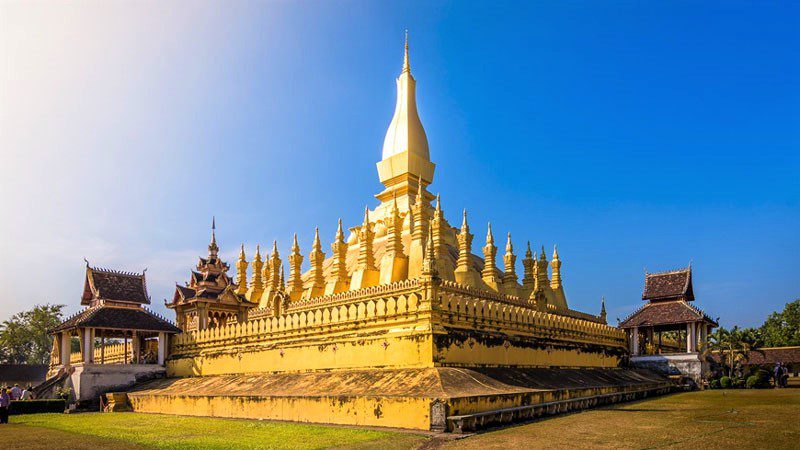
The Great Stupa – a gold-plated Buddhist stupa enclosing a revered relic of the Buddha – is the most important national monument in Laos, appearing on the national emblem. Built in its original form in 1566 by King Setthathirath (the same king who built Wat Xieng Thong in Luang Prabang), it was destroyed by Siamese forces in 1828 and reconstructed by French colonial authorities in the 1930s.
The stupa stands at the center of a large ceremonial plaza, surrounded by four smaller stupas and an exterior gallery punctuated by 30 smaller spires representing the 30 Buddhist perfections. The surrounding area fills with worshippers during the annual That Luang Festival (usually October or November).
Practical details:
- Open: Tuesday–Sunday 8am–noon and 1pm–4pm. Allow 45 minutes.
- Entry: 5,000 kip.
- Dress code: modestly – shoulders and knees covered.
7. Wat Si Saket
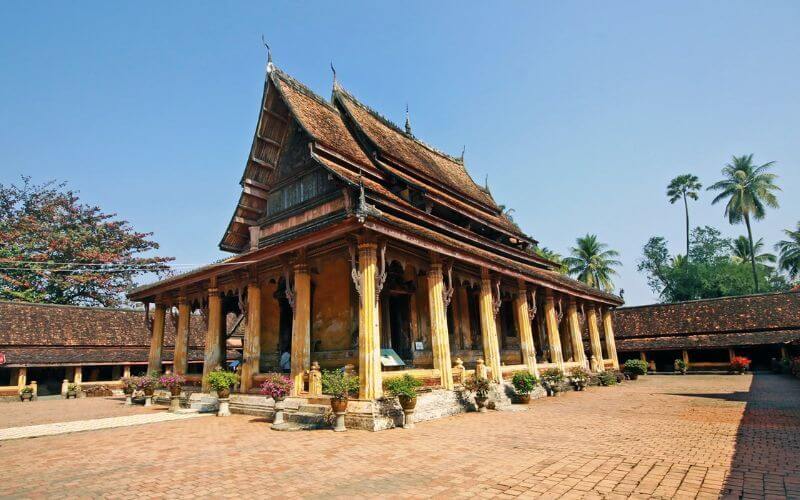
Wat Si Saket
Built in 1818 during the reign of King Anouvong, Wat Si Saket survived the Siamese sacking of Vientiane in 1828 because it was commandeered as headquarters. It’s the oldest surviving temple in the capital. The cloister walls are lined with over 6,000 Buddha statues in various sizes – silver, terracotta, and bronze, many damaged by the Siamese and all coated in centuries of incense residue. The effect is mesmerizing, particularly in the morning when the light enters through the cloisters.
Practical details:
- Open: daily 8am–noon and 1pm–4pm. Allow 45 minutes to 1 hour.
- Entry: 10,000 kip.
8. Haw Pha Kaew (Ho Phra Keo)
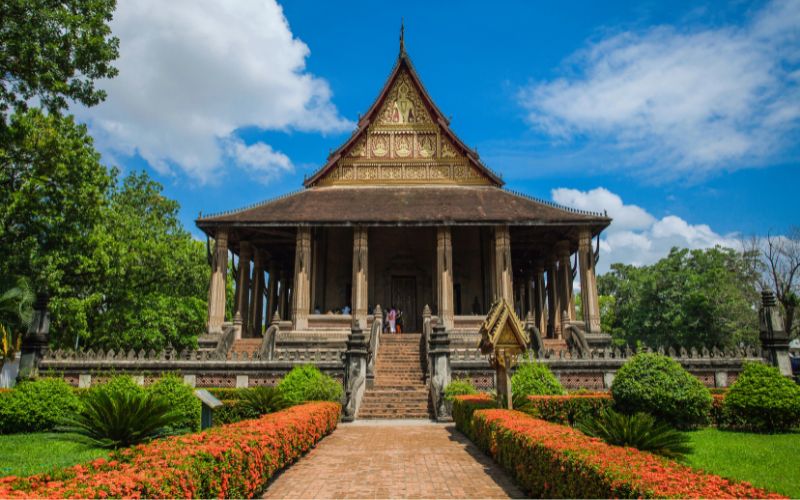
Wat Ho Phra Keo
Originally built in 1565 to house the Emerald Buddha (now in Wat Phra Kaew, Bangkok — removed by the Siamese in 1779), Haw Pha Kaew was repeatedly damaged and rebuilt. It now serves as a museum of Lao religious art rather than an active temple. The collection includes bronze Buddha statues, carved sandstone reliefs, Lao textiles, and ceremonial objects. The building’s design is beautiful and the museum is worth an hour.
Practical details:
- Open: Tuesday–Sunday 8am–noon and 1pm–4pm.
- Entry: 10,000 kip.
9. Wat Si Muang
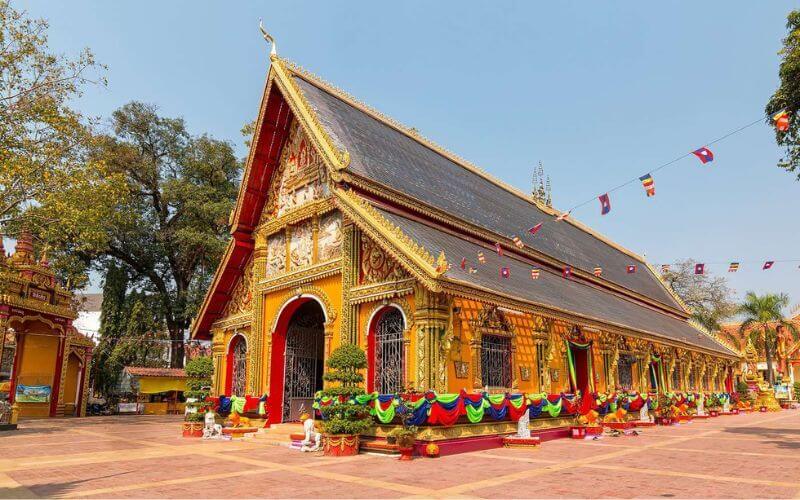
Wat Simuang – Laos
The most actively worshipped Buddhist temple in Vientiane, Wat Si Muang is built over the city’s protective pillar — the Sao Inthakin — believed to contain the spirit that protects Vientiane. Daily offerings are made here by local families, and the atmosphere of genuine religious devotion is palpable in a way that distinguishes it from the more tourist-frequented temples.
Practical details: Open daily. Entry free. Best visited on weekday mornings when the space is full of local worshippers. Dress code strictly observed.
Temple Etiquette in Laos
The rules are consistent across all Lao temples:
- Dress code: Shoulders and knees covered at all times within temple grounds. Sarongs or lightweight long pants are the practical solution. Sandals are acceptable; bare feet required when entering buildings.
- Shoes off: Remove footwear before entering any building — the sim (ordination hall), dining hall, library. The threshold is the signal.
- Photography: Generally permitted in grounds. Inside sanctuaries, check for signs or follow what other visitors are doing. Never photograph monks without permission.
- Tak bat: At the alms-giving ceremony, maintain distance, speak quietly, and do not touch or hand items directly to monks. Women specifically must not touch monks or hand them anything directly — place items on a cloth or let a layman intermediary pass them.
- Buddha images: Never point your feet toward a Buddha image — in Buddhist cultures, the feet are the body’s lowest and least sacred part. Sitting cross-legged or kneeling is appropriate when in close proximity to shrines.
- Donations: Donation boxes are present in most temples. Contributing is appreciated and genuinely supports the monastery community.
Best Time to Visit Temples in Laos
Early morning (6–8am): The best time for photography and for experiencing temple life authentically. Monks conduct morning chants (usually around 5:30–6am) and the tak bat ceremony in Luang Prabang happens before 7am. The light at this hour in northern Laos is soft and golden.
Avoiding midday: 10am–3pm is the hottest part of the day and when tour groups tend to visit. Less pleasant for extended temple visits.
Festival timing: The most significant temple events happen during Pi Mai Lao (April), That Luang Festival (November), and Boun Ok Phansa (end of Buddhist Lent, usually October). If your visit coincides, the atmosphere at major temples is extraordinary.
Plan Your Laos Temple Journey with Us
Our Laos tours cover both Luang Prabang and Vientiane, with guided temple tours that provide historical and religious context that makes these spaces genuinely meaningful. If you want to time a visit around a specific festival or include temple-focused itinerary elements in northern or southern Laos, contact our team and we’ll design the right itinerary.
Wrapping Up
The temples of Laos reward visitors who come with curiosity rather than just a camera. Wat Xieng Thong’s gilded mosaic rear wall. The 6,000 Buddha statues lining Wat Si Saket’s cloisters. The families making morning offerings at Wat Si Muang. None of these experiences fit into a rushed half-day. But given time and the willingness to sit quietly and watch, Laos’s sacred sites deliver encounters with Buddhist practice that are authentic, moving, and unlike anything you’ll find in more heavily touristed countries. Contact us!
Read More
Nice article! I visited some temples and pagodas in Vientiane and they were all beautiful.
Thank you so much!