
To plan your first trip to Vietnam, start with 4 decisions: check whether you need a visa (citizens of 24 countries, including the UK and much of Europe, can visit for 45 days without one, while most others need a $25 e-visa), pick the right season for each region, allow 10 to 14 days, and budget about $75 to $150 per person per day for a comfortable trip. This guide shows you how to plan a trip to Vietnam in 8 simple steps, then shares 2 ready-made itineraries, one for a week and one for 2 weeks, and the things to know before going to Vietnam. Prices are in US dollars ($).
| Step | Quick answer for first-timers |
| 1. Visa | No visa for 24 countries (up to 45 days); a $25 e-visa for most others |
| 2. When to go | March and April for the whole country; October to April for the north, February to August for the centre, December to April for the south |
| 3. How many days | 10 to 14 days; 7 days if you stay in 1 or 2 regions |
| 4. Where to start | Fly into Hanoi and home from Ho Chi Minh City, or the other way round |
| 5. Budget | About $75 to $150 per person per day, plus flights |
| 6. Bookings | Book Ha Long Bay cruises, domestic flights and anything around Tet early |
| 7. Money and apps | Cash and a card, a local SIM, and Grab for rides |
| 8. Health and packing | A travel clinic visit, insect repellent, a plug adapter and clothes that cover shoulders and knees |
How to Plan a First Trip to Vietnam in 8 Steps
Follow the steps in order. The first 4 shape the whole trip, and the bookings in step 6 get harder the longer you wait.
Step 1: Check Whether You Need a Visa
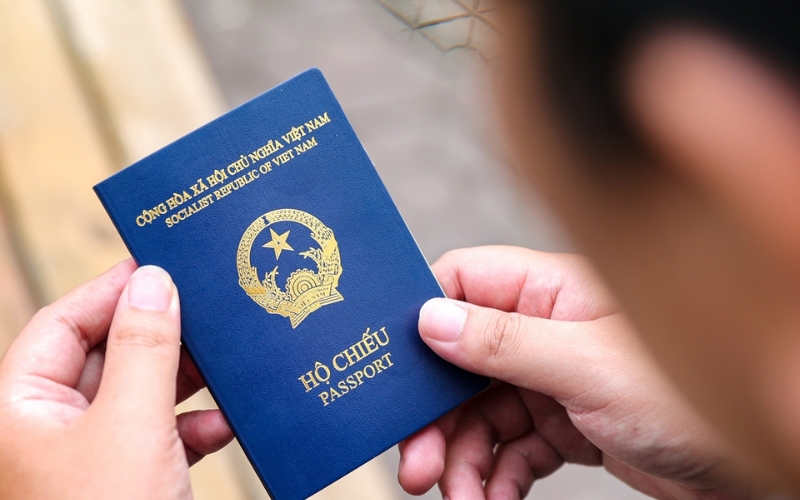
A Vietnamese passport, the starting point for every trip abroad and a key document to check before planning your Vietnam travel paperwork.
- Visa exemption (up to 45 days): citizens of the UK, Germany, France, Italy, Spain, Russia, Japan, South Korea, Denmark, Sweden, Norway and Finland, plus tourists from Belgium, Bulgaria, Croatia, the Czech Republic, Hungary, Luxembourg, the Netherlands, Poland, Romania, Slovakia, Slovenia and Switzerland. Citizens of most South-East Asian countries can also visit without a visa for shorter stays.
- Vietnam e-visa for most other visitors: including travelers from the US, Canada, Australia, New Zealand, India and South Africa. It costs $25 for a single entry or $50 for multiple entries, allows up to 90 days and usually takes 3 working days. Apply at least 2 weeks ahead, only on the Immigration Department’s official website (note: ending in .gov.vn), and enter through the airport you chose on the form.
- Passport: it should be valid for at least 6 months after you arrive and have 2 blank pages.
- Pre-Arrival Information (PAI): a free online form now used at the airports of Ho Chi Minh City, Hanoi, Da Nang and Phu Quoc. Fill it in within 3 days before landing to get a QR code that speeds up immigration. It is not a visa.
Our PAI guide shows how to fill in the form and avoid fake websites that charge a fee.
Step 2: Choose the Best Time for Your Trip

Halong Bay in northern Vietnam, a UNESCO World Heritage site where thousands of limestone islands rise from emerald water.
Vietnam has 3 weather zones, and they are rarely all at their best at the same time:
| Region | Best months | Watch out for |
| North (Hanoi, Ha Long Bay, Ninh Binh, Sapa) | October to April | Cool, grey days from December to February; storms from July to September |
| Centre (Hue, Hoi An, Da Nang) | February to August | Heavy rain and floods in October and November |
| South (Ho Chi Minh City, Mekong Delta, Phu Quoc) | December to April | Short, heavy afternoon storms from May to November |
For a first trip that covers all 3 regions, March and April are the safest choice. Also plan around Tet, the Lunar New Year, on 6 February 2027: flights, trains and hotels fill up weeks ahead, and many family-run shops and restaurants close for several days.
For a month-by-month view, see our guide to the best time to visit Vietnam.
Step 3: Decide How Many Days You Need
Vietnam is about 1,650 km long, and every new region costs at least half a day of travel. As a rule of thumb:
- 7 days: 1 or 2 regions, such as Hanoi and Ha Long Bay, or Hue and Hoi An; or a fast taste of all 3 regions with 2 domestic flights.
- 10 days: the north and the centre, linked by a short flight from Hanoi to Hue or Da Nang.
- 14 days: north to south, the classic first trip, adding Ho Chi Minh City and the Mekong Delta.
- 3 weeks: time for Sapa or Ha Giang, the caves of Phong Nha or a beach break on Phu Quoc.
With about 10 days, our 10-day itineraries compare different ways to split your time.
Step 4: Choose Where to Start and Finish
Most first trips run from north to south or the other way round. Book a multi-city ticket, flying into Hanoi and home from Ho Chi Minh City (or the reverse), so you never travel back the way you came.
- Start in Hanoi if you travel between October and December, when the north is at its best and the south is still drying out.
- Start in Ho Chi Minh City if you travel in January or February, so you reach the north later, as it warms up.
Step 5: Set Your Budget
Vietnam is good value once you arrive. Per person, per day, plan on about:
- $30 to $60 as a backpacker, staying in hostels and eating street food
- $75 to $150 for a comfortable trip with 3- or 4-star hotels and some guided tours
- $200 or more for 5-star hotels, private guides and drivers
The biggest costs on a first trip are usually the international flight, domestic flights and an overnight cruise. Our Vietnam trip cost guide lists real prices for hotels, food, transport and tickets.
Step 6: Book Flights, Hotels and Cruises
Most long-haul flights land in Hanoi (HAN) or Ho Chi Minh City (SGN), and some land in Da Nang (DAD). Ho Chi Minh City’s new Long Thanh International Airport opens on 1 December 2026, and from 28 March 2027 all long-haul international flights to the city move there, so check which airport is on your ticket. Inside Vietnam, fly between regions and use trains or vans for short hops, such as Hue to Da Nang.
Where to stay on a first trip:
- Hanoi: the Old Quarter or the streets around Hoan Kiem Lake, within walking distance of food stalls, cafés and the water puppet theatre.
- Hoi An: near the ancient town for evening walks, or by An Bang Beach for a quieter stay.
- Ho Chi Minh City: around Ben Thanh Market (Ben Thanh Ward, formerly District 1), close to the main museums and restaurants.
What to book early:
- Ha Long Bay cruise: book once your dates are fixed, and check the change and refund terms, as summer storms can keep boats in port. For a first overnight on a 3-star boat, see Oriental Sails.
- Domestic flights: 3 to 6 weeks ahead usually gives the best fares.
- Transport to Sapa: 2 to 3 weeks ahead in busy months.
- Anything around Tet: as early as possible, ideally several months ahead.
- Son Doong Cave: expeditions are fully booked for the next 2 seasons, so on a first time in Vietnam, most travellers visit Paradise Cave or Phong Nha Cave instead.
If you would rather not juggle flights, trains and transfers yourself, contact us, we can book them in the right order for you.
Step 7: Sort Out Money, a SIM Card and Apps
- Cash: Vietnam uses the dong (VND), and $1 is about 26,000 VND. Carry small notes for street food, markets, taxis and small sights, and note that the 20,000 and 500,000 VND notes are both blue and easy to mix up.
- Cards: accepted in most hotels, chain cafés and many city restaurants. When an ATM or card machine offers to charge you in your home currency, choose VND instead, as the rate is usually better.
- ATMs: local bank machines usually let you take out 2 to 3 million VND at a time, and international bank machines 5 to 10 million VND.
- SIM card: buy a tourist SIM at the airport or in a Viettel, VinaPhone or MobiFone shop; staff will ask for your passport to register it.
- Apps: Grab, Xanh SM and Be show fares before you ride, which avoids taxi overcharging. Add Google Maps and a translation app.
Step 8: Prepare Health Checks and Pack Smart
Visit a travel clinic 6 to 8 weeks before you go. Clinics commonly suggest hepatitis A, typhoid and an up-to-date tetanus vaccine, plus others such as Japanese encephalitis or rabies depending on your plans. Standard tourist itineraries do not need malaria tablets, but dengue fever is common in the rainy months, so pack insect repellent. Buy travel insurance that covers medical care and, if you plan to ride one, motorbikes.
- Pack: clothes that cover shoulders and knees for temples, light breathable clothing, a rain jacket from May to November, and a warm layer for Hanoi and Sapa from December to February.
- Plug adapter: sockets take 2-pin plugs (types A and C) at 220V, so UK and Australian plugs need an adapter.
- Leave at home: e-cigarettes and heated tobacco devices, which are banned in Vietnam.
- Large amounts of cash: declare it at customs if you carry more than $5,000 in foreign currency or more than 15 million VND.
2 Ready-Made Itineraries for Your First Time in Vietnam
Both itineraries are based on private IDC Travel tours, so you get a driver, guides and hotels already arranged, and you can change any part of them. Itinerary 1 suits travellers with a week; itinerary 2 shows what 2 weeks can include.
Itinerary 1: Classic Vietnam in 7 Days
- Route: Hanoi – Ha Long Bay – Hue – Hoi An – Ho Chi Minh City
- Best for: first-timers with one week who want a taste of the north, centre and south.
- Strengths: you see all 3 regions in 7 days, the domestic flights from Hanoi to Hue and from Da Nang to Ho Chi Minh City are included, and you stay in only 4 hotels.
- Weaknesses: Ha Long Bay is a long day trip rather than a night on board, and there is no time for the Mekong Delta or the Cu Chi Tunnels.
- Best time: February to April, when the centre and south are dry and Hanoi is mild.
- Should avoid: October and November, when floods can disrupt Hue and Hoi An, and July to September, when storms can cancel the Ha Long Bay cruise.
- Pace note: day 2 is long, with 2.5 to 3.5 hours on the road each way, so keep that evening free.

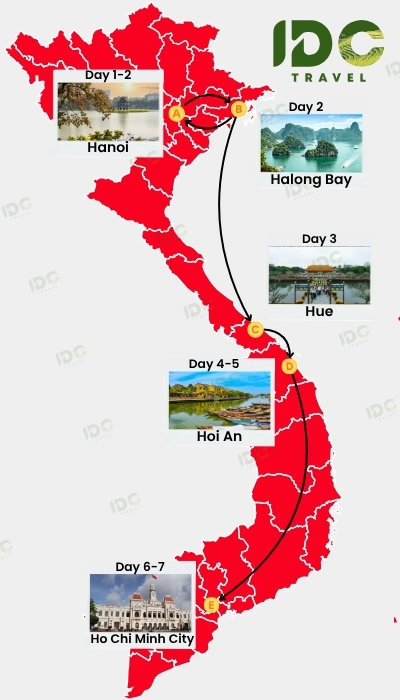
Day 1 | Arrive in Hanoi
Transfer to your hotel in the Old Quarter and take an easy walk around Hoan Kiem Lake. Finish with a first taste of Hanoi street food close to the hotel.
Day 2 | Ha Long Bay Day Cruise
Leave early for the coast and spend the day cruising among the limestone islands, with a cave visit and lunch on board. Return to Hanoi in the evening.
Day 3 | Fly to Hue
Take a short morning flight to Hue. Depending on your arrival time, visit the Imperial City or one of the royal tombs in the afternoon.
Day 4 | Hue to Hoi An via the Hai Van Pass
Drive south over the Hai Van Pass, stopping at the top for views of the coast. Arrive in Hoi An in time for an evening walk through the lantern-lit ancient town.
Day 5 | Hoi An at Your Own Pace
Choose one theme for the day: a heritage and food walk, a bike ride through the countryside, a cooking class or time on the beach. Keeping to one theme makes the day relaxed rather than rushed.
Day 6 | Fly to Ho Chi Minh City
Fly from Da Nang to Ho Chi Minh City and explore the historic centre, including the Independence Palace and the War Remnants Museum. Enjoy a relaxed dinner on your last night.
Day 7 | Depart from Ho Chi Minh City
Spend any free time near your hotel before your transfer to the airport. Avoid adding the Cu Chi Tunnels or the Mekong Delta on the day you fly home.
>>> See the full itinerary: Classic Vietnam in 7 days. We can add an overnight cruise or an extra day in Hoi An if you have more time.
Itinerary 2: Must-See Vietnam in 14 Days
- Route: Hanoi – Sapa – Ninh Binh – Ha Long Bay – Hue – Hoi An – Ho Chi Minh City – Mekong Delta
- Best for: first-timers with 2 weeks who want mountains, a night on the bay, heritage towns and river life in one trip.
- Strengths: you see all 3 regions plus Sapa and the Mekong Delta, the night trains and the cruise save hotel nights, and there are plenty of local moments, from a homestay to a lunch with a village family.
- Weaknesses: 2 night trains in 3 days can be tiring, 8 different stops mean a lot of packing, and the Sapa walks need moderate fitness.
- Best time: March and April, when Sapa is mild, the centre is dry and the south is sunny.
- Should avoid: October and November, when floods can hit Hue and Hoi An; July and August, the wettest months in Sapa; and December to February, when Sapa is cold and foggy.
- Pace note: pack a small bag for Sapa and the night trains and leave your main luggage at your Hanoi hotel.
Day 1 | Arrive in Hanoi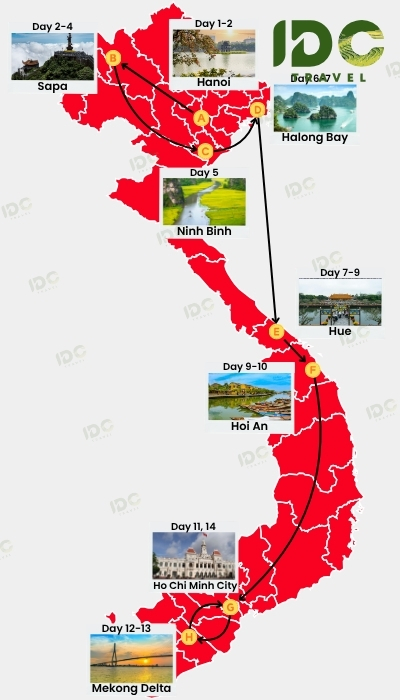
Settle into your hotel and visit the Vietnam Museum of Ethnology, a good introduction to the country’s ethnic groups. A welcome dinner ends the day.
Day 2 | Hanoi and the Night Train to Lao Cai
See the Temple of Literature and Tran Quoc Pagoda, then ride a cyclo through the Old Quarter. In the evening, board the night train to Lao Cai.
Day 3 | Sapa Villages and a Homestay
Visit a highland market, then walk to Hmong and Ta Phin villages in the valleys around Sapa. Spend the night in a local homestay.
Day 4 | Sapa Valleys and the Night Train Back
Walk through rice terraces and villages and share lunch with a local family. Take the night train back to Hanoi in the evening.
Day 5 | Ninh Binh
Visit Hoa Lu, Vietnam’s ancient capital, and glide by sampan through the caves of Tam Coc. Finish with a bike ride through the countryside of Thung Nham.
Day 6 | Ha Long Bay Cruise
Board your cruise and sail among the limestone islands, visiting Thien Canh Son Cave and Hon Co Island. Spend the night on board.
Day 7 | Ha Long Bay to Hue
Enjoy a last morning on the bay, then return to Hanoi and take an evening flight to Hue.
Day 8 | Hue
Explore Dong Ba Market and the Imperial City, then visit the Tomb of Tu Duc and Tu Hieu Pagoda in the hills outside the city.
Day 9 | Hue to Hoi An
Visit Thien Mu Pagoda by the Perfume River and cycle through the garden village of Thuy Bieu. In the afternoon, travel via Da Nang to Hoi An.
Day 10 | Hoi An
Walk the ancient town in the morning, then cycle to Tra Que, a vegetable village where farmers still grow herbs by hand.
Day 11 | Fly to Ho Chi Minh City
Fly from Da Nang to Ho Chi Minh City and visit the Independence Palace. See Notre-Dame Cathedral from outside, as it is still under restoration.
Day 12 | Mekong Delta
Drive to Ben Tre for a boat trip along the river and its canals, with village visits and a bike ride. Continue to Can Tho for the night.
Day 13 | Cai Rang Floating Market
Reach Cai Rang Floating Market early, when trading is busiest, then cycle to Binh Thuy before returning to Ho Chi Minh City.
Day 14 | Depart from Ho Chi Minh City
Enjoy a final breakfast and some free time before your transfer to the airport.
>>> See the full itinerary: Must-see Vietnam in 14 days. We can swap Sapa for Phong Nha or add a beach stay if you prefer.
Things to Know Before Going to Vietnam
These Vietnam travel tips for first-timers cover the everyday etiquette, safety basics and new place names that surprise most visitors.
Local Etiquette
- Cover shoulders and knees at temples and pagodas, and take off your shoes where you see others doing so.
- Ask before taking photos of people, especially in villages in the northern mountains.
- Bargain politely at markets, but not in shops with marked prices.
- Stay calm when things go wrong; raising your voice rarely helps.
Our list of do’s and don’ts covers more of the unwritten rules.
Staying Safe
- Crossing the road: walk slowly and steadily and let motorbikes flow around you; do not run or step back suddenly.
- Motorbikes: only ride if you are experienced and hold your home licence, an international driving permit and insurance; helmets are compulsory.
- Bags and phones: keep them on the side away from traffic, as bag snatching from passing motorbikes happens in big cities.
- Getting around: use pre-booked transfers or official apps rather than offers from strangers at the airport.
- Emergency numbers: 113 for police, 114 for fire and rescue and 115 for an ambulance.
New Place Names
Vietnam merged many of its provinces in 2025, so maps and tickets may show names that differ from older guidebooks. Hoi An is now part of Da Nang City, Phong Nha is in Quang Tri province, Ha Giang is in Tuyen Quang province and Phu Quoc belongs to An Giang province.
Our guide to the provincial merger lists the new names for every major destination.
Start Planning Your First Vietnam Trip with IDC Travel
A first trip to Vietnam comes together quickly once the big decisions are made: your visa, the season, the number of days and where to start. After that, it is about booking in the right order and packing for the weather.
If you would like local help from the start, create your trip with our travel experts, and we will shape the itinerary around your dates, interests and budget.
Read more: