2 weeks is enough for Laos if you choose one coherent itinerary instead of trying to cover every region. First-time visitors can spend two or three nights in Luang Prabang, then either travel south through Vang Vieng, Vientiane, Khong Lor and the Bolaven Plateau to the 4,000 Islands, or use the full two weeks for Northern Laos, combining river journeys, trekking and remote communities. The first itinerary offers broader national variety, while the second gives more time to landscapes and local culture. Allow some flexibility for road, rail and river conditions. For land arrangements, budget roughly USD 900-2,900 per person, excluding international flights, visas, insurance and personal shopping.
Two Itineraries for 2 Weeks in Laos
| Route | Main stops | Best for | Main advantage | Honest limitation |
| Complete Laos from North to South | Luang Prabang, Xieng Khouang, Vang Vieng, Vientiane, Ban Na Hin, Khong Lor, Pakse, Bolaven Plateau, Wat Phou and Si Phan Don | First-time visitors who want the widest view of Laos | Connects royal heritage, caves, plateau landscapes and the Mekong South | Several long road days and a border finish rather than an airport departure |
| Northern Laos River and Mountain Adventure | Luang Prabang, Kamu Lodge, Pak Beng, Huay Xai, Luang Namtha, Nam Ha, Phongsaly, Muang Khua and Nong Khiaw | Active travelers, repeat visitors and nature lovers | Deep river, forest and village experiences with little urban repetition | Demanding logistics, basic stays and activities requiring suitable fitness |
- Choose Itinerary 1 if this may be your only Laos trip and long transfers are acceptable.
- Choose Itinerary 2 if you care more about landscapes and participation than checking off Vientiane and the South.
The second option requires flexibility and respect for local communities; it should not be treated as a staged village photo tour.
Itinerary 1: Complete Laos from Luang Prabang to the Southern Border
- Route: Luang Prabang, Pak Ou, Xieng Khouang, Vang Vieng, Vientiane, Ban Na Hin, Khong Lor Cave, Pakse, Bolaven Plateau, Wat Phou and Si Phan Don
- Best for: First-time visitors who want culture, archaeology, caves, highlands and the Mekong South in one journey
- Strengths: Excellent geographic variety, major heritage sites and a clear north-to-south story
- Weaknesses: Long road transfers; limited downtime; the published journey ends at the Laos-Cambodia land border
- Best time: November to February for generally cooler and drier travel, especially on long road and outdoor days
- Should avoid: A fixed rainy-season plan if cave, road and boat access are essential, or any date when frequent hotel changes feel tiring
Day 1 | Arrive in Luang Prabang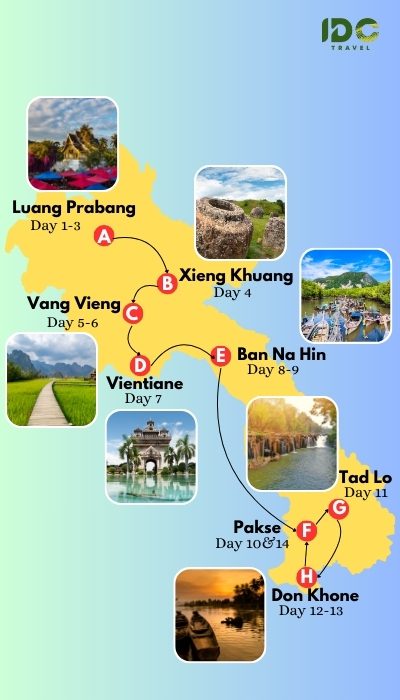
Transfer to the hotel and recover. If the flight arrives early, take a gentle old-town walk and save the main temples for the guided day.
Day 2 | Luang Prabang and Pak Ou Caves
Visit selected heritage landmarks before traveling on the Mekong to Pak Ou Caves. A craft village stop should be purposeful rather than an automatic shopping detour.
Day 3 | A Free Day in Luang Prabang
Use the extra day for Kuang Si Waterfall, a cooking class or unhurried old-town exploration. Follow respectful behavior if observing morning alms giving.
Day 4 | Luang Prabang to Xieng Khouang
Prepare for a long mountain-road transfer. Make safe rest stops, carry water and avoid planning an evening activity after arrival.
Day 5 | Plain of Jars and Vang Vieng
Explore an approved Plain of Jars site with a guide, then continue to Vang Vieng. Stay on marked paths and follow local safety guidance.
Day 6 | Vang Vieng to Vientiane
Begin with a cave, river or village experience suited to current conditions, then transfer to the capital. The day should not combine every available activity.
Day 7 | Vientiane in Context
Visit a focused group of temples and civic landmarks, then slow down by the Mekong. Vientiane provides a useful urban pause before the central cave region.
Day 8 | Vientiane to Ban Na Hin
Drive toward Khammouane Province and the gateway to Khong Lor Cave. Expect road time to dominate and keep the village walk flexible.
Day 9 | Khong Lor Cave
Travel through the cave by local boat only when water level and safety conditions permit. Wear footwear suited to wet landings and follow the operator’s instructions.
Day 10 | Ban Na Hin to Pakse
Continue south with a rest and meal stop around Savannakhet. This is another long travel day, so arrive and settle rather than adding sightseeing.
Day 11 | Bolaven Plateau and Tad Lo
Explore plateau landscapes, waterfalls and coffee-growing areas. Conditions at viewpoints and cascades can change, especially after heavy rain.
Day 12 | Wat Phou and Si Phan Don
Visit Wat Phou near Champasak, then continue toward the 4,000 Islands. The cultural site and island transfer make this a full day.
Day 13 | Islands of the Mekong
Use a local boat to explore the Don Khon or Don Det area, waterfalls and former railway traces. Wildlife sightings should never be promised.
Day 14 | Khone Phapheng and the Laos-Cambodia Border
Travel toward the southern border with a stop at Khone Phapheng if conditions and timing allow. If Cambodia is not next, ask IDC Travel to redesign the final nights and provide a suitable transfer to Pakse Airport (PKZ) instead.
>>> Want the full north-to-south journey? Review IDC Travel’s live Discover the Best of Laos in 14 Days. Confirm the final border or airport transfer before booking because it changes the onward travel plan materially.
Itinerary 2: Northern Laos River and Mountain Adventure
- Route: Luang Prabang, Pak Ou, Kamu Lodge, Pak Beng, Huay Xai, Luang Namtha, Nam Ha, Phongsaly, Muang Khua and Nong Khiaw
- Best for: Fit travelers who enjoy trekking, river journeys, simple lodges and meaningful time outside cities
- Strengths: Deep immersion in Northern Laos, varied Mekong and Nam Ou travel, and little repetition
- Weaknesses: Remote roads and basic facilities; trekking and paddling depend on weather; limited medical access in some sectors
- Best time: November to February for cooler trekking conditions, with warm layers for northern mornings and evenings
- Should avoid: A rigid plan during heavy rain, or this route entirely if long boat rides, uneven trails or rustic stays are unsuitable
Day 1 | Arrive in Luang Prabang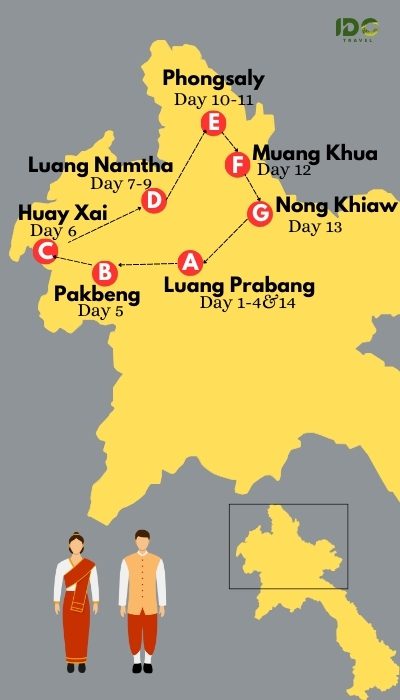
Transfer to the hotel and rest. Use the evening only for an easy walk or dinner near the old town.
Day 2 | Luang Prabang Heritage
Explore selected temples, the former royal area and Mount Phousi according to mobility and crowd levels. Observe religious life without obstructing worshippers.
Day 3 | Kuang Si Waterfall
Travel outside the city for forest paths and the multi-tiered waterfall. Swimming access can change, so follow current signs and local guidance.
Day 4 | Pak Ou Caves and Kamu Lodge
Cruise upstream on the Mekong, visit Pak Ou and continue to a river-valley lodge. Choose low-impact activities and follow the lodge’s community rules.
Day 5 | Kamu Lodge to Pak Beng
Continue by boat through the Mekong landscape with a suitable village stop. This is a river journey, not a day to stack several excursions.
Day 6 | Pak Beng to Huay Xai
Spend another substantial day on the Mekong and arrive near the Thai border. Keep the evening free after the boat sector.
Day 7 | Huay Xai to Luang Namtha
Cross northern mountain country by road with an optional cave or village visit when access is safe. Settle into Luang Namtha and prepare for trekking.
Day 8 | Trek in Nam Ha and Village Stay
Walk through the protected landscape with a trained local guide and carry only what you can manage. Respect photography, dress and household guidance in the host village.
Day 9 | Nam Tha River and Return to Luang Namtha
Kayak or raft only after a safety briefing and assessment of water conditions. A road alternative should be available for travelers who do not paddle.
Day 10 | Luang Namtha to Phongsaly
Allow most of the day for the mountain drive. Photo stops should not turn residents or villages into attractions without consent.
Day 11 | Communities around Phongsaly
Visit a museum and a community program arranged with local agreement. The purpose is learning and exchange, not collecting portraits.
Day 12 | Old Tea Landscapes and Muang Khua
Explore tea-growing country before continuing to Muang Khua on the Nam Ou. Road condition and journey time can vary.
Day 13 | Nam Ou River to Nong Khiaw
Travel downstream by long-tail boat when the river sector is operating safely. Attempt the Pha Daeng viewpoint only with enough daylight, suitable footwear and fitness.
Day 14 | Return to Luang Prabang and Depart
Drive back to Luang Prabang Airport (LPQ) with a protected time buffer. A morning departure may require an extra night near the airport.
>>> Ready for a more active Northern Laos journey? Explore IDC Travel’s live 14 Days Northern Laos Adventure Tour. Ask the team to confirm trekking grade, river alternatives, accommodation standard and medical or evacuation planning for your dates.
Estimated Budget for 2 Weeks in Laos
These planning ranges are per person for 14 days and 13 nights, assuming two people share a room. They exclude international flights, visa fees, insurance, shopping and emergency transport.
| Cost category | Budget | Mid-range | Premium |
| Accommodation for 13 nights | USD 260-650 | USD 780-1,950 | USD 2,600-6,500 |
| Meals and drinks | USD 180-420 | USD 420-910 | USD 980-1,820 |
| Transport (Private Cars, Trains and Boats) | USD 220-850 | USD 750-2,200 | USD 2,000-5,500 |
| Guides, permits and activities | USD 240-980 | USD 850-2,400 | USD 2,200-5,500 |
| Estimated ground total | USD 900-2,900 | USD 2,800-7,460 | USD 7,780-19,320 |
The Northern Laos adventure can cost more than a classic route because private boats, trained guides, remote logistics and simple but exclusive lodges are expensive to operate. Confirm what the quote includes: meals, guide days, river sectors, permits, village contributions, luggage handling and contingency transport.
Essential Travel Guide for 2 Weeks in Laos
A two-week journey reaches beyond Laos’ easiest tourist centers, so entry documents, cash, transport bookings, mobile coverage and seasonal conditions should be planned around the actual itinerary.
Do You Need a Visa for Laos?
Visa requirements depend on nationality, passport type and intended entry point. The official Lao eVisa is a single-entry tourist visa permitting a stay of up to 30 days. Processing normally takes three working days after a complete application and payment, while the approval letter is valid for entry for up to 60 days after issue.
An eVisa can only be used at designated entry points, including Luang Prabang International Airport, Wattay International Airport, Pakse International Airport and several approved land and railway checkpoints. Confirm that the first entry point in your itinerary appears on the official Lao eVisa portal before applying. Carry a printed approval letter and enter with the same passport used for the application.
How Should You Carry and Withdraw Money?
Laos uses the Lao kip, or LAK. Cash remains important outside Luang Prabang, Vang Vieng, Vientiane and Pakse, particularly for village purchases, small restaurants, local boats and services in remote areas.
Cards are accepted at some established hotels and businesses in larger towns, but they should not be the only payment method for a two-week journey. Withdraw enough kip before traveling to Khong Lor, the Bolaven Plateau, the 4,000 Islands or remote Northern Laos, where ATMs may be limited or temporarily unavailable.
Keep your travel funds in two places. Carry smaller notes for daily spending and store a backup card separately. Before accepting an ATM conversion, check whether the screen is offering to charge the transaction in your home currency. Paying or withdrawing in LAK usually allows your own card network to perform the conversion.
How Do Private Cars, Trains and Boats Fit the Itinerary?
The Laos-China Railway is useful between Luang Prabang, Vang Vieng and Vientiane, but it does not replace road transport for Khong Lor, the Bolaven Plateau or the far South. Northern itineraries may also require private cars and boats where no direct rail connection exists.
Domestic train tickets are commonly released only a few days before departure, often around three days in practice, although the sales window has changed before. Check the official LCR Ticket app rather than assuming tickets will be available weeks in advance. Popular departures can sell quickly, so keep alternative times or a road transfer in reserve.
Enter each passenger’s name exactly as it appears in the passport and carry the same passport to the station. Allow approximately 45 to 60 minutes for document checks, security screening and boarding.
Fast-train passengers are commonly limited to about 20 kilograms of luggage. Bags are screened, and sharp objects, flammable products, pressurised aerosols and other dangerous items may be restricted. Check the current rules before packing because baggage and prohibited-item policies can change.
River journeys require a different kind of flexibility. Water levels, weather and local operations can affect boat duration or departure points. Avoid placing an important international flight immediately after a long road or river sector.
Should You Buy a Local SIM or eSIM?
Buy and test a local SIM or eSIM in Luang Prabang, Vientiane or another major town before entering remote areas. Unitel is a practical first option for broad domestic coverage, while TPlus can serve as an alternative depending on the exact itinerary. An eSIM is convenient if the traveler’s phone supports it, but the underlying Lao network matters more than whether the SIM is physical or digital.
No provider should be expected to work continuously in caves, mountains, river valleys or isolated villages. Coverage may become weak around Khong Lor, the Bolaven Plateau, Nam Ha, Phongsaly, Muang Khua and sections of the Mekong or Nam Ou rivers.
Before leaving a connected town:
- Download offline maps for the next sector.
- Save hotel, guide and driver contact details.
- Take screenshots of tickets and pickup instructions.
- Carry a charged power bank.
- Agree on a meeting point in case the group loses mobile coverage.
What Is the Best Time for 2 Weeks in Laos?
November to February is generally the best period for a two-week Laos itinerary because temperatures are more comfortable for long road journeys, trekking and outdoor sightseeing. Northern evenings and early mornings can feel cool, especially in higher areas, so bring a light warm layer.
March and April are hotter, and smoke or haze may affect parts of Northern Laos. Start outdoor activities earlier and avoid building demanding trekking days around the hottest hours. IDC Travel’s best time to visit Laos guide gives a broader month-by-month comparison.
The rainy season brings greener landscapes and stronger waterfalls, but it can slow rural roads, alter boat operations and make some trails or caves harder to access. Build extra time around remote transfers and keep a backup activity for weather-sensitive days.
Travelers interested in the green season can review IDC Travel’s Laos rainy-season guide before deciding whether the trade-off suits their travel style.
Lao Dishes to Try Along the Route
- Khao piak sen (chewy rice noodle soup): A comforting broth with hand-cut rice noodles, herbs and meat, often eaten for breakfast.

Khao Piak Sen (Lao Chicken Soup)
- Or lam (Luang Prabang herb stew): A gently spicy stew with vegetables, herbs and sometimes meat, traditionally thickened and deeply aromatic.
Or lam (Luang Prabang herb stew)
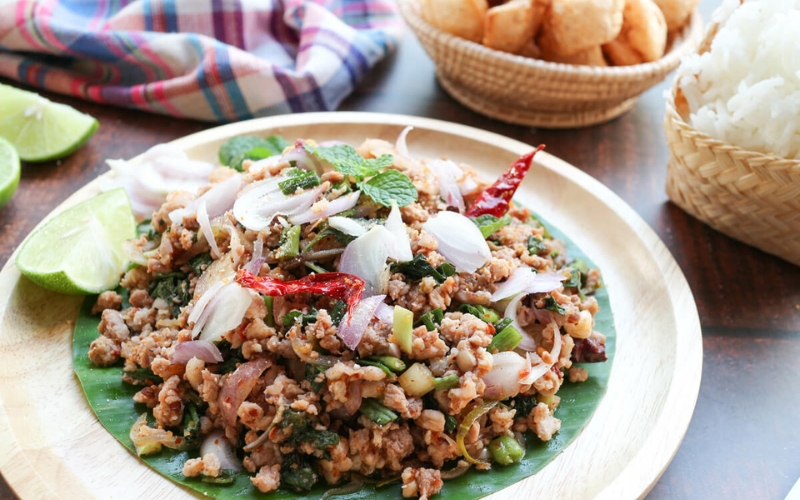
- Laap (minced meat and herb salad): Finely chopped meat or fish mixed with herbs, lime and toasted rice powder; ask whether the version is cooked.
Laap (minced meat and herb salad)
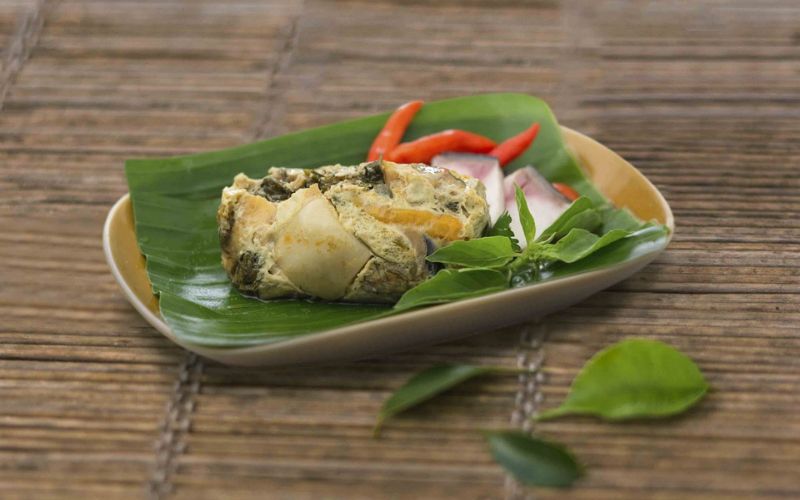
- Mok pa (fish steamed in banana leaf): Fish mixed with herbs and seasoning, wrapped and steamed until fragrant.
Mok Pa (Lao Steamed Fish)
- Khao jee pate (Lao baguette sandwich): A French-influenced baguette filled with pate, vegetables, herbs and sauce.
Khao jee pate (Lao baguette sandwich)
- Khao niao (sticky rice): The everyday staple, traditionally rolled by hand and used to pick up dips and shared dishes.
Khao Niao (Sticky Rice)




Drink treated or sealed water, and be more selective with raw salads, ice and uncooked meat in remote areas. Travelers with allergies should carry a Lao-language allergy card and discuss fish sauce, peanuts and shared utensils.
Plan for the Real Pace of Laos
Two weeks in Laos should not be planned like two weeks in a country with frequent flights and short transfers. Mountain roads, river journeys and remote-area logistics are part of the experience, so an itinerary needs enough space for delays, rest and meaningful time in each destination.
- Treat long transfers as travel experiences: A full road or boat sector should be the main event of the day, not the gap between two packed sightseeing programs. Keep the evening light after arriving.
- Prepare a realistic weather alternative: Caves, waterfalls, trekking routes and river journeys can be affected by local conditions. Each outdoor day should have a suitable alternative rather than forcing the original plan.
- Separate your essential belongings: Pack a small day bag for boats, village stays and overnight excursions. Protect passports, electronics and medication from water, and do not leave necessities inside luggage transported separately.
- Choose community visits responsibly: Look for experiences arranged with local permission, clear community benefits and respectful photography rules. A smaller, well-managed visit usually offers more value than moving quickly through several villages.
- Select temples for meaning, not quantity: Choose a few sites that explain Lao history, architecture and religious life instead of visiting every temple on the route. IDC Travel’s guide to the most famous temples in Laos can help you identify the places that best match your itinerary.
- Match the route to your comfort level: The complete north-to-south journey suits travelers who accept several long transfers. The Northern Laos route requires fewer regions but may involve boats, mountain roads, trekking and simpler accommodation.
A realistic Laos itinerary does not need to feel busy every day. It should give important places enough time while leaving room for the country’s naturally slower rhythm.
Create a Laos Journey That Fits Your Comfort Level
Two weeks is enough for a broad national journey or a deep Northern Laos adventure, but the right choice depends on fitness, transfer tolerance and onward flights. IDC Travel can replace a long road sector, use the railway where it genuinely helps, change the southern border finish or add recovery nights. Contact IDC Travel to plan the route around current access and your preferred pace.
Read more: