
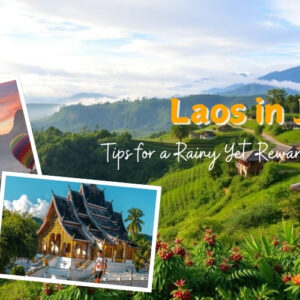
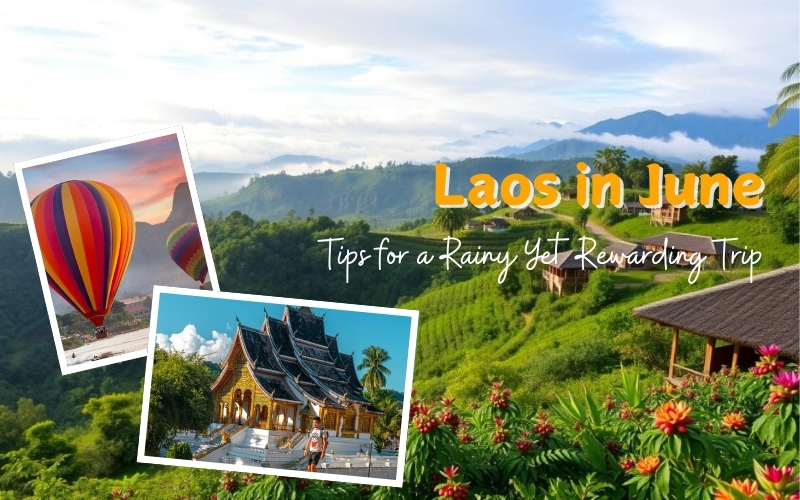
June is when most travel guides tell you to avoid Laos. The rainy season has started, humidity is high, and yes, you will get rained on. But here is the thing about visiting Laos in June that those guides leave out: the waterfalls are at their most powerful, the rice paddies turn an almost unreal shade of green, hotel prices drop, and you can walk through temples without dodging selfie sticks. If you are willing to pack a rain jacket and adjust your expectations, June can be one of the most rewarding months to travel this country.
This guide covers everything you need to plan a trip to Laos in June, from weather patterns and regional differences to the best destinations, festivals, travel costs, and practical tips that actually matter.
Overview of Laos
Laos, officially the Lao People’s Democratic Republic, is a landlocked country in the middle of mainland Southeast Asia. Its neighbors are Vietnam, Cambodia, Thailand, Myanmar, and China. The country has a population of roughly 7.5 million people, and about 70% of them practice Theravada Buddhism.
Laos weather in June
What you get in Laos are ancient temples, the Mekong River winding through mountain valleys, hill tribe villages that feel untouched by time, and a pace of life that forces you to slow down whether you planned to or not. The country’s former royal capital, Luang Prabang, is a UNESCO World Heritage Site, and places like Vang Vieng and the 4,000 Islands region in the south have become popular stops on the Southeast Asia backpacker trail.
The local currency is the Lao Kip (LAK), though US dollars and Thai Baht are widely accepted in tourist areas.
Laos stretches roughly 1,000 km from north to south, sandwiched between the Mekong River and the Annamite Mountains. The country is divided into three main travel regions, each with a different character.
- Northern Laos (Luang Prabang, Nong Khiaw, Luang Namtha) is mountainous and cooler. The terrain is rugged, the roads are winding, and the scenery looks like something from a nature documentary.
- Central Laos (Vientiane, Vang Vieng) has shifted from backpacker party town to adventure tourism hub, with kayaking, caving, and rock climbing now the main draws.
- Southern Laos (Pakse, 4000 Islands, Savannakhet) is where the Mekong widens and the landscape flattens.
>>> For travelers thinking about a multi-country trip, Laos pairs naturally with Vietnam and Cambodia. Many Vietnam and Laos combined tours run overland through border crossings, and it is also common to connect Laos with Thailand via the Friendship Bridges.
Laos in June Weather: What Is the Temperature?
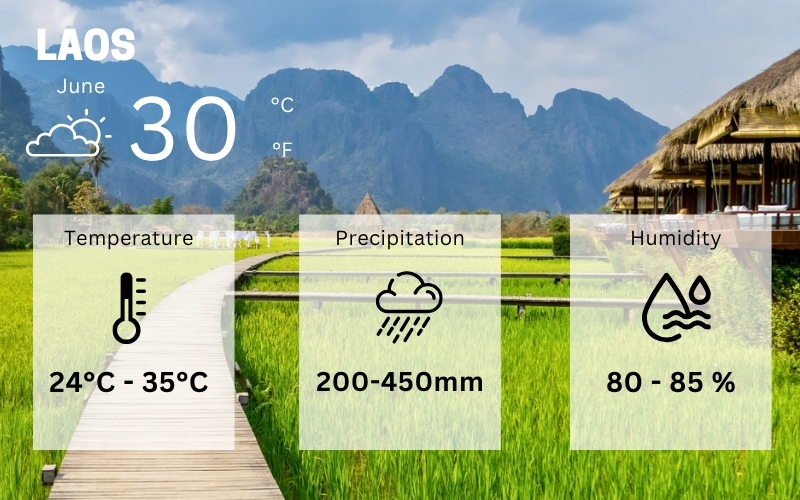
Let’s start with the facts. June is the early wet season in Laos. Here is what the weather data looks like across the main travel regions:
- Vientiane: daytime highs around 32°C (90°F), nighttime lows around 25°C (77°F), roughly 280 mm of rainfall across 18 rainy days
- Luang Prabang: highs of 32°C (90°F), lows of 24°C (75°F), about 258 mm of rain over 14 days
- Pakse (south): highs reaching 33 to 34°C (91 to 93°F), with heavier rainfall, up to 420 mm across 21 days
- Phonsavan (Plain of Jars): slightly cooler at 28 to 30°C (82 to 86°F), about 193 mm of rain over 20 days
Humidity hovers between 80-85% across the country. That combination of heat and moisture means you will sweat through your shirt before lunch, no matter what you wear.
But here is the detail that matters most: the rain in June does not fall all day. Mornings are typically dry and partly sunny. Showers tend to hit in the late afternoon or evening, lasting anywhere from 30 minutes to a couple of hours. Then the sky clears, the temperature drops a few degrees, and the air feels almost pleasant. This pattern is fairly consistent in early June and becomes more intense toward the end of the month.
The Laos climate in June varies by region too. The northern highlands get less total rainfall than the south, and the riverside towns below Vientiane tend to be drier than the mountain areas. If you plan outdoor activities in the morning and keep afternoons flexible for indoor visits or rest, the weather is manageable.
One genuine concern: unpaved roads in remote areas can become muddy or flooded. If you are planning to trek in Luang Namtha or travel overland to very rural destinations, road conditions may slow you down or require alternate routes.
Things to Do in Laos in June: the Highlights
This is where June actually starts to work in your favor. The rainy season transforms the landscape in ways that dry-season visitors never see. Rivers run high and fast, waterfalls thunder with full force, and the countryside turns so green it almost looks artificial. Here is what is worth your time.
1. Explore Luang Prabang without the crowds
Luang Prabang is the most visited destination in Laos for a reason. The old town sits at the meeting point of the Mekong and Nam Khan rivers, and its mix of golden temples, saffron-robed monks, and French colonial shophouses creates an atmosphere you do not find anywhere else in Southeast Asia.
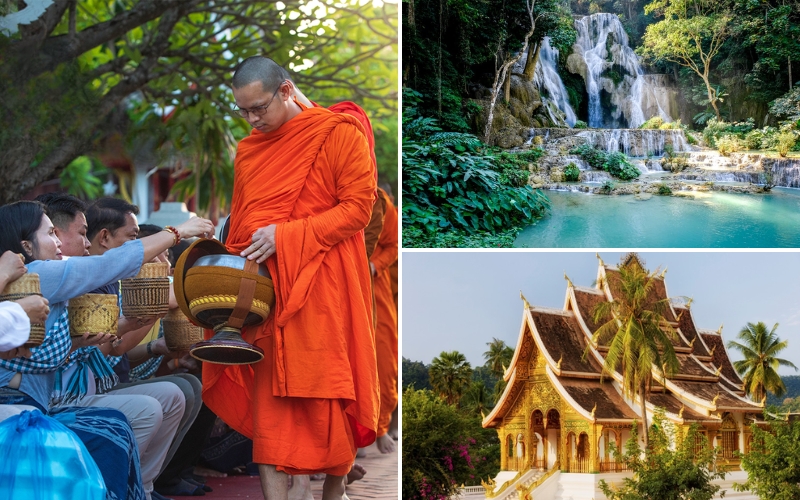
Discovering tranquility and tradition in the heart of Luang Prabang
In June, the usual crowds thin out considerably. You can visit Wat Xieng Thong, arguably the most beautiful temple in the country, without competing for space. The morning alms ceremony (Tak Bat), where hundreds of monks walk silently through the streets collecting food from locals, feels more intimate and less like a tourist spectacle.
The Kuang Si Waterfalls, about 30 km south of town, are at their peak flow in June. The turquoise pools are fuller, the cascades louder, and the surrounding forest is deep green from the recent rains. Swimming is still possible in the lower pools, though water levels are higher and the current stronger than in the dry season.
The Royal Palace Museum (Haw Kham), the night market along Sisavangvong Road, and the view from Mount Phousi at sunset all remain open and accessible year-round. A bowl of Luang Prabang’s signature khao piak sen (rice noodle soup) at a roadside stall costs around 25,000 LAK (~$1.10) and tastes even better when it is raining outside.
>>> If you are planning a longer stay, Luang Prabang tour can include boat trips to the Pak Ou Caves, visits to nearby weaving villages, and cooking classes focused on Lao cuisine.
2. Chase waterfalls at full power
June is the waterfall season in Laos. The early rains bring rivers and streams back to life after months of dry weather, and waterfalls that looked thin or disappointing in March are now running at full volume.

The breathtaking Kuang Si Waterfall, where crystal-clear waters flow gracefully through layers of limestone amid vibrant jungle greenery.
Beyond Kuang Si, consider these:
- Tad Fane, near Pakse on the Bolaven Plateau, is one of the tallest waterfalls in Southeast Asia at roughly 120 meters. In June, the twin cascades are surrounded by mist and jungle, and you can zipline across the gorge for a closer look.
- Tad Sae, closer to Luang Prabang, is a series of limestone cascades and pools. It is less visited than Kuang Si and feels more like a local swimming hole.
- Khone Phapheng, near the Cambodian border in Si Phan Don, is the largest waterfall (by volume) in Southeast Asia. In June, the Mekong pushes enormous amounts of water through this stretch, and the power of the falls is genuinely impressive.
>>> If you enjoy chasing waterfalls, the Bolaven Plateau in Pakse tour offers a full loop of falls, coffee farms, and ethnic minority villages that can fill two to three days comfortably.
3. River activities on the Mekong and Nam Song
High water levels in June open up river activities that are not available during the dry season. The Mekong becomes navigable for longer boat journeys, and the Nam Song River near Vang Vieng runs faster, making kayaking and tubing more exciting (and more challenging).
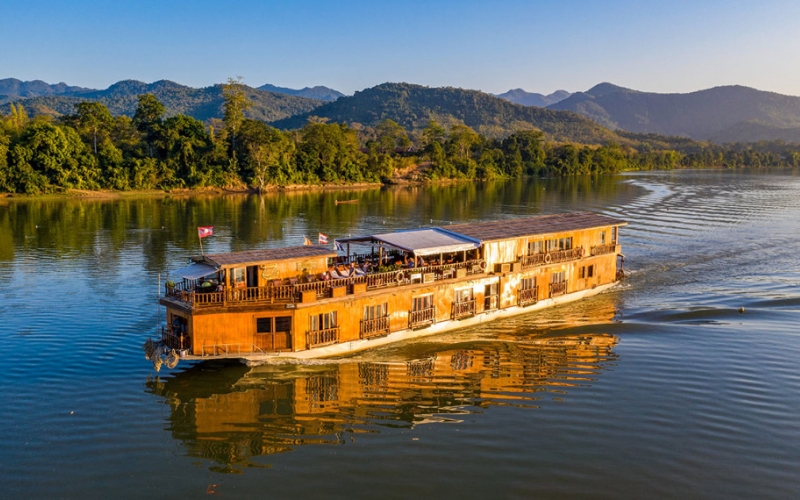
Enjoy the scenic beauty of Laos with a relaxing river cruise on the Mekong
In Vang Vieng, tubing has cleaned up considerably from its party-town reputation. Operators now run organized trips with safety gear, and several companies offer guided kayaking that combines river time with cave exploration. The karst limestone scenery around Vang Vieng looks extraordinary in June, with low clouds threading through the cliffs and the river running a muddy green.
>>> Vang Vieng tour typically pair river activities with visits to the Blue Lagoon and Tham Chang Cave.
4. Discover Vientiane’s quieter side
Vientiane does not try to compete with Bangkok or Hanoi. It is probably the most laid-back capital city in Southeast Asia, and in June it feels even more relaxed. The main attractions are spread along the Mekong riverfront and can be covered in a day or two.
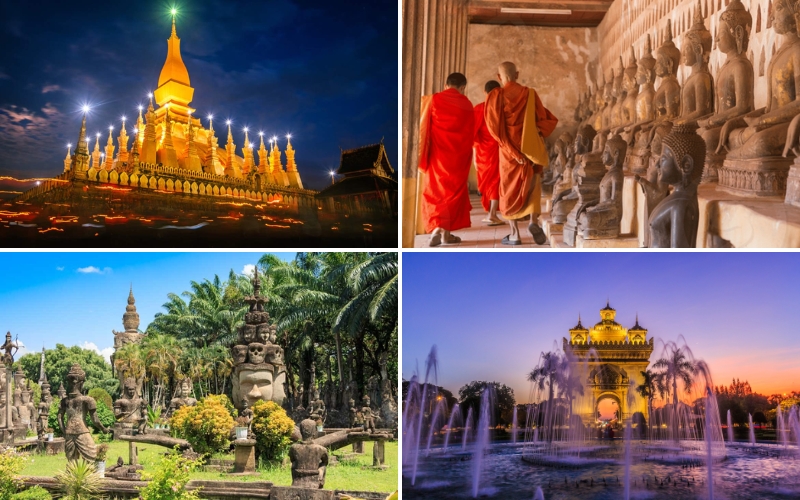
Discover the rich cultural heritage of Vientiane through its historic landmarks
Pha That Luang, the gold-covered stupa that is Laos’ national symbol, sits on the eastern edge of the city. Patuxai, sometimes called the Lao Arc de Triomphe, offers rooftop views of the city and surrounding area. Wat Si Saket, the oldest surviving temple in Vientiane, contains over 6,800 Buddha images arranged in wall niches.
The Mekong riverfront promenade comes alive in the evening, with food stalls selling grilled meats, papaya salad (tam mak hoong), and sticky rice. A full dinner at a riverside stall runs about 60,000 to 80,000 LAK (~$2.70 to $3.60).
>>> Vientiane tour often combine city sightseeing with day trips to nearby Buddha Park (Xieng Khuan), a sculpture park about 25 km south of the city center.
5. Trek through green jungles in the north
If you enjoy hiking, June puts the northern highlands in peak green mode. The forests around Nong Khiaw, Luang Namtha, and Phongsali are thick with vegetation, and the misty mountain views can be spectacular when clouds break.
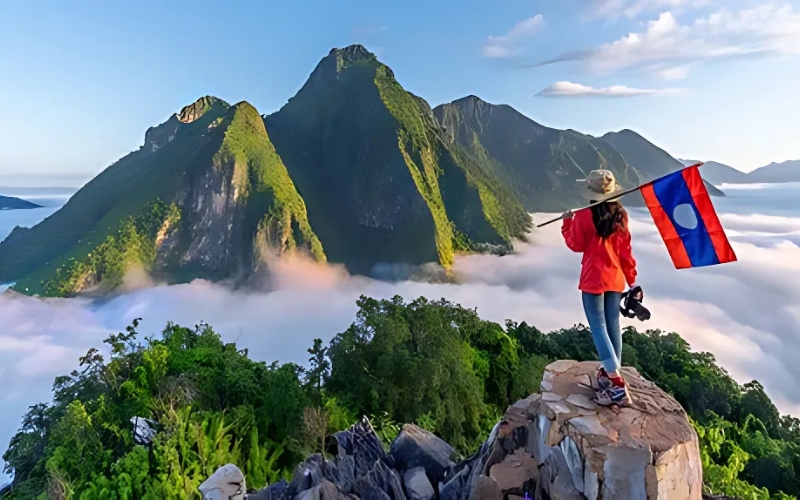
Trekking through the lush, misty mountains of Nong Khiaw
That said, trekking in June requires realistic expectations. Trails are muddy and sometimes slippery. Leeches come out after rain. River crossings may be deeper than in dry months. A local guide is not optional here; it is necessary for navigation and safety.
The Nam Ha National Protected Area near Luang Namtha runs multi-day eco-treks that include homestays in Akha, Khmu, and Hmong villages. These community-based tourism programs have been operating for over two decades and are well-organized even during the wet season. The treks are moderate in difficulty, but the humidity makes them feel harder than the elevation would suggest.
6. Experience the Bolaven Plateau and southern Laos
The Bolaven Plateau, accessible from Pakse, is one of Laos’ most underrated regions. At around 1,200 meters above sea level, temperatures are noticeably cooler than in the lowlands, making June more comfortable here than in Vientiane or Savannakhet.
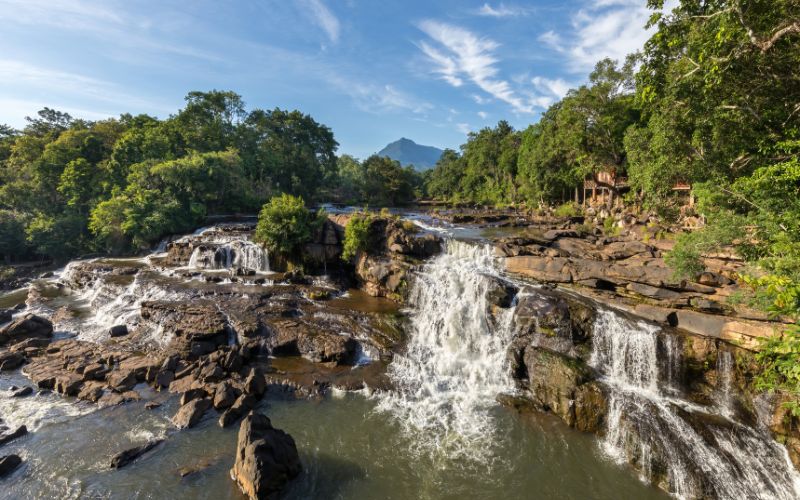
Bolaven Plateau
This is where most of Laos’ coffee is grown. Lao coffee, particularly the robusta and arabica beans from the Bolaven Plateau, has been gaining recognition among specialty coffee buyers. Several farms offer tours where you can see the full process from cherry to cup, and a bag of locally roasted beans costs around 80,000 to 120,000 LAK (~$3.60 to $5.40).
The plateau is also dotted with waterfalls. Tad Fane, Tad Yuang, and Tad Champee are all reachable by motorbike or car, and in June they are running at full power. Villages of the Laven, Alak, and Katu ethnic groups are scattered across the plateau, and visiting them offers a window into rural life that has changed slowly over generations.
7. Visit the Plain of Jars and Savannakhet
Phonsavan, the gateway to the Plain of Jars in Xieng Khouang Province, is one of Laos’ most intriguing archaeological sites. Hundreds of massive stone jars, some weighing up to six tons, are scattered across the plateau. Nobody knows definitively who made them or why, though they are believed to be around 2,000 years old and possibly connected to burial rituals. UNESCO added the site to its World Heritage List in 2019.
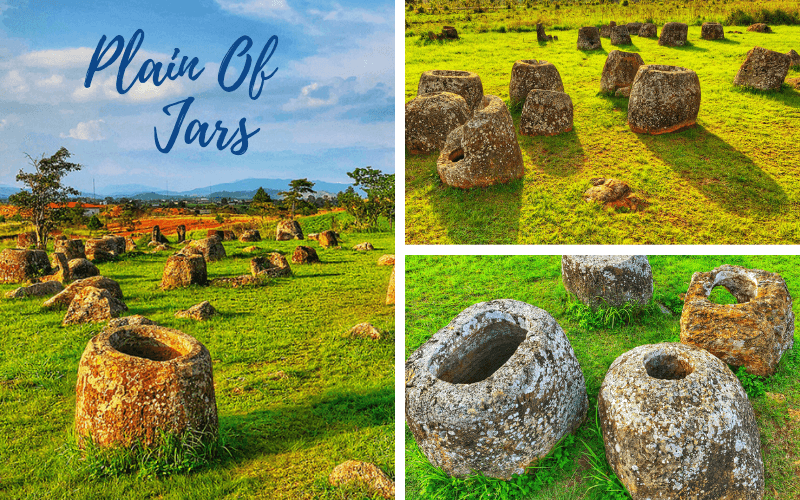
Plain of Jars
In June, the plateau is green and atmospheric, with mist rolling through the jar sites in the morning. The cooler temperatures at this elevation (around 28°C / 82°F) make walking between sites more comfortable than in the lowlands.
Savannakhet, further south along the Mekong, is one of the least-visited cities on the main tourist routes. Its old quarter features French colonial buildings, Vietnamese-style shophouses, and Catholic churches, all faded and quiet. The Dinosaur Museum displays fossils found in the region, and the Heuan Hin (Stone House), a Khmer-era archaeological site, is about 15 km outside town.
8. Festivals and cultural events in June
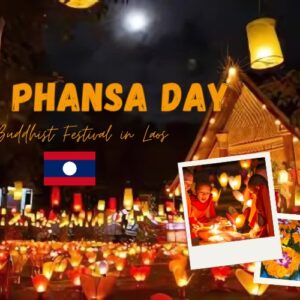
June sits near the beginning of Buddhist Lent (Bun Khao Phansa), which typically starts in July based on the lunar calendar. But the lead-up to Lent means temples are active with preparations, and monks are more visible in daily life.
The bigger festival to watch for is Bun Bang Fai, the Rocket Festival. While the main celebrations happen in May, some villages and provinces in Laos hold their own rocket launches into early June.
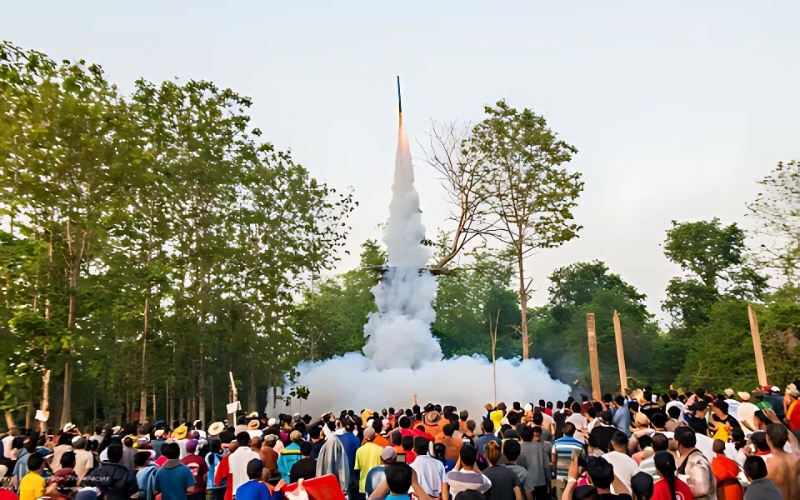
The Rocket Festival, or Bun Bang Fai is a unique festival in Laos
Bun Bang Fai is a pre-Buddhist tradition meant to summon rain for the planting season. Villagers build bamboo rockets, sometimes several meters long, and launch them skyward. The village whose rocket flies highest wins bragging rights. The festivities include parades, folk dancing, cross-dressing performances, and plenty of Lao Lao (rice whiskey). You can read more about Bun Bang Fai traditions and festival dates to check if any local celebrations coincide with your trip.
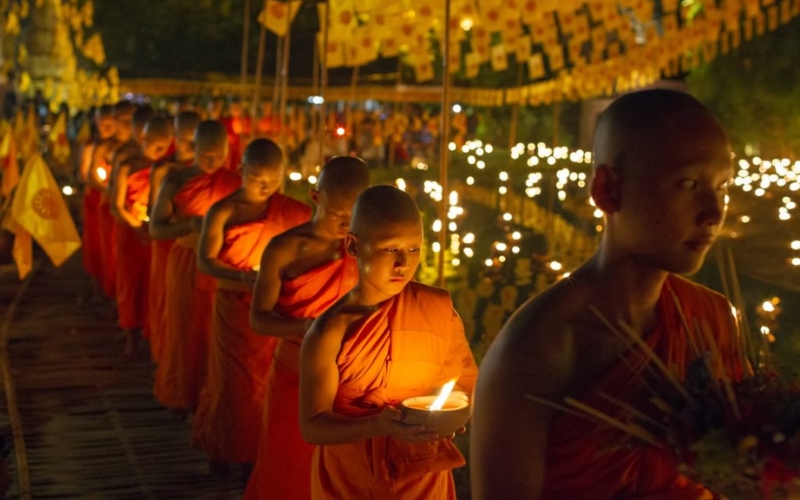
Visakha Bucha Day
June also overlaps with the Visakha Bucha festival (celebrating Buddha’s birth, enlightenment, and death), which falls on the full moon of the sixth lunar month. Temples hold candlelit processions and special prayers, and the atmosphere is reflective rather than celebratory.
Budget and Costs: Why June Is Easy on Your Wallet
One of the strongest arguments for visiting Laos in June is the cost. Because June is the low season, prices for accommodation, tours, and domestic transport drop noticeably.
- Guesthouses and budget hotels: rooms that cost $20 to $30 per night in December may go for $12 to $18 in June.
- Mid-range hotels: expect discounts of 20 to 40 percent, especially in Luang Prabang where high-season demand inflates prices.
- Tours and activities: operators in Vang Vieng and Luang Prabang often discount group tours or offer extras (free transfers, complimentary meals) to fill seats.
- Domestic flights: Lao Airlines runs flights between Vientiane, Luang Prabang, and Pakse year-round, and June fares tend to be lower than peak-season rates.
A comfortable mid-range budget for Laos in June is around $40 to $60 per day, covering accommodation, meals, local transport, and one or two activities. Budget travelers can get by on $15 to $25 per day with dormitories, street food, and public transport.
Practical Tips for Visiting Laos in June
- What to pack: a lightweight waterproof jacket (not a heavy raincoat, you will overheat), waterproof shoes or quick-dry sandals, a dry bag for electronics, sunscreen (the UV index stays high even on cloudy days), and insect repellent with DEET. Mosquitoes are more active during the rainy season, and malaria and dengue are present in rural areas.
- Getting around: roads in major tourist corridors (Vientiane to Vang Vieng, Vang Vieng to Luang Prabang) are paved and generally fine in June. The new Vientiane to Luang Prabang railway, part of the Laos-China Railway, runs year-round and takes about two hours, which makes this the most reliable way to travel between the two cities. For remote areas, hire a private car through a Laos travel agency rather than renting a motorbike, especially if you are unfamiliar with local road conditions.
- Health: drink bottled water, check with your doctor about malaria prophylaxis if you plan to visit rural northern areas, and bring a basic medical kit. Pharmacies in Vientiane and Luang Prabang carry common medications, but selection is limited outside major towns.
- Dress code at temples: cover your shoulders and knees when visiting temples, even when it is hot. This applies to both men and women. Lightweight long pants and a cotton shirt work fine.
- Timing your days: schedule outdoor activities (trekking, waterfalls, river trips) for the morning. Keep afternoons open for temple visits, museum tours, cooking classes, or simply waiting out the rain with a Beerlao and a book. This is how locals live during the rainy season, and it is a good rhythm to follow.
Is June the Best Time to Visit Laos?
No. The best time to visit Laos for most travelers is November through February, when the weather is cool and dry, the skies are clear, and the rivers are calm. That is peak season for a reason.
But if your priority is avoiding crowds, spending less money, and seeing the landscape in its greenest state, June has real appeal. If you are a photographer, the moody skies, mist-wrapped mountains, and saturated greens create images you cannot get in the dry season. If you are flexible with your schedule and comfortable with some unpredictability, Laos in June rewards you with a slower, more local experience.
>>> If this is your first time in Southeast Asia, you might prefer to combine Laos with neighboring countries. A Vietnam, Laos, and Cambodia tour can give you variety across different climates and landscapes, even within the same month.
Laos in June: Overview at a Glance
| Detail | Information |
| Season | Early wet / rainy season (monsoon) |
| Average temperature | 25°C to 33°C (77°F to 91°F) |
| Average rainfall | 193 to 420 mm depending on region |
| Rainy days per month | 14 to 21 days |
| Humidity | 80 to 85% |
| Tourism season | Low season |
| Budget |
|
| Currency | Lao Kip (LAK); $1 ≈ 22,000 LAK |
| Visa | Visa on arrival at airports and major border crossings; ~$30 to $42 depending on nationality |
| Best for | Waterfalls, green landscapes, fewer crowds, lower prices |
| Not ideal for | Remote overland travel, beach holidays, heavy outdoor trekking |
Plan Your June Trip to Laos
Traveling to Laos in June works best with some planning. Roads, ferry schedules, and outdoor activities can shift with the weather, so having a flexible itinerary matters more than in dry season. If you prefer not to handle the logistics yourself, working with a local tour operator familiar with wet-season conditions can save you time and frustration.
IDC Travel organizes Laos tours year-round, including during the rainy season, with private guides, vehicle transfers, and backup plans for weather-related changes. Whether you want a quick 3 to 5 day itinerary focused on Luang Prabang or a longer trip covering the entire country, our team can tailor the schedule to your interests and comfort level. Contact us for more information!
Read more:
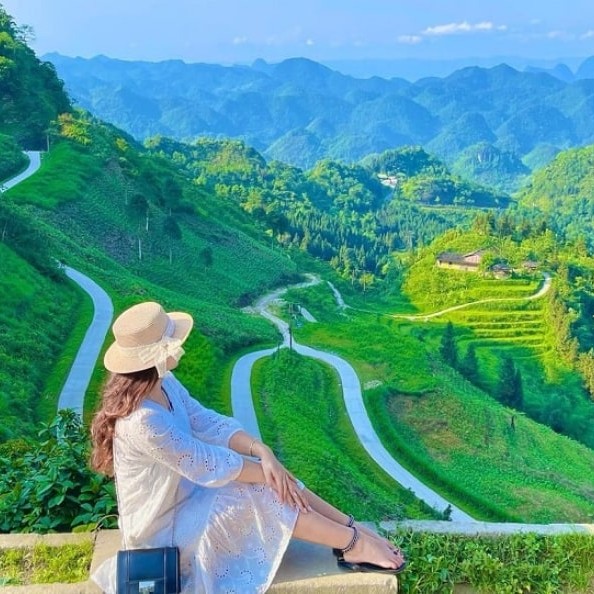

I just got back from Luang Prabang and the lush greenery was unbelievable! I was worried about the rain, but honestly, it added this magical mist to the waterfalls. Did you hike Kuang Si in the rain too? Totally worth the muddy shoes!