


Laos in rainy season has an unfair reputation. The phrase conjures washed-out roads and ruined plans, and travelers routinely cross the whole May-to-October window off their calendars. Having run trips through every month of the Lao year, we can tell you what the rainy season actually delivers: waterfalls at full thunder, rice terraces in impossible green, rivers alive again, prices 20-40% lower, and the famous sights shared with a fraction of the high-season crowds.
This guide explains what the weather genuinely does month by month, the best places to visit in Laos during the rains, what to skip, what to pack, and how to plan around the season instead of against it.
When Is the Rainy Season in Laos?
The southwest monsoon runs roughly May to October, with regional and monthly texture that matters for planning:
| Month | What to expect | Temperatures |
| May | Season opens: hot, humid, short storms breaking the April heat | 25-34°C (77-93°F) |
| June | Regular afternoon rain settles in; landscape turns green | 25-32°C (77-90°F) |
| July | Steady pattern: sunny mornings, 1-3 hour afternoon downpours | 24-31°C (75-88°F) |
| August | Peak rains, especially in the north and on the Bolaven Plateau | 24-30°C (75-86°F) |
| September | Wettest month in much of the country; rivers at maximum | 24-30°C (75-86°F) |
| October | Rains taper; landscapes at their greenest before the dry season | 23-31°C (73-88°F) |
The single most important fact: rain in Laos comes in bursts, not curtains. The typical pattern is a clear or hazy-bright morning, a heavy downpour somewhere between 2:00 and 6:00 PM, and a rinsed, cool evening. All-day rain happens, but it is the exception, usually tied to a tropical system passing through Vietnam.
Pros and Cons of Visiting Laos in Rainy Season
An honest ledger, from years of green-season departures:
What you gain
- Waterfalls at full power: Kuang Si, Tad Sae, and the Bolaven giants run at two or three times their dry-season volume
- The green: rice paddies, karst hills, and riverbanks in a saturation no photo filter reproduces
- Space: the tak bat alms ceremony, Kuang Si’s pools, and Vang Vieng’s lagoons with room to breathe
- Prices: hotels drop 20-40%, and the best rooms in Luang Prabang become bookable on short notice
- Rivers restored: the Nam Ou and Mekong run high, making boat trips faster and more scenic
What you trade
- Afternoon plans need flexibility; the 3:00 PM viewpoint hike moves to 8:00 AM
- Remote dirt roads (parts of the far north, plateau back-roads) can close after big storms
- Kuang Si occasionally runs brown for a day or two after heavy rain upstream; the famous turquoise is a dry-and-early-wet-season color
- Leeches join jungle treks in August and September; long socks and repellent handle them
- Slow boat and minibus schedules shift with river and road conditions; build slack around fixed flights
7 Best Places to Visit in Laos in Rainy Season
1. Luang Prabang
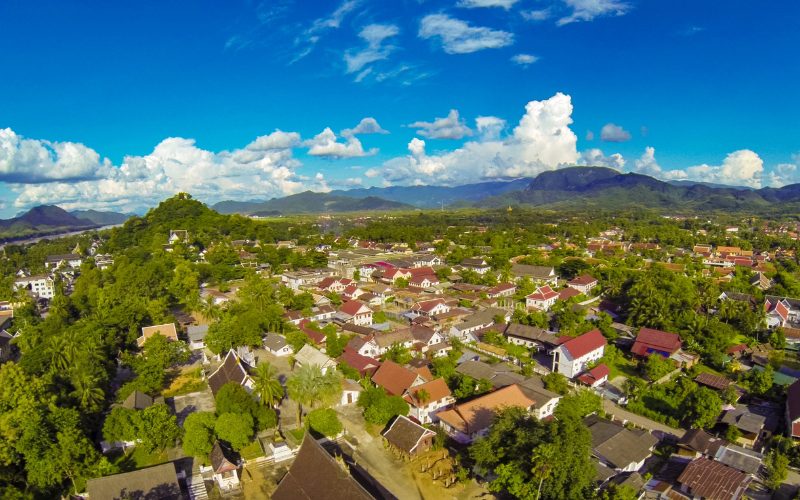
Luang Prabang
The UNESCO-listed old town is arguably better in the rains: monks under umbrellas at dawn, wet gold roofs, cafes made for storm-watching, and the night market intact under awnings. Every signature experience (tak bat, Wat Xieng Thong, Mount Phousi between showers) functions normally, and hotel value peaks. Base here and let the season decorate the town around you. Our full route ideas are in the 6 days in Laos itinerary.
2. Kuang Si Waterfall

The breathtaking Kuang Si Waterfall, where crystal-clear waters flow gracefully through layers of limestone amid vibrant jungle greenery.
The green season is when Kuang Si becomes the thing the drone photos promise: a multi-tiered roar instead of a trickle. Go in the morning after a dry night for the best mix of flow and clarity, and accept that after major storms the pools trade turquoise for jade-brown for a day. Entry runs around 25,000-30,000 LAK (~$1.15-1.35); the bear rescue center by the entrance is an all-weather stop.
3. Nong Khiaw and Muang Ngoi
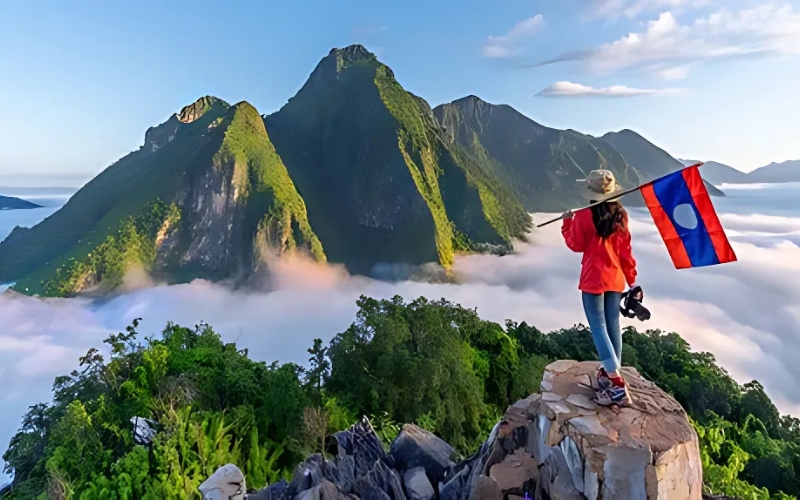
Trekking through the lush, misty mountains of Nong Khiaw
The Nam Ou River valley is the rainy season’s masterpiece: karst towers wrapped in cloud, the river high and quick, and the viewpoint hikes (Phadeng Peak at dawn, before the heat and the storms) delivering sea-of-mist mornings that dry-season visitors never see. Boats to roadless Muang Ngoi Neua run reliably on the full river. Pack for mud on the trails and go.
4. Vang Vieng

Hot air balloon rides are the most famous activity in Vang Vieng
Vang Vieng’s limestone amphitheater was designed for dramatic weather. Mornings suit the lagoons and caves (Tham Poukham’s Blue Lagoon holds its color better than Kuang Si after rain), hot-air balloons still fly in stable dawn windows, and the karst-against-storm-cloud views from Nam Xay viewpoint justify the muddy climb. One caution we enforce on our own trips: river activities respect the water. Kayaking and tubing run only when operators judge the Nam Song safe; on high-flow days, cycle the paddies instead.
5. Vientiane
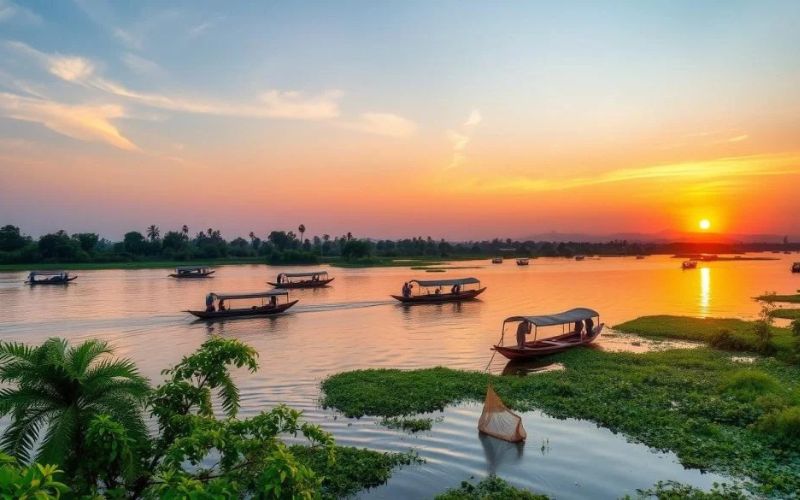
Sunset on Mekong River in Vientiane
The capital is the season’s most rain-proof stop: Pha That Luang, the COPE Visitor Centre, Wat Si Saket’s cloister of Buddhas, and cafe culture all work regardless of the sky, and the Mekong sunsets after a storm clears are the best of the year. The Laos-China Railway makes Vientiane an easy all-weather anchor for the Vang Vieng-Luang Prabang line.
6. The Bolaven Plateau (Pakse)
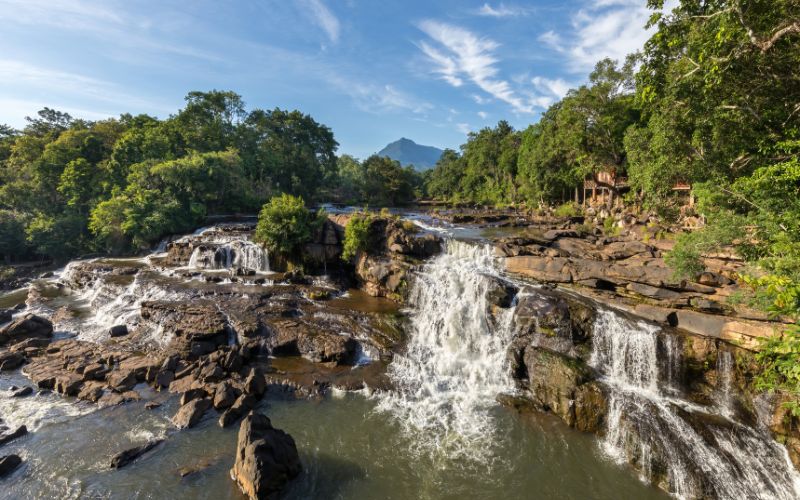
Bolaven Plateau
Southern Laos’s coffee highlands are the rainy season’s power move. Tad Fane’s twin falls plunge 120 meters into a jungle gorge at full volume, Tad Yuang and Tad Lo thunder, and the coffee farms (this is where Lao coffee grows) welcome visitors between harvests. The plateau’s altitude keeps temperatures a merciful 22-28°C (72-82°F). Stick to the sealed loop roads after heavy rain and the region is comfortably doable.
7. The 4000 Islands (Si Phan Don)
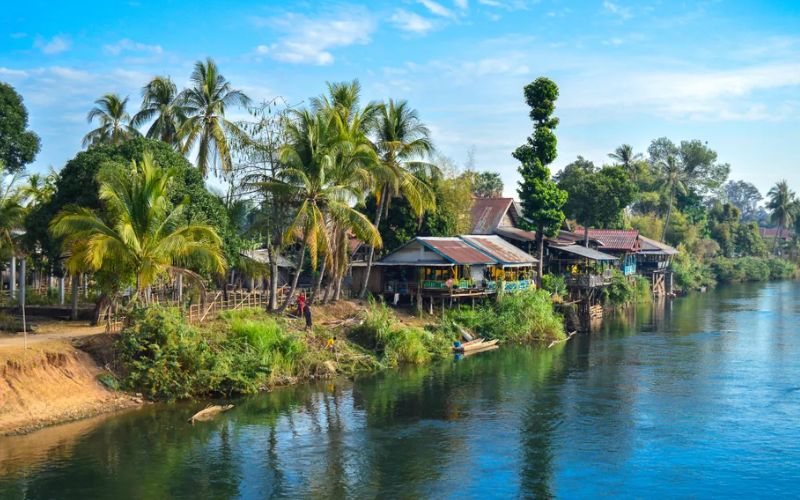
4000 islands (Si Phan Don)
At the country’s southern tip, the Mekong splits around thousands of islands, and in the rains the river becomes the show: Khone Phapheng, Southeast Asia’s largest waterfall by volume, is at its most violent and magnificent. Don Det and Don Khon’s hammock culture continues under roofs, and the swollen river narrows the odds of spotting the Irrawaddy dolphins, so treat that as a bonus rather than a promise.
What to Pack for Laos in Rainy Season
Keep it light and quick-drying; the rain is warm and the sun between storms is strong:
- A proper rain jacket or poncho (sold cheaply at every market if you forget)
- A dry bag for phone, passport, and camera on boats and treks
- Sandals with grip (Tevas or similar) for town, plus closed shoes for muddy trails
- Quick-dry clothing and one warm layer for northern evenings and air-conditioned buses
- Insect repellent with DEET: dengue-carrying mosquitoes are the season’s real hazard; use it morning and evening
- Long socks for jungle treks in August and September (the leech months)
- A small umbrella, which locals use more than jackets, for good reason
Travel Tips for Laos in Rainy Season
- Schedule mornings hard, afternoons soft. Hikes, boats, and viewpoints before noon; cafes, museums, cooking classes, and massages after 2:00 PM. The weather will enforce this anyway; planning for it feels like winning.
- Build slack around fixed flights. Give yourself a buffer night before any international departure; mountain roads and boat schedules deserve respect after big storms.
- The railway is your all-weather spine. Vientiane, Vang Vieng, and Luang Prabang stay connected in about an hour per hop regardless of road conditions; book seats 1-3 days ahead.
- Visa and entry: the standard rules apply year-round: 30-day visa on arrival ($30-45, photo and USD cash) or the official Lao eVisa in advance.
- Money: carry kip; ATMs cluster in the main towns and thin out fast on the plateau and islands.
- Check conditions locally, not globally. Weather apps show rain icons for weeks straight and are functionally useless here; your guesthouse owner’s morning forecast is the real one.
- Insurance that covers trip delay earns its premium in this season more than any other.
Estimated Costs: The Green Season Discount
Prices are in USD per person, based on 2026 green-season rates (roughly 20-40% below December-February peaks). Figures are estimates and subject to change.
| Category | Budget | Mid-Range | Luxury |
| Accommodation (per night) | $6-14 | $22-45 | $70-180+ |
| Meals (per day) | $8-12 | $18-32 | $45-75+ |
| Activities (per day avg.) | $8-18 | $25-50 | $70-140+ |
| Local transport (per day) | $5-10 | $12-22 | $35-65 |
| Estimated daily total | $27-54 | $77-149 | $220-460+ |
Plan Your Rainy Season Laos Trip with Us
Green-season Laos is where a local operator earns their keep: we know which road closed last night, which boat is actually running, and which morning window your Kuang Si visit should claim. We build rainy-season departures with the slack pre-installed, so the storms become scenery instead of stress. Explore our combined Vietnam and Laos tours, or tell us your dates through Create My Holiday and we will design the version of Laos your month deserves.
Wrapping Up
Laos in rainy season is not a compromise; it is a different and, for many travelers, better country: louder waterfalls, greener valleys, softer prices, emptier temples. The trade is simple and fair: give the season your afternoons, and it gives you everything else. Plan mornings, pack a dry bag, respect the rivers, and go see what the postcards look like at full volume. Contact us!
Read More:


Honestly, rainy season in Laos sounds dreamy if you’re into nature and slower travel. I’ve always avoided Southeast Asia this time of year, but now I’m rethinking that. The misty mountains and waterfalls sound magical. Do you think it’s still easy to get around when it rains heavily?
Dear Keanu,
You’re absolutely right, Laos during the rainy season has a quiet, almost mystical charm, especially in the countryside. The lush greenery, full-flowing waterfalls, and misty mountain views create a truly romantic atmosphere for nature lovers and slow travelers. While occasional heavy rains can affect rural road conditions, most major routes and towns remain accessible. We’d be happy to help you plan around the weather for a smooth and memorable trip!
Best regards,
IDC Travel Team.
When is the best time to visit Kuang Si Falls? I’m planning to visit Laos in February 2024. Is the weather favorable?
Hi Edwards,
To admire the magnificent beauty of Kuang Si Falls, it is best to visit between December and May, a few months after the rain has ceased.
Also, February is a good time to visit Laos and best for outdoor activities. It is the dry season which is sunny during the daytime and mild at night. You can visit Vientiane, Luang Prabang, Pakse, and 4000 Islands.
Need help on planning your Laos trip, you can contact us right here or ping us on WhatsApp at (+84)913 000 858.
Look forward to hearing from you.
Best regars,
Alice Pham.