
The best things to do in Thailand are visiting the Grand Palace in Bangkok, eating your way through Chinatown’s street food, exploring the temples of Chiang Mai, island hopping in Phang Nga Bay or Phi Phi, and joining a festival such as Songkran or Yi Peng. November to February is the best time for most of the country, while the Andaman coast around Phuket and Krabi is at its best from November to April. This guide covers 20 things to do in Thailand, grouped by region, with prices, opening hours, time needed and practical tips checked in October 2026. Use the table below to compare them at a glance.
| # | Experience | Region | Best for | Best time | Time needed | Admission / activity cost |
| 1 | Grand Palace and Wat Phra Kaew | Bangkok | First-timers, culture | Nov-Feb, 08:30 | 2-3 hours | Admission 500 THB (US$15) |
| 2 | Wat Pho and Wat Arun | Bangkok | Culture, couples, budget | Year-round | 3-4 hours | 500 THB for both temples; massage extra |
| 3 | Yaowarat street food | Bangkok | Food lovers, friends | Evenings, not Mon | 2-3 hours | Food budget about US$10-20 |
| 4 | Chatuchak and night markets | Bangkok | Shoppers, families | Sat-Sun | Half a day | Free entry; shopping extra |
| 5 | Muay Thai at a stadium | Bangkok | Friends, solo | Evenings | 3-5 hours | Tickets from about 1,000 THB (US$30) |
| 6 | Floating and railway markets | Near Bangkok | Families, photographers | Early morning | 1 day | Free entry; boat rides extra |
| 7 | Ayutthaya Historical Park | Central | Culture, families | Nov-Feb | 1 day | 50-80 THB per temple |
| 8 | Kanchanaburi and Erawan Falls | West | History, nature | Nov-Feb | 1-2 days | Erawan entry 300 THB (US$9); transport extra |
| 9 | Khao Yai National Park | Northeast of Bangkok | Families, nature | Nov-Apr | 1-2 days | Park entry 400 THB (US$12) |
| 10 | Chiang Mai Old City and Doi Suthep | North | First-timers, older travellers | Nov-Jan | 1-2 days | Temple 30 THB (US$1); funicular extra |
| 11 | Thai cooking class | North | Food lovers, families | Year-round | Half a day | Class from about US$27 |
| 12 | Ethical elephant sanctuary | North | Families, animal lovers | Year-round | Half or full day | Half day 2,500 THB (US$75) |
| 13 | White Temple, Blue Temple, Golden Triangle | North | Culture, photographers | Nov-Feb | 1-2 days | White Temple 200 THB (US$6) |
| 14 | Sukhothai Historical Park | North | Slow travellers, cyclists | Nov-Feb | 1-2 days | Central zone 200 THB (US$6) |
| 15 | Mae Hong Son Loop, Pai, Doi Inthanon | North | Adventure, solo | Nov-Jan | 1-7 days | Doi Inthanon 300 THB (US$9); transport extra |
| 16 | Phang Nga Bay and Phi Phi | Andaman coast | Couples, families | Nov-Apr | 1-3 days | Park fees 300-400 THB; boat tours extra |
| 17 | Railay Beach climbing | Andaman coast | Couples, adventure | Nov-Apr | 1-3 days | Boat 100 THB (US$3) one way; climbing extra |
| 18 | Similan Islands or Koh Tao diving | South | Divers, young travellers | Oct-May (Similan) | 1-4 days | Similan entry 500 THB (US$15); diving extra |
| 19 | Khao Sok raft house | South | Families, couples | Dec-Apr | 2-3 days | Park fee 300 THB (US$9); raft stay extra |
| 20 | Songkran, Yi Peng and Loy Krathong | Nationwide | Friends, festival lovers | Apr; Nov | 2-3 days | Public events free; ticketed releases extra |
Admission prices are shown for foreign adults where applicable, while food, transport, classes and tours use indicative per-person costs. Figures reflect published rates checked in October 2026, converted at about 33.5 THB to 1 USD, and may change before travel in 2027, so check with the attraction or operator before booking.
20 Best Things to Do in Thailand by Region
This list of things to do in Thailand runs from Bangkok and Central Thailand to the mountains of the north and the islands of the south, with festivals at the end. Numbers follow geography rather than ranking, so you can pick the experiences that sit close together on your itinerary.
Bangkok & Central Thailand
Bangkok is where most trips begin, and it holds many of the best things to do in Thailand within a short boat ride of each other. Ayutthaya and the markets west of the city make easy day trips.
1. Visit the Grand Palace and Wat Phra Kaew (Bangkok) – Thailand Royal Showpiece
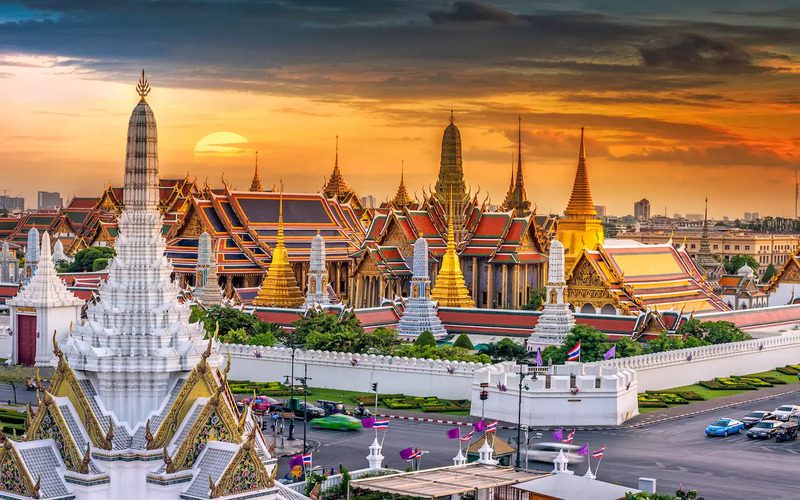
The Grand Palace and Wat Phra Kaew in Bangkok, home to the Emerald Buddha and the most visited landmark in Thailand.
The Grand Palace is one of Bangkok’s most recognisable attractions and a rewarding first stop for travellers interested in Thai history and architecture. Inside its walls, Wat Phra Kaew houses the Emerald Buddha, the country’s most revered image, surrounded by gilded chedis, mural galleries and towering guardian figures.
- Location: Rattanakosin Island, Phra Nakhon district, Bangkok
- Best for: first-time visitors, culture lovers and older travellers
- Best time: at 08:30 when ticket sales open, before the heat and tour groups; November to February is the most comfortable season
- Time needed: 2 to 3 hours
- Cost: 500 THB (about US$15), sold from 08:30 to 15:30; the ticket also covers the Queen Sirikit Museum of Textiles, the Arts of the Kingdom Museum near Bang Pa-In in Ayutthaya province (Wednesday to Sunday) and a Khon masked dance show at Sala Chalermkrung Royal Theatre (Monday to Friday), with one visit to each site allowed within 7 days
- Getting there: Chao Phraya Express Boat to Tha Chang pier, or MRT to Sanam Chai station and a 15 to 20-minute walk
- Tip: Cover your shoulders and knees, as guards turn away visitors in shorts or sleeveless tops. Ignore anyone outside who says the Grand Palace is closed today; it is a long-running scam that ends at a gem shop.
>>> For more sacred sites to add to your itinerary, see our guide to the most famous Buddha temples in Thailand.
2. Explore Wat Pho and Wat Arun (Bangkok) – Reclining Buddha, Riverside Temple and Thai Massage
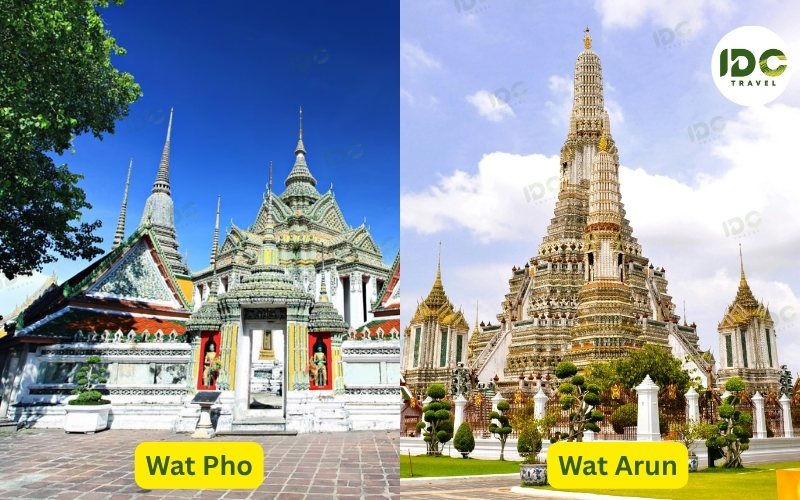
Two of Bangkok’s most visited temples: Wat Pho, home of the Reclining Buddha, and Wat Arun, the Temple of Dawn, facing each other across the Chao Phraya River.
Wat Pho, a 10-minute walk south of the Grand Palace, is home to the 46-metre Reclining Buddha and Thailand’s best-known traditional massage school. Wat Arun, the Temple of Dawn, rises directly across the river, and its porcelain-studded central prang is one of Bangkok’s most photographed landmarks.
- Location: Phra Nakhon (Wat Pho) and Bangkok Yai (Wat Arun), on opposite banks of the Chao Phraya River
- Best for: culture lovers, couples and budget travellers
- Best time: Wat Pho opens at 08:00, so go early; Wat Arun is open from 08:00 to 18:00 and looks best in late-afternoon light
- Time needed: 3 to 4 hours for both, plus time for a massage
- Cost: Wat Pho 300 THB (about US$9); Wat Arun 200 THB (about US$6); a Thai massage at Wat Pho costs about 340 THB (about US$10) for 30 minutes or 520 THB (about US$16) for 60 minutes
- Getting there: MRT Sanam Chai station for Wat Pho, then the cross-river ferry from Tha Tien pier to Wat Arun
- Tip: Book a massage at Wat Pho’s own pavilion early in the visit, as queues build by midday. Wat Arun’s upper terraces are steep, so wear shoes with grip.
3. Eat Your Way Through Yaowarat (Bangkok) – Chinatown’s Best Street Food Crawl
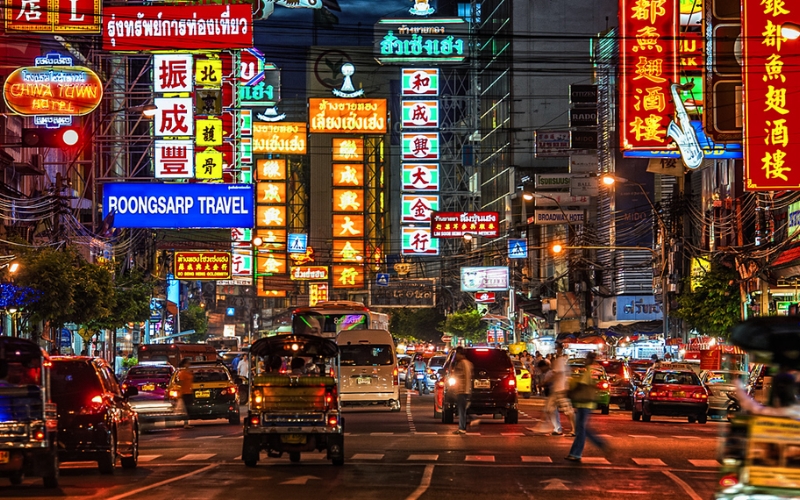
Yaowarat Road, the heart of Bangkok’s Chinatown, where neon signs and street food stalls come alive after dark.
Yaowarat Road, the main street of Bangkok’s Chinatown, becomes one of the city’s liveliest street food strips after dark. Stalls under the neon signs sell grilled seafood, pepper soup, noodles, dim sum and mango sticky rice, which makes it the easiest place to try a wide range of Thai street food in a single evening. A Chinatown food crawl is also one of the best things to do in Bangkok at night.
- Location: Samphanthawong district, Bangkok
- Best for: food lovers, groups of friends and couples
- Best time: stalls set up from about 17:00 and are busiest from about 19:00; many close on Mondays
- Time needed: 2 to 3 hours
- Cost: about US$10 to US$20 per person for a full evening of tasting
- Getting there: MRT to Wat Mangkon station, then a 5-minute walk
- Tip: Share small plates at several stalls rather than ordering a big meal at the first one. For a Michelin-recognised meal earlier in the day, Urai Braised Goose on nearby Song Wat Road holds a Bib Gourmand in the MICHELIN Guide Thailand 2026; it usually opens 10:00 to 13:00 and 16:00 to 19:00 (mornings only on Mondays), so check current hours before visiting.
>>> Not sure what to order? Our list of must-try Thai dishes explains the classics.
4. Shop at Chatuchak and Bangkok’s Night Markets (Bangkok) – Bargains, Crafts and Snacks
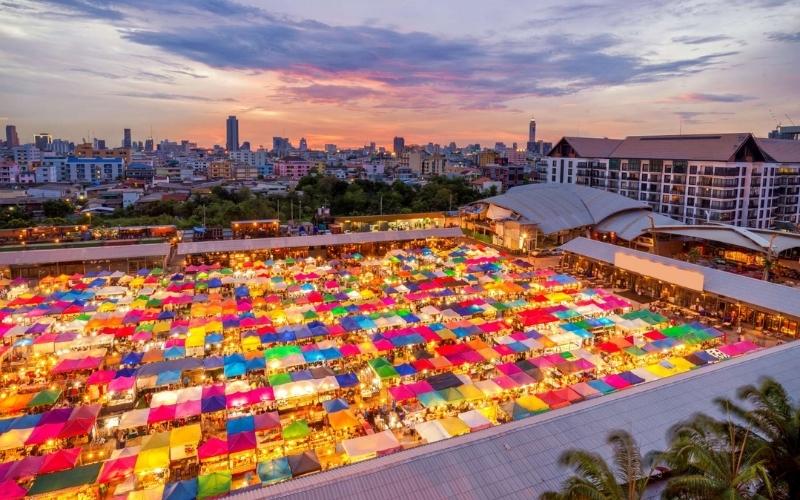
A lively evening at the Bangkok night market, where rows of colorful tents glow under the sunset sky, offering food, crafts, and local culture.
Chatuchak Weekend Market is one of the largest markets in Asia, with thousands of stalls selling clothes, ceramics, plants, vintage finds and snacks. On other evenings, Bangkok’s night markets, such as Asiatique The Riverfront, offer souvenirs, food and a breezy setting by the river.
- Location: Chatuchak district, northern Bangkok
- Best for: shoppers, families and budget travellers
- Best time: Saturday and Sunday, 09:00 to 18:00; arrive before 11:00 to avoid the worst of the heat
- Time needed: half a day
- Cost: free entry; set aside about US$20 to US$50 for shopping and snacks
- Getting there: MRT to Chatuchak Park or Kamphaeng Phet station, or BTS to Mo Chit
- Tip: Note the section number when you find a stall you like, as the market is easy to get lost in. Bargain politely, and drink plenty of water.
5. Watch Muay Thai at Rajadamnern or Lumpinee (Bangkok) – Thailand’s National Sport Live

Rajadamnern Stadium in Bangkok, Thailand’s oldest Muay Thai venue and one of the best places to watch a professional fight.
A night at one of Bangkok’s 2 best-known stadiums is the most authentic way to see Muay Thai, from the wai kru ritual dance before each bout to the live pipe-and-drum music that drives the fighters on. It is also one of the best things to do in Bangkok for solo travellers and groups of friends.
- Location: Rajadamnern Stadium, near Democracy Monument; Lumpinee Boxing Stadium, on Ram Intra Road in northern Bangkok
- Best for: groups of friends, solo travellers and sports fans
- Best time: Rajadamnern holds fights every evening; Lumpinee hosts ONE Friday Fights on Friday evenings
- Time needed: 3 to 5 hours
- Cost: Rajadamnern from about 1,000 to 2,500 THB (about US$30 to US$75); Lumpinee from about 1,000 to 3,500 THB (about US$30 to US$105), depending on the card and seat
- Getting there: taxi or Grab, especially for Lumpinee in the northern suburbs
- Tip: Buy tickets at the stadium box office or on the official website rather than from street touts. Ringside and VIP seats cost the most, while the upper tiers are cheaper and often livelier.
6. Browse the Floating and Railway Markets (Near Bangkok) – Damnoen Saduak, Amphawa and Maeklong

Damnoen Saduak, the best known floating market near Bangkok, where vendors in conical hats sell fruit and cooked food straight from their boats.
Damnoen Saduak is one of Thailand’s best-known floating markets, where vendors paddle boats piled with fruit, noodles and coconut pancakes along narrow canals. Combine it with the Maeklong Railway Market, where traders pull back their awnings as the train rolls through, and the more local Amphawa Floating Market in the afternoon. Children love the boats and the passing train, so this day out suits families looking for things to do in Thailand with kids.
- Location: Ratchaburi (Damnoen Saduak) and Samut Songkhram (Maeklong and Amphawa), about 1.5 to 2 hours southwest of Bangkok
- Best for: families and photographers
- Best time: Damnoen Saduak runs from about 07:00 until around noon and is best before 09:00; Amphawa opens Friday to Sunday from around midday until about 20:00 and is liveliest in the late afternoon; the Maeklong train passes through the market 8 times a day
- Time needed: a full day for all 3, from Friday to Sunday when Amphawa is open
- Cost: free to enter; paddle-boat rides and food cost extra
- Getting there: private car or a guided day trip, as public transport between the 3 markets is slow
- Tip: Agree on the boat price before you step aboard at Damnoen Saduak, and check the Maeklong train times on the day so you arrive a few minutes before it passes.
7. Cycle Around Ayutthaya Historical Park (Ayutthaya) – Ruins of a UNESCO-Listed Capital

The three distinct chedis of Wat Phra Si Sanphet are the most photographed landmark of the ancient Royal Palace grounds in Ayutthaya.
Ayutthaya was the capital of Siam for more than 400 years until 1767, and its brick temples and prangs have been a UNESCO World Heritage Site since 1991. Flat lanes link the main ruins, so cycling is the best way to explore. For history lovers, it is the best day trip from Bangkok.
- Location: Ayutthaya, about 80 km north of Bangkok
- Best for: culture lovers, families and cyclists
- Best time: November to February; start early or stay for the softer light in the late afternoon
- Time needed: a full day
- Cost: 50 to 80 THB (about US$1.50 to US$2.40) per main temple, as sources differ after a 2025 fee update; a combined pass covering the main temples is also sold (reported at 220 to 300 THB), so confirm prices at the ticket booth
- Getting there: train from Krung Thep Aphiwat Central Terminal in 50 to 75 minutes, then hire a bicycle near the station
- Tip: At Wat Mahathat, see the Buddha head entwined in tree roots, but keep your head lower than it in photos as a sign of respect. Wat Chaiwatthanaram is the classic sunset spot.
>>> Our 6-day Thailand historical tour focuses on the country’s most significant cultural and historical sites.
Nature and Day Trips from Bangkok
If you have an extra day or 2 in the capital, these places to visit in Thailand swap traffic for rivers, jungle and waterfalls within 3 hours of the city.
8. Explore Kanchanaburi (West of Bangkok) – River Kwai, Hellfire Pass and Erawan Falls

Sunset at the bridge over the River Kwai
Few things to do in Thailand are as moving as a trip to Kanchanaburi, which combines Second World War history with jungle scenery. The Bridge on the River Kwai and Hellfire Pass, a rock cutting dug by Allied prisoners of war and Asian labourers, tell the story of the Thailand-Burma Railway, while the 7-tiered Erawan Falls offer turquoise pools for swimming.
- Location: Kanchanaburi province, about 130 km west of Bangkok
- Best for: history lovers, families and nature lovers
- Best time: November to February; the falls are fullest just after the rainy season
- Time needed: a long day, or better 2 days
- Cost: Erawan National Park 300 THB (about US$9), open 08:00 to 16:30; the Hellfire Pass Interpretive Centre is free, open 09:00 to 16:00
- Getting there: about 2.5 to 3 hours by road, or the train from Bangkok’s Thonburi station to Kanchanaburi in about 2.5 hours for 100 THB (about US$3)
- Tip: Flooding closed the scenic railway section between Tha Kilen and Nam Tok, including the wooden viaduct at Tham Krasae, from 28 September 2026, and services have changed several times since, so check the latest State Railway of Thailand notice (hotline 1690) before planning to ride it.
>>> Our Kanchanaburi travel guide has more on where to stay and what to see.
9. Spot Wildlife in Khao Yai National Park (Nakhon Ratchasima) – Elephants and Waterfalls near Bangkok
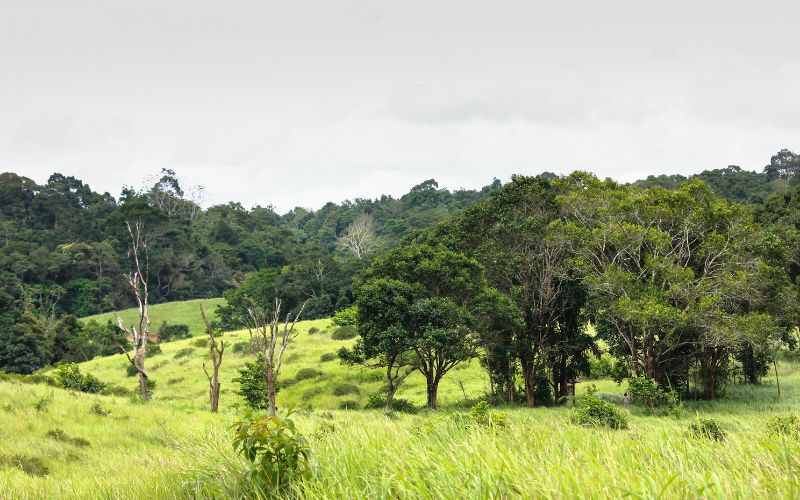
Khao Yai’s open grasslands and thick jungle create a diverse ecosystem where wildlife can be spotted in its natural habitat.
Khao Yai is Thailand’s first national park and part of the Dong Phayayen-Khao Yai Forest Complex, a UNESCO World Heritage Site since 2005. Wild elephants, gibbons, hornbills and deer live here, and waterfalls such as Haew Suwat are an easy walk from the road. Khao Yai is a well-known place to look for wild elephants, although sightings are unpredictable and never guaranteed.
- Location: the park spans 4 provinces northeast of Bangkok, and most visitors enter from Pak Chong in Nakhon Ratchasima province
- Best for: families, nature lovers and couples on a weekend escape
- Best time: November to April for dry trails; the waterfalls are at their fullest late in the rainy season
- Time needed: 1 to 2 days
- Cost: 400 THB (about US$12) per foreign adult
- Getting there: about 2.5 to 3 hours by car from Bangkok
- Tip: Hire a licensed guide for the best chance of seeing wildlife, drive slowly after dark when elephants use the roads, and never feed the macaques.
Northern Thailand
The north brings cooler mountain air, Lanna temples and some of the most hands-on things to do in Thailand, from cooking classes to elephant sanctuaries. Chiang Mai is the natural base, with Chiang Rai, Sukhothai and the Mae Hong Son mountains within reach.
10. Discover Chiang Mai Old City and Doi Suthep (Chiang Mai) – Lanna Temples and Mountain Views

The ancient walls and ornate temples of Chiang Mai Old City offer a beautiful setting for travelers exploring the city’s rich history on foot.
Chiang Mai’s moated Old City is packed with Lanna-style temples, including Wat Phra Singh and the ruined great chedi of Wat Chedi Luang. On the mountain to the west, Wat Phra That Doi Suthep looks out over the city from its golden terrace, a view that puts it among the top things to do in Chiang Mai.
- Location: Chiang Mai, Northern Thailand
- Best for: first-time visitors, older travellers and culture lovers
- Best time: November to January for the clearest skies; smoke from seasonal burning can cause haze from late February to April
- Time needed: 1 to 2 days
- Cost: Doi Suthep admission is 30 THB (about US$1) for foreign visitors; if you prefer not to climb the long naga staircase, a return funicular ride costs about 50 THB (about US$1.50) including admission, though published fares vary, so check the ticket structure on arrival
- Getting there: a shared red songthaew from near Chiang Mai Zoo takes 30 to 45 minutes and costs about 40 to 50 THB (about US$1.20 to US$1.50) per person
- Tip: Stay for the Sunday Walking Street on Ratchadamnoen Road in the Old City, a good place for crafts and northern Thai snacks.
>>> The 5-day Chiang Mai tour is a short, activity-filled introduction to Chiang Mai and northern Thailand.
11. Take a Thai Cooking Class on a Farm (Chiang Mai) – From Market Visit to Your Own Curry
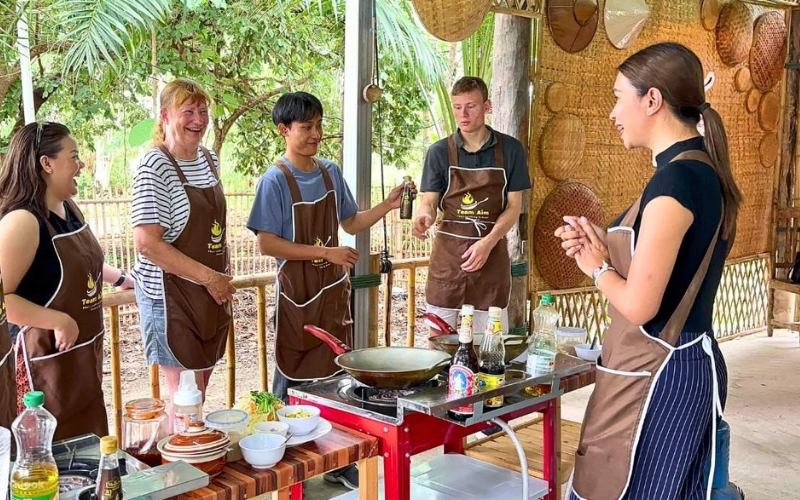
Mastering the art of authentic Thai cuisine in a fun and hands-on cooking class!
A Thai cooking class ranks high on most lists of things to do in Chiang Mai, and for good reason. Most start with a guided walk through a local market, then move to an open-air farm kitchen where you cook 3 to 6 dishes, such as green curry, tom yum soup and pad thai, and eat everything you make.
- Location: farms and cooking schools on the outskirts of Chiang Mai
- Best for: food lovers, families and couples
- Best time: year-round; check that your class includes the market visit, as some half-day or evening classes skip it
- Time needed: half a day
- Cost: about US$27 to US$60 per person
- Getting there: most schools include pick-up from hotels in the Old City
- Tip: Mention allergies and vegetarian needs when booking. Many schools let each person choose different dishes, so couples can share and taste twice as much.
12. Visit an Ethical Elephant Sanctuary (Chiang Mai) – Watch Elephants Roam, Never Ride

Seeing these magnificent creatures happy and free in an ethical Thai sanctuary is truly heartwarming!
Visiting an ethical elephant sanctuary lets you see rescued elephants bathing in rivers, grazing and socialising in their own groups. A genuine sanctuary focuses on observation rather than rides, shows or tricks, and it is a firm favourite among things to do in Thailand with kids.
- Location: the Mae Taeng valley and other rural areas around Chiang Mai
- Best for: families with kids and animal lovers
- Best time: year-round; November to February is the most comfortable
- Time needed: a half day or a full day, including transfers
- Cost: Elephant Nature Park half-day visits cost 2,500 THB (about US$75) and full-day programmes such as SkyWalk start at 3,500 THB (about US$105) per person; check current availability and inclusions before booking
- Getting there: hotel pick-up from Chiang Mai, about 1 to 1.5 hours each way
- Tip: World Animal Protection advises choosing observation-only venues where you can look but not ride, bathe, feed or touch elephants. Avoid any venue that offers rides, painting or performances.
13. See the White Temple, Blue Temple and Golden Triangle (Chiang Rai) – Art Temples and a 3-Country Viewpoint
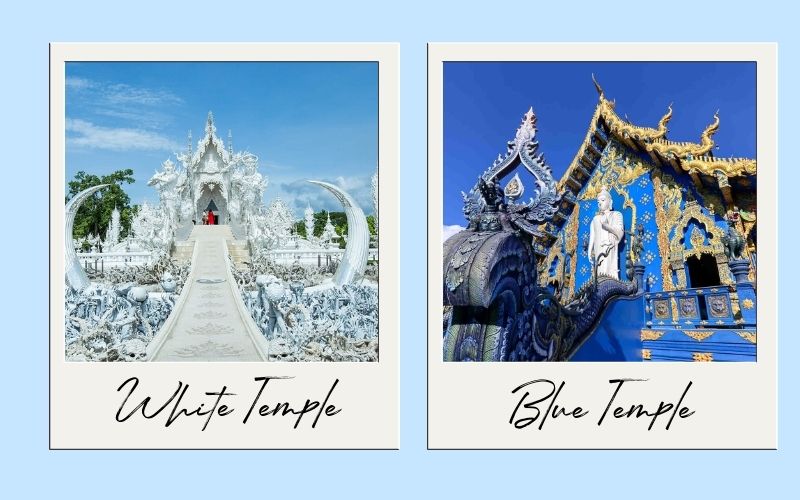
The breathtaking White Temple (Wat Rong Khun) and the magnificent Blue Temple (Wat Rong Suea Ten).
Chiang Rai’s modern temples are unlike any others in Thailand. Wat Rong Khun, the White Temple, is a glittering white artwork created by Chalermchai Kositpipat, and Wat Rong Suea Ten, the Blue Temple, glows sapphire blue inside. An hour north, the Golden Triangle viewpoint looks across the Mekong to Laos and Myanmar.
- Location: Chiang Rai province, Northern Thailand
- Best for: culture lovers and photographers
- Best time: November to February; the White Temple is open from 08:00 to 17:00, and the early morning is quietest
- Time needed: a full day, or better 2 days with a night in Chiang Rai
- Cost: the White Temple charges foreign visitors 200 THB (about US$6) since 1 January 2026; the Blue Temple is free
- Getting there: Chiang Rai is 185 km (about 3 hours) from Chiang Mai, and the Golden Triangle is 67 km (about 1 hour) from Chiang Rai
- Tip: If you only have a day, join a tour from Chiang Mai, but expect about 8 hours on the road and a 12 to 14-hour day.
>>> The 8-day Bangkok and northern Thailand tour pairs the capital with the scenic north.
14. Bike Through Sukhothai Historical Park (Sukhothai) – Cradle of the First Thai Kingdom
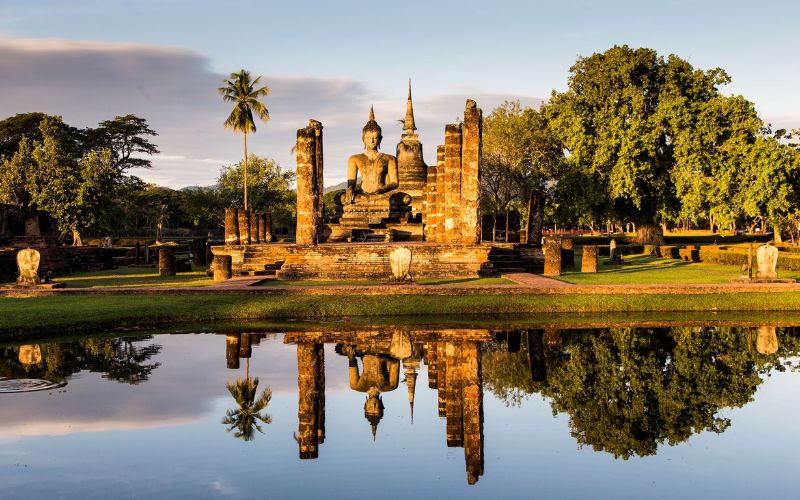
Sukhothai Historical Park, Thailand
Sukhothai was the capital of the first Thai kingdom in the 13th century, and its lotus-bud chedis and seated Buddhas reflected in lily ponds feel calmer and greener than Ayutthaya. The park has been a UNESCO World Heritage Site since 1991, and its wide, flat lanes are ideal for cycling. Cycling between the ruins makes a peaceful contrast to the busier things to do in Thailand.
- Location: Old Sukhothai, about 12 km west of the modern town
- Best for: culture lovers, slow travellers and cyclists
- Best time: November to February, and especially during Loy Krathong, when the ruins are lit by candles
- Time needed: 1 to 2 days
- Cost: the central zone costs 200 THB (about US$6) and the north and west zones 120 THB (about US$3.50); taking a bicycle in adds 10 THB (about US$0.30) per zone
- Getting there: Sukhothai has a small airport with flights from Bangkok, and long-distance buses run from Bangkok and Chiang Mai; the town sits between them, so it breaks the journey north
- Tip: Start at sunrise, when the stone Buddhas glow and the ponds are still.
>>> The 8-day Sukhothai and Chiang Mai tour starts in Sukhothai and ends in Chiang Mai.
15. Ride the Mae Hong Son Loop to Pai and Doi Inthanon (Northern Mountains) – Trekking and Hill Villages

Breathtaking views from the summit of Doi Inthanon
For mountain scenery, travel the Mae Hong Son Loop, a circuit of roughly 600 km from Chiang Mai through Pai and Mae Hong Son, or take a day trip to Doi Inthanon, Thailand’s highest peak at 2,565 metres. Both offer cool forests, rice terraces and hill-tribe villages, and they are among the best things to do in Thailand for adventurous travellers.
- Location: Mae Hong Son and Chiang Mai provinces
- Best for: adventurous travellers, young travellers and solo travellers
- Best time: November to January; roads are slippery in the rainy season, and haze often builds from late February to April
- Time needed: 4 to 7 days for the full loop, or 1 day for Doi Inthanon
- Cost: Doi Inthanon National Park 300 THB (about US$9)
- Getting there: Pai is 135 km from Chiang Mai, a 3 to 4-hour drive with 762 curves
- Tip: Only ride a motorbike if you hold a valid licence and travel insurance that covers it. On treks, choose guides who use community-run homestays, so the village earns directly from your visit.
>>> The 7-day northern Thailand tour explores the mountains and culture of the north, with reviews mentioning Mae Hong Son, Pai and Doi Inthanon.
Southern Thailand Beaches and Islands
For most visitors, beaches and boat trips top the list of things to do in Thailand, but the 2 coasts have different weather patterns. The Andaman side, including Phuket and Krabi, is best from November to April, while the Gulf islands such as Koh Samui and Koh Tao are drier from about January to September.
16. Island-Hop Phang Nga Bay and Phi Phi (Phuket and Krabi) – Limestone Islands and Turquoise Lagoons

Island hopping around Phang Nga Bay and the Phi Phi Islands, where longtail boats carry visitors between limestone cliffs and clear snorkeling bays.
Thailand island hopping is at its most dramatic in Phang Nga Bay, where limestone towers rise straight out of green water, and around Koh Phi Phi, with its lagoons and snorkelling bays. These boat trips rank among the best things to do in Phuket and Krabi.
- Location: Phang Nga Bay, between Phuket and Krabi; the Phi Phi Islands, Krabi province
- Best for: couples, honeymooners and families
- Best time: November to April; Maya Bay has seasonal conservation closures (1 August to 30 September in 2026) and reopened on 1 October 2026; swimming is still not allowed, so check the latest rules before travelling
- Time needed: a day trip for each, or 2 to 3 nights on Phi Phi
- Cost: foreign adults pay 400 THB (about US$12) to land on Phi Phi Don, Phi Phi Le or Bamboo Island, and Ao Phang Nga National Park charges 300 THB (about US$9); these fees are often not included in tour prices, so carry cash
- Getting there: speedboat or ferry from Phuket or Krabi
- Tip: Choose an early departure to reach Maya Bay and Khao Phing Kan (James Bond Island) before the crowds, and paddle into the sea caves of Phang Nga Bay by canoe.
>>> The 4-day Phi Phi beach break is an easy way to add slow island time to your trip.
17. Rock-Climb and Kayak at Railay Beach (Krabi) – Cliffs You Can Only Reach by Boat

Railay Beach in Krabi, reachable only by boat, framed by dramatic limestone karsts that draw rock climbers from around the world.
Railay is a peninsula in Krabi cut off by limestone cliffs, so it can only be reached by boat. It is one of Thailand’s best-known rock-climbing areas, with climbs for complete beginners and experts, and its sheltered bays are ideal for kayaking at high tide.
- Location: Krabi province, near Ao Nang
- Best for: couples and adventurous travellers
- Best time: November to April
- Time needed: a day trip, or 2 to 3 nights
- Cost: longtail boat from Ao Nang 100 THB (about US$3), or 150 THB (about US$4.50) after dark; a half-day climbing course costs about US$36 to US$54
- Getting there: longtail boat from Ao Nang or Krabi town
- Tip: Walk to Phra Nang Cave Beach in the morning, then stay on Railay West for the sunset.
18. Dive or Snorkel the Similan Islands or Koh Tao (Andaman Sea and Gulf) – Thailand’s Best Underwater Sites

Diving and snorkeling in Thailand, from the Similan Islands in the Andaman Sea to Koh Tao in the Gulf, two of Southeast Asia’s top underwater destinations.
The Similan Islands are one of Thailand’s best-known dive destinations, with granite boulders, clear water and manta rays at some sites, while Koh Tao in the Gulf is one of Thailand’s most popular places to learn to dive. Both suit snorkellers too.
- Location: the Similan Islands, off Phang Nga in the Andaman Sea; Koh Tao, in the Gulf of Thailand.
- Best for: divers, snorkellers and young travellers
- Best time: the Similan Islands are scheduled to open from 15 October 2026 to 15 May 2027; Koh Tao is diveable year-round, with the calmest seas from about January to September
- Time needed: a day trip or a 3 to 4-day liveaboard for the Similans; 3 to 4 days on Koh Tao for an Open Water course
- Cost: Similan Islands National Park 500 THB (about US$15); an Open Water course on Koh Tao costs about US$270 to US$375
- Getting there: speedboats to the Similans leave from Khao Lak; ferries to Koh Tao run from Chumphon and Koh Samui
- Tip: The park has capped visitors at about 3,850 a day, including divers, in recent seasons, so book early during the open season and confirm the current park rules.
>>> Looking for a quieter stretch of sand? See our pick of the best beaches in Thailand.
19. Stay on a Raft House in Khao Sok National Park (Surat Thani) – A Night on a Jungle Lake
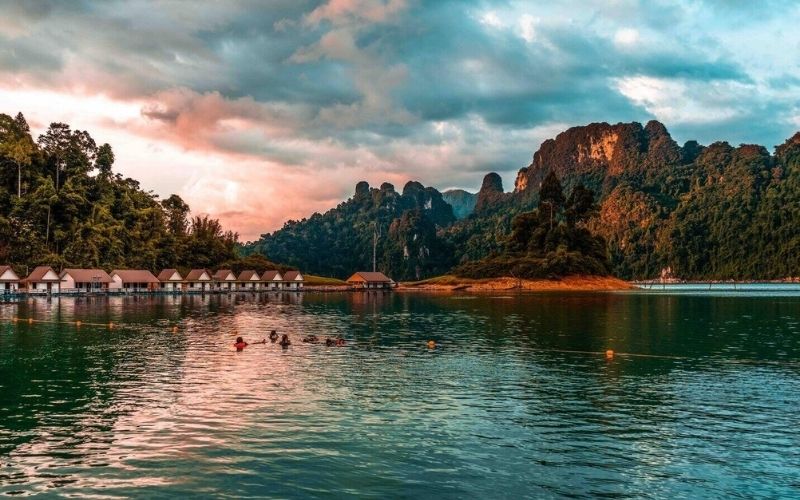
Tranquil beauty of Khao Sok – floating villas on Cheow Lan Lake framed by majestic limestone cliffs and emerald-green waters.
Khao Sok protects biodiverse tropical rainforest and includes Cheow Lan Lake, where floating raft houses sit below limestone cliffs. Days are spent kayaking, swimming, visiting caves and listening for gibbons at dawn, far from the crowds at the busier places to visit in Thailand.
- Location: Surat Thani province, between the Andaman coast and the Gulf
- Best for: families, couples and nature lovers
- Best time: December to April
- Time needed: 2 to 3 days
- Cost: national park fee of about 300 THB (about US$9) at the headquarters gate; Cheow Lan Lake has its own checkpoint and fee, plus a small pier fee. Overnight raft-house packages start at about US$75 (2,500 THB) per person, usually excluding park fees, and prices vary by operator, room standard and boat transfers, so request a current quote
- Getting there: by road from Phuket, Khao Lak or Surat Thani, which makes Khao Sok an easy stop between the 2 coasts
- Tip: Bring a torch and a dry bag, as raft houses have limited electricity and boat trips can be splashy.
>>> The 9-day Thailand culinary tour includes canoeing and a farm cooking lesson in Khao Sok.
Thailand Festivals
Festivals are among the most memorable things to do in Thailand, but flights and hotels sell out early, so plan around them from the start.
20. Join Songkran or Yi Peng and Loy Krathong (Nationwide) – Water Fights and Floating Lanterns

Locals and tourists join the Songkran street water battle in Pattaya.
Songkran, the Thai New Year in April, turns the streets into a friendly nationwide water fight, while temples hold merit-making ceremonies. In November, Loy Krathong fills rivers with candlelit floats, and in Chiang Mai, the Yi Peng festival adds thousands of lanterns released into the night sky.
- Location: nationwide; Bangkok and Chiang Mai host the biggest Songkran celebrations, Chiang Mai is the centre of Yi Peng, and Sukhothai holds a famous Loy Krathong festival
- Best for: groups of friends and festival lovers
- Best time: Songkran runs from 13 to 15 April 2027; Loy Krathong falls on 24 November 2026; Chiang Mai’s public Yi Peng celebrations are scheduled for 23 to 25 November 2026, while separately ticketed lantern-release events follow their own schedules; 2027 dates for Loy Krathong and Yi Peng are to be confirmed
- Time needed: 2 to 3 days
- Cost: free to join public celebrations; ticketed lantern events cost extra
- Getting there: fly into Bangkok or Chiang Mai, and book flights and hotels several months ahead for all 3 festivals
- Tip: Release lanterns only at permitted events, as Chiang Mai restricts unauthorised launches for air-traffic and fire safety. During Songkran, keep your phone and passport in a waterproof pouch.
Best Things to Do in Thailand by Traveller Type
The right things to do in Thailand depend on who you travel with. Use the numbers below to jump to the experiences that suit you best.
- Couples and honeymooners: island hopping in Phang Nga Bay and Phi Phi (#16), sunsets at Railay (#17), a raft house in Khao Sok (#19), a farm cooking class (#11) and Yi Peng lanterns in November (#20). These are the most popular things to do in Thailand for couples, and our Thailand honeymoon package combines Bangkok with the Andaman coast.
- Families with kids: an ethical elephant sanctuary (#12), a cooking class (#11), wildlife in Khao Yai (#9), the floating markets (#6), swimming at Erawan Falls (#8) and island hopping with calm Andaman beaches from November to April (#16).
- Solo and young travellers: Yaowarat street food (#3), Muay Thai (#5), the Mae Hong Son Loop and Pai (#15), diving on Koh Tao (#18) and Songkran (#20).
- Older travellers and first-timers: the Grand Palace (#1), Wat Pho and Wat Arun (#2), Ayutthaya (#7), Chiang Mai’s temples (#10), Chiang Rai (#13) and Sukhothai (#14), all of which are easy to visit with a driver and guide.
- Budget travellers: many things to do in Thailand are cheap. Most temples, including Wat Arun (#2), cost 200 THB (about $6) or less, Ayutthaya (#7) and Sukhothai (#14) cost little beyond entry and bike hire, and an evening of Thai street food in Yaowarat (#3) costs about $10 to $20.
- Luxury travellers: private longtail or speedboat charters in Phang Nga Bay (#16), a private guide at the Grand Palace (#1), a private boat on Cheow Lan Lake in Khao Sok (#19) and a dinner cruise on the Chao Phraya River.
What to Do in Thailand Month by Month
Thailand has 3 main seasons, and the 2 coasts follow different patterns, so what to do in Thailand depends on when you travel. The table shows where conditions are best in each period. For more detail, read our guide to the best time to visit Thailand.
| Months | Bangkok and Central | North (Chiang Mai) | Islands | Top things to do |
| November to February | Dry and less humid; peak season | Cool and clear; the best months | Andaman coast at its best; Gulf islands wet until about December | Grand Palace, Chiang Mai temples, Yi Peng and Loy Krathong (November), island hopping |
| March to May | Very hot | Hot, with haze from late February to April | Andaman good until April; Gulf islands calm | Songkran (13 to 15 April), diving on Koh Tao, early-morning temple visits |
| June to September | Rainy season, wettest in August and September | Green rice terraces, waterfalls flowing | Andaman rough; Maya Bay usually closed in August and September; Gulf islands good | Khao Yai, cooking classes, Koh Samui and Koh Tao |
| October | Rains easing | End of the rainy season | Maya Bay reopened on 1 October 2026; Similans open from 15 October; rain on both coasts, with Gulf rain building towards November | Erawan Falls at full flow, the end of Buddhist Lent, quieter temples before peak season |
How Many Things Can You Fit into 7, 10 or 14 Days?
Deciding what to do in Thailand often comes down to time. Most travellers manage 2 to 3 experiences a day in Bangkok and 1 or 2 a day elsewhere, plus travel time between regions. As a rough guide:
- 5 to 7 days: Bangkok and a second region. Spend 3 days on a mix of items 1 to 7, then head to either Chiang Mai or a beach area. Our 5-day Bangkok highlights tour covers the capital’s major sights.
- 8 to 10 days: Bangkok, Chiang Mai and a beach area, which covers most of the classic Thailand bucket list. Try the Thailand 10-day itinerary if you prefer to travel independently.
- 14 days: Bangkok, Chiang Mai, Chiang Rai and 2 beach bases in Krabi and Phuket, with time for Khao Sok or Kanchanaburi. The 14-day Thailand tour covers Phuket, Krabi, Chiang Mai and Bangkok.
>>> Browse all our Thailand tour packages to compare more trip lengths and styles.
Thailand Travel Tips for First-Time Visitors
A little preparation goes a long way. These rules and habits make the things to do in Thailand on this list easier and safer. For a full checklist, see our Thailand travel tips.
Entry Rules: Visa Exemption and TDAC
From 15 September 2026, travellers from 60 visa-exempt countries and territories can stay in Thailand for up to 30 days without a visa, down from 60 days under the previous scheme. A few nationalities receive 15 days or keep 90 days under bilateral agreements, and some that were previously exempt now need a visa, so check the rules for your passport with a Royal Thai Embassy before booking.
Foreign visitors must also complete the free Thailand Digital Arrival Card (TDAC) within 3 days before arrival, including the arrival date; exceptions include transit passengers who do not pass through immigration and Border Pass holders. Use the official website and avoid sites that charge a fee; our TDAC guide explains each step. A 450 THB (about US$13) tourist entry fee has been proposed, with collection targeted for early 2027, but it was not in force as of October 2026.
Temple Dress Code and Etiquette
Cover your shoulders and knees at temples and royal sites, and take off your shoes before entering prayer halls. Do not point your feet towards a Buddha image or a monk, and women should not touch monks or hand items to them directly. A light scarf and a pair of long trousers in your day bag will get you into almost any temple.
Responsible Wildlife and Hill-Tribe Visits
Choose elephant venues that let you observe without riding, bathing or shows, and skip any attraction that offers photos with tigers or other wild animals. In hill-tribe areas, visit with a local guide or a community-run homestay, ask before photographing people and buy crafts directly from the makers. At Maya Bay, stay on the boardwalk and respect the no-swimming rule, which protects the recovering coral and blacktip reef sharks.
Money and Common Scams
Thai ATMs usually charge foreign cards a fixed fee of 250 to 350 THB (about US$7.50 to US$10.50) per withdrawal, depending on the bank and card network, so take out larger amounts less often, and always choose to be charged in baht rather than your home currency. Use metered taxis or ride-hailing apps such as Grab and Bolt, and be wary of friendly strangers who say a sight is closed and offer a cheap tuk-tuk tour, as these often end at gem or tailor shops. Our guide to Thailand travel apps lists the apps worth downloading before you go.
Turn Your Thailand Bucket List into a Trip with IDC Travel
From royal temples in Bangkok to lantern-lit nights in Chiang Mai and long days on the Andaman Sea, these 20 things to do in Thailand show how much variety one country can hold. The best trips mix 2 or 3 regions and leave enough time between them to enjoy each place at its own pace.
If you would like help choosing which things to do in Thailand fit your dates, contact our travel experts.
Read more: