

If you are flying into Vietnam through Ho Chi Minh City, Hanoi, Da Nang, Nha Trang, or Phu Quoc, you will likely need to submit a Vietnam Pre-Arrival Information (PAI) declaration online before you board your flight. This new digital step, run through the official portal, has quietly become one of the most important things to prepare before a Vietnam trip, and a surprising number of travelers still land without knowing it exists. This guide walks you through exactly what PAI is, who needs it, how to fill it out correctly, and how to avoid the mistakes that trip up thousands of arriving passengers every month.
Quick Facts: Vietnam PAI at a Glance
| Question | Answer |
| What is it? | A free online pre-arrival declaration that generates a QR code for immigration |
| Official website | prearrival.immigration.gov.vn only |
| Who runs it? | The Immigration Department, Ministry of Public Security |
| Airports currently covered | Tan Son Nhat (SGN), Noi Bai (HAN), Da Nang (DAD), Cam Ranh (CXR), Phu Quoc (PQC) |
| When to submit | Within 24 to 72 hours before your scheduled arrival |
| Cost | Free |
| Is it a visa? | No. You still need your own visa exemption, e-visa, or visa on arrival |
What Is the Vietnam Pre-Arrival Information (PAI) System?
PAI is an online utility that lets international travelers submit their passport, visa, and flight details before they land in Vietnam, so immigration officers can process them faster at the border. Instead of filling out a paper arrival card on the plane or at the counter, you complete the form on your phone or computer in advance and receive a QR code by email. At the airport, an officer scans that code alongside your passport, which speeds up the queue considerably during busy arrival waves.
The system was first piloted at Tan Son Nhat International Airport starting April 15, 2026. Within the first 15 days, more than 161,000 passengers attempted the declaration, and the Immigration Department reported strong interest even while the pilot was still voluntary. Since then, the rollout has expanded in stages, first to Phu Quoc, then to Noi Bai and Da Nang, and most recently to Cam Ranh, with officials stating plans to keep extending PAI to more international airports and eventually study its use at land border crossings.
PAI Is Not a Visa: The Distinction That Confuses Most Travelers
This is the single most important thing to understand. Submitting a PAI declaration does not grant you permission to enter Vietnam and does not replace any visa requirement you already have. If your nationality qualifies for visa-free entry, you still need to meet the passport validity and return-ticket rules for that exemption. If you hold an e-visa, you still need to travel with your printed or digital e-visa approval. If you are getting a Visa on Arrival stamp, you still need your approval letter and stamping fee. PAI simply adds a digital pre-check on top of whichever entry method already applies to you.
For the current list of visa-exempt nationalities, e-visa eligibility, and Visa on Arrival procedures, our dedicated Vietnam visa guide covers all three paths in detail, since visa policy is a separate topic from the PAI declaration covered here.
Which Airports Currently Require a PAI Declaration
| Airport | City / Region | Status |
| Tan Son Nhat (SGN) | Ho Chi Minh City | First airport to require PAI, since April 2026 |
| Phu Quoc (PQC) | Phu Quoc Island | Added June 2026 |
| Noi Bai (HAN) | Hanoi | Added mid-2026 |
| Da Nang (DAD) | Da Nang | Added mid-2026 |
| Cam Ranh (CXR) | Nha Trang | Most recent addition |
If you are arriving at any other Vietnamese airport, such as Cat Bi in Hai Phong, PAI is not required yet, though the system is expected to keep expanding. Because the rollout schedule has moved quickly since the pilot began, it is worth checking the official portal a few days before departure to confirm your specific arrival airport is covered.
Who Must Complete a PAI Declaration
| Traveler type | PAI required? |
| Foreign passport holders (any nationality) | Yes, if arriving at a covered airport |
| Overseas Vietnamese entering on a visa | Yes |
| Visa-exempt travelers | Yes, being visa-exempt does not exempt you from PAI |
| E-visa holders | Yes |
| Visa on Arrival travelers | Yes |
| Vietnamese citizens using a Vietnamese passport | No |
| Same-day airside transit passengers who do not clear immigration | No |
What You Will Need Before You Start
Gather these before you open the form, since the session can time out if you have to go searching for documents partway through:
- A clear photo or scan of your passport bio page (the system tries to auto-read your details from this image, so a sharp, well-lit photo saves time)
- Your visa details: e-visa number and dates, or your Visa on Arrival approval letter details, or simply your visa-exemption status if applicable
- Your flight number and arrival airport
- The full address of where you are staying in Vietnam for at least your first night (hotel name, street address, ward or district, and city or province)
- A working phone number and an email address you can check before landing
Step-by-Step: How to Submit Your Vietnam PAI Declaration
1. Go to the official portal
Open prearrival.immigration.gov.vn on your phone, tablet, or computer. The website interface that appears before you will look like the image below. Do not use any other website, even one that looks similar.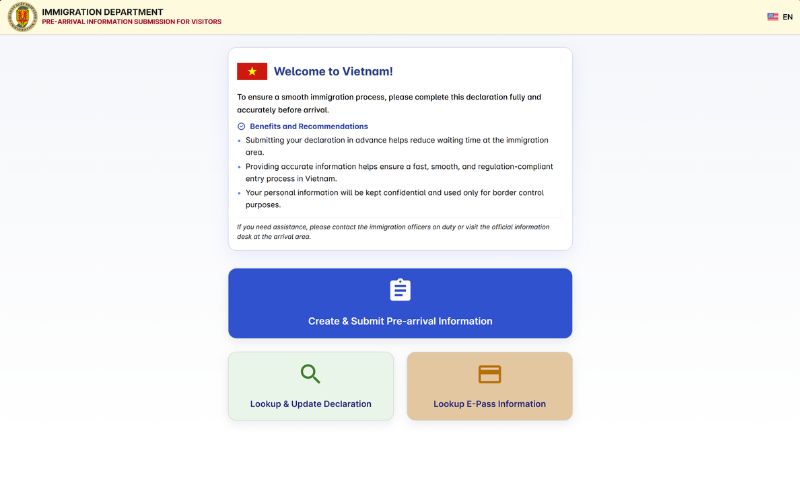
2. Choose your language
The site offers Vietnamese, English, Chinese, French, and several other languages. After you select the language, the website will immediately reload entirely in your chosen language.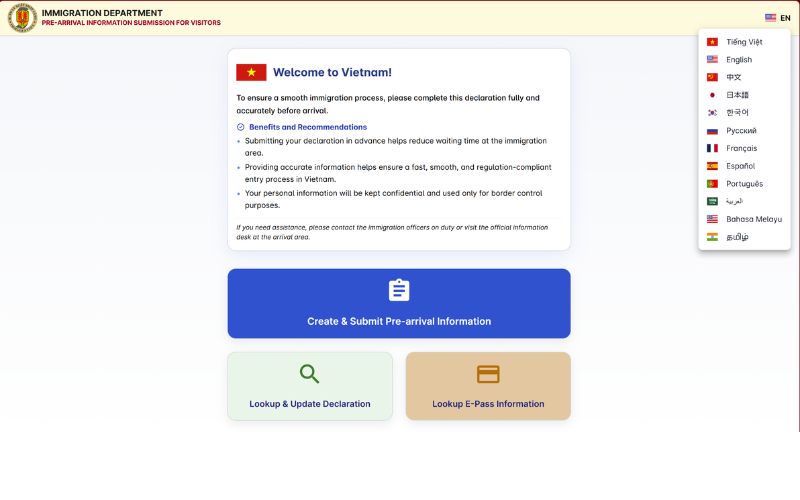
3. Create and Submit Pre-Arrival Information
Click on “Create & Submit Pre-Arrival Information” button. Complete the CAPTCHA verification to proceed.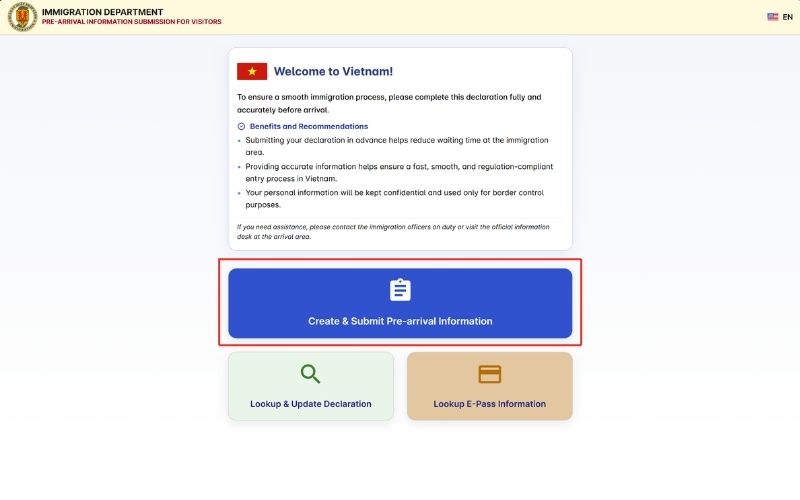
4. Choose your nationality
After complete the CAPTCHA, you must choose your nationality. You can select or type to search your country. Then press “Next” to move on to the next step. 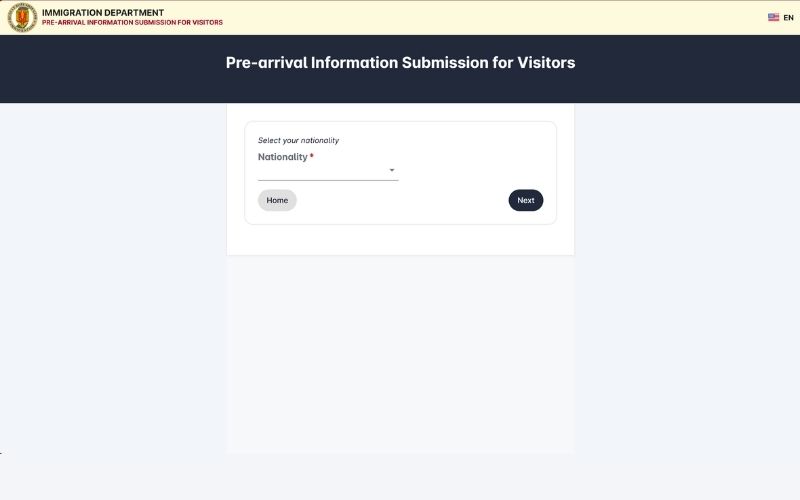
If you accidentally selected the wrong nationality, don’t worry, you can still change it in the next step. Scroll to the bottom and click “Change Nationality“.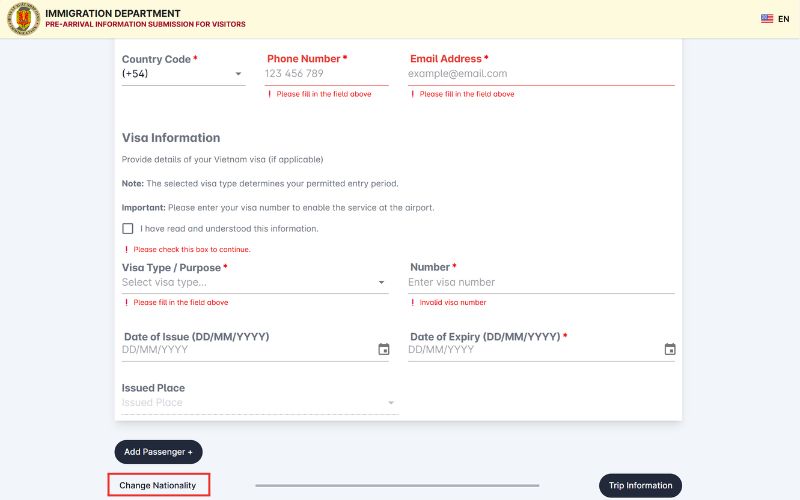
5. Upload your passport photo
The expected arrival date can be selected within 3 days prior to arrival, including today. You may upload your passport bio data page for autofill or enter the details manually. The system will attempt to read your passport number, full name, date of birth, gender, nationality, and expiry date automatically. Please double check every field carefully; auto-read errors are common with worn or glossy passport covers, and you can correct any field manually.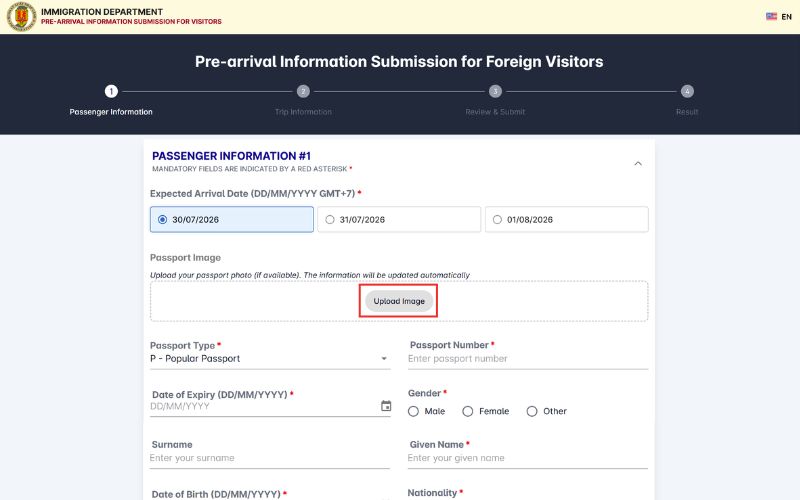
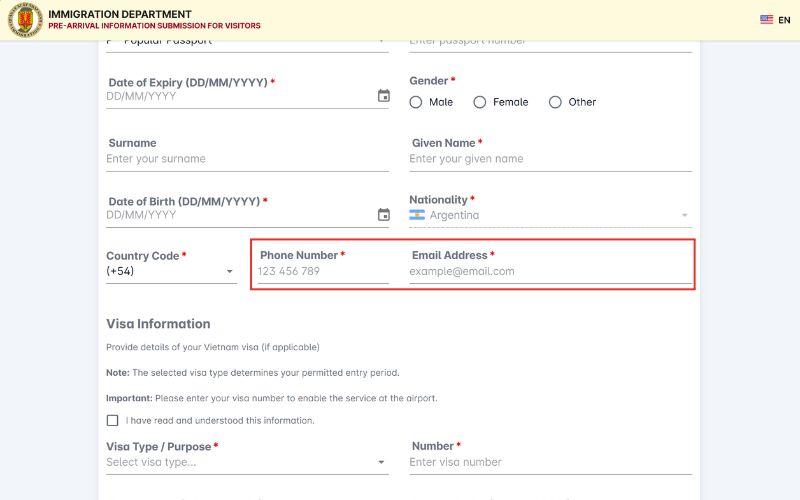
6. Provide your number contact and email address
Type your “Phone Number” and “Email Address“. The pre-arrival information number will be sent to this email. Please remember to check your email later.
7. Enter your visa information
Vietnam visa details is required. Select your “Visa Type / Purpose” such as e visa, visa exemption, residence card or others.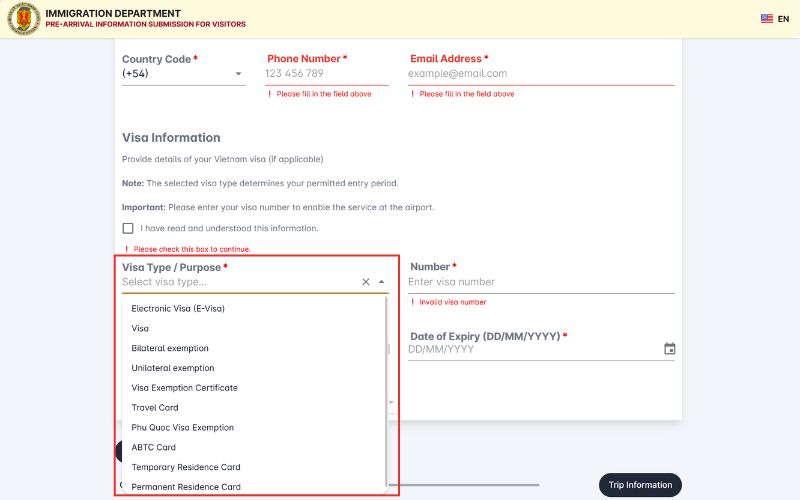
If you have a visa, provide the visa number, date of issue, and date of expiry and issued place. If you are entering visa-free, enter “0” or “N/A” for the visa number, use your arrival date as the issue date, and use your planned departure date as the expiry date. Selecting the wrong visa category here is one of the most common reasons travelers run into length-of-stay problems later, so double-check this step. 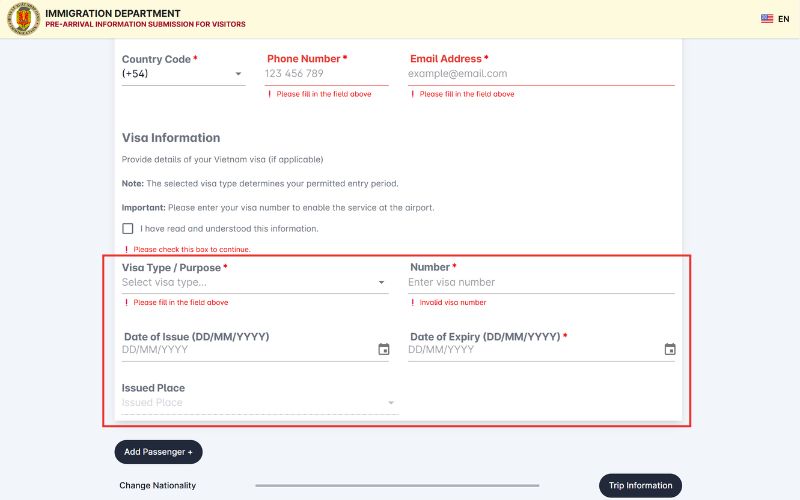
Click “Add Passenger +” to add another passenger if needed. Enter the additional passengers details and select the relationship with the lead passenger. 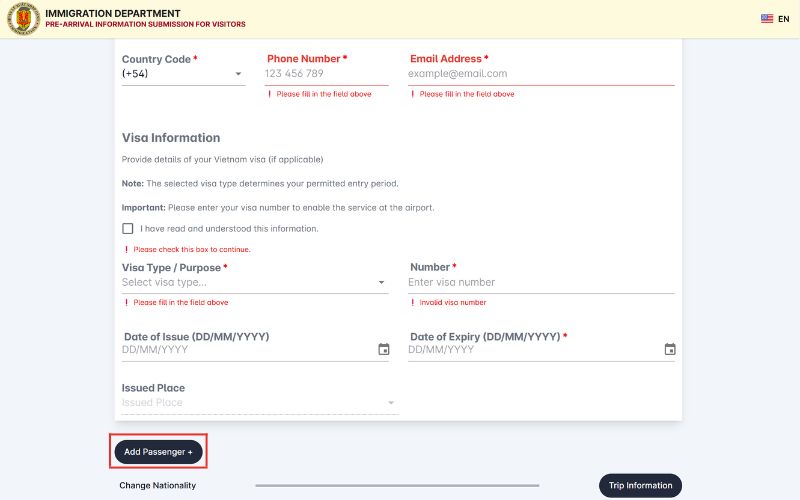
If there’s no more passenger to add, you may proceed to the “Trip Information” section.
Note: if the system prompts that the session has expired after some time, simply complete the capture verification again to return to where you left off.
8. Enter your flight details
Select the departure country before arriving in Vietnam. This should be the original point of departure. If you are transiting through multiple countries, for example, if your journey is from the US with a transit in Thailand, then to Vietnam, the departure country entered should be the US or if you go from Canada to Vietnam, the departure country will be Canada. And select your purpose of travel. If you’re just transiting in Vietnam, select “Transit” or “Travel“.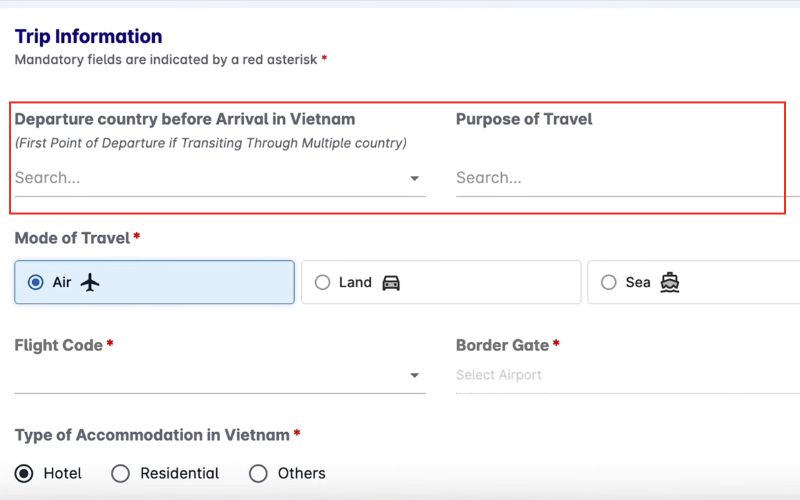
- For Air Travel, enter the “Flight number” and the “Border Gate” will be selected automatically.

- For Land or Sea Travel, enter the “Vehicle identification number” and select the relevant “Border Gate” or “Port of entry” (Sea section).
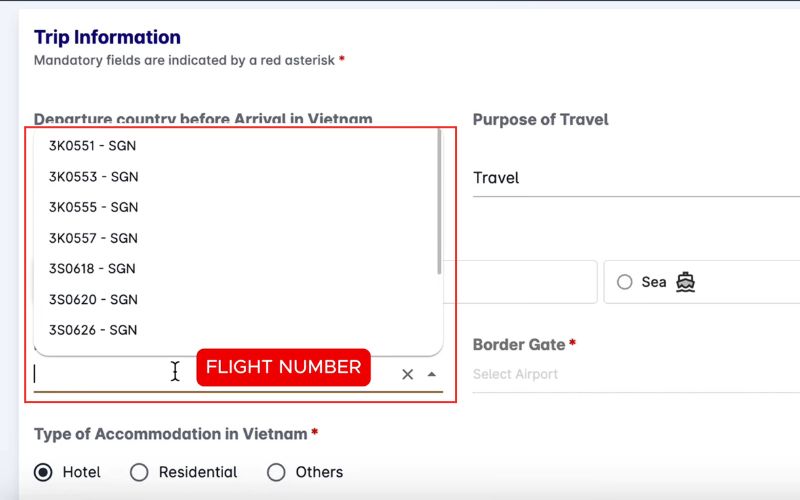
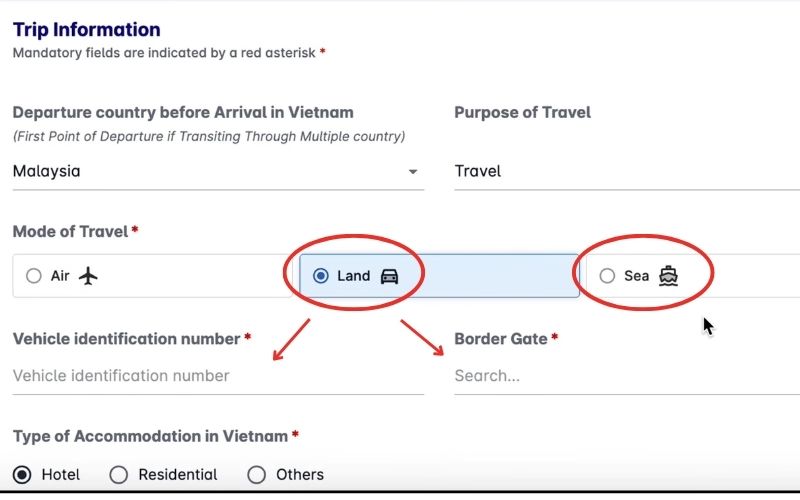
9. Enter your accommodation address
Next, choose your Type of Accommodation in Vietnam. If staying at a hotel, you may search for it from the list. If the hotel does not appear, simply enter the address manually.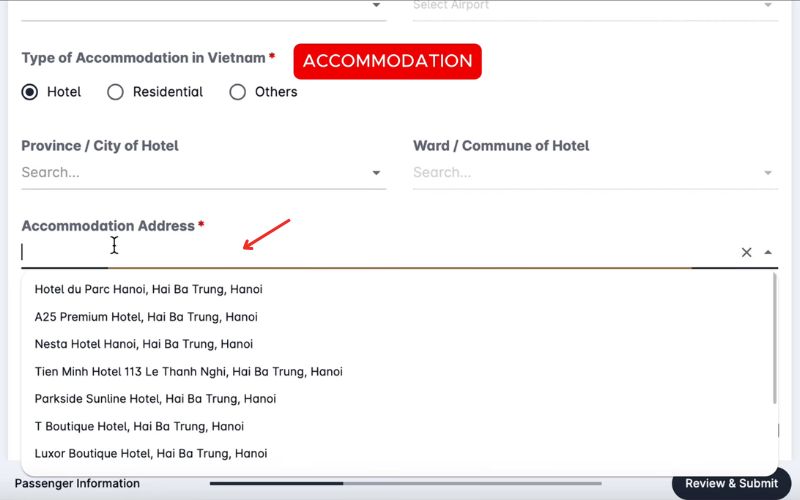
Provide workplace information if applicable. Then enter your expected departure date from Vietnam. Review all details carefully before confirming then press “Review & Submit” button.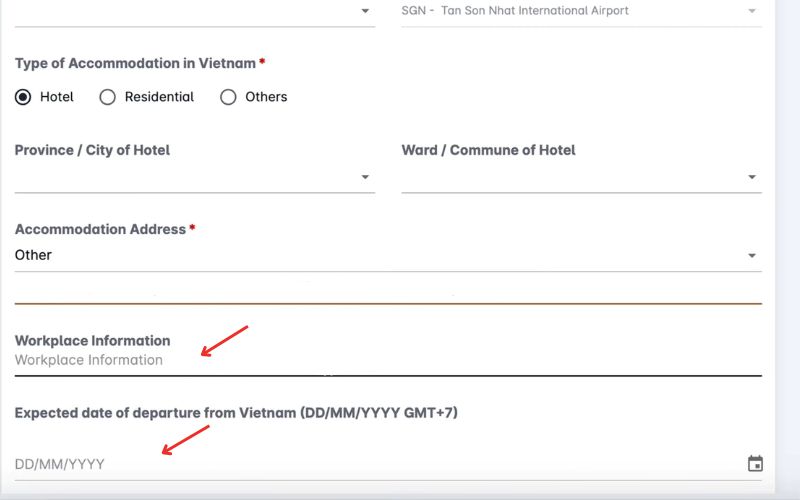
10. Review everything, then submit.
Review all details carefully before confirming. If every information is alright, tick the box “I confirm that the information is correct“. A 6-digit code has been sent to your email, check it then fill. You better be quick because it only has a minute for one code. Then press “Verify“.
11. Save your QR code
Once completed, the system generates a declaration code and QR code. Screenshot it, save it to your phone’s photo gallery, and email yourself a copy or save the PDF, since airport WiFi is not always reliable the moment you land.
12. Lookup and update your declaration
You can search and update your declaration after submit. 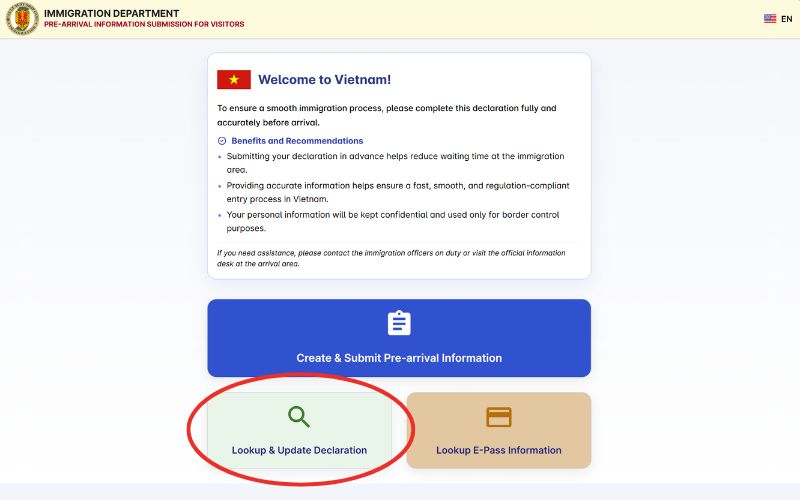
Fill the “Pre-Arrival Information Number” and “Passport Number“. If you don’t remember the number, click “Forgot number (PAI)” then type your “Passport Number“, “Expected Arrival Date” and “Email“ to take the PAI number.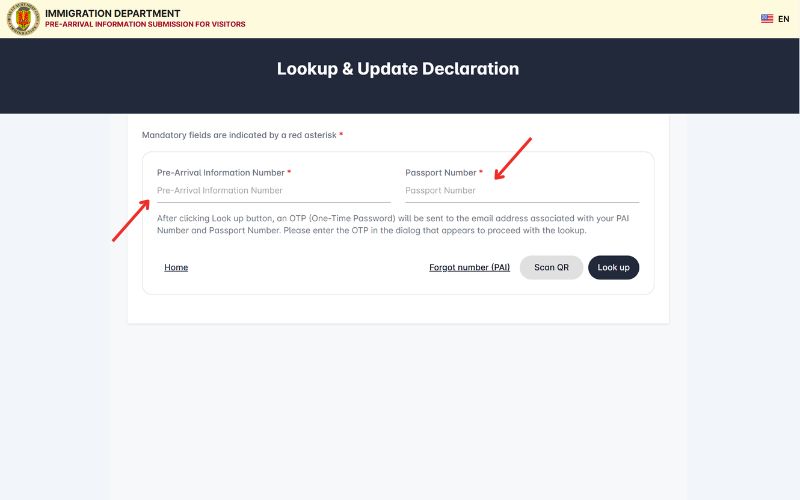
When to Submit: Timing Rules You Need to Know
The window is strict: you can only submit between roughly 24 and 72 hours before your scheduled arrival time in Vietnam (using Vietnam’s GMT+7 time zone). Submit too early and the system will reject it; submit too late and you risk arriving without a confirmed QR code. The safest approach is to complete the form the evening before you fly, while you still have easy access to your documents and a stable internet connection, rather than trying to do it from the departure gate.
What Happens at Immigration When You Land
Once you land, follow signage toward the immigration checkpoint for foreign passport holders. Present your passport, your visa or e-visa printout (or approval letter, if applicable), and your QR code, either on your phone screen or printed on paper. The officer scans the code, cross-checks it against your passport, and stamps you into the country. Travelers who completed PAI in advance generally move through noticeably faster than those relying on the airport’s own kiosks, which can add another 20 to 40 minutes during peak arrival banks.
Common Mistakes That Cause Declarations to Fail
During the first month of the pilot at Tan Son Nhat, a meaningful share of submissions were unsuccessful, mostly due to avoidable errors. The most frequent one was a flight number that did not match the airline’s own passenger record, often because the traveler copied an old confirmation number instead of the actual operating flight number. Other common issues include:
- Selecting the wrong visa category, which can shorten your permitted stay without you realizing it until later
- Submitting outside the 24 to 72 hour window
- Uploading a blurry, angled, or glare-covered passport photo that the system misreads
- Typing a name that does not exactly match the spelling on your passport, including middle names or diacritics
If your declaration does not go through, do not panic. You can still complete the process at the airport, though it will take longer, so it is worth attempting it again from your phone before you board if there is time.
Beware of Fake PAI Websites
Since PAI launched, Vietnamese authorities have publicly warned that fraudulent copycat websites have appeared, designed to look like the real portal in order to collect credit card details from travelers. There is only one legitimate address for this service: prearrival.immigration.gov.vn. The declaration itself is completely free, so any site asking for a payment to “process”, “expedite”, or “guarantee” your PAI submission is not affiliated with the Vietnamese government. Bookmark the official link directly rather than searching for it each time, and be cautious of sponsored search results or social media ads offering to file it for a fee.
PAI Versus the Vietnam Health Declaration: Two Different Things
Around the same time PAI was expanding, a separate regulation, Decree No. 165/2026/ND-CP, came into effect on July 1, 2026, introducing a legal framework for health declarations at Vietnam’s borders. This led to some understandable confusion online about whether travelers now face two separate mandatory forms. According to the Vietnamese government’s own clarification, the health declaration is not a routine requirement for every traveler at every entry; it only activates for specific nationalities, routes, or time periods if the Ministry of Health identifies a disease outbreak risk, and it would be announced publicly if and when that happens.
In other words, most travelers arriving in Vietnam today only need to complete the PAI declaration described in this guide, not a separate health form, unless official channels state otherwise closer to your travel date.
Getting From the Airport After You Land
Once you have cleared immigration and collected your bags, the transfer into the city is usually the next question on your mind.
- Ho Chi Minh City (Tan Son Nhat): Metered taxis, ride-hailing apps, and pre-booked private transfers are all available right outside arrivals. If you would rather skip the queue entirely, our Tan Son Nhat Airport transfer service has a driver waiting for you at the terminal with your name on a board.
- Hanoi (Noi Bai): A taxi or private car into central Hanoi typically runs about 250,000 to 400,000 VND (~$12 to $18), plus a small toll fee of roughly 15,000 VND (~$0.70). See our Hanoi airport transfer options if you would like a car arranged in advance.
- Da Nang: Taxis and ride-hailing apps run frequently between the airport and the city center, which is only a short drive away. Our Da Nang airport transfer service can have a car waiting for you on arrival.
- Nha Trang (Cam Ranh): The airport sits a fair distance from Nha Trang city, so most visitors prefer a pre-booked transfer over hailing a taxi cold. Check our Cam Ranh to Nha Trang transfer guide for options.
- Phu Quoc: Taxis and Grab are both readily available at the terminal for the short ride into Duong Dong town or your resort.
Practical Tips for a Smooth Arrival
- Get connected immediately. An eSIM activated before you fly, or a local SIM bought at the airport, means you have maps, ride-hailing, and translation apps working the moment you land.
- Carry some Vietnamese dong. While cards are widely accepted in hotels and restaurants in major cities, having roughly 500,000 to 1,000,000 VND (~$20 to $40) in small bills makes taxis, markets, and street food much easier in your first hours.
- Screenshot everything twice. Your PAI QR code, your e-visa or approval letter, and your hotel booking should all be saved offline on your phone, not just accessible through email, in case connectivity is patchy right after landing.
- Double-check your passport validity. Regardless of which entry method you use, your passport should have at least six months of validity remaining from your planned departure date from Vietnam.
Plan Your Trip With Us
Navigating a new entry procedure on top of planning flights, hotels, and an itinerary can feel like a lot at once. If you would rather have a Vietnam-based team confirm your documents, arrange your airport pickup, and build the rest of your trip around it, our team can help you put the whole picture together so the only thing you need to think about at the airport is scanning your QR code.
Wrapping Up
The Vietnam Pre-Arrival Information system is a genuinely useful addition for travelers, provided you know it exists and complete it correctly within the right window. Fill it out the evening before your flight using only the official prearrival.immigration.gov.vn portal, keep your visa documents in order separately, save your QR code somewhere offline, and you will likely spend far less time standing in line than the traveler next to you who is discovering all of this for the first time at the counter. Contact us!
Read more: