


Vietnam and Thailand in 20 days can support a complete first trip when each country receives a clear role. Itinerary 1 travels through Vietnam from Hanoi to Ho Chi Minh City before slowing down in Bangkok and Koh Samui. Itinerary 2 combines northern Thailand with Vietnam’s heritage corridor, Ninh Binh, Ha Long Bay and Sapa. Calculate Vietnam and Thailand separately from the daily ranges below, then add route-specific flights, cruises and other one-off services.
Suggested Complete Itinerary for Vietnam and Thailand in 20 Days
20 days is close to 3 weeks, but transport can still consume a quarter of the usable time. The routes below cap the number of bases and place the longest flight sectors between logical gateways. Choose an itinerary rather than merging them.
Itinerary 1: Vietnam from North to South with Koh Samui
- Route: Hanoi – Ha Long Bay – Hoi An – Nha Trang – Ho Chi Minh City – Bangkok – Koh Samui
- Best for: First-time visitors, couples and families who want Vietnam’s main regions followed by a warm-weather beach finish.
- Strengths: The route follows a direction through Vietnam and gives both Nha Trang and Koh Samui genuine downtime. Bangkok provides a cultural bridge between the 2 coasts.
- Trade-offs: Beach time takes the place of northern Thailand. The itinerary has several flights and should not be attempted with separate tickets and short connections.
- Best time: January to March is often the easiest broad overlap, but Nha Trang and Koh Samui have different weather patterns. Check both coasts for the exact travel month.
- Think twice if: Mountain scenery matters more than beaches, or your group dislikes frequent flights.
Day 1 | Arrive in Hanoi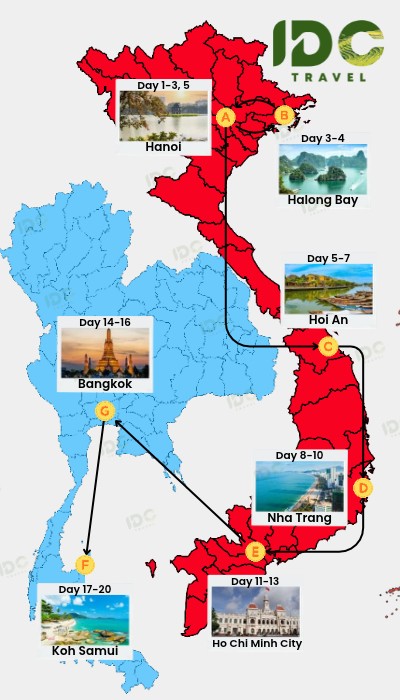
Check in and rest. If energy allows, walk around Hoan Kiem Lake and eat near the hotel.
Day 2 | Hanoi History and Neighbourhoods
Combine the Old Quarter, Temple of Literature and a museum or local market. Avoid crossing the city repeatedly for isolated attractions.
Day 3 | Hanoi to Ha Long Bay
Travel to the coast and board an overnight cruise. Confirm the current route and activities with the operator because weather and port instructions can change the programme.
Day 4 | A Full Day on Ha Long Bay
Use a two-night cruise to reach quieter areas or add more time on the water. Pack medicine and essentials in a small bag.
Day 5 | Return to Hanoi and Fly to Da Nang
Disembark, return toward Hanoi and fly to Da Nang before continuing to Hoi An. This is a long travel day with no need for an evening tour.
Day 6 | Hoi An Ancient Town
Explore the historic centre, markets and merchant houses. Add a lantern workshop or countryside cycle ride according to the weather.
Day 7 | Hoi An at Leisure
Choose a cooking class, beach time or a rural village visit. Keep part of the day open for tailoring, laundry or rest.
Day 8 | Fly to Nha Trang
Transfer to Da Nang airport and fly south. Settle near the coast and keep dinner within walking distance.
Day 9 | Nha Trang Beach Day
Use the day for the beach, a spa or a licensed boat excursion. Follow local sea warnings and operator safety advice.
Day 10 | A Flexible Day in Nha Trang
Protect a second day for weather changes or family recovery. Add a cultural site only if the beach is not the main purpose of the stop.
Day 11 | Fly to Ho Chi Minh City
Fly south and check in near the places you plan to visit. Use the evening for a short food walk.
Day 12 | Ho Chi Minh City
Focus on the city’s central history, architecture and markets. Travellers interested in museums should keep the day in the city.
Day 13 | Mekong Delta or Cu Chi
Choose a full excursion. The Mekong offers waterways and rural life, while Cu Chi focuses on wartime history and requires less regional movement.
Day 14 | Fly to Bangkok
Complete the intercountry flight and immigration formalities. Keep the first Bangkok evening flexible.
Day 15 | Bangkok Temples and River
Visit the Grand Palace area, Wat Pho and Wat Arun with river transport. Begin early and dress for religious sites.
Day 16 | Bangkok at Your Own Pace
Choose a neighbourhood market, a cooking class or contemporary Bangkok. This free day also absorbs any earlier disruption.
Day 17 | Fly to Koh Samui
Fly to the island and settle near the beach that matches your preferred atmosphere. Avoid booking a boat excursion on arrival day.
Day 18 | Koh Samui Beach and Island Time
Keep a complete day for the coast. Confirm marine conditions before any snorkelling or boat programme.
Day 19 | A Flexible Day on Koh Samui
Use the final full day for rest or a weather-dependent excursion. Pack and reconfirm the onward flight before dinner.
Day 20 | Depart Koh Samui
Allow a comfortable connection if the international journey continues through Bangkok. One protected booking is safer than separate tickets with little margin.
>>> See the full itinerary: Tropical Delights of Vietnam and Thailand in 20 Days. IDC Travel can adjust beach nights, cruise length and private services around the season.
Vietnam and Thailand in 20 Days
Itinerary 2: Northern Thailand and Vietnam’s Mountains and Heritage
- Route: Chiang Mai – Chiang Rai – Bangkok – Ayutthaya – Da Nang – Hue – Ninh Binh – Hanoi – Ha Long Bay – Sapa
- Best for: Active travellers who prefer temples, mountain scenery, trekking and heritage cities to a second beach stay.
- Strengths: Northern Thailand and northern Vietnam receive meaningful time, while Bangkok, Ayutthaya, Hoi An and Hue create a strong heritage thread. The route uses an open-jaw pattern from Chiang Mai to Hanoi.
- Trade-offs: 11 bases or major stops make this the more active option. The Ha Long Bay to Sapa transition needs careful timing and the route omits southern Vietnam.
- Best time: November to February often provides the most comfortable temperatures for outdoor travel. Sapa can be cold or foggy, and northern Thailand conditions should be checked near departure.
- Think twice if: You need a low-mobility route, dislike cool mountain weather or want several beach days.
Day 1 | Arrive in Chiang Mai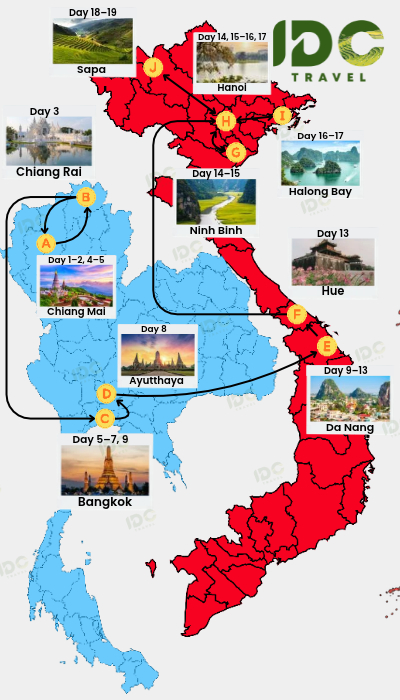
Check in and take a gentle old-city walk. Save Doi Suthep and formal sightseeing for the next day.
Day 2 | Chiang Mai Temples and Mountain View
Visit key old-city temples and Wat Phra That Doi Suthep. A guide helps explain etiquette and religious context.
Day 3 | Chiang Rai Day or Overnight Excursion
Travel to Chiang Rai for Wat Rong Khun and another selected site. An overnight stay reduces the road burden if the group dislikes very long day trips.
Day 4 | Chiang Mai Countryside and Free Evening
Choose a craft community, cooking class or responsible elephant programme. Keep the evening free before the flight.
Day 5 | Fly to Bangkok
Fly south and settle near the river or urban rail. Use the evening for a neighbourhood meal rather than a cross-city attraction.
Day 6 | Bangkok Palaces and River Life
Combine the Grand Palace area, Wat Pho and Wat Arun. Start early and allow time for temple clothing rules and security checks.
Day 7 | Bangkok Markets or Local Districts
Choose a market excursion or explore a neighbourhood within the city. Do not combine distant floating markets with a full palace day.
Day 8 | Ayutthaya Day Trip
Visit a selected group of ruins and learn how the former capital relates to modern Thailand. Return to Bangkok and prepare for the Vietnam flight.
Day 9 | Fly from Bangkok to Da Nang
Fly to central Vietnam and transfer to Hoi An or stay in Da Nang according to arrival time. Keep the rest of the day unstructured.
Day 10 | Da Nang and Nearby Landscape
Choose the Marble Mountains, Son Tra or another focused city-area experience. Avoid stacking distant attractions merely because this is the only Da Nang day.
Day 11 | Hoi An Ancient Town
Walk through the old town, merchant houses and market area. Try mi Quang (Quang-style turmeric noodles with meat, herbs and a small amount of broth).
Day 12 | Hoi An Countryside or Rest Day
Cycle through nearby villages, join a workshop or keep a free day. The pause makes the later northern section more sustainable.
Day 13 | Hoi An to Hue
Cross the Hai Van area by road and arrive in Hue. Visit a light site only if the transfer begins early.
Day 14 | Hue to Ninh Binh via Hanoi
Fly from Hue to Hanoi, then continue by road to Ninh Binh if schedules allow. Otherwise, overnight in Hanoi and move Ninh Binh to the following morning.
Day 15 | Ninh Binh and Hanoi
Take a boat trip through Trang An or Tam Coc and add a nearby heritage or viewpoint stop. Continue to Hanoi in the afternoon.
Day 16 | Hanoi to Ha Long Bay
Transfer to the coast and board an overnight cruise. Confirm sailing details and carry only a small bag onboard.
Day 17 | Ha Long Bay to Sapa
Join the morning activity, disembark and begin the long transfer toward Sapa through Hanoi. If the schedule feels too tight, sleep in Hanoi and shorten Sapa by a night.
Day 18 | Sapa Villages and Terraces
Choose a walking route that matches fitness, weather and trail conditions. A local guide adds cultural context and helps avoid unsuitable paths.
Day 19 | Sapa Morning and Return to Hanoi
Use the morning for a second village area or rest, then return to Hanoi. Keep the final evening close to the hotel.
Day 20 | Depart Hanoi
Schedule only a flexible breakfast or nearby walk before the airport transfer. Leave generous time for traffic and check-in.
>>> See the full itinerary: Ancient Heritages and Natural Wonders of Thailand and Vietnam in 20 Days. IDC Travel can slow the route, replace Sapa or adjust walking difficulty.
Manage Entry Forms and Money Across Both Countries
Complete the entry preparation country by country. Vietnam and Thailand use different permission systems, and only Thailand requires the Thailand Digital Arrival Card. Check the official portals again shortly before travel because passport eligibility and procedures can change.
Vietnam Entry and Payment Preparation
- Entry permission: Some travellers qualify for visa-free entry, while others require an e-visa or another permission. The official Vietnam e-visa portal states that e-visas may be valid for up to 90 days with single or multiple entry. The approved dates and port must still match the route.
- Currency and cards: Vietnam uses Vietnamese dong (VND). Use cards at established hotels and larger businesses, but keep local cash for markets, smaller restaurants, tips and rural stops. The official tourism site explains common practice in its Vietnam currency and payments guide.
- ATM preparation: Withdraw from a machine attached to a bank or in a secure area, review the fee and exchange-rate screen and carry a backup payment method separately from the main wallet.
Thailand Visa, TDAC and Payment Preparation
- Visa or exemption: Check the traveller’s passport through the official Thailand e-Visa website. A Vietnam visa or exemption has no effect on Thailand’s decision.
- Thailand Digital Arrival Card: Non-Thai nationals must submit the Thailand Digital Arrival Card online before entering Thailand. Submission is available within 3 days before arrival, including the arrival date. TDAC is not a visa and is not required for the Vietnam portion of the trip.
- Currency and cards: Thailand uses Thai baht (THB). Cards work at many established hotels and businesses, while local markets, small vendors and some transport services still need cash. Obtain THB for Thailand rather than trying to spend leftover VND.
- ATM preparation: Check the operator charge before completing the withdrawal and compare any home-currency conversion with the card provider’s rate. Keep emergency cash, a second card and essential documents in separate secure places.
Decide What 20 Days Can and Cannot Hold
20 days can cover both countries well, but it cannot make every transfer disappear. The useful question is whether a destination adds a different experience that justifies checkout, transport and another hotel. If 2 stops serve the same purpose, keep the one that fits the route and give its spare day to the coast, mountains or departure city.
- Itinerary 1 needs a clear beach hierarchy: Nha Trang breaks the long Vietnam journey, while Koh Samui provides the final beach block. Keep both only when travellers value 2 different coastal settings and accept the flights. Otherwise, remove Nha Trang and use the time for Hoi An or Koh Samui rather than reducing each beach to one usable day.
- Itinerary 2 trades beaches for northern depth: Chiang Mai, Sapa and Ninh Binh all bring landscapes, but they require different transfers. Keep Sapa only when mountain scenery and walking are priorities; travellers who want a gentler finish should replace it with extra Hanoi time or choose Itinerary 1.
- Ha Long Bay needs protected time: An overnight cruise is more rewarding than a rushed return, but disembarkation should not connect directly to an unprotected international flight. Place a buffer in Hanoi when the next booking is important.
- Flights must save time after door-to-door costs: Count hotel checkout, airport travel, check-in, immigration, baggage collection and the next transfer. If a flight consumes most of the only full day in a destination, remove the stop.
- Keep one weather buffer where it matters: Place it beside Koh Samui for Itinerary 1 or Sapa for Itinerary 2. The day can absorb a changed boat trip, poor visibility or fatigue without forcing the rest of the itinerary to move.
A strong 20-day plan usually has a major purpose in each region: heritage, mountains, city life or beach recovery. When the draft contains 2 Thai beach bases plus northern Thailand, or both Sapa and a Thai island alongside the full Vietnam corridor, it has exceeded the comfortable limit. Remove a region before shortening every stay.
Match Beach and Mountain Seasons Separately
Itinerary 1 depends on 2 beaches with different regional weather. Nha Trang and Koh Samui should each be checked for the actual month rather than treated as a tropical season. January to March is a useful starting window, but no month guarantees calm seas at both stops.
Itinerary 2 is strongest when cooler conditions suit city walking and mountain activity. November to February often works well, though Sapa can be cold and visibility can change quickly. Northern Thailand may also face haze later in the dry season. Use IDC Travel’s regional guides to the best time to visit Vietnam and the best time to visit Thailand before fixing flights.
Regional Food for a 20-Day Journey
Street food is one of the best reasons to combine the 2 countries. For more Thai dishes, see our guide to Thai street food.
In Vietnam
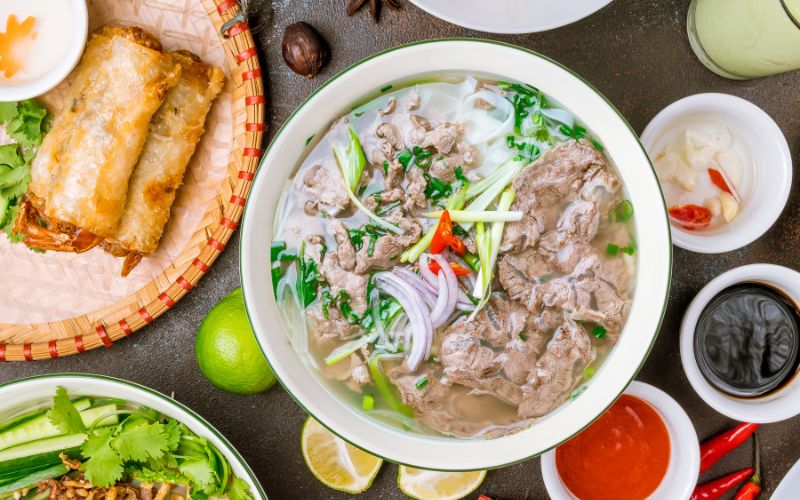
- Pho bo (beef pho): beef noodle soup, eaten for breakfast in Hanoi.

Pho bo (beef pho)
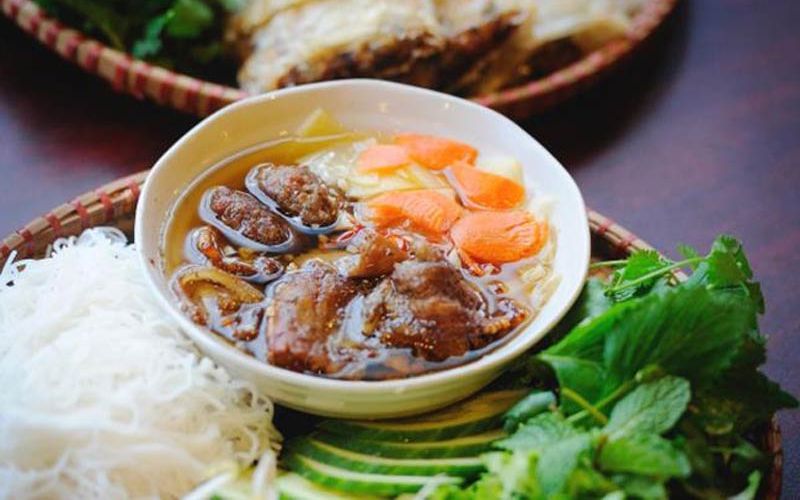
- Bun cha (grilled pork with rice noodles): grilled pork patties with rice noodles and herbs.
Bun cha (grilled pork with rice noodles)
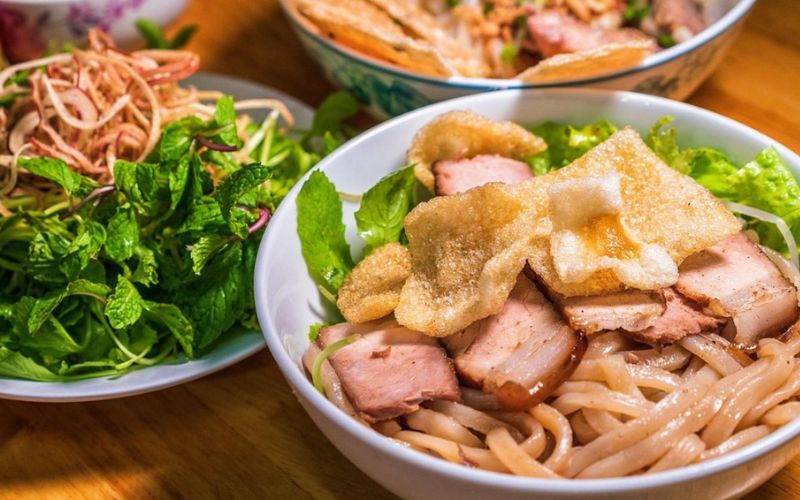
- Cao lau (Hoi An-style pork noodles): chewy noodles with pork and greens, found only in Hoi An.
Cao lau (Hoi An-style pork noodles)
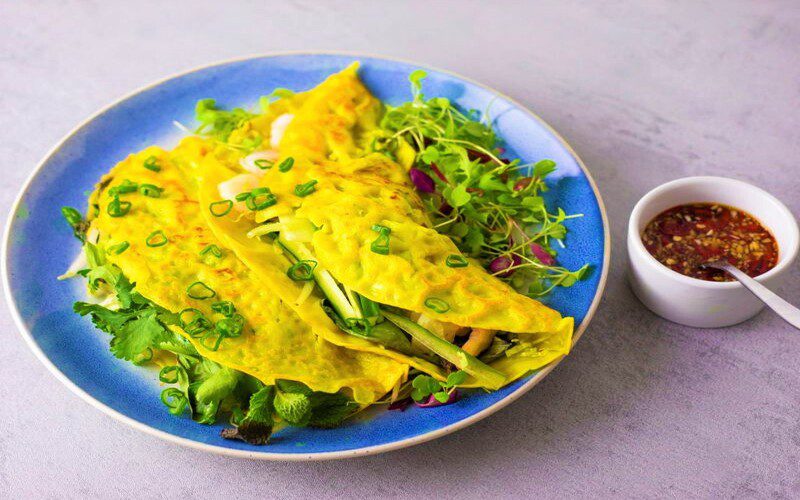
- Banh xeo (crispy savory pancake): a crispy rice pancake with shrimp and bean sprouts, wrapped in herbs.
Banh xeo (crispy savory pancake)
- Banh mi Hoi An: the Vietnamese baguette sandwich, at its best in Hoi An and Saigon.
Banh mi Hoi An

In Thailand
- Pad thai: stir-fried rice noodles with egg, tofu, peanuts and lime.
Pad Thai
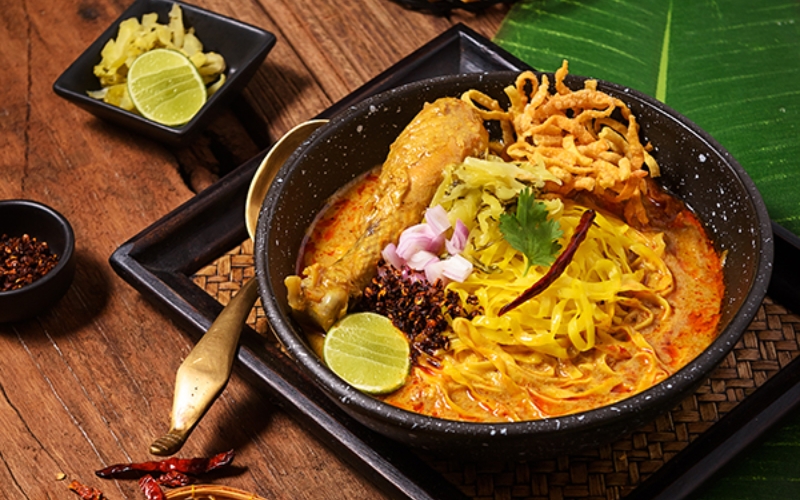
- Khao soi (northern curry noodles): curry noodle soup topped with crispy noodles, a Chiang Mai speciality.
Khao soi (northern curry noodles)
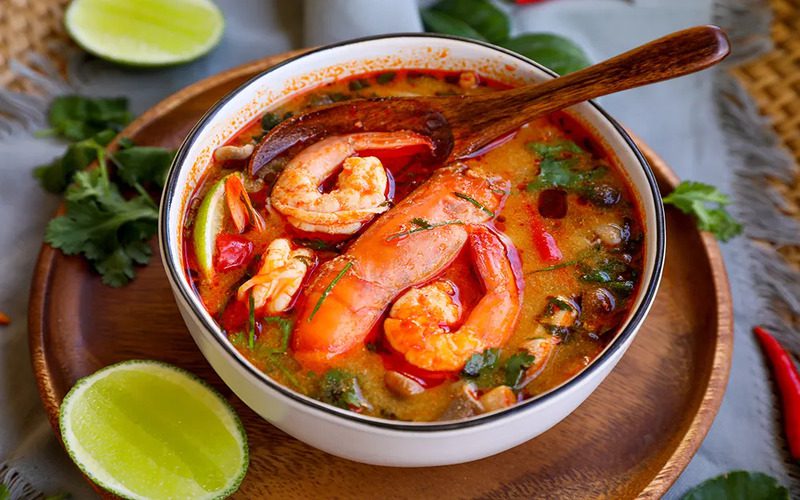
- Tom yum goong (Thai tom yum soup with shrimp and herbs): hot and sour prawn soup with lemongrass.
Tom Yum Goong (Thai tom yum soup with shrimp and herbs)
- Som tam (Green Papaya Salad): green papaya salad, as spicy as you ask for.
Som Tam (Green Papaya Salad)
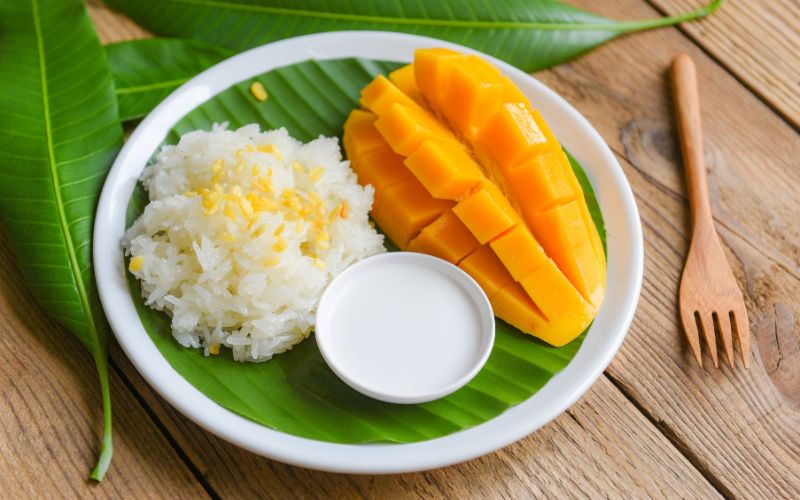
- Khao Niao Mamuang (Mango sticky rice): coconut sticky rice with ripe mango, best from March to June.
Khao Niao Mamuang (Mango Sticky Rice)


Estimated Budget for Vietnam and Thailand in 20 Days
The total depends on how many days fall in each country and whether the route finishes at a beach or in the mountains. These USD ranges are per person when 2 travellers share a room. A daily total combines a normal sightseeing day with a hotel night; arrival, transfer and recovery days may be cheaper.
Vietnam Estimated Daily Land Costs
| Daily cost category | Budget | Mid-range | Premium |
| Accommodation share per night | USD 20-45 | USD 55-120 | USD 150-350 |
| Meals and non-alcoholic drinks | USD 15-30 | USD 35-60 | USD 70-130 |
| Local ground transport | USD 8-25 | USD 25-60 | USD 70-180 |
| Guides, entrances and activities | USD 20-60 | USD 70-150 | USD 180-400 |
| Typical daily land total | USD 63-160 | USD 185-390 | USD 470-1,060 |
Thailand Estimated Daily Land Costs
| Daily cost category | Budget | Mid-range | Premium |
| Accommodation share per night | USD 25-60 | USD 70-170 | USD 220-650 |
| Meals and non-alcoholic drinks | USD 15-35 | USD 40-80 | USD 90-180 |
| Local ground transport | USD 8-30 | USD 25-75 | USD 80-240 |
| Guides, entrances and activities | USD 25-80 | USD 80-200 | USD 220-500 |
| Typical daily land total | USD 73-205 | USD 215-525 | USD 610-1,570 |
- Itinerary 1 contains about 13 Vietnam nights and 6 Thailand nights.
- Itinerary 2 contains roughly 8 Thailand nights and 11 Vietnam nights.
Use the relevant country table for the actual split, then lower the calculation for free or transfer days that do not include a guide and full activity programme.
Flights between regions and countries, checked baggage, visas, insurance, shopping and peak-date surcharges are excluded. Price the Ha Long cruise separately because the cabin, meals, transfers and activities can overlap the daily categories. Itinerary 1 may spend more on Nha Trang and Koh Samui hotels and flights; Itinerary 2 can shift more money toward private guides, the Ha Long to Sapa transition and mountain transport. Always compare quotations using the same list of inclusions.
Protect Energy During the Final Week
The final week should be designed differently for the 2 routes. Itinerary 1 ends with Bangkok and Koh Samui, so its purpose is recovery after a long Vietnam section. Itinerary 2 finishes with Ha Long Bay and Sapa, which makes the last days more active and transfer-heavy. Applying the same pacing advice to both would hide their real risks.
- Itinerary 1, protect the beach finish: Keep Bangkok Day 16 flexible, use Day 19 on Koh Samui as the weather buffer and avoid a long boat excursion immediately before the departure flight. If the sea programme moves because of conditions, replace another activity rather than filling the recovery day twice.
- Itinerary 2, protect the mountain finish: The Ha Long to Sapa transition after Day 16 is demanding. Use a small overnight bag, keep the Sapa walking distance adjustable and avoid an early fixed activity on the morning after the long transfer. Travellers who recover slowly should add a Hanoi night and shorten the mountain section.
- Schedule maintenance before it becomes urgent: Put laundry, repacking and medication checks into a two-night stay before the final sequence. Keep documents, essential medicine and a change of clothes in hand luggage during every flight or long road transfer.
- Limit consecutive early starts: 2 early mornings can work; a third should trigger a slower start or the removal of an optional excursion. Do not combine a late road arrival with a sunrise activity or an early flight.
- Use a clear drop rule: Choose in advance which market, temple, day trip or island activity is optional. Remove it when poor sleep, heat, rain or walking fatigue reduces enjoyment instead of forcing the group to complete the original list.
- Protect the departure city or island: Confirm the final airport, transfer duration and ticket protection before booking the last hotel. If the long-haul flight leaves from another city, move there the previous day rather than relying on a same-day domestic connection.
Energy planning is not an instruction to leave the final week empty. It is a way to place the hardest transfers beside genuine recovery time, so the headline experiences remain enjoyable rather than becoming obligations.
Design a 20-Day Trip Around Your Preferred Finish
Choose Koh Samui for beach recovery or Sapa for a more active final chapter. Contact IDC Travel to test the route against real flights and seasonal conditions with travel dates, room needs and activity level.
Read more:



Super helpful itinerary! I was worried 20 days wouldn’t be enough to see both countries properly, but this guide proved otherwise. The transitions between cities and countries seem smooth, and I appreciate the travel tips you added. Will definitely be saving this for my upcoming backpacking trip.
Thanks so much for your feedback! We’re really happy to hear that the itinerary helped you feel more confident about fitting both Vietnam and Thailand into your 20-day trip. With the right route, it’s totally doable — and unforgettable! If you ever need help with bookings, transport tips, or hidden gems along the way, we’re just a message away.
Best regards,
IDC Travel Team