

A journey through Cambodia and Vietnam in 10 days is enough for a memorable first visit if you choose a focused route and accept that some famous places must wait for another trip. The most rewarding plans either connect Hanoi, Ha Long Bay, Ho Chi Minh City and Angkor, or follow the Mekong from southern Vietnam through Phnom Penh to Siem Reap. Both options protect a full day at Angkor, avoid unnecessary backtracking and finish at a different airport from where they begin. This guide compares the routes day by day, explains current entry procedures and gateways, separates the budget for each country and shows how weather, food and travel pace should affect your decision.
How Should You Plan Vietnam and Cambodia in 10 Days?
The best way to plan Vietnam and Cambodia in 10 days is to give Vietnam 4-6 days, Cambodia 4-6 days and treat the country change as a genuine travel day. Trying to cover northern, central and southern Vietnam before adding Phnom Penh and Angkor produces more transfers than experiences.
Choose the first itinerary if Ha Long Bay is essential and you are comfortable taking 2 flights within the journey. Choose the second if the Mekong, Phnom Penh and a more continuous south-to-north story matter more than seeing several regions of Vietnam.
Itinerary 1: Vietnam Highlights and Angkor
- Route: Hanoi – Ha Long Bay – Ho Chi Minh City – Mekong Delta – Phnom Penh – Siem Reap
- Best for: First-time visitors who want a northern landscape, a southern city and Cambodia’s most important heritage experience
- Strengths: Ha Long Bay and Angkor provide 2 clear highlights, while Hanoi and Ho Chi Minh City reveal contrasting sides of Vietnam
- Weaknesses: The route requires 2 flights, several hotel changes and a quick introduction to Phnom Penh
- Best time: December to February for the broadest overlap of drier weather in southern Vietnam and Cambodia, although Hanoi and Ha Long Bay may feel cool or cloudy
- Should avoid: Travellers who dislike flights, want slow mornings or prefer several nights in each destination
Day 1 | Arrive in Hanoi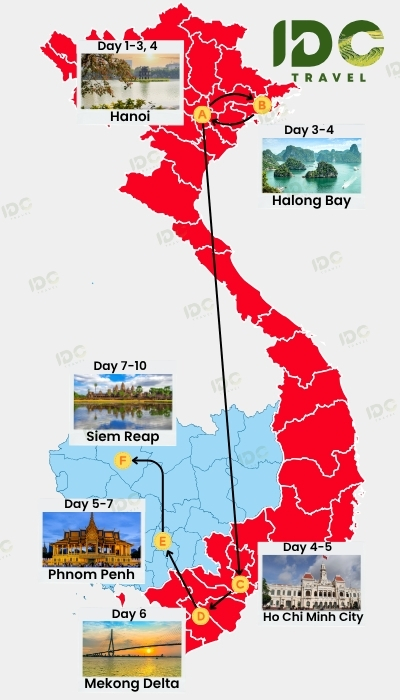
Check in, recover from the flight and take a short walk around Hoan Kiem Lake. Keep dinner close to the hotel so the first full sightseeing day starts with energy.
Day 2 | Hanoi History and Street Life
Combine the Old Quarter, the Temple of Literature and one museum or market. Try bun cha (grilled pork with rice noodles and herbs) without crossing the city repeatedly for isolated attractions.
Day 3 | Hanoi to Ha Long Bay
Travel to the coast and board an overnight cruise. Confirm the sailing route and included activities shortly before departure because weather and port instructions can affect the programme.
Day 4 | Ha Long Bay to Ho Chi Minh City
Disembark after the morning cruise, return toward Hanoi and fly south. Treat this as a transfer day and leave the evening free rather than adding a formal city tour.
Day 5 | Ho Chi Minh City and Cu Chi
Choose a focused city programme or combine selected central sights with the Cu Chi Tunnels. Avoid attempting a full museum circuit and a distant evening attraction on the same day.
Day 6 | Mekong Delta Excursion
Explore waterways, orchards and riverside communities on a day trip from Ho Chi Minh City. Ask whether the programme uses small boats, cycling or longer road transfers so it suits your group.
Day 7 | Fly to Phnom Penh
Complete the country change and settle near the riverside or central districts. If the flight arrives early, choose one museum or a gentle evening walk, not a compressed full-day programme.
Day 8 | Phnom Penh to Siem Reap
Visit one priority site in Phnom Penh before travelling to Siem Reap by road or air according to the current schedule. Build in a proper meal and avoid booking a performance immediately after arrival.
Day 9 | Angkor Archaeological Park
Start early for Angkor Wat, Angkor Thom and a carefully selected smaller temple. A licensed guide helps connect the architecture, history and religious symbolism while keeping the route efficient.
Day 10 | Depart Siem Reap
Use any spare time for a local market or a quiet breakfast. Keep at least three hours before an international flight and more when the itinerary uses separate tickets.
>>> View IDC Travel’s complete Ha Long Bay and Angkor journey for a bookable itinerary with accommodation, guides, selected meals, transfers, the Ha Long cruise and the 2 flight sectors built into one programme.
Pace note: This is the more varied but more demanding itinerary. It works best for travellers who can manage several early starts and who consider both Ha Long Bay and Angkor essential. Families with young children or travellers who need slower days should remove either Cu Chi or the Mekong excursion rather than shortening the Angkor day.
Itinerary 2: Southern Vietnam, Phnom Penh and Angkor
- Route: Ho Chi Minh City – Can Tho – Phnom Penh – Siem Reap
- Best for: Travellers who prefer a connected Mekong journey, modern history and more time in Cambodia
- Strengths: The route avoids a north-to-south flight within Vietnam, gives Phnom Penh a complete day and provides 2 full days around Siem Reap
- Weaknesses: It includes long road transfers and omits Hanoi, Ha Long Bay, Hue and Hoi An
- Best time: December to February for generally drier conditions in southern Vietnam and Cambodia
- Should avoid: Travellers for whom northern or central Vietnam is the main reason for visiting
Day 1 | Arrive in Ho Chi Minh City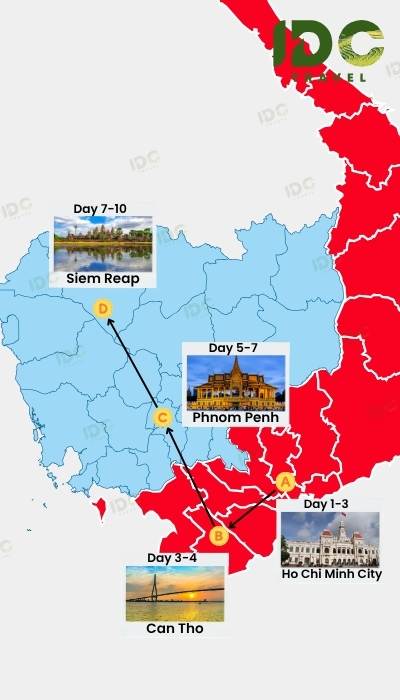
Check in and explore one nearby neighbourhood. Use the evening to sample com tam (broken rice with grilled meat and accompaniments) and recover from the flight.
Day 2 | Ho Chi Minh City and Cu Chi
Visit the Cu Chi Tunnels with a guide, then choose only the central landmarks that match your interests. Travellers focused on museums may prefer to keep the whole day in the city.
Day 3 | Ho Chi Minh City to Can Tho
Travel into the Mekong Delta through selected villages or waterways. Stay in Can Tho so the following morning begins near the river rather than after a pre-dawn drive from the city.
Day 4 | Can Tho and the Lower Mekong
Explore the river early, then continue with an orchard, local workshop or countryside cycle ride. Keep expectations realistic because market activity and river conditions change with local trade and season.
Day 5 | Continue to Phnom Penh
Cross into Cambodia using the transport option confirmed for your travel date. Keep passports, visa documents, arrival confirmation and a small amount of cash in one accessible folder.
Day 6 | Phnom Penh with Context
Pair the Royal Palace area with either the National Museum or a thoughtfully paced modern-history visit. A private guide can help families and first-time visitors decide how much sensitive history is appropriate.
Day 7 | Phnom Penh to Siem Reap
Travel to Siem Reap and settle in before sunset. If travelling by road, use a private vehicle or reputable service with planned comfort stops.
Day 8 | Angkor Wat and Angkor Thom
Give the main temple circuit a full day. Begin early, return to the hotel during the hottest hours if needed and carry water plus clothing that covers shoulders and knees.
Day 9 | Siem Reap Beyond the Main Circuit
Choose Banteay Srei, Tonle Sap or a village and craft experience according to season and interests. Do not add all three merely to fill the schedule.
Day 10 | Depart Siem Reap
Keep the final morning light and allow time for airport formalities. If the journey continues through another hub, protect the connection with a sensible margin.
>>> Explore IDC Travel’s southern Vietnam, Mekong and Cambodia itinerary for a journey that includes Can Tho, the overland country change, a complete Phnom Penh day and additional time around Siem Reap.
Pace note: This route has fewer large geographic jumps, but it is not a slow holiday. Day 4, Day 5 and Day 7 still involve substantial road travel. It suits travellers who see the Mekong corridor as part of the experience rather than time lost between attractions.
How Much Does a 10-Day Vietnam and Cambodia Trip Cost?
A 10-day Vietnam and Cambodia trip should be budgeted country by country because accommodation, transport and activity costs differ. The following figures are planning ranges per person, assuming 2 travellers share a room. They are not supplier quotations.
Count accommodation by the number of nights spent in each country, while meals, transport and activities should be counted by the actual days used. Itinerary 1 has approximately 6 nights in Vietnam and 3 nights in Cambodia. Itinerary 2 has approximately 4 nights in Vietnam and 5 nights in Cambodia.
Regional flights, visas, insurance, checked baggage, the Ha Long cruise package, the Angkor pass, premium nightlife, shopping and personal expenses must be added separately.
Vietnam Daily Planning Range
| Cost category | Budget | Mid-range | Luxury |
| Accommodation per person per night | USD 20-45 | USD 55-120 | USD 150-350 |
| Meals and drinks per day | USD 15-30 | USD 35-60 | USD 70-130 |
| Local transport per day | USD 8-25 | USD 25-60 | USD 70-180 |
| Guides, entrances and activities per day | USD 20-60 | USD 70-150 | USD 180-400 |
| Indicative daily total | USD 63-160 | USD 185-390 | USD 470-1,060 |
Money-saving tip: Spend more on the experiences where organisation materially improves the day, such as the Ha Long cruise or a private Mekong guide. Use a well-located hotel and walkable sightseeing plan in Hanoi or Ho Chi Minh City instead of paying for repeated cross-city transfers.
Cambodia Daily Planning Range
| Cost category | Budget | Mid-range | Luxury |
| Accommodation per person per night | USD 18-40 | USD 50-110 | USD 140-320 |
| Meals and drinks per day | USD 12-25 | USD 30-55 | USD 65-120 |
| Local transport per day | USD 8-22 | USD 25-55 | USD 65-150 |
| Guides, entrances and activities per day | USD 20-55 | USD 65-140 | USD 160-350 |
| Indicative daily total | USD 58-142 | USD 170-360 | USD 430-940 |
Money-saving tip: A licensed guide adds the most value on the main Angkor day and during sensitive history visits in Phnom Penh. A driver without a guide may be sufficient for a simple transfer or a free afternoon.
- Itinerary 1 normally assigns more nights to Vietnam and pays for an extra flight.
- Itinerary 2 shifts more nights to Cambodia and may spend more on a private Mekong or border transfer.
When comparing quotations, check whether airport transfers, checked baggage, cruise cabin, Angkor guide, entrance passes and tips are included.
Essential Travel Guide for Cambodia and Vietnam in 10 Days
The practical side of a Vietnam Cambodia journey becomes much easier when visas, arrival declarations, airports, money and the country transfer are planned as one system. Complete the entry requirements for each country separately, then protect the experiences that justify the trip before adding optional attractions.
What Entry Documents Should You Prepare for Vietnam and Cambodia?
Travellers should check the rules for their own passport and planned entry point before buying non-refundable transport. Vietnam’s visa or exemption conditions do not determine Cambodia’s requirements, and Cambodia e-Arrival does not replace a visa.
Vietnam
Vietnam provides an electronic visa valid for up to 90 days with single or multiple entry options. The official fees currently shown are USD 25 for a single-entry e-Visa and USD 50 for a multiple-entry e-Visa.
Apply only through the official Vietnam e-Visa portal. Confirm that the name, passport number, travel dates and entry gate match the journey exactly. The application fee is non-refundable if the visa is refused.
The Immigration Department also recommends that incoming passengers complete the Vietnam Pre-Arrival Information form before entry. Check the current instructions for your arrival airport and save the completed information or confirmation offline.
For an overland itinerary, the approved Vietnamese exit gate must also match the route. Itinerary 2 uses the Moc Bai-Bavet corridor, so travellers should check that Moc Bai remains valid for their document before confirming the transfer.
Cambodia
Check passport eligibility, visa type and entry point through the official Cambodia e-Visa portal. The tourist e-Visa currently costs USD 30, allows a single entry and permits a stay of up to 1 month. The official portal lists an estimated processing time of 3 business days.
The portal currently lists Techo International Airport, Siem Reap Angkor International Airport and Bavet among the entry points accepting an e-Visa. That makes the e-Visa relevant to both itineraries in this guide, but eligibility and port status should be checked again before travel.
Cambodia e-Arrival is a separate arrival declaration. It is not a visa. The official system says all travellers, including those who already hold a visa, must complete the form and recommends submission within 7 days before arrival.
Use only the official Cambodia e-Arrival portal. Registration is free. Save a screenshot or downloaded copy of the QR code before leaving a reliable internet connection.
Entry information and fees above were checked on 26 September 2026. Travellers should recheck the official portals shortly before departure because border procedures can change.
Which Airports and Border Routes Make the Country Change Easier?
An open-jaw flight plan is usually the most efficient choice: arrive in the first city of the itinerary and fly home from the final city instead of returning to the starting point.
Vietnam’s most useful gateways for this journey are Noi Bai International Airport in Hanoi and Tan Son Nhat International Airport in Ho Chi Minh City.
Cambodia now uses:
- Techo International Airport with the code KTI for Phnom Penh. It is the capital’s current main international gateway and is approximately 20 kilometres south of the city.
- Siem Reap Angkor International Airport with the code SAI for Siem Reap and Angkor.
The former Phnom Penh airport code PNH should not be used when planning current flights to the capital.
For the transfer between the 2 countries, compare the complete door-to-door journey rather than the flight or bus time alone:
- Fly to KTI when Phnom Penh is an important part of the itinerary and time predictability matters.
- Fly to SAI when Angkor is the only Cambodia priority and a suitable nonstop or connecting service operates on the required date.
- Use the Moc Bai-Bavet road corridor when travelling from Ho Chi Minh City to Phnom Penh and the overland journey supports the route’s Mekong story.
- Consider a river or alternative border journey only after verification. The operator, schedule, entry direction, visa type and border-point eligibility must all work together.
For Itinerary 1, the cleanest flight structure is normally an international arrival in Hanoi, a domestic sector to Ho Chi Minh City, a regional flight to KTI and an international departure from SAI.
For Itinerary 2, arrive in Ho Chi Minh City, cross by road through Moc Bai-Bavet, travel from Phnom Penh to Siem Reap and depart from SAI.
Travellers can also reverse either route if international fares or onward connections work better. The important principle is to avoid returning to Hanoi, Ho Chi Minh City or Phnom Penh solely to catch the flight home.
Do not assume that a particular nonstop flight operates every day. Confirm the schedule before fixing hotels, and leave a larger buffer when tickets are issued separately. Contact IDC Travel if you need help comparing the current flight, private-transfer and border options before booking the hotel sequence.
How Should You Manage Money in Both Countries?
Use Vietnamese dong for normal spending in Vietnam. In Cambodia, carry Cambodian riel for smaller transactions while recognising that clean US dollar notes are still widely used in tourism areas.
Paying in Vietnam
Use Vietnamese dong (VND) for everyday payments in Vietnam, while keeping an international card and a separately stored backup card for larger or unexpected expenses.
- Main currency: Vietnamese dong, written as VND or ₫.
- Cash is useful for: Street food, markets, small cafés, local taxis, tips and services outside major tourist centres.
- Cards usually work at: Established hotels, larger restaurants, shopping centres and professional tour operators.
- ATM availability: International-card ATMs are common in Hanoi and Ho Chi Minh City but may be less convenient during Mekong excursions or early departures.
- Before withdrawing: Check the ATM operator’s fee, withdrawal limit and the charges applied by your own bank.
- Currency conversion: If an ATM or card terminal offers to charge the transaction in your home currency, compare the displayed rate carefully. Paying or withdrawing in VND usually allows your card network or bank to handle the conversion.
- Practical preparation: Withdraw or exchange enough VND before leaving a major city, but do not carry the full trip budget during sightseeing.
- Backup plan: Store the main card, backup card and emergency cash separately so the loss or rejection of one payment method does not interrupt the journey.
For banknote identification, ATM guidance, authorised exchange options and cash-declaration rules, read IDC Travel’s Vietnam Currency Guide.
Paying in Cambodia
Carry a combination of Cambodian riel (KHR), clean US dollar notes and an international card when travelling in Cambodia.
- Main currency: Cambodian riel is the national currency.
- Use of US dollars: US dollars are also commonly accepted in hotels, restaurants and tourism areas, while riel is frequently used for smaller purchases and change.
- Cash is useful for: Markets, tuk-tuks, small shops, local meals, tips and stops outside Phnom Penh or Siem Reap.
- Cards usually work at: Established hotels, larger restaurants, shopping centres and professional travel businesses.
- Condition of USD notes: Torn, heavily marked or badly worn US dollar notes may be refused. Check every note received as change before leaving the counter.
- ATM withdrawals: Fees, limits and available currencies differ by bank, machine and card issuer. Read the complete ATM screen before confirming a withdrawal.
- Currency conversion: Decline an ATM’s conversion into your home currency unless you have compared the offered rate with your card provider’s terms.
- Before travelling onward: Obtain enough modest cash denominations before a temple day, rural excursion or long road transfer, but keep emergency money separate from the daily wallet.
IDC Travel’s Cambodian Currency Guide explains how riel and US dollars work together, where to exchange money and how to avoid common payment problems.
What Experiences Should You Protect in a 10-Day Itinerary?
Protect 2 defining experiences before adding secondary attractions. A short multi-country itinerary usually becomes unsatisfying when every important place is reduced to a few rushed hours.
- For Itinerary 1, the anchors are the overnight Ha Long cruise and a complete Angkor day.
- For Itinerary 2, they are the Mekong journey and at least 2 nights in Siem Reap.
Use the following rules when the schedule becomes too full:
1. Remove a region before shortening every destination. Central Vietnam requires a flight through Da Nang and at least 2 nights to make Hoi An worthwhile. It should not be squeezed between Ho Chi Minh City and Cambodia without removing another region.
2. Remove duplicated experiences. A well-designed Mekong programme is stronger than several similar boat stops. A coherent Angkor circuit is more useful than collecting unrelated temples merely to increase the count.
3. Protect recovery after the country change. A free evening after a flight or border crossing is more valuable than an attraction experienced while tired, hungry and worried about luggage.
4. Keep a complete Angkor day. Do not shorten the main temple circuit to claim another city in Vietnam. The transfer to Cambodia makes little sense if Angkor becomes a hurried half-day stop.
5. Keep Phnom Penh when it supports the story. The capital belongs in the route when travellers value modern Cambodian history, architecture or the Mekong connection. It can be removed when Angkor is the sole Cambodia priority and a direct route to SAI substantially improves the journey.
6. Save important documents offline. Store visa approvals, e-Arrival QR codes, insurance details, flight tickets, hotel addresses and emergency contacts on each traveller’s phone.
7. Check baggage rules across separate flights. A regional ticket may include less checked baggage than the international journey. Paying in advance is often simpler than reorganising luggage at the airport.
8. Avoid a fragile final day. Do not place a long road transfer, cruise return or border crossing immediately before the international flight home.
These choices turn a compressed country count into a coherent Vietnam Cambodia holiday.
When Is the Best Time to Visit Cambodia and Vietnam in 10 Days?
December to February is generally the best time to visit Vietnam and Cambodia in 10 days because southern Vietnam and Cambodia are usually drier, while temperatures around Phnom Penh and Angkor are more comfortable for long outdoor visits.
However, northern Vietnam follows a different weather pattern from Ho Chi Minh City and Cambodia. The best month therefore depends partly on whether the itinerary includes Hanoi and Ha Long Bay or remains around Mekong and Cambodia.
| Travel period | General conditions | Best for | Main consideration |
| December to February | Drier weather in southern Vietnam and Cambodia; cooler conditions in northern Vietnam | First-time visitors, Angkor sightseeing, Mekong journeys and city tours | Hanoi and Ha Long Bay may feel cool, misty or cloudy |
| November and March | Transitional weather with generally workable conditions across both countries | Travellers seeking a balance between weather, greenery and visitor numbers | March becomes noticeably hotter around the Mekong and Angkor |
| April | Hot conditions across southern Vietnam and Cambodia | Travellers who tolerate heat and can begin outdoor activities early | Midday temple visits and long road journeys can become tiring |
| May to October | Wetter, greener and generally less crowded | Flexible travellers, greener landscapes and fuller waterways | Heavy showers may affect cruises, roads, boat trips and outdoor schedules |
Best Time for the Ha Long Bay and Angkor Itinerary
December to February is a practical overall period for this itinerary, but travellers should prepare for different conditions in each region.
- Hanoi and Ha Long Bay: Expect cooler mornings and the possibility of mist or grey skies. Bring a light layer rather than packing only tropical-weather clothing.
- Ho Chi Minh City and the Mekong Delta: The southern dry season generally makes city touring and river excursions easier.
- Phnom Penh and Siem Reap: Lower rainfall and more manageable temperatures support longer sightseeing days around Angkor.
- Main scheduling risk: Ha Long cruise operations remain subject to weather and official safety decisions. Do not place the flight to Ho Chi Minh City immediately after the expected cruise return without a realistic road and check-in buffer.
- Period requiring more flexibility: Summer and early autumn may bring heavier rain or storms in northern Vietnam. Keep the cruise-to-flight connection adjustable where possible.
Best Time for the Mekong, Phnom Penh and Angkor Itinerary
December to February provides the most comfortable overall conditions for southern Vietnam, Phnom Penh and Siem Reap.
- Ho Chi Minh City and the Mekong Delta: Drier weather usually makes road transfers, boat activities and village visits easier to organise.
- Phnom Penh: Cooler mornings and lower rainfall are helpful for city walks and outdoor heritage sites.
- Siem Reap and Angkor: Begin early even during the cooler season because temple circuits involve prolonged walking and limited shade.
- March and April: Travel remains possible, but the heat becomes more demanding. Schedule outdoor visits in the morning and leave the hottest part of the day for lunch, rest or indoor activities.
- May to October: The Mekong and Tonle Sap landscapes become greener, but rainfall and changing water levels can alter boat programmes. Avoid treating a specific floating-market or lake experience as guaranteed without checking seasonal conditions.
Travellers planning a northern and southern route can compare IDC Travel’s guide to the best time to visit Vietnam. For temple weather, the green season and month-by-month conditions, consult the best time to visit Cambodia before fixing the Angkor programme.
Top Vietnamese and Cambodian Dishes to Try
The best food choices follow the route rather than sending travellers across a city for a famous name. Northern Vietnamese cooking is generally more restrained and savoury, while southern food often uses more sweetness, coconut, tropical produce and abundant herbs. Khmer cuisine develops a different identity through freshwater fish, kroeung spice pastes, prahok, coconut and balanced sour, salty and gently sweet flavours.
What Should You Eat in Vietnam?
In Hanoi, look for clear flavours, grilled meats, rice noodles and fresh herbs. In Ho Chi Minh City and the Mekong, expect sweeter sauces, wider ingredient combinations and influences from the region’s trading history.
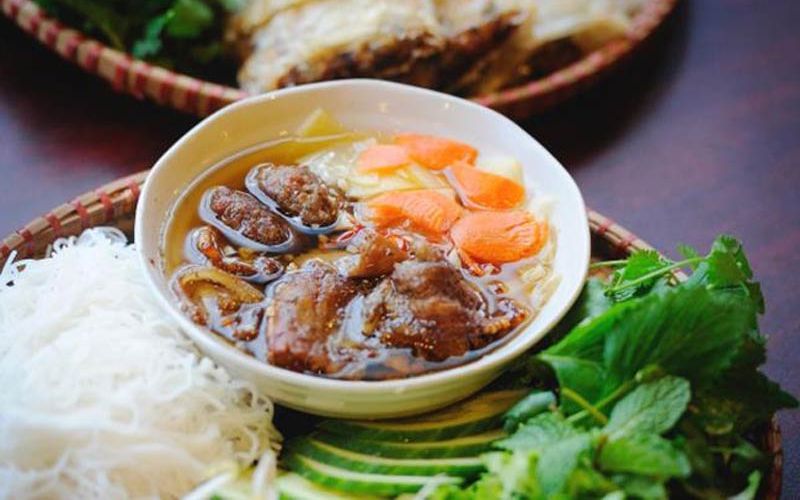
- Bun cha: Grilled pork served with rice noodles, herbs and a savoury-sweet dipping broth. It is a practical Hanoi lunch after exploring the Old Quarter.

Bun Cha
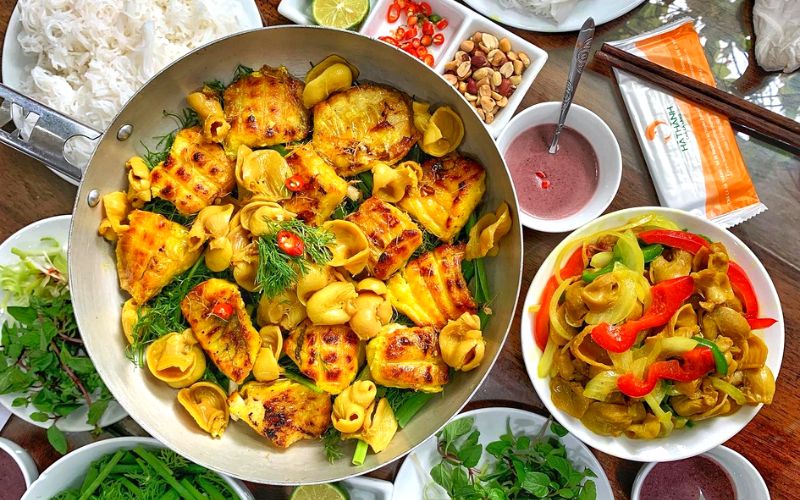
- Cha ca: Turmeric-marinated fish cooked with dill and spring onion, normally eaten with noodles, herbs and peanuts.
Cha ca (turmeric fish with dill)
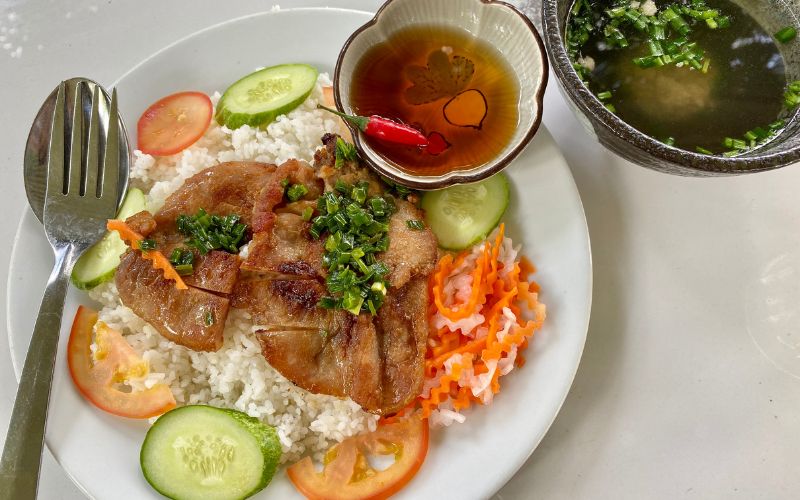
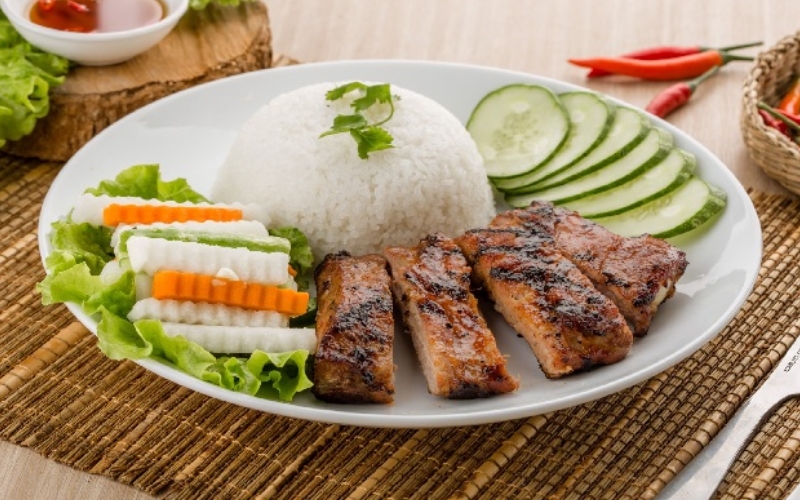
- Com tam: Broken rice with grilled pork, pickles, egg or other accompaniments. This is closely associated with everyday dining in Ho Chi Minh City.
Com tam (broken rice)
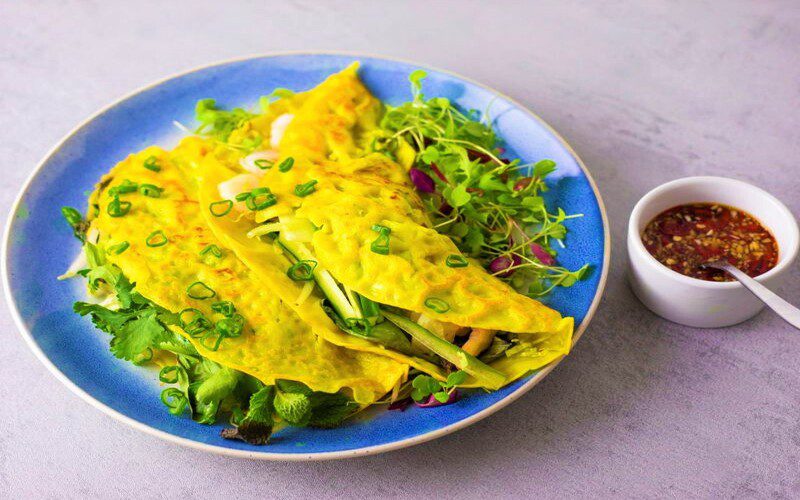
- Banh xeo: A crisp rice-flour pancake filled with ingredients such as shrimp, pork and bean sprouts, then wrapped with herbs.
Banh xeo (crispy savory pancake)
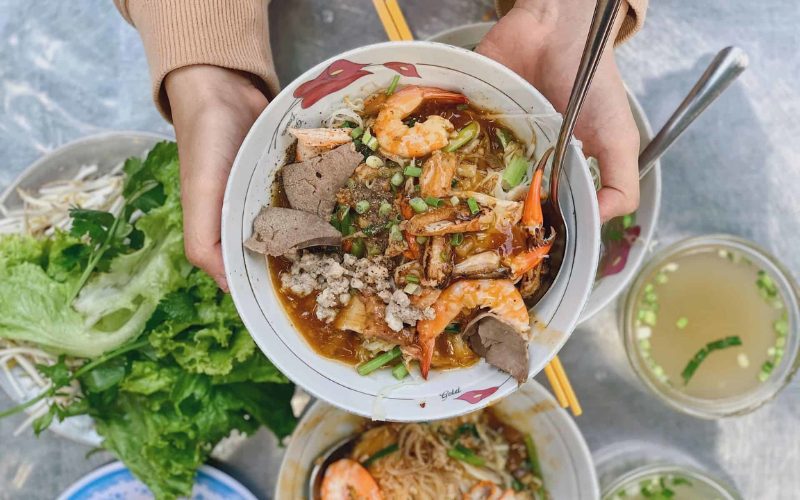
- Hu tieu: A southern noodle dish served with broth or dry, with variations across Ho Chi Minh City and the Mekong.
Hu tieu (southern noodle soup)
- Goi cuon: Fresh rice-paper rolls with herbs, noodles and shrimp, pork or vegetables, useful as a lighter meal during a busy travel day.
Goi cuon (Fresh spring rolls)
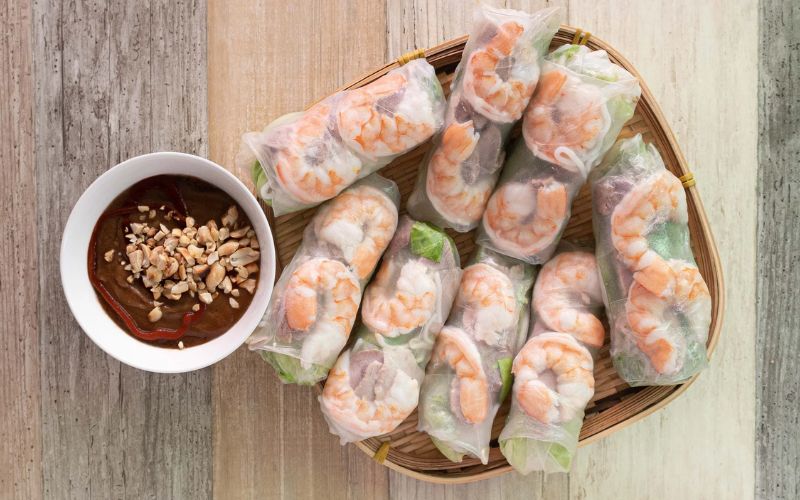
Explore IDC Travel’s guide to popular Vietnamese dishes if food is an important part of your Vietnam itinerary.
What Should You Eat in Cambodia?
Khmer food is often less chilli-heavy than visitors expect. Aromatic ingredients, fermented flavours and the balance between freshwater produce, herbs and rice are more important than strong heat.
- Fish amok: Fish cooked with coconut milk and kroeung, often steamed until soft and custard-like in a banana-leaf cup.
Fish amok (steamed coconut fish curry)
- Beef lok lak: Stir-fried beef served with vegetables and a lime-and-black-pepper dipping sauce.
Beef lok lak (shaking beef)
- Nom banh chok: Rice noodles topped with a fish-based herbal gravy, commonly eaten in the morning.
Nom banh chok (Khmer curry noodle)
- Bai sach chrouk: Grilled pork with rice, pickled vegetables and light broth, another popular breakfast.
Bai sach chrouk (grilled pork with rice)
- Samlor korkor: A substantial soup or stew using vegetables, herbs and fish or meat.
Samlor Korkor
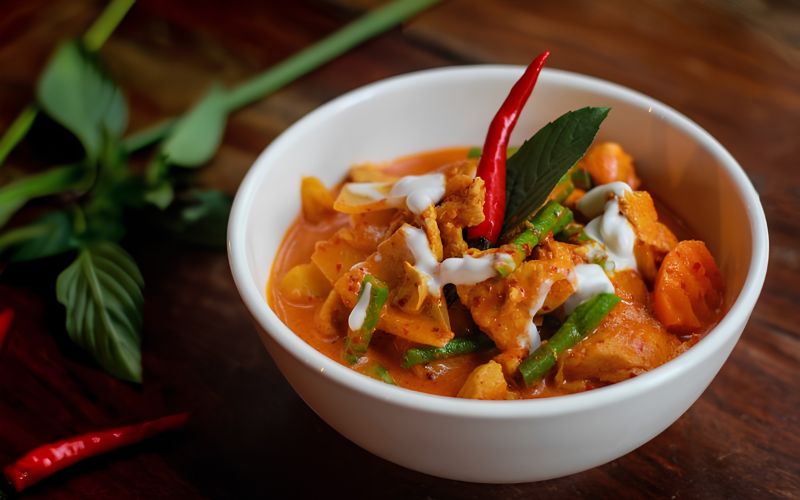
- Khmer red curry: A coconut-based curry that is generally milder than many neighbouring versions and may be served with bread or rice noodles.
Khmer red curry with chicken
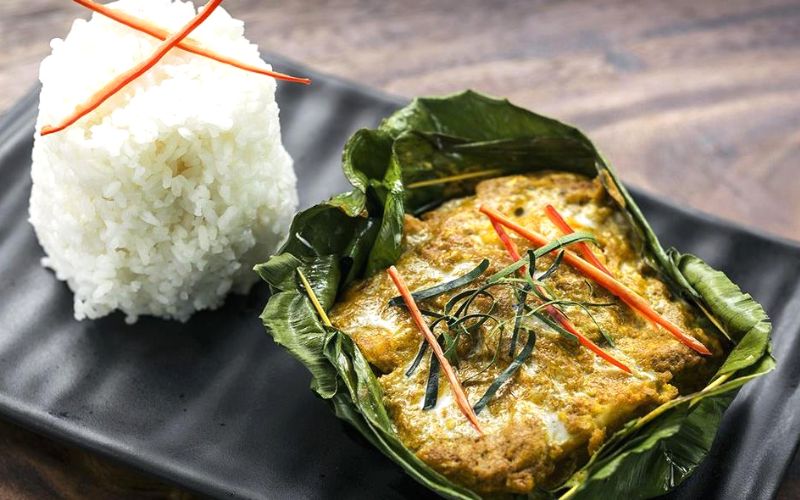
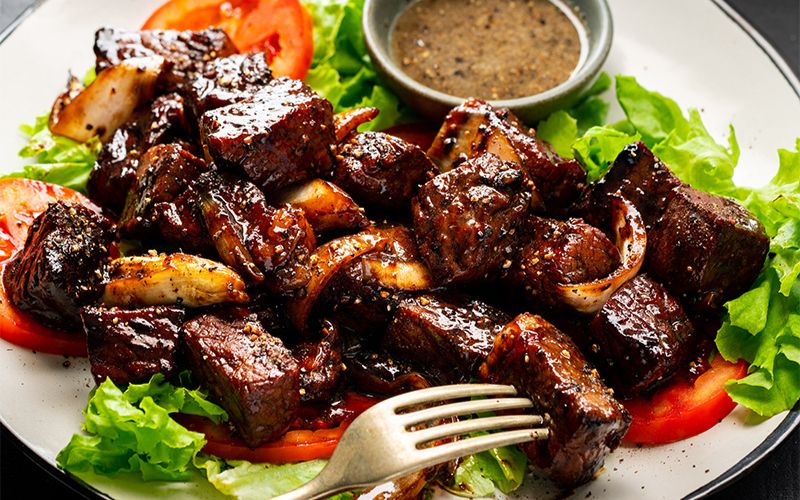
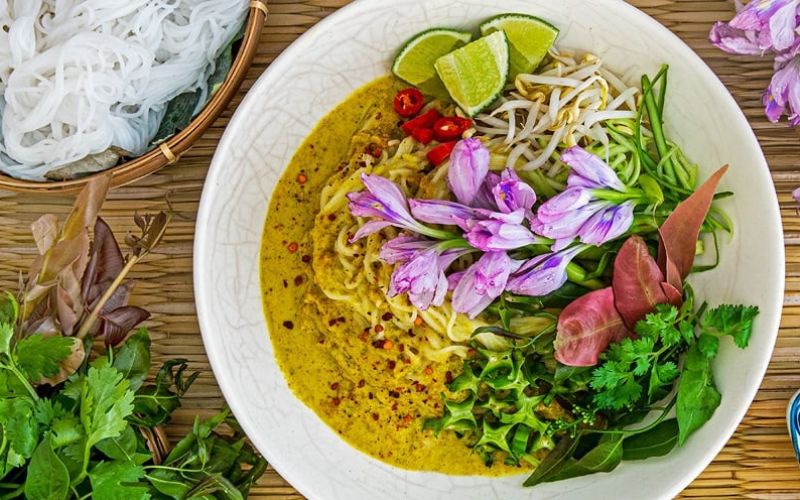

IDC Travel’s guide to the best dishes in Cambodia explains the ingredients and cultural background of Khmer specialities in more detail.
Travellers with allergies should carry translated cards in Vietnamese and Khmer. Ask specifically about fish sauce, shrimp paste, prahok, peanuts, coconut and shared cooking oil, even when these ingredients are not visible.
Build a Ten-Day Journey Around Your Priorities with IDC Travel
Choose the first itinerary if Ha Long Bay and a cross-section of Vietnam matter enough to justify 2 flights and a faster pace. Choose the second if you want the Mekong, a complete Phnom Penh day and more time around Siem Reap.
The strongest Vietnam Cambodia journey is not the one with the most pins on the map. It is the one that gives its defining places enough time to feel different from the transfers between them. Create a personalised Vietnam and Cambodia holiday with IDC Travel if you want the route, hotels, guides and country connection adjusted to your passport, month, interests and preferred pace.
Read more:



I really enjoy local food and street markets, and I read about Hanoi Old Quarter and Phnom Penh night markets. I’m a bit worried about money though because currencies are different and I don’t know how easy it is to pay everywhere. My question is, can I mostly use USD in both countries or should I exchange a lot to local currency?
USD is widely accepted in tourist areas of both Vietnam and Cambodia, especially for hotels, tours, and bigger restaurants. But for street food, small shops, and local transport, it’s better to have Vietnamese Dong in Vietnam and Riel in Cambodia. It’s a good idea to bring some cash in both currencies or exchange along the way. Wish you a good trip!
I’m planning my first trip to Southeast Asia and I want to see as much as possible in a short time. I love history and temples, but I’m worried about being too rushed in 10 days. Reading this itinerary, it seems so packed and I’m not sure if I can really enjoy each place. So my question is, is it realistic to do both Vietnam and Cambodia in 10 days without feeling exhausted?
It’s possible to see the highlights of both countries in 10 days, but yes, it will be quite busy. You’ll mostly focus on major attractions like Hanoi, Ha Long Bay, Ho Chi Minh City, Phnom Penh, Siem Reap, and Angkor Wat. If you prefer a slower pace, you might consider focusing on just one country or adjusting the itinerary to skip a few places.
What’s the best time of year to do this 10-day Vietnam and Cambodia trip?
The ideal time is from November to March, when the weather is cooler and drier in both countries. You’ll avoid the peak heat and heavy rains, making it much more comfortable for sightseeing and travel.
I am a foodie traveler, and I am going to Vietnam and Cambodia this March. Can you share some local restaurants that offer authentic cuisines of these two countries? Thanks a lot.
Hi Sebastian, thank you for reaching us! To get an authentic culinary journey to Vietnam and Cambodia, we suggest visiting these restaurants.
In Vietnam
Hanoi Garden: established in 1988 in the OId Quarter, this restaurant offers a variety of Vietnamese dishes in a setting that blends tradition with modernity.
Banh Khoai Thuong Tu: If you visit Hue, then this is a place to go. Located adjacent to the palace, this eatery is famed for its Vietnamese crepes, incorporating unique ingredients specific to Hue’s culinary heritage.
Ben Thanh Market: This is one of the most bustling markets in Ho Chi Minh City, where you can enjoy street food. This place is even more vibrant in the evenings!
Cambodia:
Malis: This restaurant, which has branches both in Phnom Penh and Siem Reap and is renowned for its innovative approach to Cambodian cuisine, offers an excellent dining experience.
Cuisine Wat Damnak: Led by Chef Joannès Rivière, this restaurant focuses on seasonal, locally sourced ingredients to craft menus that reflect the rich tapestry of Cambodian flavors.
Khmer Kitchen: Located in Siem Reap, this is a popular spot for traditional Cambodian dishes, this restaurant offers a range of authentic flavors in a welcoming atmosphere.
We hope this suggestions will help you in your trip. If you need any further information, please contact us, our gurus are willing to help at any time.
Best regards,
IDC Travel Team.