
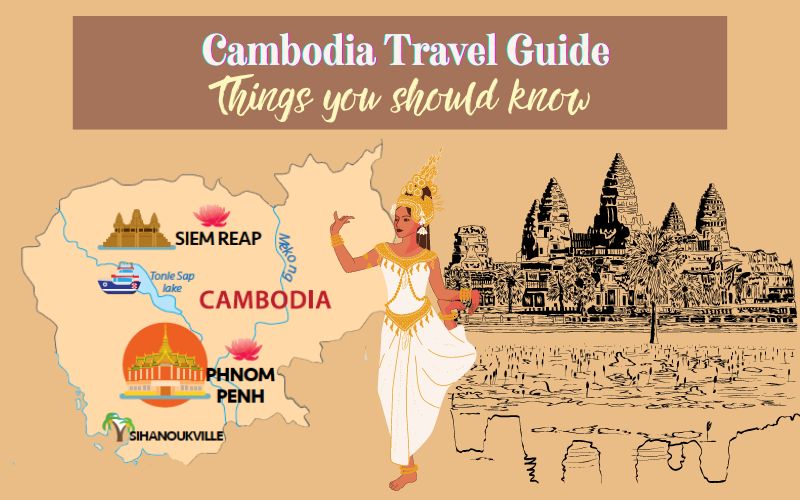
Cambodia travel guide essentials, upfront: a tourist e-visa runs $30, the one-day Angkor Pass costs $37, and a realistic daily budget lands between $30 and $100 depending on how you travel. If you’re weighing Cambodia visa requirements, working out Cambodia travel costs, or just asking when to go, the short version is the dry season from November to February for the easiest weather, with the shoulder months on either side saving you real money on flights and hotels.
What follows is everything a first-time visitor actually needs before booking: current 2026 visa rules and the e-Arrival card, where to go and how many days each region deserves, an honest cost breakdown by budget tier, what to eat, and the etiquette and safety details that keep a trip smooth from Phnom Penh to the temples of Angkor.
Cambodia Travel Guide at a Glance: Essential Fast Facts
| Capital | Phnom Penh |
| Currency Cambodian | Riel (KHR), but US Dollars (USD) are used for almost all everyday transactions; riel mostly shows up as small change |
| Language | Khmer |
| Time zone | ICT, UTC+7 (no daylight saving) |
| Plug type | Type A/C/G sockets, 230V; pack a universal adapter, as all three show up depending on the building |
| Emergency numbers | Police 117, Fire 118, Ambulance 119 |
| International airport | Phnom Penh: Techo International Airport (KTI), Siem Reap: Siem Reap-Angkor International Airport (SAI), Sihanoukville: Sihanouk International Airport (KOS) |
Tourist SIM cards from Cellcard, Smart, or Metfone are sold at counters in both Phnom Penh and Siem Reap international airports, and typically cost $5-10 USD (~12,500-25,000 KHR) for a data package that covers the length of a standard trip; bring your passport, since registration is required by law.
Best Time to Visit Cambodia: Season & Weather Guide
Cambodia’s pricing follows the weather in a simpler way than you might expect: rather than a gradual shoulder-season curve, hotels, guides, and tour operators generally split the year into just two rates, high season from October through April and low season from May through September. Here’s how each half of the calendar actually plays out, and what to do with it.
High Season (October-April)
This stretch covers Cambodia’s entire dry period, and the weather shifts noticeably within it: cool and comfortable from November through February, with daytime temperatures around 24-30°C (75-86°F), then climbing fast in March and April, often hitting 35-40°C (95-104°F) by early afternoon. Pricing stays at the high-season rate the whole way through regardless of that swing, and it’s peak season for a reason: the driest, most reliable weather for temple visits and beach time, and the biggest crowds at Angkor Wat to match.
April carries an extra note: Cambodian Khmer New Year (Choul Chnam Thmey, usually around April 13-15) falls right in this window, and domestic travel surges alongside the usual international high season. That pushes prices higher still and empties out rooms and transport earlier than the rest of high season.
Best for: first-time visitors who want reliable dry weather for temples and beaches; just budget for the highest prices of the year.
Pro tip: book Siem Reap accommodation 4 to 6 weeks ahead for December or January. If your dates fall around mid-April, book earlier still and confirm long-distance transport too, since Khmer New Year sells out both ahead of the rest of high season.
Low Season (May-September)
This is the wet season, though showers tend to arrive as short, heavy downpours rather than all-day rain, and the countryside turns a brilliant green. Tonle Sap Lake swells to several times its dry-season size, bringing its floating villages back to life. It’s also the one stretch of the year with meaningfully cheaper hotel and tour pricing.
Best for: landscape and photography-focused travelers, anyone who wants Angkor Wat’s reflecting pools actually full of water, and budget-conscious travelers willing to plan around the rain.
Pro tip: unpaved rural roads, think Battambang’s countryside or a Cardamom Mountains trek, can turn to mud in August and September, so build in extra transfer time if your route includes them.
Important Cambodia Cultural Festivals to Plan Around
Two festivals are worth timing a trip around, and one is worth knowing about so it doesn’t catch you off guard.
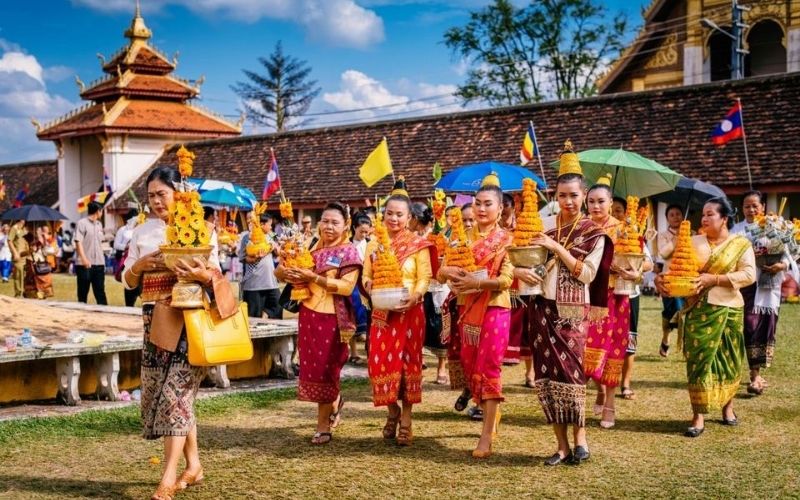
- Choul Chnam Thmey, the Khmer New Year, 14-16 April 2026: Cambodia’s biggest holiday. Most Cambodians travel home to their home province, city offices and many restaurants close for several days, and pagodas fill with visitors. Rewarding if you’re in a rural town for it, frustrating if you needed something done in Phnom Penh that week.

Khmer New Year – Choul Chnam Thmey
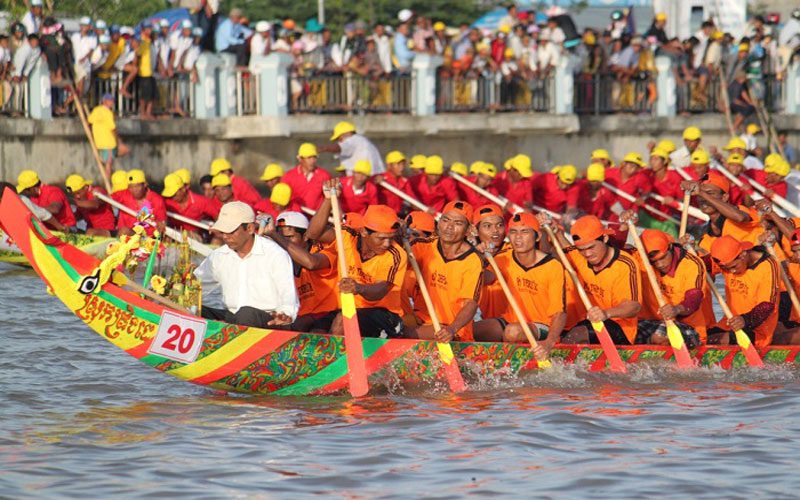
- Bon Om Touk, the Water Festival, late November (tentatively 23-25 November 2026): Cambodia’s largest secular celebration, with boat races, illuminated floats, and fireworks along the Phnom Penh and Siem Reap riverfronts. It follows the lunar calendar, so exact dates are only confirmed closer to the event. Spectacular, but also the single most crowded weekend of the year in the capital, so book ahead if your trip lands on it. See more in our new update Bon Om Touk 2026’s An Unforgettable Festival in Cambodia.
Bon Om Touk
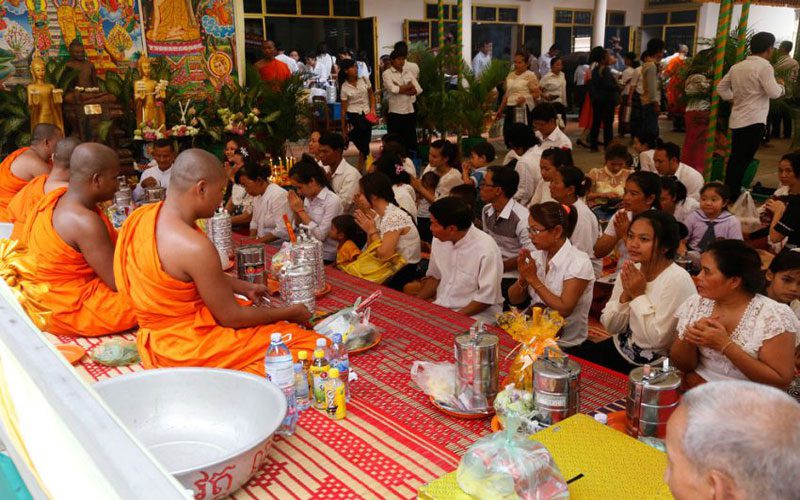
- Pchum Ben, culminates 10-12 October 2026: a fifteen-day Buddhist festival honoring ancestors, ending in a three-day public holiday. Like Khmer New Year, it triggers a nationwide exodus to home provinces, so expect packed buses and trains in the days right before it.
Cambodians pray and make offerings to the monks on Pchum Ben
Cambodia Entry Requirements: Visas & The e-Arrival Card (2026 Rules)
Almost every nationality needs a visa to enter Cambodia, and the rules are more straightforward than most of Southeast Asia once you know the current fees.
1. Cambodia E-Visa vs. Visa on Arrival
The tourist e-visa (Type T) costs US$30, is normally processed within 3 business days, is valid for entry within 3 months of issue, and allows a single stay of up to 30 days. Where eligible, arrange it through the official Cambodia e-Visa portal before departure if you will enter through a port that accepts it. Applying in advance lets you complete the application and payment before you travel and can reduce processing on arrival. Use only the official government portal, because third-party sites may add substantial service charges.
A tourist visa on arrival remains available to eligible travelers at Cambodia’s international airports and certain open international land and sea checkpoints. Availability depends on your passport and the specific checkpoint, so confirm both with Cambodian immigration or a Cambodian embassy before traveling. If you plan to obtain a visa on arrival, also check with your airline before departure to avoid boarding problems.
Citizens of the ten ASEAN member states, including Vietnam, Thailand, Laos, and the Philippines, can enter Cambodia visa-free for a set number of days that varies by bilateral agreement, generally 14 to 30 days. Check the current allowance for your specific nationality on the General Department of Immigration’s website before booking flights.
2. Mandatory Cambodia e-Arrival Card

Complete your Cambodia e-Arrival before your trip
Complete the free Cambodia e-Arrival through the official Cambodia e-Arrival portal within the seven days before you arrive. Cambodia’s General Department of Immigration also allows submission on arrival, but completing it in advance is the smoother option. The e-Arrival is separate from your visa and is required even if you already hold one; save the confirmation on your phone for immigration.
3. Land Border Crossings & Passport Validity
Do not assume an e-visa works at every land border. As of 29 August 2026, the official e-Visa entry-port list names Techo International Airport (KTI), Siem Reap Angkor International Airport (SAI), Sihanoukville International Airport (KOS), Bavet on the Vietnam border, and Tropaeng Kreal on the Laos border. For other checkpoints, visa-on-arrival availability can vary by nationality and location; confirm the exact crossing with Cambodian immigration or an embassy before departure.
As of the same date, all land border crossings between Cambodia and Thailand remain suspended, including the commonly used Poipet–Ban Khlong Luek and Cham Yeam–Hat Lek routes. Government travel advisories warn against travel near the border because security conditions remain unpredictable. Do not plan an overland itinerary between the two countries; fly into Cambodia instead and check current government travel advice again before departure.
Whatever entry method you use, your passport needs at least 6 months of validity remaining and one blank page. Business and long-stay visa categories exist too (Type E and its sub-classes), for travelers who need more than a tourist visit.
Best Places to Visit in Cambodia: Region Snapshot
Siem Reap & Angkor: The reason most people book the trip. The temple complex stretches across roughly 400 square kilometers, so most visitors spend two to three days working through the highlights: Angkor Wat itself at sunrise, Bayon’s roughly 200 serene stone faces carved into its towers, and Ta Prohm’s sandstone walls half-swallowed by strangler fig and silk-cotton tree roots, the temple made famous by Tomb Raider. Entry runs on the Angkor Pass system (see the cost table below).
Phnom Penh: Cambodia’s capital pairs the riverside Royal Palace and Silver Pagoda with the National Museum’s collection of Khmer sculpture, one of the largest of its kind anywhere. A visit to Tuol Sleng Genocide Museum and the Choeung Ek Killing Fields memorial is heavy, but most travelers consider it an essential part of understanding modern Cambodia rather than an optional add-on. For a full rundown of the capital’s museums and historic sites, see our guide to Cambodia’s best museums.
The Coast: Sihanoukville itself functions mainly as a ferry gateway these days rather than a destination on its own, but Kep and Kampot more than make up for it. Kep’s crab market, a strip of stilted shacks built right over the water, serves crab caught that morning tossed in Kampot pepper, grown at plantations a short drive inland that offer tastings and tours. Koh Rong and Koh Rong Samloem split the difference between backpacker energy and quieter, resort-style stays, with the Samloem side generally the calmer of the two.
The Highlands: Mondulkiri centers on the town of Sen Monorom, the gateway for ethical elephant sanctuaries where visitors observe and walk alongside elephants rather than ride them, plus waterfalls like Bou Sra reachable on a half-day trip. Ratanakiri, further north and considerably more remote, is built around Yeak Laom, a near-perfectly circular volcanic crater lake, and multi-day treks through Virachey National Park into villages of the Tampuan, Jarai, and other indigenous highland communities. Both provinces sit at higher elevation and run noticeably cooler than the lowlands year-round. For trekking routes and elephant sanctuary details, see our guide to trekking in Cambodia.
Suggested Cambodia Itineraries: 5 to 12 Days
Two ready-made starting points cover most first-time trips, one tight and temple-focused, one longer with beach time built in. Both can be adjusted to your dates.
Itinerary 1: Angkor Wat & Phnom Penh in 5 Days
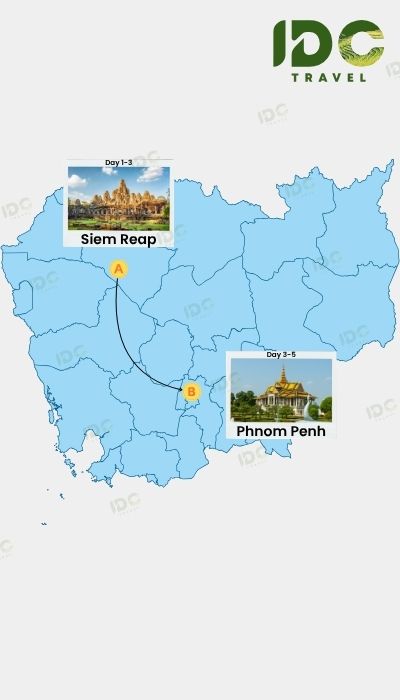
Route: Siem Reap → Phnom Penh
Best for: first-time visitors who want Cambodia’s two essential stops without adding internal flights or long transfers.
Strengths: covers the two most iconic destinations, Angkor’s temples and Phnom Penh’s history, in a tight loop with no internal flight required (a 6-hour bus or a short domestic flight connects the two).
Weaknesses: no beach time, and three temple-heavy days back to back can feel like a lot in the heat if you’re not used to it.
Day-by-day:
Day 1 – Arrive in Siem Reap, settle in, and get an early night ahead of the temples.
Day 2 – Sunrise at Angkor Wat, then Angkor Thom’s Bayon and the jungle-swallowed ruins of Ta Prohm.
Day 3 – A second temple day at your own pace, Banteay Srei or Beng Mealea for something quieter, then fly or bus to Phnom Penh in the afternoon.
Day 4 – Royal Palace and Silver Pagoda in the morning, Tuol Sleng and the Killing Fields in the afternoon for Cambodia’s more recent history.
Day 5 – A relaxed morning at the Central Market or riverside before your onward flight.
>>> This one isn’t a fixed package, but if you like this itinerary, we can customize it just for you. Don’t hesitate to contact us.
Itinerary 2: Temples, Capital & Coast in 12 Days
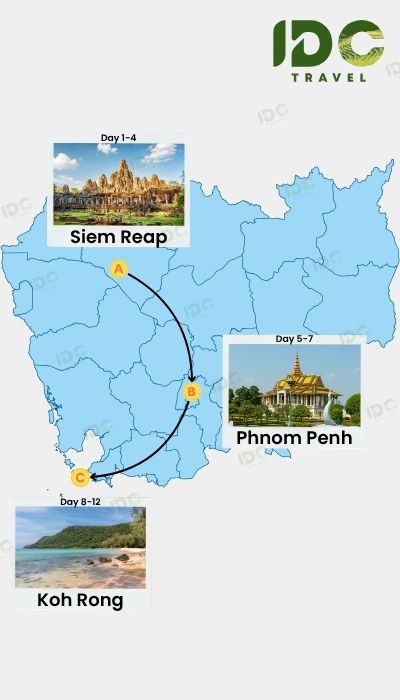
Route: Siem Reap → Phnom Penh → Koh Rong (Sihanoukville)
Best for: travelers who want the full introduction, temples, history, and real beach downtime, without rushing any of it.
Strengths: the only length here that comfortably fits Cambodia’s three signature experiences, plus a buffer day for the inevitable slow travel day.
Weaknesses: 12 days is a real commitment, and the Sihanoukville-Koh Rong leg adds a domestic flight plus a boat transfer.
Day-by-day:
Day 1-2 – Arrive in Siem Reap and ease in with a smaller temple, Banteay Srei or a walk around Angkor Thom’s outer wall.
Day 3-4 – Full Angkor Wat sunrise, Ta Prohm, and Bayon on day one; Beng Mealea or a Tonle Sap floating-village boat trip on day two.
Day 5 – Fly or bus to Phnom Penh.
Day 6-7 – Royal Palace, Silver Pagoda, and the National Museum, then Tuol Sleng and the Killing Fields, with an evening riverside stroll to close the day.
Day 8 – Fly to Sihanoukville and transfer by boat to Koh Rong.
Day 9-10 – Free beach days on Koh Rong, with an optional snorkeling trip or a day excursion to the quieter Koh Rong Samloem.
Day 11 – Boat back to Sihanoukville, kept as a buffer day for delays or one more beach morning.
Day 12 – Fly out for departure.
>>> This one isn’t a fixed package either, but if the pace looks right, let our specialists tailor it to you.
Cambodia Travel Costs & Daily Budget Breakdown
Cambodia runs on a dual-currency system: US dollars are the default for most tourist spending (hotels, tours, restaurant bills), while riel mostly shows up as small change for amounts under a dollar. Figures below are per-day ranges.
| Tier | Accommodation | Food | Local transport | Total per day |
| Budget | $10-20 (Hostel/Guesthouse) |
$8-15 (Street food) |
$3-8 (Shared/local bus) |
$21-43 |
| Mid-Range | $20-60 (3-star hotel) |
$15-30 (Mid-range) |
$8-20 (Private tuk-tuk/Grab) |
$43-110 |
| Luxury | $120-300+ | $40-80+ (Fine dining) |
$20-50+ (Private car+driver) |
$180-430 |
Figures above are 2026 estimates in USD; local-currency (riel) equivalents vary with the exchange rate and are not shown here for that reason. Treat these as a planning baseline rather than a quote: actual prices shift with the season (peak-season hotel rates run noticeably higher), fuel surcharges on transport, and ordinary year-to-year inflation, so it’s worth confirming current rates before you book. Contact us for more!
Two costs are budgeted separately rather than folded into the table: the Angkor Pass, currently $37 for one day, $62 for three days, or $72 for seven days through Angkor Enterprise’s official ticket portal, and any domestic flights or long-distance buses between regions.
Money-Saving Tips
- Buy the Angkor Pass online in advance rather than at the ticket office. The office line alone can eat 30 to 45 minutes on a sunrise morning.
- Choose the three-day Angkor Pass even for a two-day visit. At $62 it costs only $25 more than the one-day pass and buys an extra full day of flexibility.
- Eat where locals eat. A plate of fish amok or a bowl of noodle soup at a local restaurant runs $2 to $4, a fraction of the same dish at a hotel restaurant.
- Travel in the shoulder months of May or October rather than the December-to-February peak. Hotel rates in Siem Reap commonly drop 20 to 30 percent for only a modest weather trade-off.
- Use ride-hailing apps like Grab or PassApp for tuk-tuks in Phnom Penh and Siem Reap city center. The fixed, upfront price avoids the negotiation, and the occasional detour, that unmetered street tuk-tuks are known for.
Money, Cash & ATM Rules in Cambodia
Cambodia runs on a dual-currency system in practice: US dollars for anything above a couple of dollars, Cambodian riel for small change, at a rate of roughly 4,000 KHR to $1. Bring clean, undamaged USD bills from home if you can; Cambodian businesses and some ATMs are strict about torn or heavily worn notes and may simply refuse them.
ATMs are widely available in Phnom Penh and Siem Reap and dispense USD by default. Nearly every bank charges a withdrawal fee on top of whatever your home bank charges, typically $4 to $6 per transaction, so withdrawing larger amounts less often saves money over a trip. When a card machine asks whether to charge you in your home currency or in USD, always choose USD: accepting the home-currency conversion (dynamic currency conversion) applies a worse exchange rate.
Outside Phnom Penh and Siem Reap, cards are accepted at larger hotels and restaurants, but tuk-tuks, local markets, and much of the coast and countryside still run on cash only, so carry more cash than feels necessary once you leave the two main cities.
Tipping isn’t obligatory in Cambodia but is genuinely appreciated given local wages, and it’s become a practical expectation in tourist-facing services. A rough guide: $1 to $2 per person for a restaurant meal if a service charge isn’t already on the bill, around $5 to $10 USD per day for private guides and $3 to $5 USD per day for drivers, depending on group size and satisfaction. $1 to $3 per day for a tour guide, and a similar $1 to $2 per day for a private driver. Check the bill first, since some hotels and higher-end restaurants already add a 10 percent service charge.
Must-Try Cambodian Food (Khmer Cuisine)
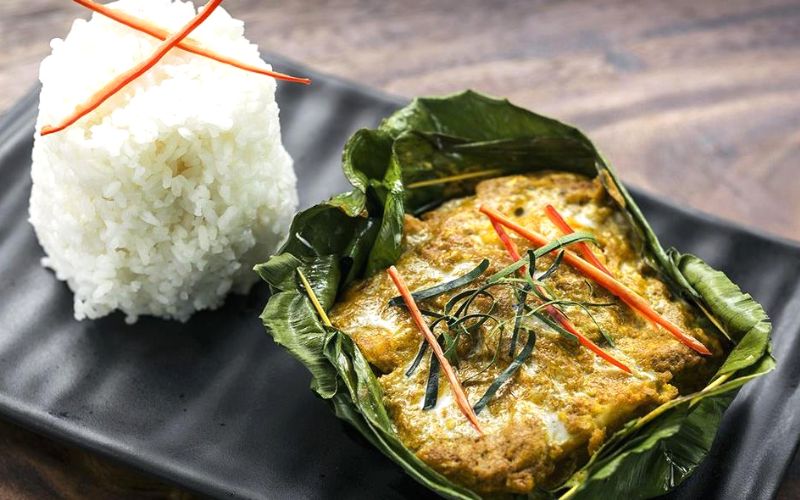
- Fish Amok (Steamed Fish Curry): Cambodia’s signature dish, a steamed curry made with fish, coconut milk, and kroeung (Khmer spice paste), traditionally served in a banana leaf cup.
Fish Amok
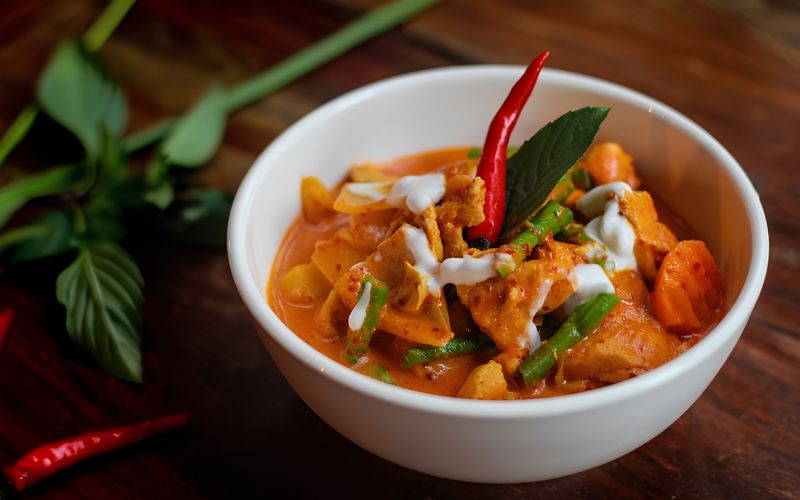
- Khmer Red Curry (Kari Sach Moan / Chicken Curry): a milder, less oily curry than its Thai counterpart, usually made with chicken, potato, and coconut milk, and eaten with bread rather than rice.
Khmer red curry with chicken
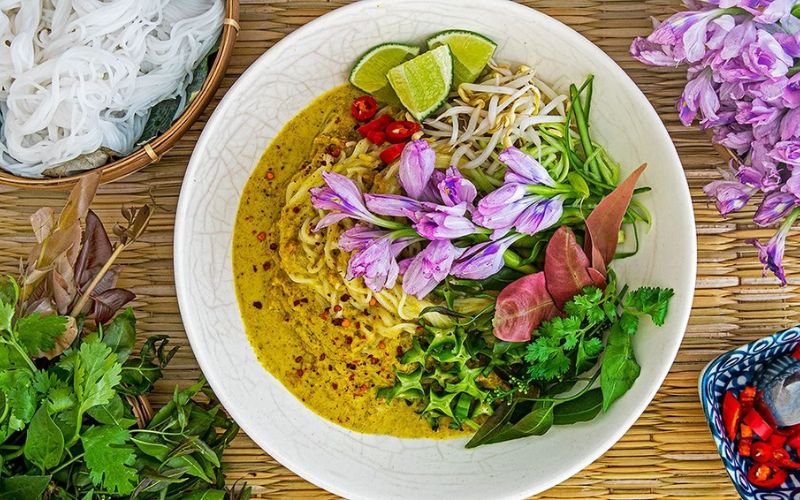
- Nom Banh Chok (Khmer Rice Noodles): fresh rice noodles topped with a fish-based green curry sauce and fresh herbs, widely considered Cambodia’s national breakfast dish.
Nom Banh Chok
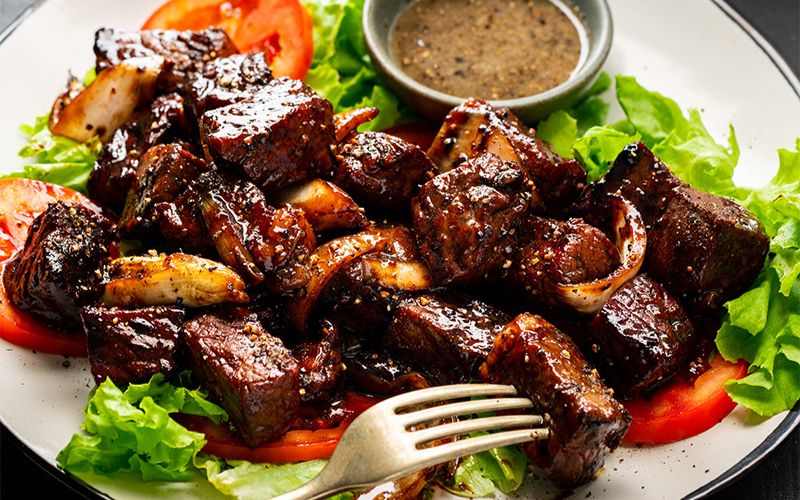
- Beef Lok Lak (Shaking Beef): stir-fried marinated beef served over lettuce and tomato with a lime-and-pepper dipping sauce, a Phnom Penh institution.
Beef Lok Lak
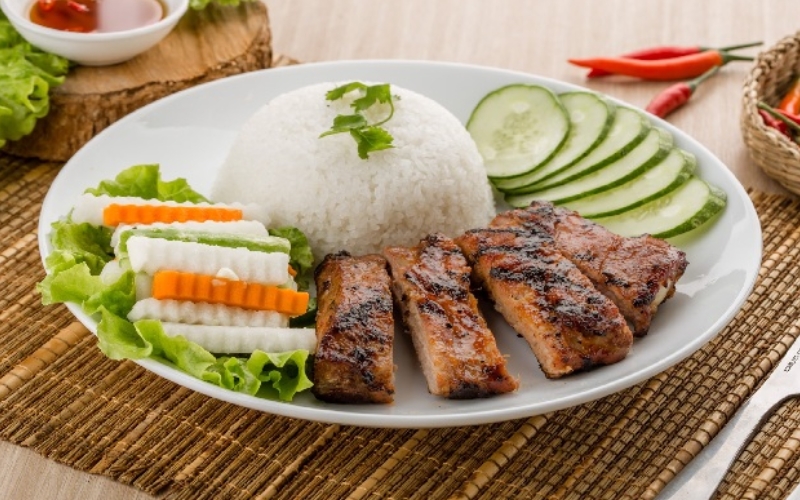
- Bai Sach Chrouk (Grilled Pork & Rice): grilled pork over broken rice, sold from street carts every morning and often paired with a light pickle and a clear broth.
Bai Sach Chrouk
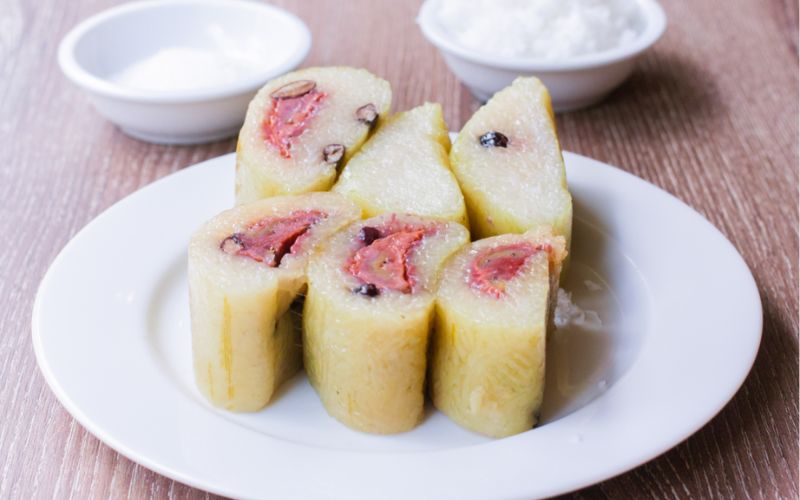
- Nom Ansom Chek (Sticky Rice & Banana Cake): sticky rice and banana steamed inside a banana leaf, a common festival snack around Khmer New Year and Pchum Ben.
Nom Ansom Chek
- Kampot Pepper Crab (Stir-Fried Crab with Green Peppercorns): a Sihanoukville and Kep coastal specialty, fresh crab stir-fried with the famously fragrant green peppercorns grown nearby in Kampot province.
Kdam chaa mrech Kampot

Street stalls and local markets (Phnom Penh’s Central Market food stalls, Siem Reap’s Old Market area) tend to serve more authentic, cheaper versions of all five dishes than restaurants aimed squarely at tourists; a bowl of kuy teav or nom banh chok from a market stall rarely runs more than ~$2-3 (8,000-12,000 KHR).
Cultural Etiquette, Safety & Scam Prevention in Cambodia Every Visitors Should Know
Temple Dress Code & Cultural Etiquette
When visiting Angkor Wat and other active temples in Cambodia:
- Wear clothing that covers your shoulders and knees.
- Shorts, skirts above the knee, and bare shoulders may result in denied entry to sacred areas.
- Keep noise levels low and behave respectfully around worshippers and monks.
- Ask permission before photographing monks.
- Women should avoid touching monks or standing excessively close during interactions.
- Do not climb on fragile structures, touch carvings, or remove archaeological objects.
- Avoid littering and follow all signs within temple complexes.
- In Khmer culture, touching another person’s head is considered disrespectful.
- Avoid pointing your feet toward people, monks, Buddha images, or religious objects.
Safety, Scams & Local Realities
Personal Safety
- Cambodia is generally safe for tourists visiting major destinations.
- Petty theft is the most common crime affecting visitors.
- Bag snatching and phone theft occasionally occur in Phnom Penh, Siem Reap, and Sihanoukville.
- Keep phones and bags away from the roadside when riding in tuk-tuks.
- Use hotel safes for passports, extra cash, and valuables whenever possible.
Common Tourist Scams
- Agree on transportation prices before starting a ride if a meter or app is unavailable.
- Ride-hailing apps such as Grab can help reduce fare disputes.
- Be cautious if strangers quickly invite you to private homes, gambling activities, or shopping opportunities.
- Check USD banknotes carefully when receiving change, as counterfeit notes have occasionally been reported.
Health & Practical Advice
- Do not drink tap water.
- Choose bottled water or properly filtered drinking water instead.
- Carry basic travel insurance that covers medical emergencies and transportation.
Landmines & Border Areas
- Unexploded ordnance and landmines still exist in some remote border regions.
- This issue does not affect normal tourist routes such as: Phnom Penh, Siem Reap, Angkor Wat, Battambang, Kampot, Kep and Koh Rong.
- Stay on marked roads and designated trails when visiting rural areas.
- Avoid venturing off-trail near remote border zones.
Plan Your Cambodia Trip With IDC Travel
Whether Angkor Wat is the whole reason for your trip or one stop on a longer Southeast Asia route, the details above, visa, budget, timing, are the ones that actually decide how smoothly it runs. Our specialists build every Cambodia itinerary around your dates and pace rather than a fixed template, from a fast 5-day Angkor-focused trip to a slower 12-day loop through Phnom Penh and the south coast. Start building your Cambodia trip with our team, or reach out to us with any questions before you book.
Read more:
I heard US dollars are widely accepted. Is it still worth exchanging for Cambodian riel?
Dear Jack,
Thank you for your question! You’re absolutely right—US dollars are widely accepted in Cambodia, especially for hotels, tours, and larger purchases. However, it’s still a good idea to have some Cambodian riel on hand. Riel is most commonly used for small transactions such as local food stalls, tuk-tuk rides, markets, or when you need change for amounts under $1.
Best regards,
IDC Travel Team
Really helpful guide! I’m planning my first trip to Cambodia next month and had no idea about the currency situation—great tip about using US dollars. Also appreciate the advice on temple dress codes. Can’t wait to explore Angkor Wat and try some local street food. Thanks for sharing!
I loved this post! The section about visa requirements and entry rules was super clear — I’ve seen conflicting info elsewhere, so this made it easier to plan. Also, the reminder about avoiding scams was spot on. Looking forward to seeing Phnom Penh and Siem Reap later this year!
Thanks so much for your thoughtful comment! We’re really happy to hear the visa and entry section was helpful. Phnom Penh and Siem Reap both have so much to offer, from ancient temples to vibrant local life. Wishing you an incredible journey ahead, and if you need any assistance along the way, we’re here to help!
Best regards,
IDC Travel Team