


Vietnam’s golden rice fields turn gold on a rolling schedule that runs from late May all the way through November, so “rice season” means something different depending on which of the seven regions below you’re looking at, not one single window. This guide ranks the 7 best places to see golden rice fields in Vietnam, from Ninh Binh’s flat river paddies to Hoang Su Phi’s steep mountain amphitheaters, with the exact harvest month for each place, how to get there, and what a realistic trip costs. Use the at-a-glance table below to see every region’s peak window side by side before diving into the full mini-guide for each one.
Vietnam’s Golden Rice Fields at a Glance
| No. | Place | Province | Landscape Type | Peak Window | Time Needed | Distance from Hanoi |
| 1 | Mu Cang Chai | Lao Cai (formerly Yen Bai) | Mountain Terraces | Sept-early Oct | 2-3 days | ~280-300 km |
| 2 | Sapa | Lao Cai | Valley Terraces | Sept-early Oct | 1-2 days | ~320 km |
| 3 | Hoang Su Phi | Tuyen Quang (formerly Ha Giang) | Amphitheater Terraces | Mid-Sept-mid-Oct | 2-3 days | ~300 km |
| 4 | Tam Coc | Ninh Binh | Lowland River Paddies | Late May-early June | Half day – 1 day | ~100 km |
| 5 | Pu Luong | Thanh Hoa | Nature Reserve Terraces | Late May-early June and Sept-Oct | 2 days | ~160 km |
| 6 | Bac Son Valley | Lang Son | Valley Paddies | Late Sept-Nov | 1-2 nights | ~160 km |
| 7 | Y Ty | Lao Cai | High-altitude Terraces | Late Aug-early Sept | 2 days | ~360-365 km |
Peak windows above are one-line summaries; for the full month-by-month calendar across every region, see IDC Travel’s golden rice season guide.
7 Places to See Golden Rice Fields in Vietnam
1. Mu Cang Chai (Lao Cai) – The King of rice terraces
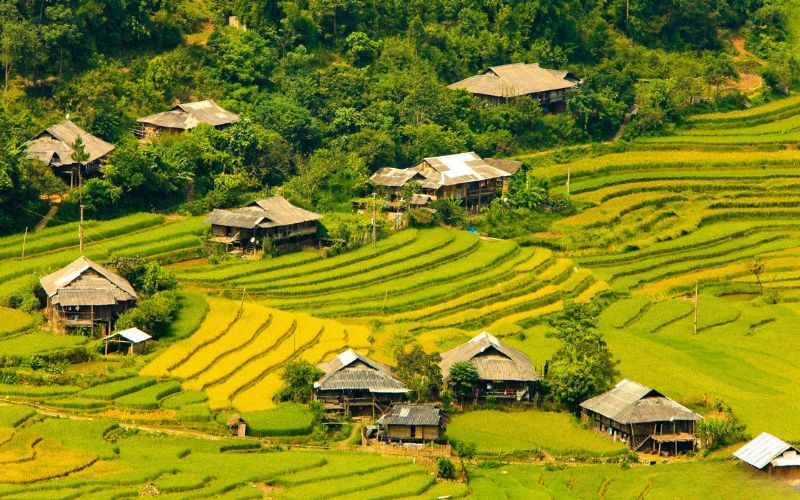
Mu Cang Chai, Lao Cai
The most dramatic terracing on this list, and the reason most golden rice season photos of Vietnam exist in the first place. Mu Cang Chai now sits in Lao Cai province (formerly Yen Bai province), following the July 2025 provincial merger that folded Yen Bai into Lao Cai.
- Location: Lao Cai province (formerly Yen Bai province), northwest Vietnam.
- Getting there: Roughly 280-300 km from Hanoi via National Highway 32, a 6-7 hour drive through Nghia Lo and Tu Le. No direct train; the nearest rail link is Yen Bai station, followed by a taxi or motorbike. Sleeper buses and limousine vans run from Hanoi’s My Dinh station.
- Best viewpoint: Mam Xoi Hill, nicknamed “Pineapple Hill” for its stacked, curving terraces, plus La Pan Tan, Che Cu Nha, and the Khau Pha Pass overlook, one of the most scenic mountain passes in northern Vietnam.
- Time needed: 2 full days minimum to cover the main viewpoints without rushing; 3 days if combined with Khau Pha Pass trekking.
- Seasonal note: Golden season runs September into early October.
Homestays in Mu Cang Chai town and along the road to La Pan Tan range from simple stilt-house rooms to slightly more polished eco-lodges with private bathrooms; either works, but book ahead during golden season since rooms sell out fast. For photography, early morning (before 7am) at Mam Xoi Hill avoids both the harsh midday light and the bulk of the day-trip crowds arriving from Sapa and Hanoi.
>>> Interested in Mu Cang Chai? Discover the Ripe Rice Field of Mu Cang Chai in 3 Days with us.
2. Sapa & Muong Hoa Valley (Lao Cai) – Most accessible trekking
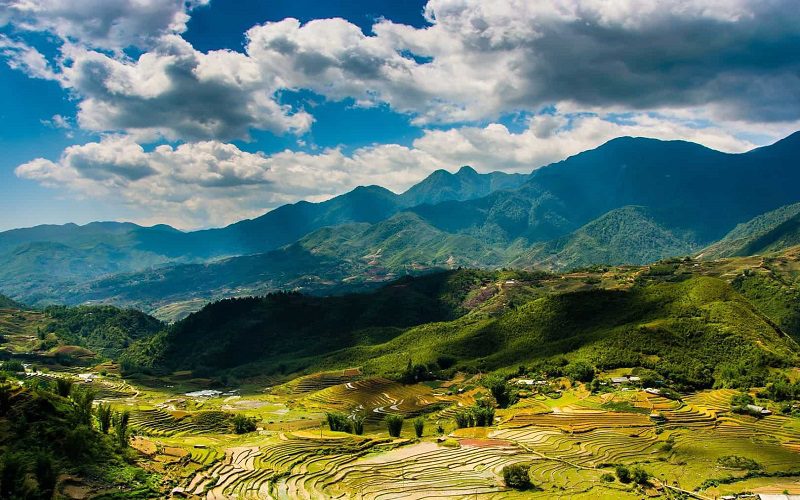
Muong Hoa Valley, Lao Cai
The most accessible of the mountain terraces, and the only one genuinely set up for casual trekking without a specialist guide.
- Location: Muong Hoa Valley, Sapa town, Lao Cai province.
- Getting there: Overnight train from Hanoi to Lao Cai city, followed by a roughly 1-hour shuttle to Sapa, or a direct bus or limousine van that takes 5-6 hours.
- Best viewpoint: The valley floor around Lao Chai and Ta Van villages, walkable on a half-day trek, or the Fansipan cable car for a panoramic overview of the whole terraced valley from above.
- Time needed: 1-2 days; a single day covers the main valley trek, a second adds Fansipan or a further village.
- Seasonal note: Peak golden window is September into early October, matching Mu Cang Chai closely enough to combine both on one trip.
Sapa town itself has the widest range of accommodation on this entire list, from backpacker dorms to full resorts, so booking pressure is lower than the more remote entries below, though weekend rooms still fill up fast in peak season. The Fansipan cable car runs year-round regardless of rice season and is worth combining with a valley trek for travelers who want both the up-close paddy views and the wide overview in a single visit.
>>> Ready to trek through the valley yourself? Browse Sapa Tours
3. Hoang Su Phi (Tuyen Quang) – Off-the-beaten-path amphitheaters
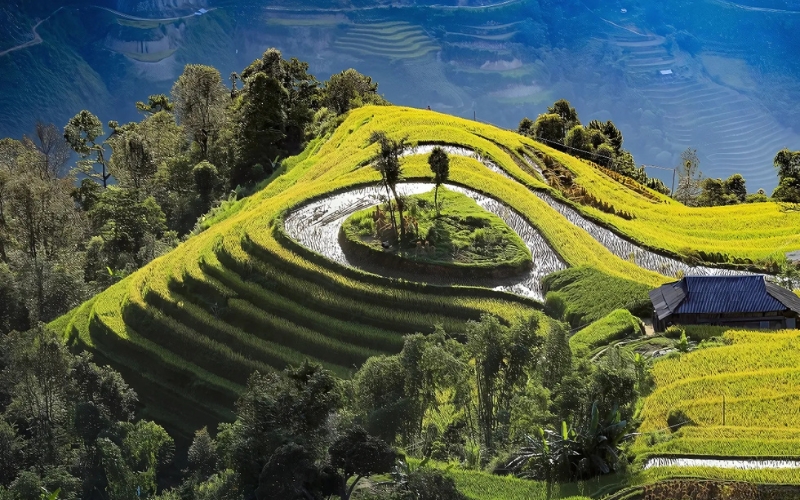
Hoang Su Phi, Tuyen Quang
Remote, amphitheater-style terraces carved into steeper slopes than Mu Cang Chai’s, and genuinely less touristed than either Sapa or Mu Cang Chai. Following the 2025 reform, Hoang Su Phi now sits in Tuyen Quang province (formerly Ha Giang province); Ha Giang was merged into Tuyen Quang, which kept its name and became the province’s administrative center.
- Location: Tuyen Quang province (formerly Ha Giang province), far northern Vietnam near the Chinese border.
- Getting there: Around 300 km and 7-8 hours from Hanoi by road; most visitors combine it with a wider Ha Giang Loop motorbike trip rather than a direct there-and-back.
- Best viewpoint: The terrace roads around Ban Phung, Nam Ty, and Thong Nguyen villages, farmed by La Chi, Dao, and Nung communities whose staggered planting schedules create visibly different shades of green and gold within the same valley.
- Time needed: 2-3 days, since the remoteness makes a rushed day trip impractical.
- Seasonal note: Peaks slightly later than Mu Cang Chai and Sapa, typically mid-September into early-to-mid October. Frame this one for travelers who’ve already done Sapa and want something quieter.
Hoang Su Phi’s weekly market draws ethnic minority communities from surrounding villages and is worth timing a visit around if the schedule lines up; ask a homestay host or driver for the current market day, since it can shift. A local guide isn’t strictly required but makes navigating the unmarked terrace roads considerably easier, and most homestays can arrange one on short notice.
4. Tam Coc (Ninh Binh) – Golden river paddies
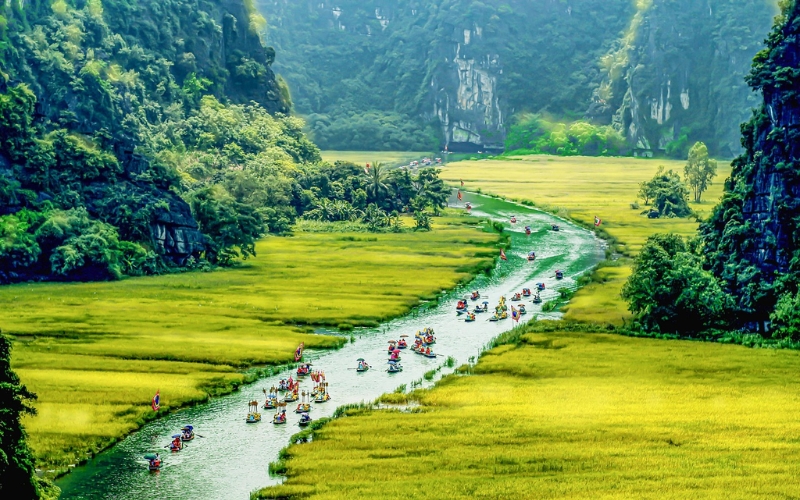
Tam Coc, Ninh Binh
The outlier on this list: a flat lowland field, not mountain terracing, combined with karst river scenery and viewed from a small rowing boat rather than a viewpoint. Its peak window is genuinely different from everything above it on this list, and it’s the single most important seasonal correction to make here: travelers who plan one “rice season” trip covering both Tam Coc and Sapa in September will miss Tam Coc’s window entirely, since it’s already well past by then.
- Location: Ninh Binh province, about 100km south of Hanoi.
- Getting there: An easy day trip from Hanoi by car or bus, roughly 2 hours each way.
- Best viewpoint: From the boat itself along the Ngo Dong River, or from above at Hang Mua viewpoint after a steep but short climb.
- Time needed: Half a day is enough for the boat ride; a full day allows Hang Mua and Bich Dong Pagoda too.
- Seasonal note: Peak window is late May into early June, roughly three months earlier than the mountain regions above. For the boat ride logistics and the rest of Ninh Binh’s sights, see our guide to things to do in Ninh Binh.
Boats depart continuously from the Tam Coc pier rather than on a fixed schedule, so there’s rarely a wait even at busy times, though arriving before 9am still means calmer water for photos and fewer other boats in frame. Being only two hours from Hanoi, Tam Coc is the one entry on this list that works comfortably as a spontaneous, lightly-planned day trip rather than something booked weeks ahead.
>>> Make it part of a proper Ninh Binh escape. Book Ninh Binh 2 Days 1 Night
5. Pu Luong (Thanh Hoa) – Two harvests a year
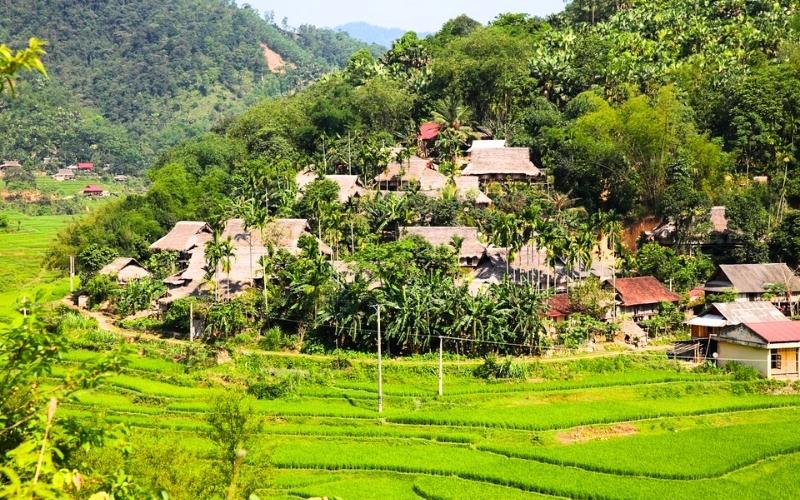
Pu Luong, Vietnam
Closer to Hanoi than any mountain terrace on this list, with a nature-reserve setting and bamboo eco-lodges that make it a genuine weekend option rather than a multi-day expedition.
- Location: Pu Luong Nature Reserve, Thanh Hoa province.
- Getting there: About 160 km from Hanoi via National Route 6, roughly 3.5-4 hours by car through winding mountain passes.
- Best viewpoint: Kho Muong valley for the flooded “mirror” season, or the terrace roads around Ban Don for the harvest season; both are walkable directly from most homestays.
- Time needed: 2 days, 1 night is the standard visit; a second night allows time for both a valley walk and a longer trek.
- Seasonal note: Pu Luong genuinely has two harvest windows a year,
- The first harvest (late May-early June): when the rice turns a vivid gold mixed with fresh new green for a multicolored, eye-catching look.
- The main harvest (Sep-Oct): when the whole valley and mountainside turn a deep, uniform gold, the larger and more photogenic of the two.
Bamboo eco-lodges here range from basic community-run homestays to a handful of higher-end resorts with infinity pools looking out over the terraces; both sit within walking distance of the paddies themselves, which is Pu Luong’s real advantage over the more remote mountain entries above. Roads are relatively good by regional standards, making Pu Luong one of the more comfortable self-drive options on this list.
>>> Explore Pu Luong as part of a wider northern loop by Trekking Pu Luong Nature Reserve 4 Days
6. Bac Son Valley (Lang Son) – The late harvest insider pick
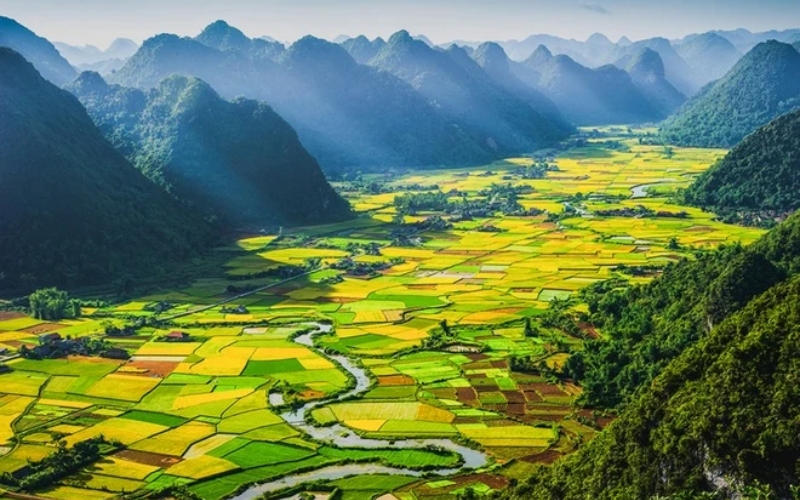
Bac Son Valley, Lang Son
The insider pick on this list: a rice-field valley ringed by limestone karst, viewed from the Na Lay Peak viewpoint, and far less commercialized than anywhere else here. This is the entry that separates this list from every competitor’s identical Sapa-Mu Cang Chai-Tam Coc lineup.
- Location: Bac Son district, Lang Son province, roughly 160 km northeast of Hanoi. Lang Son kept its own provincial identity in the July 2025 reform and was not merged with a neighboring province.
- Getting there: About 3-4 hours from Hanoi by car or motorbike; no direct train.
- Best viewpoint: Na Lay Peak, an intermediate 30-60 minute climb up roughly 1,200 stone steps to a small platform beside a telecommunications tower, rewarding climbers with a 360-degree view over the entire valley.
- Time needed: A rushed day trip from Hanoi is technically possible but long; 1-2 nights in Quynh Son village, known for its traditional roof-tile craft, gives a much better experience with time for both sunrise and sunset at the peak.
- Seasonal note: Golden harvest season runs late September into November, later and longer than most of the mountain regions above, since Bac Son’s flat valley floor allows staggered planting across the same season.
A homestay in a traditional Tay stilt house in Quynh Son is the standard way to overnight here, and most include a home-cooked dinner of local dishes like sticky rice and grilled fish spring rolls. The climb to Na Lay Peak involves roughly 1,200 uneven stone steps with limited shade, so hiking shoes and an early start matter more here than at any other viewpoint on this list.
>>> Ready to combine Bac Son with Vietnam’s other northeastern highlights? Book the Adventure Tour to Ha Giang, Cao Bang, Lang Son in 6 Days
7. Y Ty (Lao Cai) – Cloud-hunting & High-altitude terraces
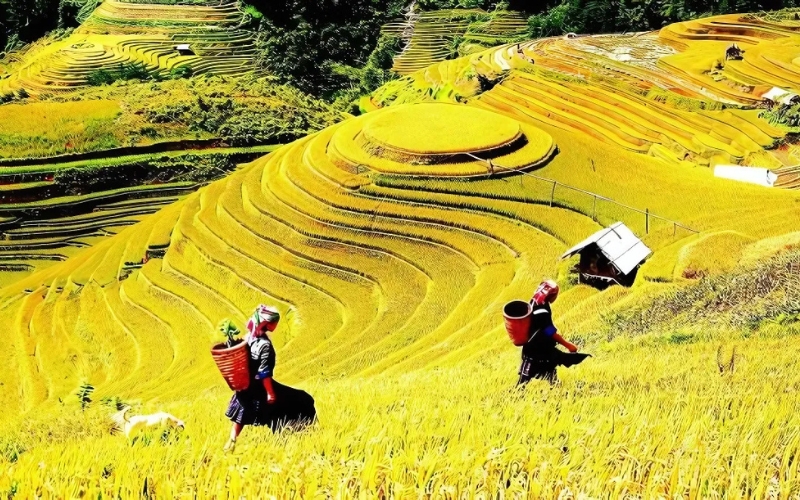
Y Ty, Lao Cai
The most remote entry on this list, and the closest for travelers who’ve already seen the famous four terraces above and want something quieter still.
- Location: Bat Xat district, Lao Cai province, near the Chinese border.
- Getting there: Roughly 400 km from Hanoi and 70 km from Lao Cai city; the final stretch is narrow mountain road best done by private car or experienced motorbike rider, not a standard tourist bus.
- Best viewpoint: The terrace roads around the Ha Nhi ethnic minority villages that define the district, best explored on a guided village-to-village trek rather than from a single fixed lookout.
- Time needed: 2 days minimum given the distance involved; most visitors combine it with a wider Lao Cai or Sapa itinerary rather than a standalone trip.
- Seasonal note: Golden season runs late August into early September, earlier than Sapa and Mu Cang Chai and worth noting if a trip is built around visiting more than one of these regions.
Accommodation is limited to a small number of basic homestays in Y Ty town itself, so this isn’t the entry to arrive at without a booking already confirmed. The reward for the effort is genuine quiet: even during peak golden weeks, Y Ty sees a fraction of the visitor numbers that Sapa or Mu Cang Chai do on the same weekend.
3 Ready-Made Itineraries for Vietnam’s Golden Rice Season
A single combined route trying to hit several of the destinations above in two or three days isn’t realistic for inbound travelers, since the drive alone to somewhere like Mu Cang Chai eats most of a short trip. Instead, here are three short, standalone itineraries built around the routes travelers actually book, each staying within one region rather than stretching across several.
Itinerary 1: Mu Cang Chai in 3 Days – The Photographer’s Golden Terrace Route
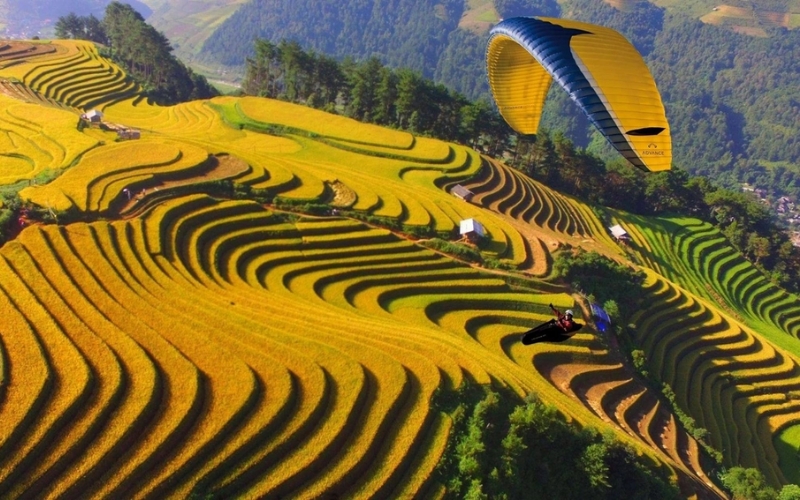
Terraced rice fields glowing gold in Mu Cang Chai
Best for: First-time photographers and travelers who want Vietnam’s single most iconic terrace view without cramming it into a rushed day trip.
Best time: Mid-September to early October, when Mam Xoi Hill, Che Cu Nha, and La Pan Tan all peak together.
Should avoid: June to August, when Khau Pha Pass is at its wettest and most exposed.
Strength: The biggest concentration of famous viewpoints on this list, all within a short drive of each other.
Weakness: The 6-7 hour drive each way eats most of Day 1 and Day 3, leaving only one full day on the ground.
Day-by-day overview:
- Day 1: Depart Hanoi in the morning, arriving in Mu Cang Chai by late afternoon after the 6-7 hour drive. Settle into a homestay and catch early evening light over the nearest terraces.
- Day 2: Full day at the main viewpoints, sunrise at Mam Xoi Hill, midday at Che Cu Nha, sunset at La Pan Tan.
- Day 3: Morning stop at the Khau Pha Pass overlook on the way out, then the drive back to Hanoi.
>>> Book the Ripe Rice Field of Mu Cang Chai in 3 Days tour
Itinerary 2: Sapa in 2 Days – The Easy Trekking Weekend for First-Timers
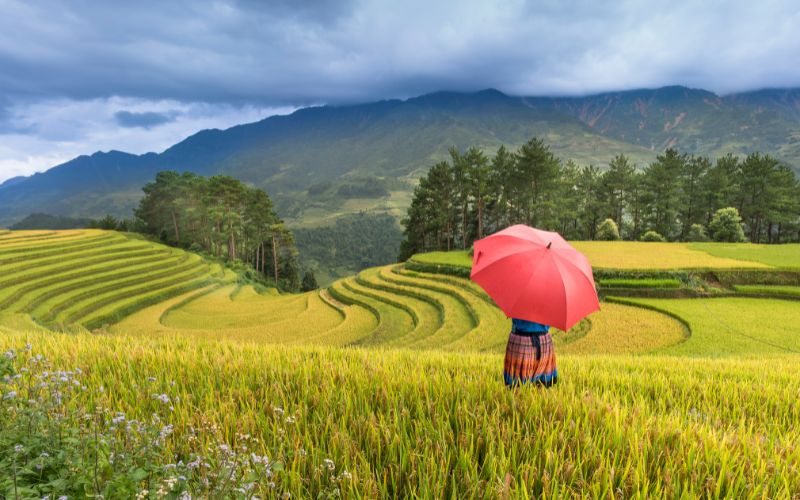
Sapa in Vietnam
Best for: First-timers who want real trekking without hiring a specialist guide, or anyone short on time.
Best time: Late August to early October for the golden harvest, or May to June for the flooded mirror fields.
Should avoid: June to August, when the wettest stretch of the year turns the valley trails slick.
Strength: The shortest, easiest itinerary to arrange, with more accommodation and transport options than any other entry on this list.
Weakness: Two days barely covers the valley trek and the cable car; there’s no time left for a further village or a longer trek.
Day-by-day overview:
- Day 1: Overnight train or morning transfer to Sapa, then a half-day trek through Lao Chai and Ta Van villages in the Muong Hoa Valley.
- Day 2: Morning at the Fansipan cable car for the panoramic overview, afternoon free in Sapa town before the return journey.
>>> Browse Sapa Tours to build your own version of this route.
Itinerary 3: Pu Luong & Mai Chau in 3 Days – A Slow Nature Escape Near Hanoi
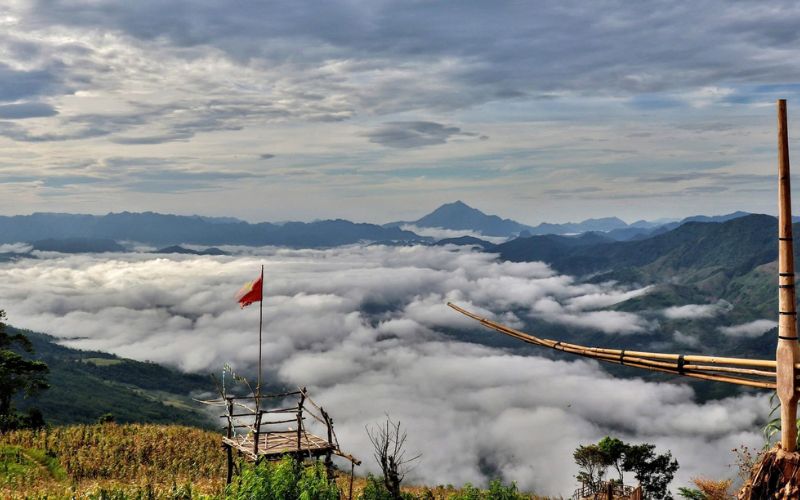
Mai Chau
Best for: Travelers who want a genuine nature escape without the long drive north, or a weekend-plus add-on to a Hanoi trip.
Best time: Late May to early June, or September to October, Pu Luong’s two harvest windows; Mai Chau on the same route follows a similar dry-season calendar.
Should avoid: No hard closure, but eco-lodges here book out fastest on weekends year-round, so reserve ahead regardless of season.
Strength: The closest mountain terrace to Hanoi on this list, paired with Mai Chau’s valley villages on the same route, with the most comfortable eco-lodge options of any entry.
Weakness: A gentler, smaller-scale landscape than Mu Cang Chai or Hoang Su Phi; not the pick for the most dramatic terracing.
Day-by-day overview:
- Day 1: Drive from Hanoi (about 3-3.5 hours), stop in Mai Chau to visit Lac or Pom Coong village and cycle through the rice paddies, then continue on to Pu Luong by late afternoon.
- Day 2: Full day trek to Kho Muong village and the bat cave, overnight at an eco-lodge or homestay inside the reserve.
- Day 3: Morning walk around the Ban Don terraces, then the drive back to Hanoi by early evening.
>>> Book Trekking Tour Mai Chau – Pu Luong 3 Days 2 Nights for this exact route.
Essential Travel & Logistics Rules for Vietnam Rice Season
Booking & Accommodation Strategies
Homestay rooms in Mu Cang Chai, Sapa, and Bac Son sell out during the peak golden weeks (mid-September through mid-October), so book at least 2-3 weeks ahead if a trip lands during that window. Hoang Su Phi and Y Ty, being less commercialized, are more forgiving on short notice but still tighten up on weekends. Tam Coc and Pu Luong, both within a half-day of Hanoi, are the two spots where a same-week booking is realistic even in peak season.
Drone & Photography Etiquette
Hoang Su Phi and Y Ty both sit close to the Chinese border, so drone use there needs checking with local authorities or your homestay before flying rather than assuming it’s fine everywhere. Every terrace on this list is working farmland, not a landscaped attraction: stepping into the paddies for a photo damages the crop a local family depends on, and it’s an increasingly sore point with communities in Mu Cang Chai and Sapa specifically, where tourist traffic is heaviest. Sticking to marked paths and viewpoints gets the same photos without the damage, and always ask before photographing farmers or villagers directly.
Packing & Road Safety
Road conditions on the mountain routes above (Mu Cang Chai, Hoang Su Phi, Y Ty) range from good to genuinely rough in patches, especially after rain; a private driver or an experienced motorbike rider handles this far more comfortably than a standard tourist bus, particularly for Hoang Su Phi and Y Ty’s final approach roads.
Mobile signal is patchy to nonexistent on the more remote terrace roads around Hoang Su Phi and Y Ty, so downloading offline maps before setting out is worth the extra five minutes.
Mountain weather also shifts fast: mornings can start clear and cloud over by midday, so travelers chasing a specific viewpoint for photography should build in a buffer day rather than relying on a single shot at sunrise or sunset.
Plan Your Vietnam Trip With IDC Travel
Chasing golden rice season means timing matters as much as the destination itself, and the seven-week gap between Tam Coc’s May window and Bac Son’s November one shows exactly why. IDC Travel builds custom northern Vietnam routes around whichever region and season fit a trip best, from a fast Mu Cang Chai weekend to a longer loop through several of these seven. Reach out to our specialists to talk through timing, or start building your own itinerary if you already know which regions you want to see.
Read more:




How to get to Mu Cang Chai?
Hi Carissa,
Mu Cang Chai is 280 kilometers from Hanoi. To get there, you have several options:
– By private car: This is the safest and most convenient way to get to Mu Cang Chai. You can rent a car with a driver by IDC Travel and let the driver take you there.
– By bus: Catch a bus at My Dinh or Giap Bat Stations, which will take you about 8 hours. The ticket price is VND 200,000 – 350,000.
– By train: You can take a train from Hanoi to Yen Bai (about 4 – 5 hours), then take a bus to Mu Cang Chai. The second way is to embark on a train from Hanoi to Sapa, stop here for 1-2 days for sightseeing, and then catch a bus to Mu Cang Chai.
Don’t hesitate to contact us if you need help to arrange your transportation.
Best regards,
Alice Pham.
I’m going to have 1-month business trip in Hanoi in November this year. I will be free on Saturday and Sunday and want to visit Ninh Binh. Can you please update me on a 1-day or 2-day Ninh Binh trip?
Hi Steffen,
Thank you so much for your interest! Our specialist has contacted you through your email. Please check and let us know your idea.
For immediate support, you can ping us on WhatsApp at (+84)913 000 858.
Looking forward to seeing you in Vietnam.
Best regards,
Alice Pham.