
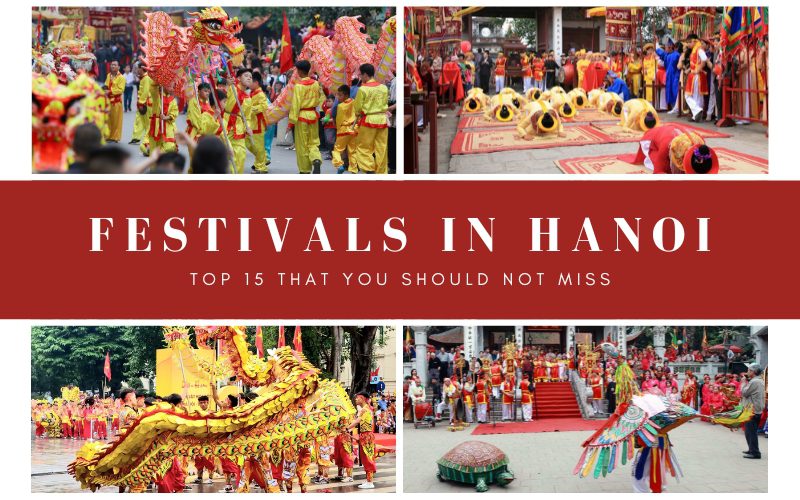
Hanoi is one of those cities where the calendar never really goes quiet. Festivals in Hanoi aren’t just dates on a tourism brochure, they’re the reason locals stay up past midnight, streets get blocked off, and the smell of incense and street food hits you from three blocks away. If you’re planning a trip to Vietnam’s capital, knowing when these celebrations happen can completely change your experience.
This guide covers the 15 most memorable festivals in Hanoi, from the biggest nationwide events to smaller, deeply local ones that most visitors never hear about.
Why Are Festivals in Hanoi So Special?
Hanoi has over 1,000 years of history as a capital city, and that history plays out every year through its festival cycle. The city’s festivals mix Confucian tradition, Buddhist ceremony, Vietnamese folk culture, and in some cases memories of war and resistance. You get a very different Hanoi depending on when you arrive.
The general pattern: the lunar calendar drives most major events, which means dates shift year to year. Always verify exact dates before booking, especially for Tet and other lunar-based holidays.
1. Hanoi during Tet – The Lunar New Year (January/February)
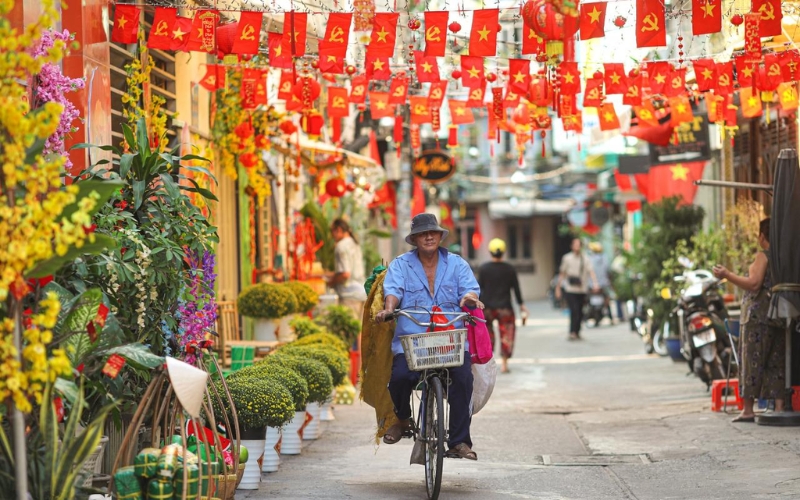
Vietnamese decorate their houses and streets in Lunar New Year.
There is no bigger festival in Vietnam than Tet, and Hanoi during Tet is unlike the city at any other time of year. More than a public holiday, Tet is a genuine religious and cultural festival built on centuries of ceremony and in Hanoi, that ceremonial dimension is more visible than almost anywhere else in the country.
In the weeks before Tet, temples and pagodas fill with families making offerings and burning votive paper for deceased relatives, seeking blessings for the year ahead. By New Year’s Eve, Hanoi’s pagodas like Tran Quoc, Quan Su, Ngoc Son are packed at midnight with worshippers seeking good fortune on the year’s first hour. The air is thick with incense smoke and the sound of bells.
In recent years, New Year’s Eve in major cities like Hanoi has featured spectacular fireworks and pyrotechnic displays at numerous locations. No matter where you are in Hanoi, you can see the brilliant lights in the sky and enjoy the festive atmosphere with the locals.
The festival continues through the first days of the new year with temple pilgrimages, where Hanoians visit multiple pagodas to offer prayers, place flowers and fruit on altars, and ask for health, prosperity, and good exam results. Hang Luoc flower market and Nhat Tan peach blossom market transform the streets into a sea of red, pink, and gold.
- Time: 1st – 7th day of the 1st lunar month; preparations and festival atmosphere from the 23rd day of the 12th lunar month.
- 2026 date: February 17th (New Year’s Day); official public holiday period February 14th – 22nd.
- Location: Citywide – Hang Luoc and Nhat Tan flower markets, Tran Quoc and Quan Su pagodas, Hoan Kiem Lake for New Year’s Eve fireworks.
- What to expect: Temple offerings, incense ceremonies, Kitchen God rituals, peach blossom displays, “banh chung” cooking, family feasts, and New Year’s Eve fireworks.
Our advice: Visit Tran Quoc Pagoda at midnight on New Year’s Eve for the most atmospheric moment of the entire festival: candles, incense, and thousands of worshippers all arriving at once.
>>> If you wonder Lunar New Year in Vietnam is a good time to travel, read more for the detailed information.
2. Mid-Autumn Festival Hanoi – Hanoi Lantern Festival (September/October)
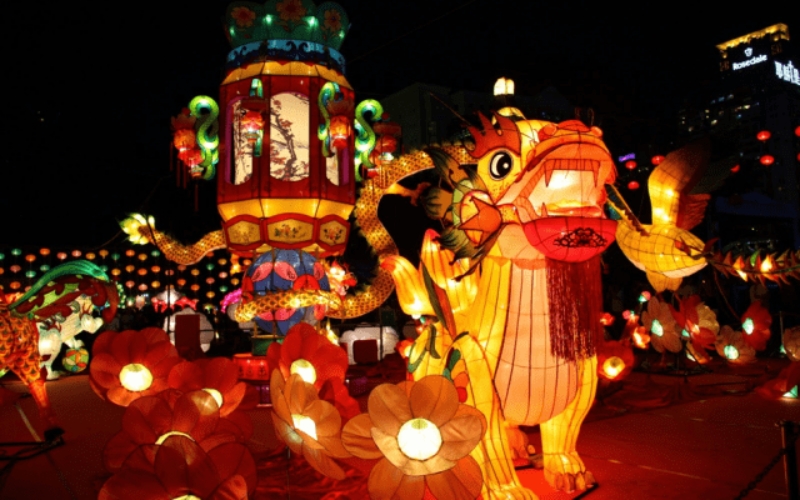
The lantern festival at Mid-Autumn night is the biggest of the year
The Mid-Autumn Festival Hanoi, called “Tet Trung Thu” locally, is the best festival in Hanoi if you’re traveling with children, or if you just want to see something genuinely beautiful without a massive crowd. Hang Ma Street transforms into a corridor of paper lanterns, dragon decorations, and mooncake vendors for the weeks leading up to the main date.
The Hanoi Lantern Festival atmosphere peaks on the 15th day of the eighth lunar month. Kids parade through streets carrying paper lanterns shaped like fish, stars, and lotus flowers. In some neighborhoods, lion dance teams perform until late into the night. Mooncakes (banh trung thu) are everywhere: traditional lotus paste with salted egg yolk, or newer flavors like matcha and durian.
- Time: 15th day of the 8th lunar month (typically September or October).
- 2026 date: October 6th.
- Location: Hang Ma Street (Old Quarter) for lanterns; Hoan Kiem Lake area for the main celebrations.
- What to expect: Paper lantern parades, lion dances, mooncake stalls, children’s games, and street performances.
>>> Read more about Mid-Autumn Festival.
3. Perfume Pagoda Festival (February-April)
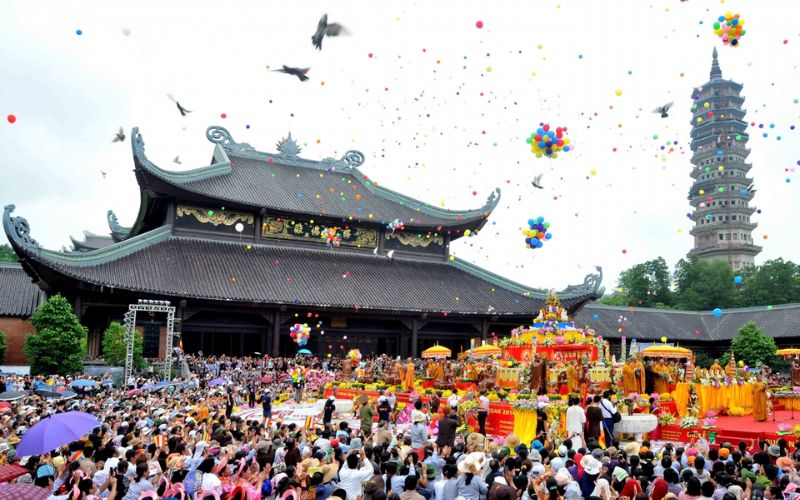
A spectacular balloon release marks a celebration at the historic Perfume Pagoda Festival.
One of the longest-running religious pilgrimages in Vietnam, the Perfume Pagoda Festival draws hundreds of thousands of visitors over its three-month run. The journey involves a boat ride down the Yen River through limestone karst scenery, followed by a hike (or cable car) up to the Huong Tich Cave pagoda complex.
The festival is most concentrated in the first two weeks of the second lunar month. During peak days, the river is so dense with pilgrims’ boats it looks like a floating village. Most visitors come to pray for health, good fortune, or children. This is one of the most famous festivals in Vietnam for Buddhist pilgrims, and the scenery makes it worth the half-day trip from the city.
- Time: 6th day of the 1st lunar month through the end of the 3rd lunar month; peak in the 2nd lunar month (roughly February-March).
- 2026 date: February 22nd – May 17th (peak period: mid-March to early April).
- Location: Huong Son Commune, ~70 km southwest of central Hanoi.
- What to expect: Boat rides on the Yen River, pilgrim processions, incense-filled cave shrines, and traditional offerings at hilltop pagodas.
>>> Maybe you don’t want to miss this Hanoi culture: the Perfume Pagoda Festival.
4. Dong Da Hill Festival (January/February)
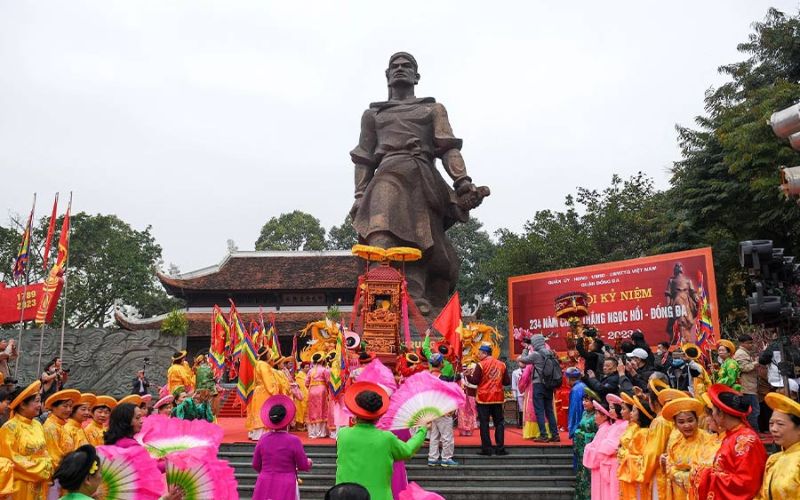
Vibrant traditional performances at the annual Dong Da Hill Festival in Hanoi.
Held on the fifth day of the first lunar month, the Dong Da Hill Festival commemorates the 1789 Tet Offensive when Emperor Quang Trung’s army defeated Chinese Qing forces at Dong Da Hill. It’s a local festival, most international visitors have never heard of it, but it draws big crowds from the surrounding neighborhoods. There are martial arts demonstrations, traditional music, and ceremonial events. The tone is more solemn and historical than the Tet flower market atmosphere.
- Time: 5th day of the 1st lunar month (January/February).
- 2026 date: February 21.
- Location: Dong Da Mound, Dong Da Ward, Hanoi.
- What to expect: Martial arts performances, traditional music, ceremonial processions, and historical reenactments.
5. Lim Festival (January/February)
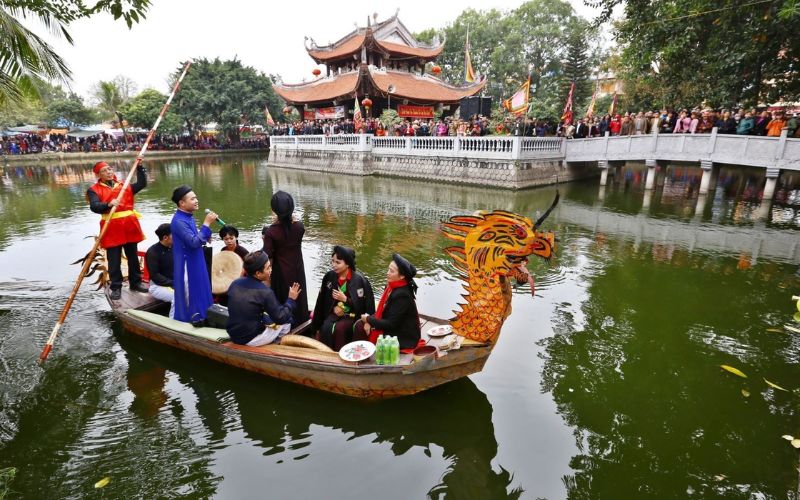
Folk singers perform Quan Ho melodies on a traditional boat during the Lim Festival.
Technically held in Bac Ninh province, about 30km from Hanoi, the Lim Festival is an easy day trip and well worth the journey. It’s the biggest event dedicated to Quan Ho folk singing – a UNESCO-recognized form of call-and-response vocal performance that originated in this region.
Teams of young men and women in traditional silk costumes perform on rowing boats across Lim Hill’s pond, trading verses back and forth. The singing is surprisingly affecting even if you don’t understand Vietnamese.
- Time: 13th day of the 1st lunar month (January/February), running for three days.
- 2026 date: February 28th – March 1st.
- Location: Lim Hill, Tien Du Commune, Bac Ninh Province (~30 km from Hanoi).
- What to expect: Quan Ho folk singing performances on boats, traditional silk costumes, folk games, and outdoor markets.
>>> Refer to Quan Ho Bac Ninh folk songs – UNESCO Intangible Cultural Heritage.
6. Ghost Festival Hanoi – Vu Lan Festival (July/August)
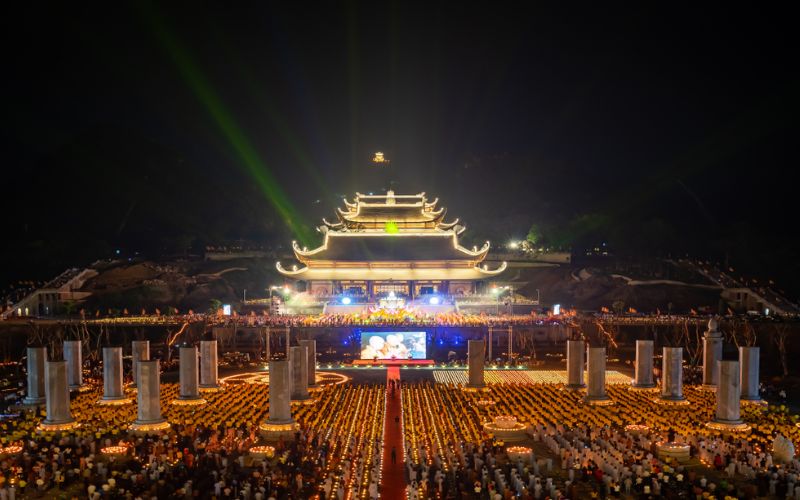
The glowing candle-lit grounds of a Hanoi temple during the solemn Vu Lan Festival.
The Ghost Festival Hanoi, or Vu Lan, or the Festival of Wandering Souls falls on the 15th day of the seventh lunar month. Vietnamese families burn votive paper offerings (fake money, paper houses, paper phones) for deceased relatives.
Buddhists visit pagodas to pray. In some neighborhoods, ceremonies are held in the streets, and the night air carries the smell of burning paper and incense.
The other side of Vu Lan is a celebration of mothers: people who still have living mothers wear a red rose; those whose mothers have passed wear a white one. It’s a quietly affecting tradition that most visitors don’t know about before arriving.
- Time: 15th day of the 7th lunar month (usually July or August).
- 2026 date: August 27th.
- Location: Citywide, Tran Quoc Pagoda (West Lake) and Quan Su Pagoda are the main focal points.
- What to expect: Paper offering ceremonies, pagoda prayers, incense-heavy street rituals, and the red/white rose tradition.
7. Co Loa Festival (January/February)
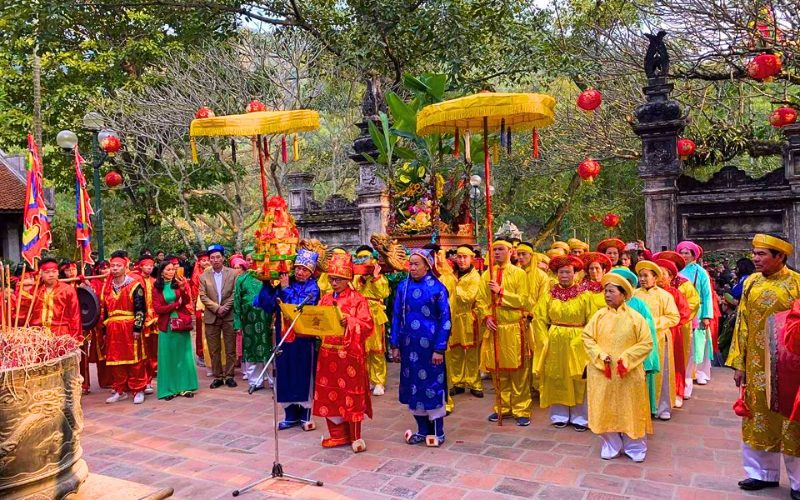
Ceremonial procession and prayers during the Co Loa Festival in Vietnam.
Co Loa Citadel, 20km north of central Hanoi, was the capital of the Au Lac kingdom in the third century BC. The Co Loa Festival held here honors King An Duong Vuong, the kingdom’s founder. The site, a three-walled ancient citadel with a moat, is worth visiting any time of year. During the festival, it is filled with traditional games, processions, and folk performances.
- Time: 6th day of the 1st lunar month (January/February).
- 2026 date: February 22nd (main festival day; pre-festival activities from February 21st).
- Location: Co Loa Citadel, Dong Anh Ward, Hanoi (~20 km north of the city center).
- What to expect: Ceremonial processions, traditional games, folk music performances, and the ancient three-walled citadel site.
8. Hanoi Autumn Festival (October)
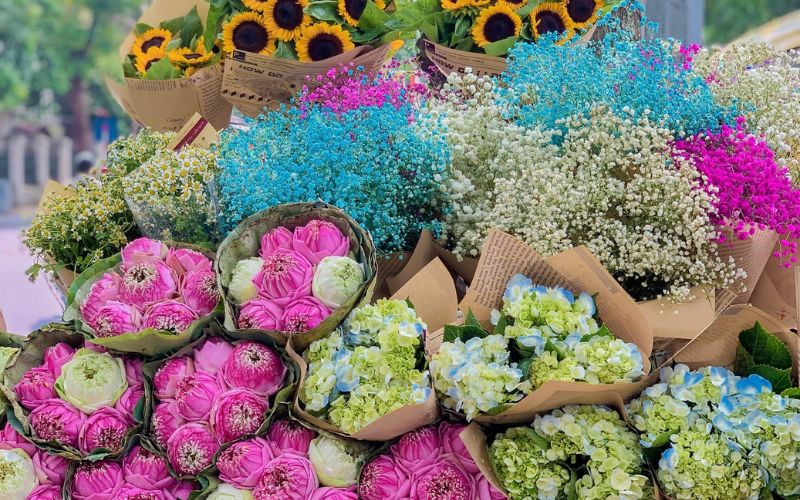
Fresh seasonal blooms capturing the essence of the Hanoi Autumn Festival.
October is arguably the best month to visit Hanoi, and the Autumn Festival is part of why. The weather shifts to something genuinely pleasant: cool mornings, blue skies, temperatures around 20-25°C (68-77°F) and the city’s parks take on a different character.
The festival involves cultural performances around Hoan Kiem Lake, art exhibitions, and the traditional “com” (young green rice) harvest. “Com” is one of those Hanoi-specific seasonal foods that locals treat as a small annual event in itself. You’ll find it sold in lotus leaf packages around West Lake.
- Time: October (exact dates vary annually; often tied to Hanoi’s Liberation Day on October 10th).
- 2026 date: Around October 10th (exact dates will be confirmed soon by Vietnam Tourism).
- Location: Hoan Kiem Lake area, West Lake, and cultural venues across the city.
- What to expect: Cultural performances, art exhibitions, “com” (young green rice) tastings, and pleasant autumn weather ideal for walking the city.
>>> If you want to explore the most beautiful season of Hanoi, visit Hanoi in Autumn: Immerse in the Romantic Capital City.
9. Giong Festival (April/May)
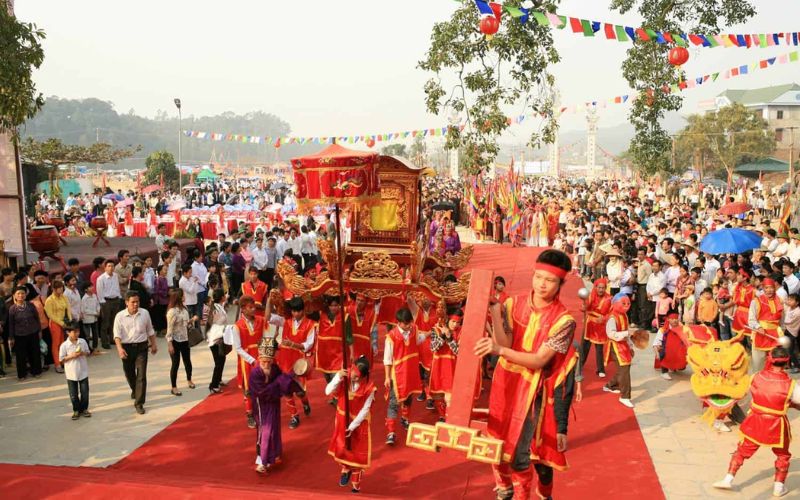
A grand palanquin procession during the UNESCO-recognized Giong Festival.
The Giong Festival, called “Hoi khoe Phu Dong” by locals, held at Phu Dong Temple in the Gia Lam district, is a UNESCO-recognized festival celebrating the legendary hero Saint Giong, who is said to have defeated an invasion of the Au Lac kingdom as a child. The event involves a complex ceremonial performance reenacting the legend, with hundreds of participants in traditional costumes. It’s one of the more historically layered festivals in northern Vietnam.
- Time: 6th – 12th days of the 4th lunar month (April/May); main procession on the 9th day.
- 2026 date: May 25th (main procession day, 9th day of the 4th lunar month).
- Location: Phu Dong Temple, Phu Dong Commune, Hanoi.
- What to expect: Large-scale ceremonial procession, hundreds of costumed participants, folk performances, and traditional ritual reenactments.
>>> Refer to Giong festival of Phu Dong and Soc temples – UNESCO Intangible Cultural Heritage.
10. Tay Ho Communal House Festival (February/March)
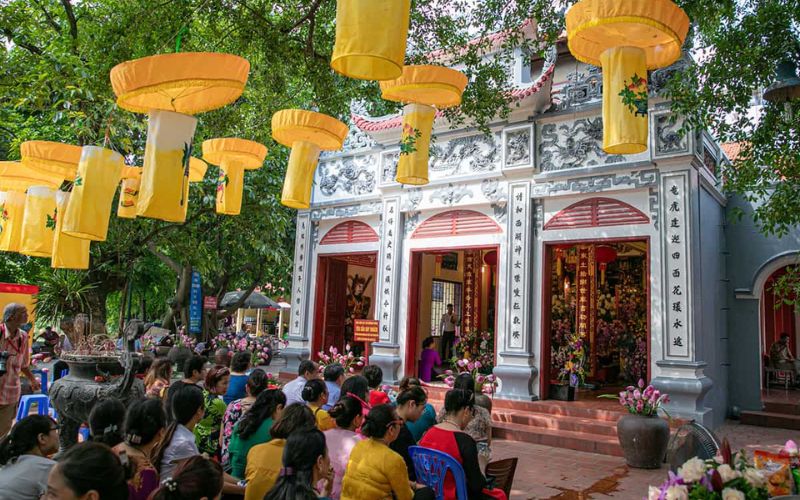
Devotees and decorative lanterns at the traditional Tay Ho Communal House Festival.
The Tay Ho Communal House, on a small peninsula in West Lake, holds a festival on the 15th and 16th days of the second lunar month honoring Princess Lieu Hanh, one of the four immortals in Vietnamese folk religion. Thousands of locals, mostly women, come to pray for health and good fortune. The offerings are elaborate: whole roasted pigs, towers of fruit, incense burning in every direction. It’s not a tourist event, which is exactly what makes it worth attending.
- Time: 15th-16th days of the 2nd lunar month (February/March).
- 2026 date: April 2nd – 3rd (tentative).
- Location: Tay Ho Communal House (Phu Tay Ho), Tay Ho Ward, Hanoi.
- What to expect: Elaborate religious offerings, incense ceremonies, crowds of local worshippers, and a serene West Lake setting.
11. Hanoi Old Quarter Night Market (Every Weekend, Year-Round)
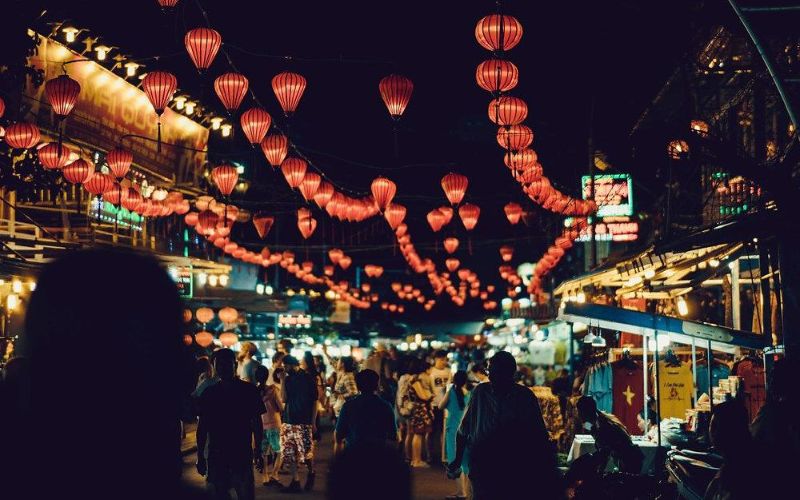
Atmospheric red lanterns illuminate the vibrant Hanoi Old Quarter Night Market.
The Hanoi Old Quarter Night Market runs every Friday, Saturday, and Sunday evening and is the closest thing Hanoi has to a weekly celebration. The streets around Hang Dao, Dong Xuan Market, and Hang Giay are closed to traffic and given over to vendors, street performers, and food stalls.
The market captures a compressed version of what makes Hanoi’s street culture interesting: “banh mi” carts, craft vendors, photo spots, and long rows of grilled skewers generating enough smoke to be visible from a distance. It gets crowded, especially near Hoan Kiem, but the energy is genuine.
- Time: Every Friday, Saturday, and Sunday evening (approximately 7pm-11pm).
- 2026 date: Year-round, every weekend, no specific annual date.
- Location: Hang Dao Street to Dong Xuan Market, Old Quarter, Hanoi.
- What to expect: Street food, handicraft stalls, live performances, pedestrian-only streets, and a lively local crowd.
>>> Don’t miss all things about the enchanting Hanoi Old Quarter!
12. Hai Ba Trung Temple Festival (January/February)
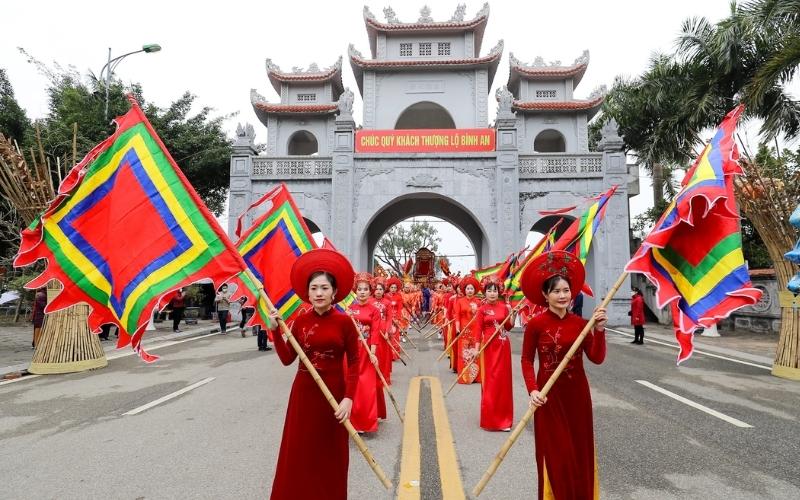
Hai Ba Trung Temple Festival
The Hai Ba Trung Temple Festival, held at the national special historical site in Hai Ba Trung Ward (Me Linh commune after the merger in 2025), is one of the most historically significant festivals in Hanoi. It commemorates the Trung Sisters: Trung Trac and Trung Nhi, who led the first Vietnamese uprising against Chinese Han rule in 40 AD, establishing a short period of independence that Hanoians have honored ever since.
The festival runs for three days and draws enormous crowds, including senior state officials and delegations from across the country. The ceremonial centerpiece is the palanquin procession: two ornate palanquins carrying representations of the Trung Sisters are processed from Ha Loi village to the main temple, with a unique ritual called “exchanging palanquins” – the palanquins are repeatedly lifted over participants’ heads and switched, creating an undulating dragon-like motion to the sound of drums and gongs. Alongside the ceremony, the festival features traditional dances, wrestling, and folk games.
- Time: 4th – 10th days of the 1st lunar month; main ceremony on the 6th day.
- 2026 date: February 22nd – 24th.
- Location: Hai Ba Trung Temple, 12 Hai Ba Trung Ward, Hanoi (~30 km northwest of the city center).
- What to expect: Solemn incense offering ceremony, the unique palanquin procession with the “exchanging palanquins” ritual, traditional dances, and folk games.
13. Trieu Khuc Village Festival (January/February)
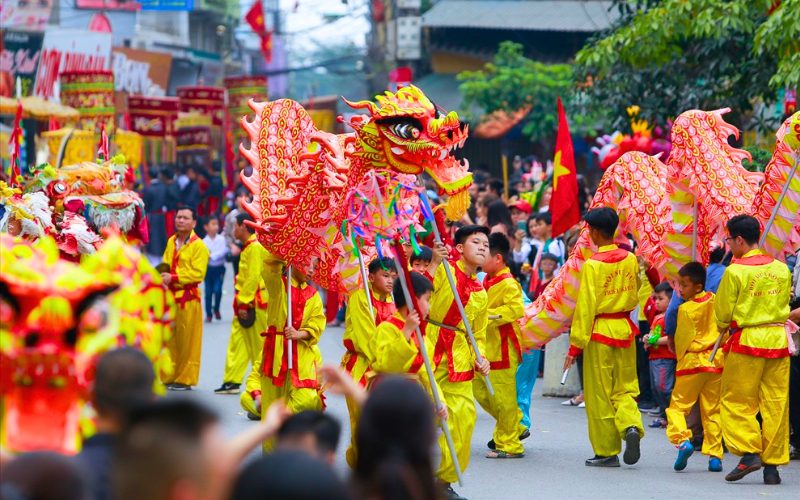
Festival in Trieu Khuc Village
Trieu Khuc village, in Thanh Liet ward about 8km south of central Hanoi, holds one of the capital’s most unusual and locally beloved festivals each spring. The event honors King Phung Hung, a national hero who led an 8th-century uprising against Tang Chinese rule and has been recognized as a National Intangible Cultural Heritage.
The festival’s most famous element is the “con di danh bong”, a ritual drum dance in which young men dress in women’s clothing, with painted cheeks and red lips, and perform an intricate percussive dance. The dance traces back to a wartime legend: Phung Hung’s soldiers reportedly disguised themselves as women to deceive the enemy, and the performance has been reenacted at every festival since.
It’s genuinely unlike anything else you’ll see in Hanoi, and the crowd reaction, delight mixed with reverence, tells you exactly how seriously the village takes it. Two processions honor King Phung Hung with palanquins, dragon dances, and folk opera performances describing his military campaigns.
- Time: 9th – 12th days of the 1st lunar month (January/February).
- 2026 date: February 25th – 28th.
- Location: Trieu Khuc Communal Houses (Dinh Sac and Dinh Dai), Thanh Liet Ward, Hanoi (~8 km from city center).
- What to expect: The unique “con di danh bong” drum dance, palanquin processions, dragon and unicorn dances, folk opera, and traditional games including wrestling.
14. Christmas in Hanoi (December)
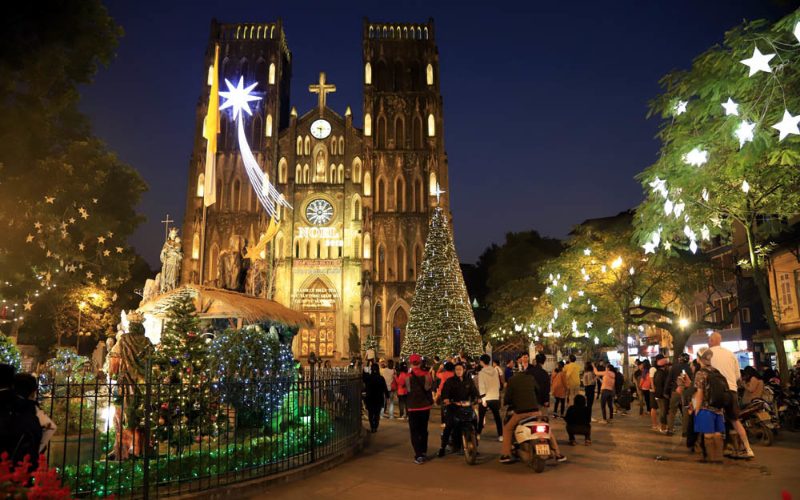
Christmas Eve at St. Joseph Cathedral in Hanoi
Hanoi has a significant Catholic population and the area around St. Joseph’s Cathedral in the Old Quarter becomes genuinely festive in late December. Christmas Eve draws enormous crowds to the cathedral; the surrounding streets fill with vendors, families, and visitors taking photos. It’s more of a social event than a religious one for most of the crowd, which makes it accessible for all visitors.
- Time: December 24th – 25th (main activity on Christmas Eve).
- Location: St. Joseph’s Cathedral (Nha Tho Lon), Hoan Kiem Ward; surrounding Old Quarter streets.
- What to expect: Carol performances, street vendors, elaborately decorated cathedral exterior, and large mixed crowds of locals and visitors.
>>> See how Christmas in Vietnam is celebrated here.
15. Bat Trang Pottery Village Festival (March/April)
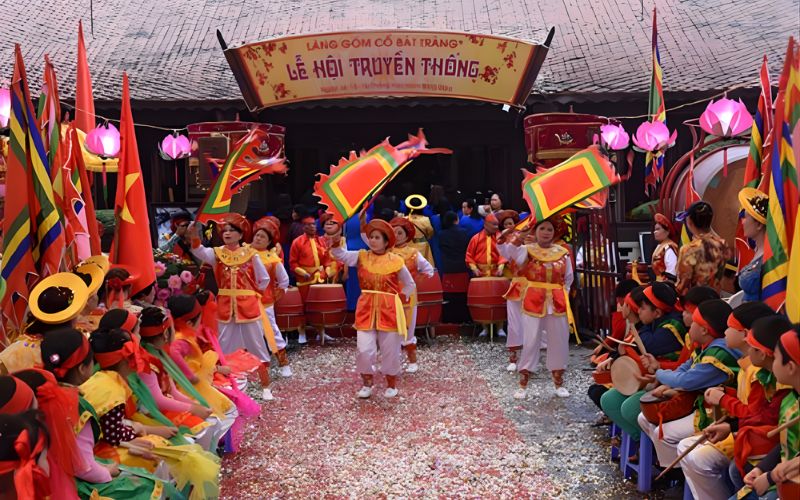
Traditional flag dancing and drumming performances at the historic Bat Trang Pottery Village Festival.
Bat Trang, on the bank of the Red River 15km southeast of central Hanoi, has been producing ceramics since the 11th century. Its annual traditional festival is both a religious event and a celebration of the craft itself, the village communal house worships six guardian deities credited with protecting the pottery trade, and the ceremonies are as much about giving thanks for a continuing livelihood as they are about honoring ancestors.
The ceremonial highlight is the water procession on the Red River: the community carries offerings from the communal house down to the riverbank in a solemn procession, symbolizing the deep connection between the village and the water that has sustained its clay supply for centuries. The festival also features palanquin processions, incense offerings, and a lantern release on the river on the final evening.
Alongside the ritual activities, craft demonstrations and a large ceramics market run throughout, making it one of the few festivals in Hanoi where you can both attend traditional ceremonies and buy directly from the artisans who made the pieces. Bat Trang’s festival was recognized as a National Intangible Cultural Heritage, and the village itself is a member of UNESCO’s Global Network of Creative Cities.
- Time: 13th – 16th days of the 2nd lunar month (March/April).
- 2026 date: March 31st – April 3rd.
- Location: Bat Trang Communal House, Bat Trang Commune, Hanoi (~15 km from city center).
- What to expect: Water procession on the Red River, palanquin ceremonies, incense offerings, evening lantern release, folk games, and a large ceramics market with hands-on pottery workshops.
>>> Contact us if you decide to plan a trip to Vietnam!
Hanoi Festivals at a Glance: How to Choose the Right One for Your Trip
Fifteen festivals is a lot to process. The honest answer is that the right one depends on what kind of traveler you are, not just when you happen to be in town. Here’s a way to think about it.
By travel style
Some festivals are genuinely for everyone. The Mid-Autumn Festival works for solo travelers, couples, and families alike. The streets are safe, the atmosphere is warm, and there’s no language barrier to enjoying paper lanterns and mooncakes. The Old Quarter Night Market is the same: low effort, high reward, available every weekend.
Tet is in a category of its own. It’s the most immersive festival on this list, but it also requires the most preparation and the most flexibility. If your schedule is rigid or your dining options are limited, the business closures will frustrate you. If you’re comfortable with some unpredictability, it’s the most memorable week in the entire Vietnam travel calendar.
The Perfume Pagoda Festival and the Lim Festival are best for travelers who want something genuinely off the tourist trail. Both require a half-day trip out of the city, and both put you in the middle of events that are almost entirely attended by Vietnamese locals.
By time of year
| Month | Festival |
| January / February | Tet (Lunar New Year), Dong Da Hill Festival, Co Loa Festival, Lim Festival |
| February / March | Trieu Khuc Village Festival, Hai Ba Trung Temple Festival, Perfume Pagoda Festival (peak), Tay Ho Communal House Festival, Bat Trang Pottery Village Festival |
| April / May | Giong Festival |
| July / August | Ghost Festival – Vu Lan |
| September / October | Mid-Autumn Festival (Hanoi Lantern Festival) |
| October | Hanoi Autumn Festival |
| December | Christmas in Hanoi |
| Every weekend | Old Quarter Night Market |
By what you’re looking for
- Best for families with children: Mid-Autumn Festival – the lanterns, lion dances, and mooncakes are genuinely delightful for kids of any age. Bat Trang Pottery Village Festival – children and their parents can make pottery in the workshop together.
- Best for history and culture: Dong Da Hill Festival, Giong Festival, Co Loa Festival, Trieu Khuc Village Festival, Hai Ba Trung Temple Festival – all these festivals are rooted in specific historical events and largely attended by locals.
- Best for religious and spiritual atmosphere: Perfume Pagoda Festival, Vu Lan (Ghost Festival), Tay Ho Communal House Festival.
- Best for food and street atmosphere: Tet flower markets, Old Quarter Night Market, Hanoi Autumn Festival.
- Best for first-time visitors: Mid-Autumn Festival or the Old Quarter Night Market, both are accessible, visually striking, and require zero advance planning.
- Least crowded by tourists: Co Loa Festival, Dong Da Hill Festival, Tay Ho Communal House Festival – you’ll mostly be surrounded by Hanoians.
A note on crowd sizes
Tet and the Mid-Autumn Festival are the two events where crowd management matters most.
The Perfume Pagoda Festival has its own crowd challenge: peak pilgrimage days mean long boat queues. Visiting on a weekday in the second half of the festival period helps.
Conclusion to Prepare for Your Visit to Vietnam
A few tips worth knowing before you build your itinerary around a specific festival:
- Tet accommodation books up early and prices rise significantly. Plan at least 2-3 months ahead if you want to be in Hanoi during the Lunar New Year period.
- Lunar calendar dates shift each year: The festivals marked as January/February or July/August above move by several weeks from year to year. Always cross-check against the current lunar calendar.
- Transport during Tet is more complicated than usual. Internal flights and trains fill up fast. Book early or plan to be flexible.
- Weather context: Hanoi’s festival calendar mostly front-loads the first quarter of the year (winter/early spring) and has another cluster in autumn. Summer (June-August) is hot and wet, with fewer major festivals.
If you’re combining festivals with broader Vietnam travel, pairing a Hanoi festival with time in Ha Long Bay, Hoi An, or Sapa. Our Hanoi city tours and customized Vietnam tours can be arranged around your chosen dates, with flexible private itineraries rather than fixed group departures.
Read more:
I’m going to visit Hanoi, Vietnam in March 2024. Is there any festival to join at this time?
Hi Nadia,
Visiting Hanoi in March, you can join the traditional festival of Bat Trang pottery village, which happens on March 23-24, 2024.
Thank you so much!
Best regards,
IDC Travel Team.