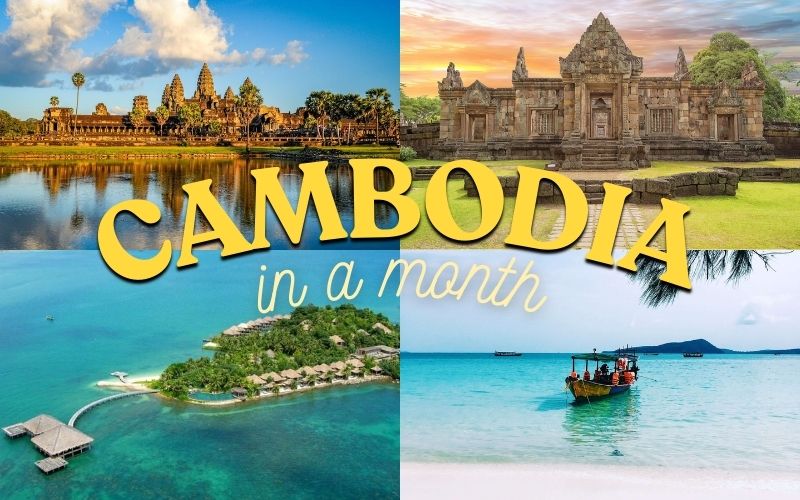
Cambodia is not only about Angkor Wat. A full month gives you time to experience ancient temples in Siem Reap, quiet Mekong riverside towns, the forested highlands of the northeast, and the laid back southern coast. Instead of racing between destinations, you can travel at a natural pace, adjusting to longer road journeys and slower local life. This guide is designed as a complete and practical roadmap for planning a Cambodia tour in a month, with realistic routes, seasonal advice, and cost considerations.
Is One Month in Cambodia Too Long?
No, one month in Cambodia is not too long if you want to experience the country beyond its most famous highlights. In fact, four weeks is often the ideal length to balance cultural exploration, nature, and rest without constant rushing.
Many travelers spend 10 Days focusing mainly on Siem Reap and Phnom Penh. Two weeks allow you to add the southern coast or the Mekong region. However, when you extend your trip to four weeks, the experience changes completely. You are no longer moving quickly from one landmark to another. Instead, you begin to understand distances, regional differences, and local rhythms.
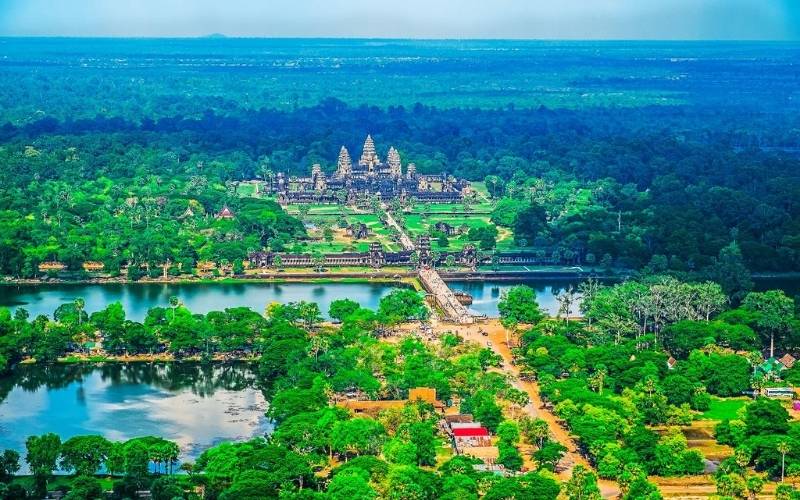
The magnificent Angkor Wat temple complex amid vibrant greenery in Siem Reap, Cambodia
Cambodia is geographically compact, but road travel takes time. A bus journey between Siem Reap and Phnom Penh can take around 5 to 6 hours. Traveling from Kratie to the northeast highlands can require half a day by road. These longer transfers naturally slow the journey. With only 10-14 days, these distances can feel exhausting. With a month, they feel manageable.
There is also the pace of daily life to consider. In riverside towns like Kampong Cham or Kratie, afternoons are quiet and slow. In Banlung or Senmonorom, trekking and nature excursions require recovery time between days. A 4-week Cambodia tour allows you to build in rest days without feeling that you are wasting time. If your goal is to deeply explore Angkor, follow the Mekong north, visit indigenous highland regions, and still enjoy time on the southern coast, one month feels balanced rather than excessive.
>>> If you are considering a structured long stay instead of planning logistics yourself, you can review Grand Tour of Cambodia in 20 Days designed for travelers who want both depth and comfort.
Best Time for a Cambodia Tour in a Month
The best time to visit Cambodia for a month is during the dry season from November to March, when temperatures are more comfortable and travel conditions are easier. However, each season offers different advantages depending on where you plan to travel.
Dry Season from November to March
This is generally considered the most pleasant period for a four week Cambodia tour. Temperatures are warm but more manageable than later in the year, especially for temple visits in Siem Reap and outdoor exploration in the northeast. Roads are in better condition, boat services operate reliably, and beach destinations in the south usually have calmer seas.
In the highlands of Ratanakiri and Mondulkiri, the cooler months are particularly comfortable for trekking and visiting waterfalls. Around Tonle Sap Lake, water levels remain relatively high after the rainy season, making floating village visits more scenic.
Hot Season from March to May
This is the hottest period of the year, with temperatures often exceeding 35 degrees Celsius (95 degrees Fahrenheit) in lowland areas. Temple visits at Angkor can feel intense by midday, so early morning and late afternoon planning becomes essential.
In the northeast highlands, slightly higher elevations can provide some relief. Beach areas remain attractive during this time, especially if your itinerary includes time to rest by the sea. For travelers who tolerate heat well, this period can still work for a month long stay, especially since it falls outside the busiest peak months.
Green Season from May to October
The green season brings regular rainfall, usually in short but heavy showers rather than continuous rain. The countryside becomes lush, rice fields turn bright green, and temple moats fill with water, creating dramatic reflections at Angkor.
Travel in the northeast can involve muddy roads, but waterfalls are at their most powerful. In coastal areas such as Kep and the islands near Sihanoukville, sea conditions can be less predictable. That said, this period often means fewer tourists and lower accommodation rates.
For a four week Cambodia itinerary that includes temples, river towns, highlands, and beaches, November to February remains the most balanced window. However, with careful planning, Cambodia can be explored year round.
>>> If you are unsure which season best fits your travel style, you can explore our Cambodia tour in 15 Days tailored to dry season, green season, and extended stays.
Best Route for a Cambodia Tour in a Month
There is no single perfect itinerary for a Cambodia tour in 4 weeks. The right route depends on your travel style, energy level, and how deeply you want to explore each region. The most logical structure follows a north to south axis, starting in Siem Reap and ending on the southern coast, which minimizes backtracking and respects real overland travel distances.
Below are three structured options built on the same geographic backbone, with different pacing and extensions:
Option 1: Fewer Destinations, Slower Travel
This route is designed for travelers who prefer depth, rest days, and fewer hotel changes. It follows a clean north to south line without major detours.
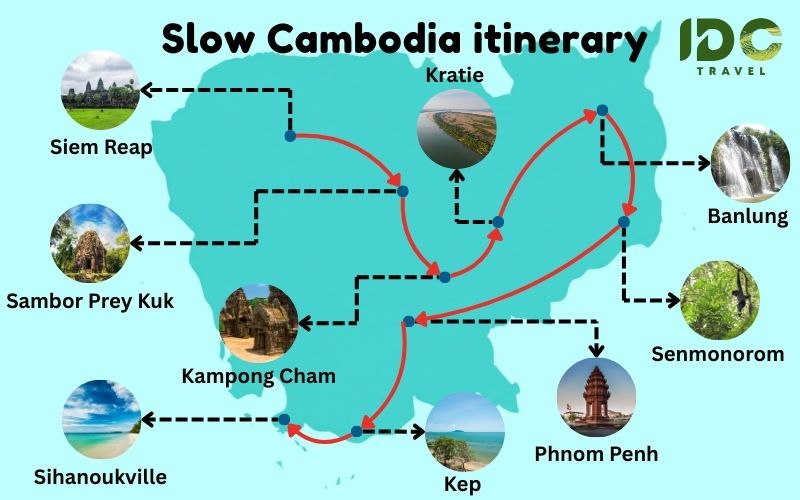
This route focuses on fewer moves, longer stays, and time to connect with local life along rivers, highlands, and southern coast.
Route: Siem Reap → Sambor Prey Kuk → Kampong Cham → Kratie → Banlung → Senmonorom → Phnom Penh → Kep → Sihanoukville
Week 1: Siem Reap and Angkor Region
- Siem Reap (6-7 days): the cultural gateway to Cambodia and base for Angkor Archaeological Park. Spending 6 to 7 nights here allows temple visits to be spread across several mornings, reducing fatigue and giving time for Tonle Sap excursions or countryside cycling.
Week 2: Mekong Riverside Cambodia
- Sambor Prey Kuk (1 day): an Angkorian temple complex surrounded by forest. 1 night is sufficient, usually as a stop between Siem Reap and Kampong Cham.
- Kampong Cham (2-3 days): a quiet Mekong riverside town with French colonial remnants and access to Koh Paen Island. 2 to 3 nights allow time for cycling and local immersion.
- Kratie (2-3 days): known for Irrawaddy dolphin watching and Koh Trong Island. 2 to 3 nights provide a relaxed introduction to rural Mekong life.
Week 3: Northeast Highlands
- Banlung (3 days): capital of Ratanakiri province, surrounded by waterfalls and Yeak Laom volcanic lake. 3 nights allow lake visits and nearby forest excursions.
- Senmonorom (3-4 days): located in Mondulkiri province, known for rolling hills and ethical elephant sanctuaries. 3 to 4 nights are recommended for trekking and wildlife experiences.
Week 4: Phnom Penh and Southern Coast
- Phnom Penh (3-4 days): Cambodia’s capital blends royal heritage and modern development. 3 to 4 nights allow visits to the Royal Palace, Tuol Sleng, and time to experience the riverfront atmosphere.
- Kep (3 days): a quiet coastal town famous for seafood and relaxed seaside life. 3 nights are ideal for rest.
- Sihanoukville (2-3 days): primarily a transport hub for beaches and islands. 2 to 3 nights are sufficient before departure or onward travel.
This option suits travelers who value slower rhythms and fewer transitions.
Option 2: Balanced Route with Broader Experiences
This version keeps the same north to south structure but adds carefully selected destinations that expand cultural and landscape diversity without making the journey overly demanding.
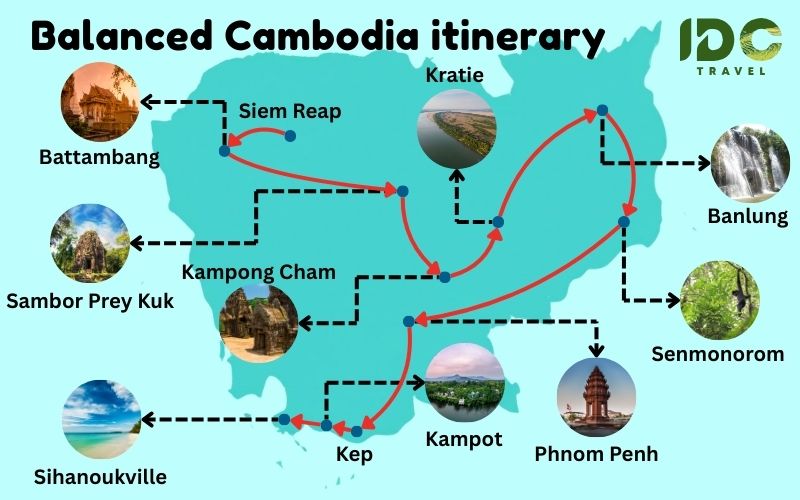
This balanced itinerary blends temples, countryside, culture, and coastline in a comfortable and logical loop.
Route: Siem Reap → Battambang → Sambor Prey Kuk → Kampong Cham → Kratie → Banlung → Senmonorom → Phnom Penh → Kep → Kampot → Koh Rong
Week 1: Siem Reap and Battambang
- Siem Reap (5 days): 5 nights are usually sufficient when the pace is slightly more active than Option 1.
- Battambang (2-3 days): located west of Siem Reap, Battambang adds French colonial architecture, rural village life, and access to Phnom Penh.
- Sampeau (2-3 days): 2 to 3 nights here enrich the early part of the trip before heading south.
Week 2: Central Mekong Region
- Sambor Prey Kuk (1 days): 1 night stop to explore this early temple complex and break the journey south.
- Kampong Cham (2 days): 2 nights to experience Mekong river life and nearby islands.
- Kratie (2 days): 2 nights for dolphin viewing and rural cycling.
Week 3: Northeast Highlands
- Banlung (2-3 days): 2 to 3 nights for waterfalls and Yeak Laom Lake.
- Senmonorom (3 days): 3 nights for forest trekking and elephant conservation projects.
Week 4: Capital and Southern Coast
- Phnom Penh (3 days): 3 nights to balance historical exploration and contemporary urban life.
- Kep (2 days): 2 nights for seafood and coastal scenery.
- Kampot (3 days): a relaxed riverside town with access to Bokor National Park and pepper plantations. 3 nights allow both nature and town exploration.
- Koh Rong (3-4 days): 3 to 4 nights on the island provide proper beach time rather than treating Sihanoukville as a long stay.
This route is ideal for travelers who want both variety and comfort.
Option 3: Dynamic Route for Active Travelers
This option is built for energetic travelers who want maximum geographic coverage within four weeks and are comfortable with longer road journeys.
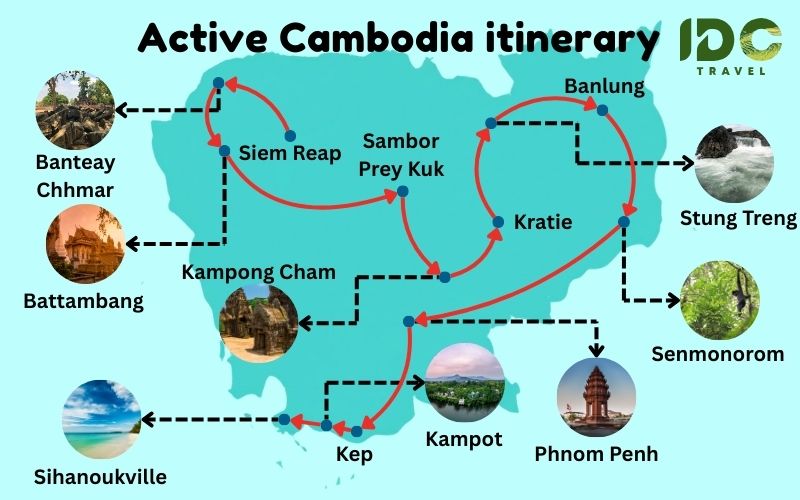
This active route covers Cambodia’s lesser-known corners, remote temples, waterfalls, and adventurous landscapes.
Route: Siem Reap → Banteay Chhmar → Battambang → Sambor Prey Kuk → Kampong Cham → Kratie → Stung Treng → Banlung → Senmonorom → Phnom Penh → Kep → Kampot → Koh Rong Samloem
Week 1: Northwest Cambodia
- Siem Reap (4-5 days): 4-5 nights with a more intensive temple schedule.
- Banteay Chhmar (2 days): a remote temple complex in northwest Cambodia with minimal tourism. 2 nights are recommended due to distance and limited infrastructure.
- Battambang (2 days): 2 nights to explore its countryside and cultural sites before heading south.
Week 2: Mekong Corridor
- Sambor Prey Kuk (1 day): 1 night to the Mekong towns.
- Kampong Cham (2 days): 2 nights for riverside immersion.
- Kratie (2 days): 2 nights for dolphin excursions.
- Stung Treng (1-2 days): a northern Mekong town near the Laos border. 1-2 nights introduce a less visited river landscape.
Week 3: Northeast Highlands
- Banlung (2-3 days): 2 to 3 nights for waterfalls and forest scenery.
- Senmonorom (3 days): 3 nights for trekking and wildlife experiences.
Week 4: Capital and Islands
- Phnom Penh (3 days): 3 nights to understand Cambodia’s recent history and present transformation.
- Kep (1-2 days): 1 to 2 nights for coastal relaxation.
- Kampot (2-3 days): 2 to 3 nights for river and national park exploration.
- Koh Rong Samloem (3-4 days): 3 to 4 nights for a quieter island experience than Koh Rong.
This option offers the broadest view of Cambodia’s cultural and natural diversity.
We recommend you to:
- Choose Option 1 if you value depth and quiet days.
- Choose Option 2 if you want variety with manageable pacing.
- Choose Option 3 if you want maximum geographic coverage and do not mind longer road journeys.
>>> If you prefer a fully organized version of any of these routes with private transfers and local guides, you can explore more our customized Cambodia tours built around different travel styles and energy levels.
Budget for A Month in Cambodia
The cost of 1 month in Cambodia depends largely on your travel style, but overall Cambodia remains one of the more affordable long stay destinations in Southeast Asia. Your main expenses will include accommodation, transport, food, and entrance fees such as the Angkor Pass.
Below is a realistic monthly budget overview based on average market prices across the country.
Estimated Cost of 1 Month in Cambodia (USD)
| Travel Style | Accommodation | Transport | Food & Daily Expenses | Angkor Pass | Estimated Total |
| Budget Backpacker | $300-600 | $150-250 | $300-450 | $72 | $900-1,400 |
| Mid Range | $900-1,500 | $250-400 | $450-700 | $72 | $1,700-2,600 |
| Comfortable Travel | $2,000+ | $400-800 | $700-1,200 | $72 | $3,200+ |
Accommodation
Budget guesthouses in provincial towns such as Kampong Cham or Kratie can cost between $10-20/night. In Siem Reap and Phnom Penh, mid range boutique hotels typically range from $40-80/night. Higher end hotels and resorts in coastal areas or Siem Reap often start from $120/night and increase significantly depending on brand and season.
Transport
Long distance buses between major cities usually cost between $10-20/journey. Private drivers or private transfers significantly increase the budget but improve comfort, especially in the northeast highlands where public transport can be limited. Domestic flights are available on selected routes such as Siem Reap to Phnom Penh but are not always necessary for a four week itinerary.
Food
Street food meals can cost $2-4. Casual restaurants often range from $5-12/meal. Fine dining restaurants in Phnom Penh and Siem Reap can range from $20+/person. Over a full month, daily food spending varies greatly depending on habits and location.
Angkor Pass
The official Angkor Pass is issued by Angkor Enterprise. A 7 day pass costs $72 and is valid for use over a month period from the date of purchase. This flexibility makes it suitable for longer stays in Siem Reap, allowing temple visits to be spread out rather than concentrated in consecutive days.
Overall, Cambodia offers strong value for long stays, especially when compared to neighboring countries with similar cultural depth.
>>> If you would like cost clarity in advance, including transport, guides, and selected hotels bundled together, you can explore our packages like 5 days Cambodia trip, 9 Days Cambodia journey or tour to Cambodia and Vietnam in 16 Days to compare structured options against independent travel.
Combining Cambodia With Vietnam, Laos or Thailand in a 4-Week Journey
You can realistically combine Cambodia with Vietnam, Laos or Thailand within four weeks, as long as the route follows a logical geographic flow. The key is not to squeeze multiple countries into short segments but to extend the journey into a structured regional itinerary. Below are realistic 4 week combinations based on established Indochina travel corridors.
Cambodia and Vietnam in 4 Weeks
A four week Cambodia and Vietnam journey typically balances northern Vietnam, central Vietnam, southern Vietnam, and Cambodia’s cultural heartland. Instead of rushing through both countries, you divide time evenly.
A logical route could look like this: Hanoi, Halong Bay, Central Vietnam including Hue, Hoi An, Ho Chi Minh City, Mekong Delta, Phnom Penh, Siem Reap and Angkor. In this structure, Cambodia becomes the final cultural highlight after exploring Vietnam’s landscapes and cities. The transition from Ho Chi Minh City to Phnom Penh follows the Mekong corridor, making the shift geographically smooth.
This combination works well for travelers who want contrast. Vietnam adds coastal scenery, mountain regions, and urban dynamism. Cambodia offers a slower rhythm and deeper temple heritage experience.
>>> If you want to structure your month around both countries, you can explore our Vietnam and Cambodia tours for inspiration on balanced cross border routes.
Cambodia, Vietnam and Laos in 4 Weeks
A four week Vietnam – Cambodia – Laos journey focuses strongly on heritage and river culture. Instead of covering every region in each country, the itinerary concentrates on key cultural centers.
A realistic 4 week route could include: Hanoi, Halong Bay, Central Vietnam, Siem Reap, Angkor, Phnom Penh and Luang Prabang in Laos. This route highlights UNESCO recognized heritage areas and major historical capitals across the region. Cambodia becomes the central segment of the journey, connecting Vietnam’s coastal regions with Laos’ mountainous landscapes.
The connection from Cambodia to Laos is often structured through the northern Mekong corridor, maintaining a consistent geographic direction.This combination suits travelers who value architecture, temple complexes, colonial history, and slower paced exploration rather than nightlife or beach resorts.
>>> For travelers interested in this style of journey, you can review our Vietnam Cambodia Laos itineraries designed around cultural depth and heritage sites.
Cambodia and Thailand in 4 Weeks
A four week Cambodia – Thailand itinerary introduces greater urban diversity and regional contrast. This version blends cultural capitals with large metropolitan centers.
A balanced route could look like this: Siem Reap, Phnom Penh and Bangkok. This structure creates a cultural arc across mainland Southeast Asia. Cambodia sits next to Thailand geographically, making overland or short regional flights practical.
Thailand adds developed tourism infrastructure, modern city energy, and additional royal heritage sites. Cambodia continues to provide Angkor as the historical centerpiece of the entire journey. This combination is ideal for travelers who want a mix of ancient temples, colonial cities, and contemporary Asian capitals within one extended trip.
>>> With four weeks available, Cambodia can either stand alone as a deep exploration or act as the central chapter of a wider Indochina journey. Explore more Thailand Cambodia Tours.
Useful Travel Tips for Traveling Cambodia
Cambodia is relatively easy to travel for four weeks, but understanding a few practical details will make your journey smoother and more comfortable. Below are essential tips for long stays, especially if you plan to follow a north to south route across temples, rivers, highlands, and the coast.
- Visa validity comes first: most nationalities can obtain a 30 day tourist visa either online through the official e-visa system or on arrival at international airports and major land borders. If you plan to stay a full four weeks, check entry dates carefully to avoid overstaying.
- Expect longer road journeys than the map suggests: distances in Cambodia are not large, but road conditions and traffic can extend travel times. For example, Siem Reap to Phnom Penh typically takes five to six hours by road. Plan transfers on dedicated travel days rather than combining them with sightseeing.
- Spread out temple visits at Angkor: the Angkor Pass 7 day option is valid over one month from the date of issue. This flexibility allows you to visit temples on non consecutive days, which is ideal during a longer stay.
- Carry small denomination US dollars: US dollars are widely accepted across Cambodia, especially in tourist areas. Small bills are useful in provincial towns. Cambodian riel is typically used for small change.
- Respect local dress codes at religious sites: shoulders and knees should be covered when visiting temples and pagodas. Lightweight clothing that still provides coverage is ideal for hot weather.
- Build rest days into your schedule: 4 weeks of continuous movement can still be tiring. Riverside towns like Kampong Cham or coastal areas such as Kep are perfect for slower days between more active segments.
- Internet access is reliable in major towns: Phnom Penh, Siem Reap, and Kampot have good Wi Fi coverage. If you are staying a month, purchasing a local SIM card with data is inexpensive and practical.
- Choose island time carefully in the rainy season: between May and October, sea conditions near Sihanoukville and Koh Rong can be less predictable. Allow flexibility in your schedule if your four week itinerary ends on the coast.
- Consider private transfers in the northeast: public transport to Banlung and Senmonorom can be limited. For comfort and efficiency during a long itinerary, private vehicles are often worth considering.
Traveling Cambodia for four weeks is not complicated, but thoughtful pacing and realistic expectations make a significant difference.
If you prefer not to manage transport logistics and regional transfers yourself, you can explore our fully arranged Cambodia 4 week tours designed with built in rest days and realistic travel times.
4 weeks is an ideal timeframe to truly experience Cambodia without rushing. A month allows you to explore Angkor in depth, follow the Mekong through quiet provincial towns, discover the forested northeast, and still unwind on the southern coast. Cambodia reveals itself gradually through its landscapes, history, and daily life. When you travel slowly, the journey becomes more meaningful and balanced. If you are ready to plan your Cambodia tour in 4 weeks, contact us to design a personalized itinerary that matches your pace, interests, and travel style.
Read more