
The best temples in Cambodia range from a UNESCO-listed empire’s crown jewel to a small hilltop pagoda in the middle of Phnom Penh, each telling a different chapter of Khmer history. For a first temple-focused trip, allow 4 to 7 days, travel between November and March, budget $37, $62, or $72 for a 1-day, 3-day, or 7-day Angkor Pass, and, if your nationality requires one, apply for a $30 tourist e-Visa plus any processing charge shown on the official application. This guide explains where to go, what each temple costs and requires, and how the best Siem Reap temples compare with the best temples in Phnom Penh, so you can build a trip around what matters most to you.
Cambodia at a Glance Before You Chase Temples
A temple-focused trip to Cambodia usually runs 4 to 7 days. November to March is the most comfortable window. Nearly every temple worth planning around sits in two clusters: Siem Reap, home to the Angkor Archaeological Park and most of the temples travelers fly in for, and Phnom Penh, with a smaller but historically rich set of Buddhist sites.
| Essential | What to know |
| International Airports | Techo International (KTI), Siem Reap Angkor International (SAI) and Sihanouk International Airport (KOS). |
| Best season | November to March (Cool mornings, low humidity, best sunrise light). |
| Hottest month | April, often above 38°C (100°F) (Visit at sunrise or late afternoon only). |
| Cheapest season | May to October (Rain falls in the afternoon, mornings stay clear, and flights and hotels drop to their lowest rates). |
| Visa | A tourist e-Visa costs $30 plus any processing charge shown during the official application, permits a 30-day stay, and usually takes about 3 business days to process. Apply only at evisa.gov.kh. The separate Cambodia e-Arrival card is free and can be submitted at arrival.gov.kh within 7 days before or on arrival. |
| Currency | USD and Cambodian riel, at roughly 4,000 KHR to $1 (2026 rate) |
| Dress code | Shoulders and knees covered at every temple. |
Buy your Angkor Pass online only through the official Angkor Enterprise ticket website. Choose a 1-day, 3-day, or 7-day pass, select your visit date, enter the required traveler details, and pay online. Your e-ticket is sent by email and can be shown on your phone or as a printed copy, helping you avoid the ticket-office queue.
Top 8 Best Temples in Cambodia You Can’t Miss
Angkor’s temples aren’t scattered randomly. They are organized around two well-established touring routes: the Small Circuit and the Grand Circuit, plus a handful of outlying sites too far out for either loop. Phnom Penh’s temples sit in a category of their own. Grouping them this way, rather than as one long flat list, matches how you’ll actually plan and drive between them. Every Angkor temple below is covered by the same Angkor Pass regardless of which circuit it falls on: $37 for one day, $62 for three days, or $72 for seven days.
Cambodia Temples at a Glance
| No. | Temple | Location | Circuit or Area | Best For | Opening Hours | Entry |
| 1 | Angkor Wat | Siem Reap | Small Circuit | First visits, sunrise, and monumental Khmer architecture | 5:00 AM – 5:30 PM | Angkor Pass |
| 2 | Angkor Thom and Bayon | Siem Reap | Small Circuit | Khmer history and the iconic stone faces | 7:30 AM – 5:30 PM | Angkor Pass |
| 3 | Ta Prohm | Siem Reap | Small Circuit | Tree-covered ruins and atmospheric photography | 7:30 AM – 5:30 PM | Angkor Pass |
| 4 | Phnom Bakheng | Siem Reap | Small Circuit | Sunset and wide views over Angkor | 5:00 AM – 5:30 PM | Angkor Pass |
| 5 | Preah Khan | Siem Reap | Grand Circuit | Quiet corridors, courtyards, and fewer tour groups | 7:30 AM – 5:30 PM | Angkor Pass |
| 6 | Banteay Srei | Siem Reap | Beyond the Circuits | Fine pink-sandstone carvings | 7:30 AM – 5:30 PM | Angkor Pass |
| 7 | Wat Phnom | Phnom Penh | Central Phnom Penh | A quick cultural stop and local Buddhist life | 7:00 AM – 6:30 PM | Around $1 |
| 8 | Silver Pagoda | Phnom Penh | Royal Palace | Royal and religious history | 8:00 – 11:00 AM 2:00 – 5:00 PM |
$10 with Royal Palace entry |
Angkor’s Small Circuit
The Small Circuit is a roughly 17 km loop covering Angkor’s most famous, most photographed temples, the ones that define most people’s mental image of Angkor. It’s the recommended route for first-time visitors and anyone with only one day, and a private tuk-tuk or car can cover it comfortably between sunrise and sunset.
1. Angkor Wat (Siem Reap) – The World’s Largest Religious Monument
Angkor Wat temple
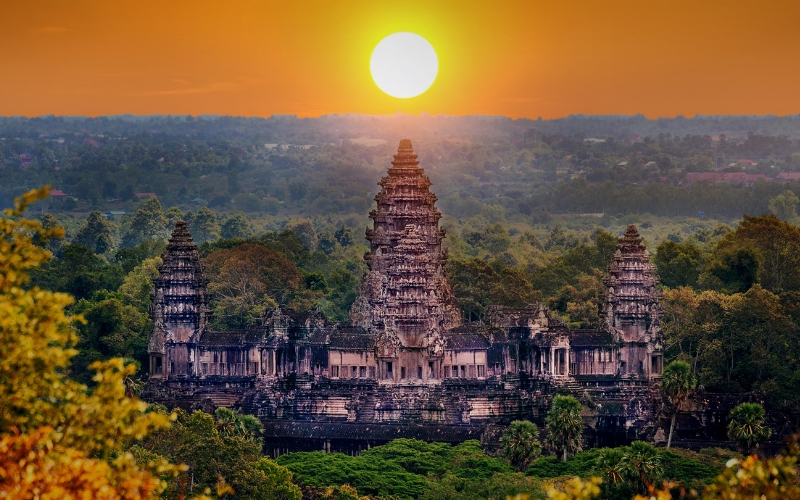
Angkor Wat is the reason most people book a trip to Cambodia in the first place, the largest religious monument on Earth and a UNESCO World Heritage Site since 1992. Built in the early 12th century under King Suryavarman II, it began as a Hindu temple dedicated to Vishnu before gradually becoming a Buddhist site, and its five iconic towers, best photographed reflected in the surrounding moat at sunrise, remain the single most recognized image of Cambodia.
- Location: About 6 km north of Siem Reap, within the Angkor Archaeological Park
- Hours: 5:00 AM-5:30 PM daily, gates open early enough for sunrise
- Entrance fee: Covered by the Angkor Pass
- Specific requirements: Shoulders and knees must be covered to enter the upper levels; the pass must be shown at every temple checkpoint
- Best for: First-time visitors and anyone who wants to understand why Angkor tops nearly every list of famous temples in Cambodia
2. Angkor Thom and Bayon (Siem Reap) – Cambodia’s Iconic Stone Faces
Angkor Thom
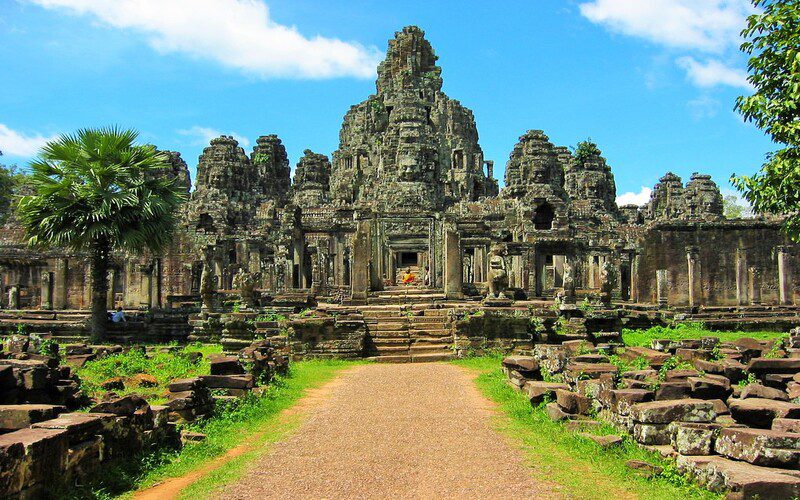
Angkor Thom, “Great City”, was the last capital of the Khmer Empire, a fortified 9-square-kilometer royal city built under King Jayavarman VII in the late 12th century. At its center sits Bayon Temple, famous for over 200 giant stone faces carved into its towers, often compared to a Southeast Asian Mona Lisa for their serene, faintly smiling expression. The South Gate, lined with statues on both sides of the causeway, is the most photographed entrance into the complex.
- Location: Immediately north of Angkor Wat, within the Angkor Archaeological Park
- Hours: 7:30 AM-5:30 PM daily
- Entrance fee: Covered by the Angkor Pass
- Specific requirements: Modest dress recommended; the causeway and inner galleries involve some uneven stone steps
- Best for: History lovers and photographers chasing that specific stone-face close-up
3. Ta Prohm (Siem Reap) – The Jungle Temple Wrapped in Tree Roots
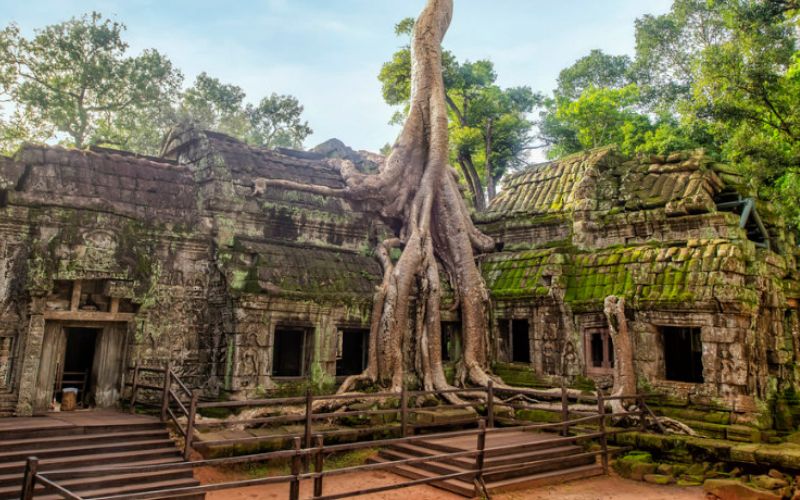
Ta Prohm Temple
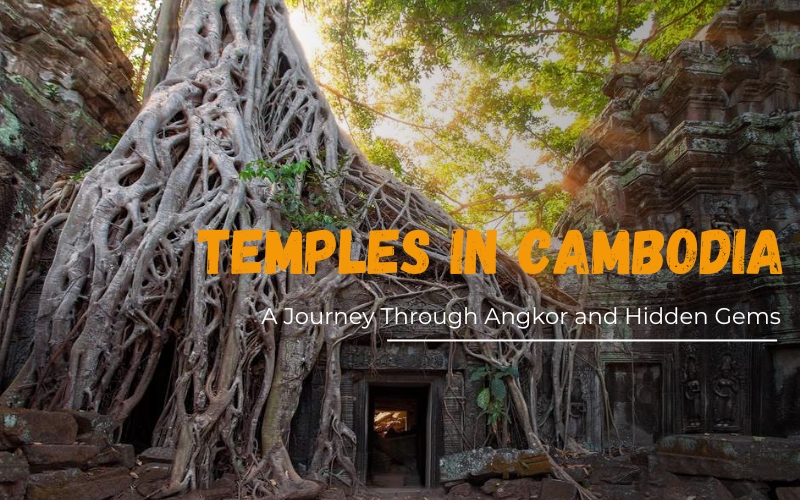
Known as the “jungle temple”, Ta Prohm was built in 1186 under Jayavarman VII and once housed more than 12,500 people, priests, dancers, and officials who lived and served within its walls. After the Khmer Empire’s collapse in the 15th century, the temple was abandoned to the forest, and giant silk-cotton and strangler fig trees have since grown directly through its stone corridors, roots wrapping around doorways in a way that’s become one of the most photographed sights in Cambodia.
- Location: About 1 km east of Angkor Thom, within the Angkor Archaeological Park
- Hours: 7:30 AM-5:30 PM daily
- Entrance fee: Covered by the Angkor Pass
- Specific requirements: Uneven ground and tree roots underfoot; wear sturdy shoes
- Best for: Travelers who want the atmospheric, nature-reclaimed version of an Angkor temple
4. Phnom Bakheng (Siem Reap) – Angkor’s Classic Sunset Viewpoint
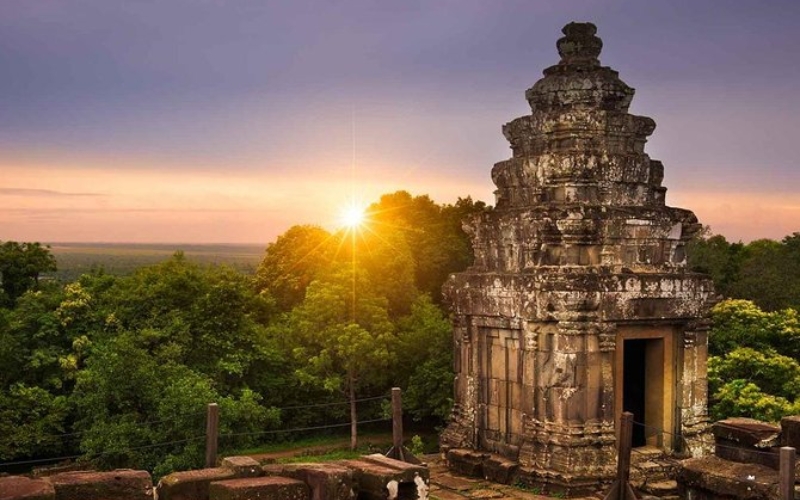
Phnom Bakheng
Built roughly two centuries before Angkor Wat, Phnom Bakheng is a Hindu mountain-temple constructed as a symbolic representation of Mount Meru, home of the gods in Hindu cosmology. Perched atop a hill 65 meters above the surrounding plain, it’s usually visited as an add-on to the Small Circuit, right at sunset, with sweeping views over Angkor Wat’s silhouette and the surrounding forest.
- Location: About 1.5 km south of Angkor Thom’s South Gate, within the Angkor Archaeological Park
- Hours: 5:00 AM-5:30 PM daily, structured to allow both sunrise and sunset visits
- Entrance fee: Covered by the Angkor Pass
- Specific requirements: Visitor numbers on the upper platform are limited for conservation reasons; arrive early for sunset to secure a spot
- Best for: Sunset chasers and anyone who wants a wide-angle view of Angkor rather than up-close carvings
>>> Ready to walk the Small Circuit yourself? Book Essentials of Angkor, 4 Days, or for a bit more time and countryside built in, see Unforgettable 5 Days in Cambodia
Angkor’s Grand Circuit
The Grand Circuit is a roughly 26 km loop that extends the Small Circuit out to Angkor’s quieter, less-restored temples, less crowded and, in many travelers’ opinion, more atmospheric than the main circuit. It’s best tackled as a second day, once you’ve already got your bearings from the Small Circuit.
5. Preah Khan (Siem Reap) – A Quiet Maze of Corridors and Courtyards
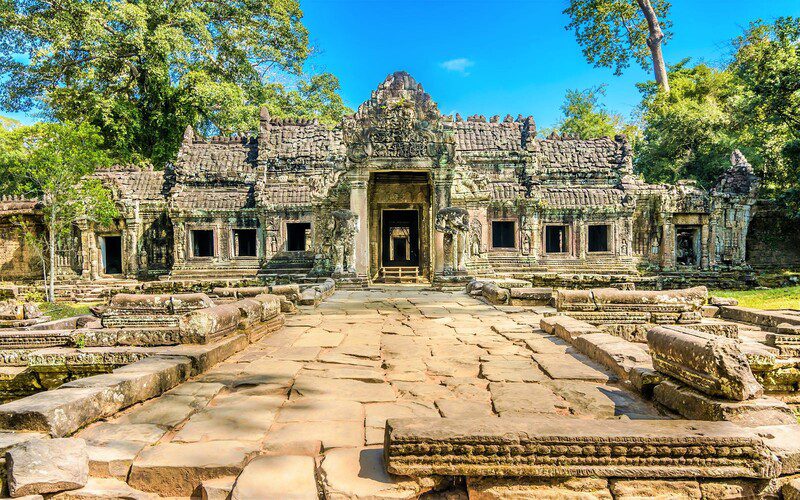
Preah Khan Temple
Preah Khan, “Sacred Sword”, was built by Jayavarman VII on the site of his father’s death, and it remains one of Angkor’s largest temple complexes, a maze of long corridors, courtyards, and doorways deliberately left less restored than Angkor Wat or Bayon. Its half-cleared, half-overgrown state gives it a genuinely different atmosphere than the more polished main temples, without the crowds.
- Location: North of Angkor Thom, within the Angkor Archaeological Park
- Hours: 7:30 AM-5:30 PM daily
- Entrance fee: Covered by the Angkor Pass
- Specific requirements: Minimal restoration means uneven surfaces in places; a flashlight helps in the darker inner chambers
- Best for: Travelers who’ve already seen the headline temples and want something quieter with fewer tour groups
The rest of the Grand Circuit is worth building into the same day: Neak Pean, a small island shrine set in a square pool; Ta Som, another jungle-reclaimed ruin in the same spirit as Ta Prohm but with far fewer visitors; and East Mebon and Pre Rup, two temple-mountains with well-preserved carved elephant statues and good late-afternoon light. All are covered by the same Angkor Pass and keep the same 7:30 AM-5:30 PM hours as Preah Khan.
>>> Craving Angkor’s quieter side, without the crowds? Reserve Explore Temples of Angkor Cambodia, 4 Days
Beyond the Circuits
6. Banteay Srei (Siem Reap) – Angkor’s Finest Pink Sandstone Carvings
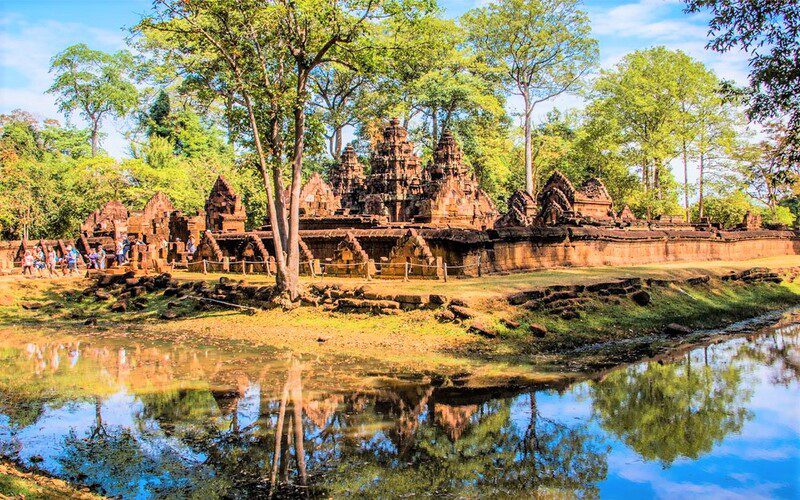
Banteay Srei Temple
Banteay Srei sits too far out for either circuit, about 25 km northeast of central Angkor, and is usually visited as its own half-day trip rather than tacked onto the Small or Grand Circuit.
Built from pink sandstone and dedicated to the Hindu god Shiva, Banteay Srei, “Citadel of Women,” is one of the smallest temples in the Angkor complex but arguably has the most intricate carving of any of them. Its walls are covered in delicate floral motifs and scenes from the Ramayana epic, carved with a precision that has led some scholars to credit female artisans, hence the name.
- Location: About 25 km northeast of central Angkor, further out than either circuit
- Hours: 7:30 AM-5:30 PM daily
- Entrance fee: Covered by the Angkor Pass
- Specific requirements: Requires a longer drive than either circuit, so it’s often paired with other outlying sites like Kbal Spean
- Best for: Travelers with at least a few days who want Angkor’s finest carving work, not just its biggest structures
>>> Want enough time to reach the outlying temples properly? Book the Angkor 10 Days Tour
Phnom Penh Temples
Outside Siem Reap, Phnom Penh has its own, much smaller collection of temples worth knowing about, none of them covered by the Angkor Pass, since they sit in a different city entirely.
7. Wat Phnom (Phnom Penh) – The Hilltop Temple Behind the City’s Name
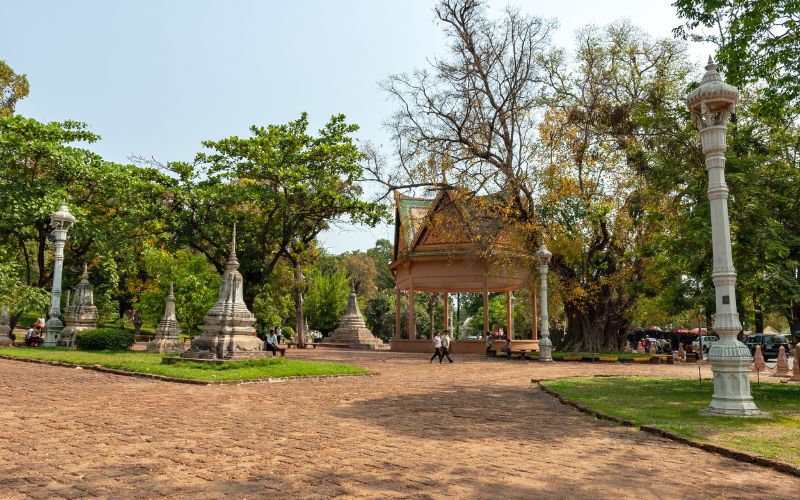
Wat Phnom, the city’s namesake temple, sits on a small hill and offers a peaceful atmosphere in the heart of Phnom Penh.
Wat Phnom sits atop a small artificial hill in the heart of Phnom Penh and, according to local legend, gives the city its name: a wealthy woman named Penh is said to have built the hill in 1373 to house Buddha statues found floating in the river. It functions less like a quiet spiritual retreat and more like Phnom Penh’s unofficial town square, joggers, fortune tellers, and street vendors all sharing the grounds with worshippers.
- Location: Central Phnom Penh, at the northern end of the city center
- Hours: 7:00 AM-6:30 PM daily
- Entrance fee: Around $1 for foreign visitors
- Specific requirements: Modest dress appreciated; expect vendors selling caged birds to “release,” a practice best skipped
- Best for: Travelers wanting a quick, low-cost cultural stop and a sense of everyday Phnom Penh life
8. Silver Pagoda (Phnom Penh) – Royal Treasures on a Silver Floor
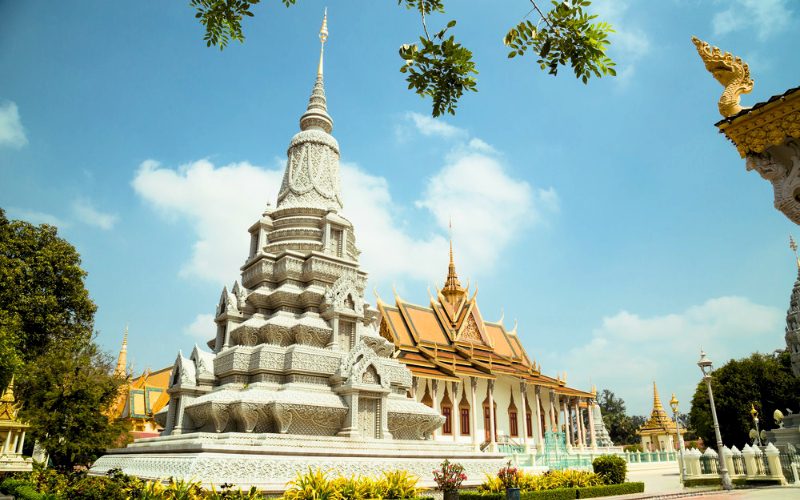
Silver Pagoda in Phnom Penh
Inside the Royal Palace compound, the Silver Pagoda takes its name from over 5,000 solid silver floor tiles and houses some of Cambodia’s most valuable religious artifacts, including an emerald Buddha and a gold Maitreya Buddha studded with thousands of diamonds. It’s still an active royal temple, used for royal ceremonies and Buddhist rituals throughout the year.
- Location: Within the Royal Palace compound, central Phnom Penh
- Hours: Roughly 8:00-11:00 AM and 2:00-5:00 PM daily
- Entrance fee: $10, which also covers the Royal Palace grounds
- Specific requirements: Strict dress code, shoulders and knees covered, no sleeveless tops; photography inside the pagoda itself is not permitted
- Best for: Culture and history travelers who want to see Cambodia’s royal and religious life in one stop
>>> Curious what Phnom Penh’s temples look like beyond Angkor? Book Discover the Jewel of Angkor, 9 Days
Which Temples Should You Visit?
If you’re deciding where to focus, time available is the most honest way to plan a route. Here’s how it breaks down.
| If You Have… | Visit | Circuit(s) |
| A few hours | Angkor Wat, or Angkor Wat plus Bayon | Small Circuit (partial) |
| 1 full day | Angkor Wat, Angkor Thom & Bayon, Ta Prohm, sunset at Phnom Bakheng | Small Circuit |
| 2 days | Add Preah Khan, Neak Pean, Ta Som, East Mebon, and Pre Rup | Small Circuit + Grand Circuit |
| 3+ days | Add Banteay Srei (and, with a 7-day pass, the Roluos Group) | Small + Grand + Beyond the Circuits |
| A Phnom Penh stop | Wat Phnom, plus the Royal Palace and Silver Pagoda | Phnom Penh (separate city) |
Safety, Border & Travel Updates
- Skip Preah Vihear for now. A ceasefire signed on 27 December 2025 remains in effect, but the border situation is still tense. The temple suffered extensive damage during the 2025 fighting, including shattered stonework, artillery craters and serious damage to all five of its gateway pavilions. Cambodian authorities have identified hundreds of damaged locations, although no independent international assessment of the full extent of the damage has yet been published. The site remains closed to tourists because of unstable structures and the risk posed by unexploded ordnance and landmines in the border area. No official reopening date has been announced. Check current government travel advisories and local-authority notices before planning any journey near the Cambodia-Thailand border.
- Dress modestly at every temple, not just Angkor Wat. Shoulders and knees covered is the standard rule across both Siem Reap and Phnom Penh’s religious sites, and enforcement is stricter at active worship sites like the Silver Pagoda than at Angkor’s ruins.
- Arrive before 5:30 AM for sunrise at Angkor Wat. The crowds thin out fast after 7:00 AM, and the light is genuinely better in the first hour.
- Only hire guides wearing an official badge and beige uniform shirt. Unlicensed guides often approach tourists directly outside the main temple gates offering cheap, immediate rates; a licensed guide’s credentials are worth confirming before you agree to anything.
- Ignore anyone in orange robes asking for a “donation”. Real Buddhist monks at Angkor don’t solicit money, hand out bracelets or incense for cash, or offer paid blessings, this is one of the most common scams around the temples, and the easiest to sidestep by simply walking on.
- Your Angkor Pass covers every temple inside the park, full stop. Nobody should ask you for an extra entrance fee at any gate; if someone in an unofficial-looking uniform does, show your pass and keep walking rather than paying.
- Carry small USD bills. Vendors near temple entrances and local restaurants often can’t break large notes.
- A tuk-tuk is the most practical way to cover the Angkor circuit. It’s cheaper than a private car and flexible enough to add or drop temples as your energy allows.
- Photography drones require APSARA Authority permission. Don’t assume you can fly one at Angkor Wat or other major temples without prior approval.
Recommended Things to Do in Cambodia For First-Time Visitors
- Watch the sunrise at Angkor Wat. The single most iconic photo opportunity in Southeast Asia, best secured by arriving before 5:30 AM with your Angkor Pass already in hand.
- Take a Tonle Sap Lake boat trip. See floating villages and, in the dry season, one of Southeast Asia’s largest freshwater lakes shrink to a fraction of its wet-season size.
- Visit the Tuol Sleng Genocide Museum and Choeung Ek Killing Fields. A sobering but important half-day in Phnom Penh that explains modern Cambodian history alongside its ancient temples.
- Explore Battambang’s Bamboo Train. A quirky, improvised rail cart ride through the countryside outside one of Cambodia’s most laid-back provincial towns.
- Ride a boat through Kampong Phluk floating village. A quieter, less touristed alternative to the busier Tonle Sap villages closer to Siem Reap.
- Browse the Old Market and Pub Street in Siem Reap. For souvenirs, night markets, and the town’s liveliest strip of restaurants and bars after a full day of temples.
Best Cambodia Dishes Worth Try
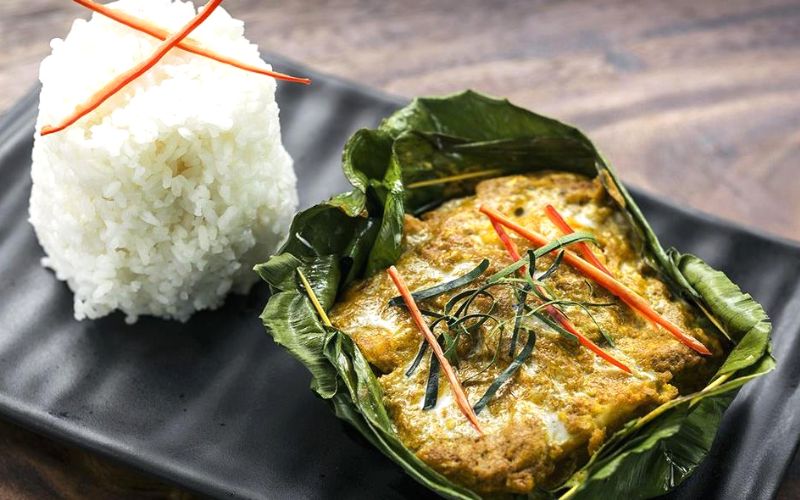
- Amok Trey (Fish Amok): Cambodia’s most famous dish, a coconut-milk fish curry with lemongrass and galangal, steamed in a banana leaf until it sets like a savory custard.

Fish Amok
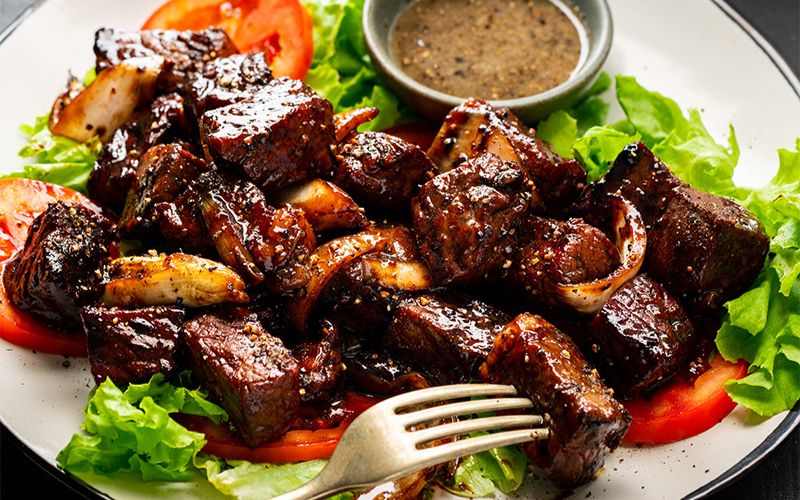
- Beef Lok Lak (Cambodian Shaking Beef): Beef stir-fried with black pepper and oyster sauce, served over lettuce with a fried egg on top, a Phnom Penh staple.
Beef Lok Lak
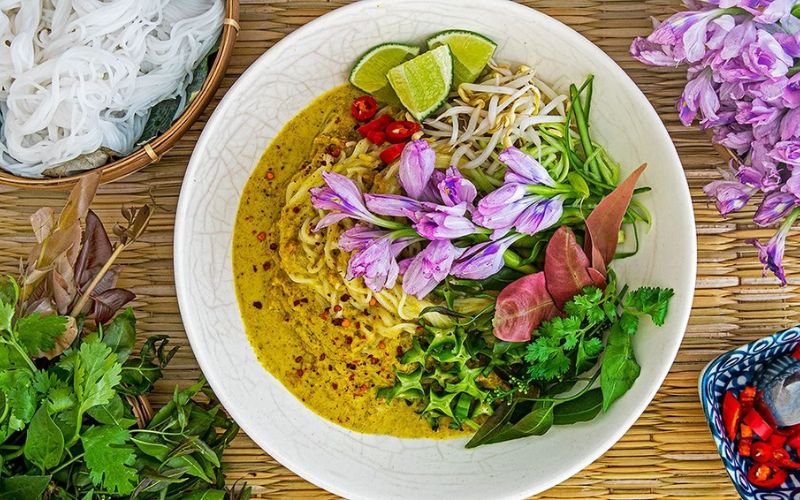
- Nom Banh Chok (Khmer Noodles): Rice noodles topped with a green fish curry sauce, traditionally a breakfast dish and available all day at good street stalls.
Nom Banh Chok
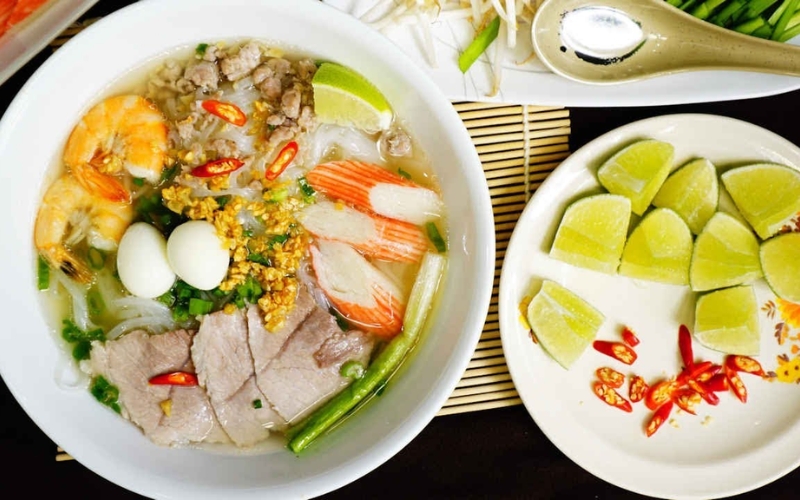
- Kuy Teav (Cambodian Noodle Soup): A clear pork and rice noodle soup, best eaten at a market stall in the early morning.
Kuy Teav, Cambodian noodle soup
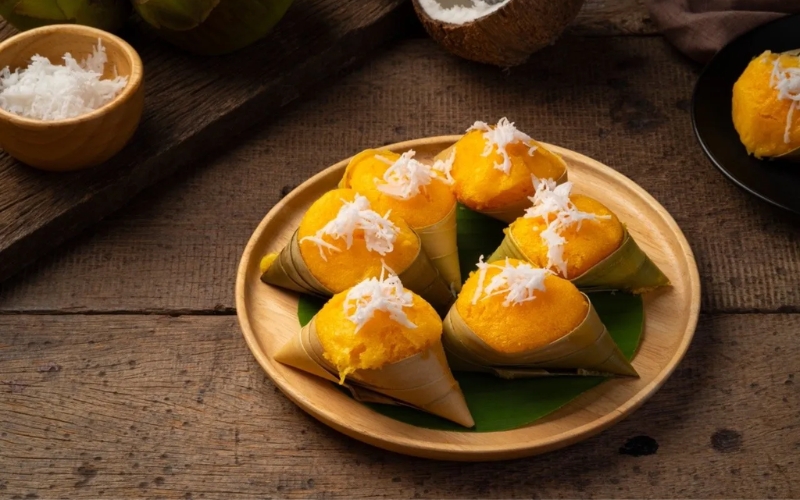
- Palm Sugar Desserts (Cambodian Palm Sugar Sweets): Sweet snacks made with palm sugar and sticky rice, sold near temple entrances and genuinely worth trying.
Palm Sugar Desserts
Where to eat:
- In Siem Reap, Khmer Kitchen Restaurant near Pub Street is a long-running local favorite known for reliable, affordable Khmer classics.
- In Phnom Penh, Malis occupies a converted Khmer house with a garden courtyard, serving refined Cambodian cuisine crafted by chef Luu Meng. Eat at local restaurants rather than hotel dining whenever you can, the price difference is significant and the food is usually better.
Start Planning Your Cambodia Temple Trip
The best temples in Cambodia reward more than a single rushed day: sunrise at Angkor Wat, the stone faces of Bayon, the tree roots of Ta Prohm, the delicate carving of Banteay Srei, and, if you make it to Phnom Penh, Wat Phnom and the Silver Pagoda’s very different kind of grandeur.
Every famous Cambodia temple on this list earns its reputation for a different reason, so pick the mix that matches how you like to travel, whether that’s a focused Angkor circuit, a longer trip that adds Phnom Penh, or a deep dive into the lesser-visited ruins, this really is one of the most rewarding places on Earth to spend a few days looking up at stone, and our local specialists can help you build the right mix.
Browse all Angkor tours or create your trip to put together a private itinerary. We are here to help you. Start planning your tailor-made tour with 1-1 help from our specialists.
Read more:
Bayon Temple with all those faces is incredible! But it was super crowded when I went. Are there any quieter temples nearby that still have the same mystical vibe?
Dear Hazel,
Thank you for sharing your experience! Bayon Temple is indeed extraordinary, but we completely understand how the crowds can affect the atmosphere.
For a quieter experience with the same mystical charm, we often recommend Banteay Kdei, sometimes called the “Citadel of Chambers.” It has similar serene faces and tree-covered ruins, but far fewer visitors. Another great option is Preah Khan, a sprawling temple complex where nature intertwines with the stones in a way that feels both peaceful and mysterious. If you’re willing to venture a bit further, Ta Som offers an enchanting vibe, especially with its giant tree roots embracing the temple gate—perfect for those who want the beauty of Angkor without the crowds.
We’d be delighted to design an itinerary that balances the iconic highlights like Bayon with these hidden gems, so you can enjoy both the grandeur and the quiet magic of Angkor. Contact us anytime, and we’ll help tailor a journey that gives you the best of both worlds.
Best regards,
IDC Travel Team
This post is amazing! I’m really into photography and your shots are inspiring. Did you use a local guide who knows good photo spots or did you explore on your own? Also, were drones allowed at any of these temples?
Thank you so much for your kind words! Cambodia’s temples are a dream for photography lovers. For most of the shots, we did explore with a local guide, which helped a lot in finding those quieter, less-crowded angles and hidden corners. They know the best times for lighting too!
As for drones, it depends on the temple. Angkor Wat and major temples in the Angkor complex generally don’t allow drone flying without special permission from the APSARA Authority. Some smaller or more remote temples may be more flexible, but it’s always best to check locally or ask your guide. Let us know if you’re planning a trip—we’d be happy to help you organize something tailored for photography!
Best regards,
IDC Travel Team