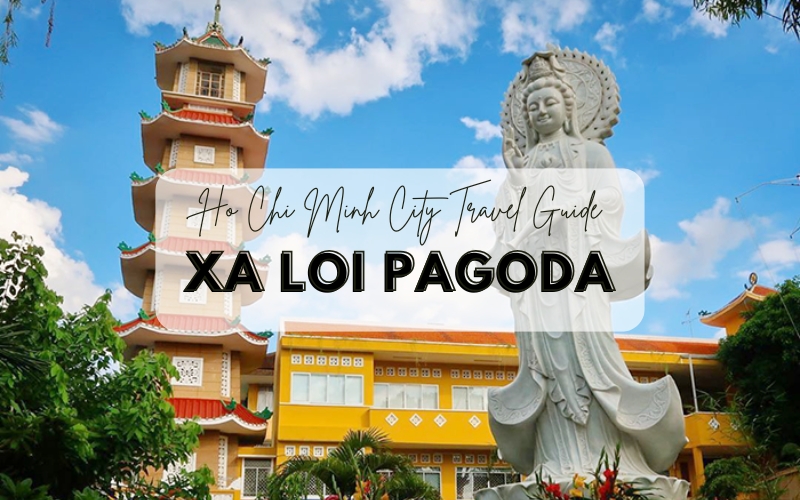
Few places in Ho Chi Minh City carry as much weight as Xa Loi Pagoda. It is the city’s largest pagoda, a working Buddhist temple, and a site where some of the most consequential moments of modern Vietnamese history unfolded. Travelers who visit expecting a quiet spiritual stop tend to leave having learned something they did not expect.
This guide covers everything you need to know before visiting: the history, the architecture, the practical details, and why this particular pagoda deserves more than a passing stop on your Saigon itinerary.
What Is Xa Loi Pagoda?
Xa Loi Pagoda (Chua Xa Loi) is the largest Buddhist pagoda in Ho Chi Minh City, built between 1956 and 1958 by the South Vietnam Buddhist Association. It covers roughly 2,400 square meters in Xuan Hoa Ward, set behind a gated fence on Ba Huyen Thanh Quan Street.
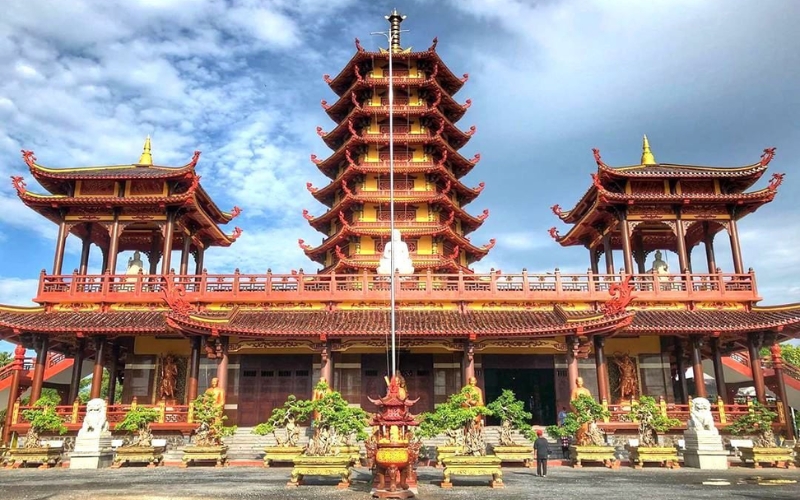
Xa Loi Pagoda
The name tells you what the pagoda was built for. “Xa Loi” is the Vietnamese rendering of “Sarira”, a Sanskrit term for sacred Buddhist relics. The pagoda was constructed specifically to house relics of Gautama Buddha, and that purpose shapes everything inside it: the altar, the stupa, the ceremonial hierarchy of the space.
It was the first pagoda in what is now Ho Chi Minh City to use a modern architectural layout, with a ground-floor lecture hall beneath the main ceremonial hall. That two-level design made it unusual for its time. It also made it something more than a place of worship: from its opening in 1958, Xa Loi served as a Buddhist school, a library, a meeting place, and eventually, the headquarters of the Vietnamese Buddhist Association from 1958 to 1981.
Where Is Xa Loi Pagoda?
- Address: 89B Ba Huyen Thanh Quan Street, Xuan Hoa Ward, Ho Chi Minh City, Vietnam.
Xa Loi Pagoda sits at the corner of Ba Huyen Thanh Quan Street and Su Thien Chieu Street in Xuan Hoa Ward, roughly 6 kilometers from Tan Son Nhat International Airport. It has two three-arched entrance gates: one on each of those two streets.
Getting there:
- By taxi or ride-hailing app (Grab, Green SM, Be): the most convenient option.
- By bus: Routes 30, 54, 91, and 150 stop at Benh Vien Mat TPHCM bus station, a short 5-minute walk from the pagoda.
- By motorbike: easily navigable via Google Maps for those comfortable with Saigon traffic.
Best Time to Visit Ho Chi Minh City
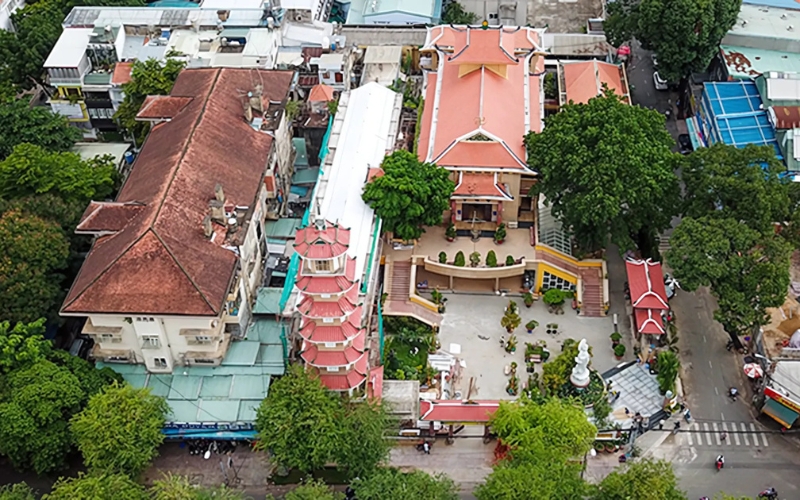
Xa Loi Pagoda from above
Understanding when to visit the city helps you plan the rest of your trip around a stop at Xa Loi Pagoda.
Ho Chi Minh City has two main seasons:
- Dry season (November to April): Temperatures sit around 25°C to 35°C (77°F to 95°F), the air is drier, and outdoor sightseeing is comfortable. This is the peak travel period and widely considered the best time to visit.
- Wet season (May to October): Rain comes in short, heavy bursts, usually in the afternoon. Mornings are generally clear. Temperatures remain high, typically 28°C to 33°C (82°F to 91°F). Travel is still perfectly feasible; you just need to carry a rain cover or light jacket for afternoons.
The most intense heat falls in April and May, just before the rains arrive. If heat is a concern for you, December through February is the most comfortable window.
Visiting Xa Loi Pagoda: Practical Information
Opening Hours
Xa Loi Pagoda is open daily from 7:00 AM to 5:00 PM. On special Buddhist holidays such as Vesak, Lunar New Year, and the Ghost Festival, hours may extend to 9:00 PM.
The pagoda also follows a split schedule on ordinary days, with some sources listing hours as 7:00 AM to 11:00 AM and 2:00 PM to 5:00 PM. Arriving in the morning is generally recommended: the light in the main hall is better, the crowds are lighter, and the monks are more likely to be present.
Xa Loi Pagoda Entrance Fee
There is no entrance fee to visit Xa Loi Pagoda. Donations are welcome and help with the upkeep of the facilities. A typical donation of 20,000 to 50,000 VND (~$0.76 to $1.92) is a reasonable gesture.
How Long to Spend
Most visitors spend 30 to 60 minutes. If you want time in the garden, the main hall, the bell tower area, and a few minutes of quiet, plan for the full hour.
Dress Code
Modest dress is required. Shoulders and knees should be covered. If you arrive in shorts or a sleeveless top, having a light scarf or wrap available is practical. Removing shoes before entering the main hall is expected.
Architecture and Key Features of Xa Loi Pagoda
This is the part of a visit that tends to surprise people. The architecture at Xa Loi is not the heavily ornamented, incense-dark style of older Vietnamese pagodas. It is modern, deliberately spacious, and filled with natural light.
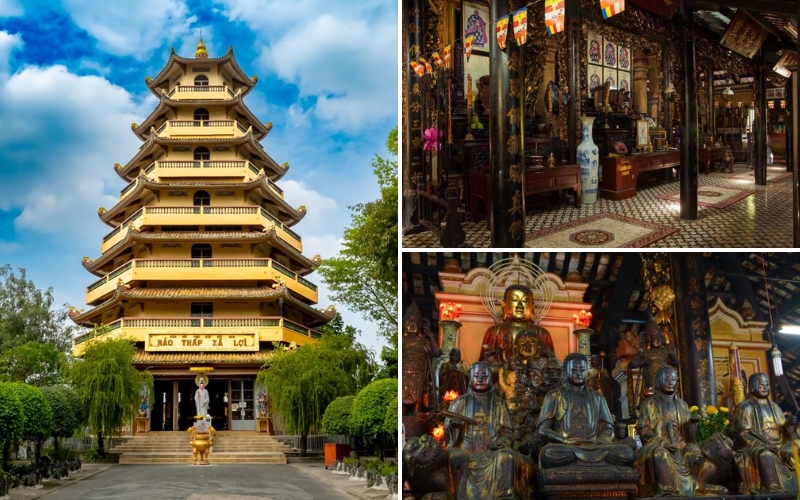
Xa Loi Stupa and other precious wood carvings of the pagoda
The Two-Story Main Building
The ground floor is a lecture hall with seating for approximately 400 people. It is surrounded by a library and the monks’ quarters. Buddhist doctrine classes are held here every Sunday morning, and calligraphy classes run on Monday, Tuesday, and Sunday evenings. The library holds over 3,000 books, including rare Chinese-language volumes.
The main ceremonial hall sits on the upper floor. Men and women enter by separate staircases: men by the stairs on the left as you come in from the gate, women by those on the right. The hall is rectangular, supported by pillars, and lit by large windows that keep the space unusually airy for a ceremonial hall.
The Gautama Buddha Statue
The central statue in the main hall shows Gautama Buddha seated in meditation on a lotus blossom, wearing a monk’s garb. It was crafted by sculptors from Bien Hoa and received its gold coating in 1969. The detail work is careful: the lengthened ears reference his royal origins before renunciation, the closely cropped curly hair marks his departure from worldly life, and the protuberance on his head indicates wisdom. A sun disc sits behind his head. In front of the statue is a small stupa that holds the sacred Buddhist relics for which the pagoda was named.
The Bell Tower
Completed in 1961, the seven-story bell tower stands 32 meters tall and was, at the time of its construction, the tallest bell tower in Vietnam. Each of the seven floors is octagonal and venerates a different Buddha. At the top hangs a bronze bell weighing 2 tons, measuring 1.2 meters in diameter and 1.6 meters in height.
The tower anchors the visual character of the pagoda. From the street, it is the first thing you see above the perimeter fence.
Courtyard and Garden
Inside the gate, the courtyard is calm in a way that feels deliberate given the surrounding urban noise. A large Bodhi tree from Colombia stands to the left of the main hall. Beside it is a statue of Bodhisattva Avalokiteshvara (Quan Am), sculpted in 1958, depicted in the Chinese style holding a vial of elixir and making the gesture of removing obstacles.
Cultural Treasures
The pagoda preserves a number of historically significant objects, including a lacquered board inscribed with four characters “Dong Thuy Phap Vu” by Empress Tu Hy of the Qing Dynasty. The Sakyamuni Buddha statue on the ground floor was an early work crafted by sculptor Le Van Mau in 1954.
The main hall walls are decorated with painted murals depicting scenes from the life of the Buddha: elephants paying homage, the conversion of the serpents, the story of Angulimala, and the Buddha entering nirvana.
The History of Xa Loi Pagoda
Construction and Early Years
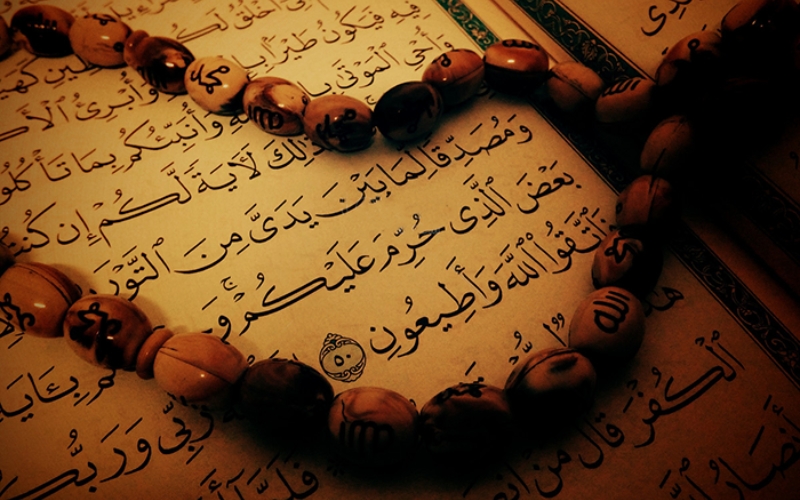
Pali Canon dating back over 1000 years at Xa Loi Pagoda
Construction began on August 5, 1956, designed by architects Tran Van Duong and Do Ba Vinh. The pagoda officially opened to the public on May 2, 1958. Funding came from Buddhist communities across 21 southern provinces, which gave the site an unusual level of collective ownership from the start.
The Buddhist Crisis of 1963
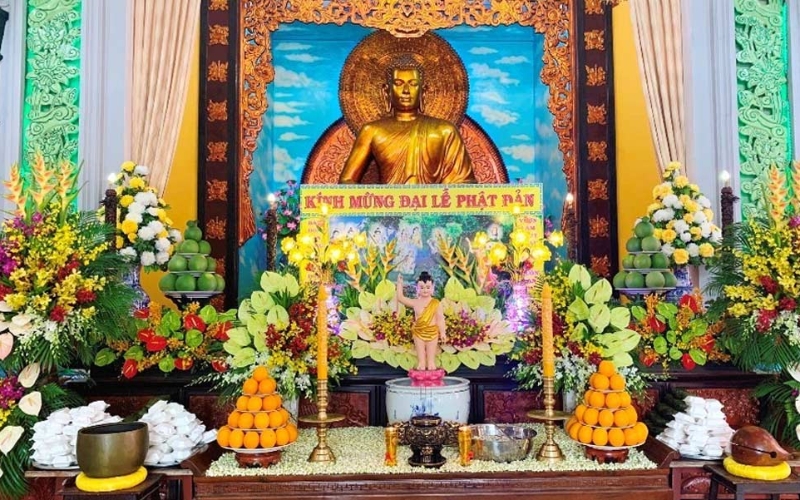
Vesak at Xa Loi Pagoda
This is the chapter of the pagoda’s history that most visitors do not expect going in. In 1963, South Vietnam was governed by President Ngo Dinh Diem, a Roman Catholic in a country where the majority of the population was Buddhist. Diem’s government had instituted policies that discriminated against Buddhist practice, including a ban on displaying Buddhist flags at the celebration of Vesak (Buddha’s birthday).
Xa Loi Pagoda became the organizational center of the Buddhist resistance. Monks, nuns, and followers gathered here to coordinate protests and issue declarations demanding religious equality. The pagoda’s profile made it a natural hub.
On June 11, 1963, Buddhist monk Thich Quang Duc set himself on fire at a busy intersection near Xa Loi Pagoda in protest against the Diem government’s religious persecution. The photograph taken by journalist Malcolm Browne circulated worldwide and drew international attention to the situation in South Vietnam in a way that diplomatic statements never had.
The government’s response came on August 21, 1963. Acting under orders from Diem’s brother, Ngo Dinh Nhu, military forces raided Xa Loi Pagoda and pagodas across the country simultaneously. At Xa Loi, approximately 400 monks and nuns were arrested, parts of the pagoda were damaged, and the country’s 80-year-old Buddhist patriarch, Thich Tinh Khiet, was seized and taken to a military hospital. Hundreds were estimated to have died or disappeared across the country, and over a thousand monks were eventually imprisoned.
The Xa Loi Pagoda raids had consequences beyond the religious sphere. The brutality of the crackdown solidified opposition to the Diem regime among Buddhists, a factor that influenced the United States government’s decision to withdraw support for Diem. He was overthrown and killed in a military coup on November 1 and 2, 1963.
The pagoda was later restored and renovated. Its most recent major restoration was completed in 2000, which preserved much of the original architectural character.
What to Expect During Religious Events
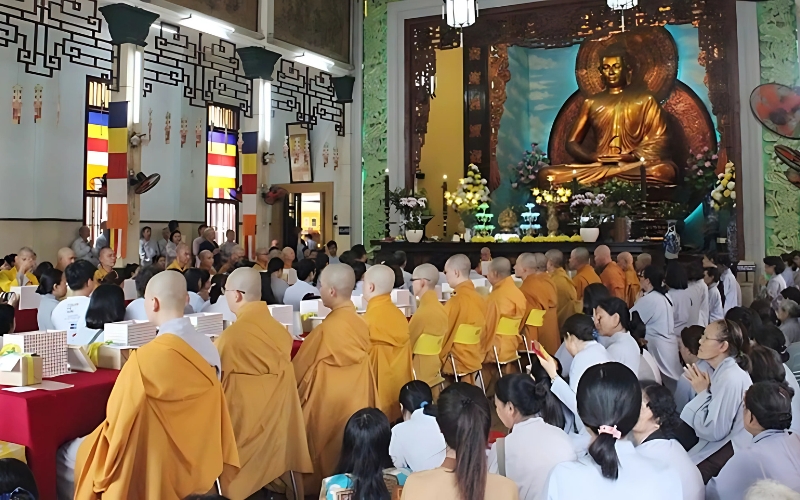
A Dharma class at Xa Loi Pagoda
If your visit to Ho Chi Minh City happens to coincide with a Buddhist holiday, visiting Xa Loi during that period is worth the effort. On Vesak (Buddha’s Birthday, typically in May on the lunar calendar), the full moon of the first lunar month, or during Lunar New Year, monks and worshippers gather for chanting sessions and ceremonial offerings.
Two dates specific to Xa Loi Pagoda are also observed: the anniversary of the death of Minister Chanh Tri Mai Tho Truyen on the 15th day of the third lunar month, and the celebration of the Medicine Buddha in January of the lunar calendar.
Visitors are welcome to observe quietly, and it is acceptable to join in making incense or flower offerings if you choose.
Attractions Nearby Xa Loi Pagoda
Xa Loi Pagoda sits in a walkable part of Xuan Hoa Ward with several other worthwhile stops nearby.
- War Remnants Museum (less than 1 kilometer away): Documents the Second Indochina War with photographs, military hardware, and firsthand accounts. One of the most visited museums in Vietnam.
- Independence Palace: The former Independence Palace, largely preserved as it was in April 1975. The architecture and the story attached to it make it one of the more unexpectedly absorbing places in the city.
- Jade Emperor Pagoda (Phuoc Hai Tu): An older and ornately decorated Taoist-Buddhist temple in District 3, with a very different visual character from Xa Loi.
- Notre Dame Cathedral: A red-brick neo-Romanesque cathedral built between 1877 and 1883, about 2 kilometers from Xa Loi.
- Ben Thanh Market: The city’s most recognizable market, roughly 2 kilometers south.
A half-day circuit can reasonably take in Xa Loi Pagoda, the War Remnants Museum, and the Reunification Palace before lunch.
Xa Loi Pagoda in Context: Vietnam’s Buddhist Heritage
Xa Loi is one of three pagodas considered cultural symbols of Saigon, alongside Jade Emperor Pagoda and Phap Hoa Pagoda. Its significance is not just historical: it remains an active place of worship, a Buddhist school, a library open to the public several days a week, and a community gathering point.
Visiting it alongside other religious sites gives a clearer sense of how Buddhism has shaped the social and political life of southern Vietnam. The Cao Dai Temple in Tay Ninh, accessible on a day trip from Ho Chi Minh City, represents another distinctly Vietnamese religious tradition worth understanding. The Giac Lam Pagoda, believed to be the oldest temple in Ho Chi Minh City (dating to 1744), offers the contrast of a much older architectural style with its Chinese-influenced layout and dense atmospheric atmosphere.
Conclusion: Quick Reference for Your Visit
| Detail | Information |
| Full Name | Xa Loi Pagoda (Chua Xa Loi) |
| Address | 89B Ba Huyen Thanh Quan, Xuan Hoa Ward, Ho Chi Minh City, Vietnam |
| Opening Hours | Daily 7:00 AM to 5:00 PM (until 9:00 PM on major holidays) |
| Entrance Fee | Free |
| Tel. | (84-28) 39.300.114 – (84-28) 66.561.059 |
| dongbon@yahoo.com | |
| Website | https://chuaxaloi.vn/ |
| Recommended Visit Duration | 30 to 60 minutes |
| Built | 1956 to 1958 |
| Architects | Tran Van Duong and Do Ba Vinh |
| Bell Tower Height | 32 meters, 7 stories |
| Total Area | Approximately 2,400 square meters |
| Best Time to Visit | Dry season, November to April |
| Dress Code | Shoulders and knees covered; remove shoes in the main hall |
| Getting There | Grab/taxi, or buses 30, 54, 91, 150 to Benh Vien Mat TPHCM stop |
Xa Loi Pagoda is the kind of place that works on more than one level. For travelers interested in Vietnamese Buddhism, it is the most historically significant temple in Ho Chi Minh City. For those drawn to twentieth-century history, it is a site directly connected to events that changed the course of the Vietnam War. And for visitors who simply want a few minutes of calm in one of Southeast Asia’s busiest cities, the courtyard and the Bodhi tree do the job.
If you are planning a broader trip through southern Vietnam, the pagoda fits naturally into a Ho Chi Minh City day tour that covers the city’s major historical and cultural sites.
IDC Travel offers private and tailor-made Ho Chi Minh City tours that can be customized around your interests and schedule, whether you want a half-day in the city or a longer itinerary that extends into the Mekong Delta or elsewhere in southern Vietnam.
Read more: