Few places in Ho Chi Minh City carry as much layered history as Cho Quan Church. Standing in Saigon for over 300 years, this Catholic church has outlasted wars, rebellions, and repeated demolitions, only to be rebuilt each time with more care than before. For travelers visiting Vietnam who want something beyond the usual tourist circuit, Cho Quan Church offers a rare combination of genuine history, striking architecture, and quiet authenticity that most guides overlook.
This article covers everything you need to know before your visit: the church’s origins, its location and surroundings, its architectural details, practical tips, and how to fit it into a broader Ho Chi Minh City itinerary.
What Is Cho Quan Church?
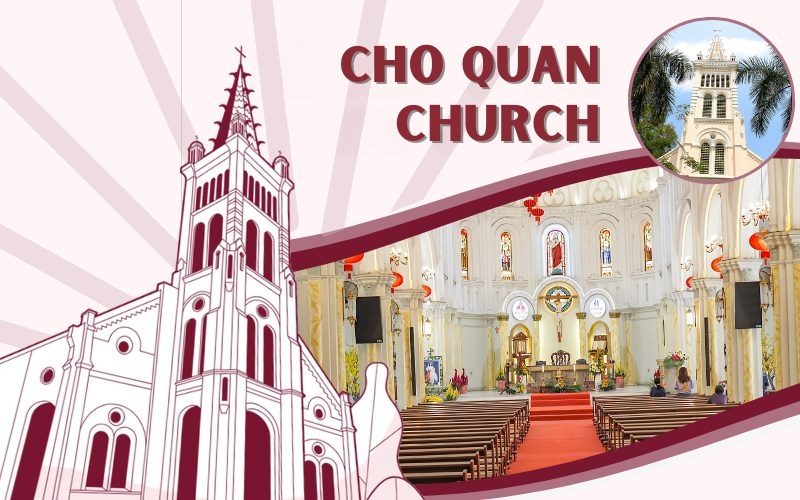
Cho Quan Church, officially named the Basilica of the Sacred Heart of Jesus (Nha tho Cho Quan in Vietnamese), is widely considered the oldest church in Ho Chi Minh City.
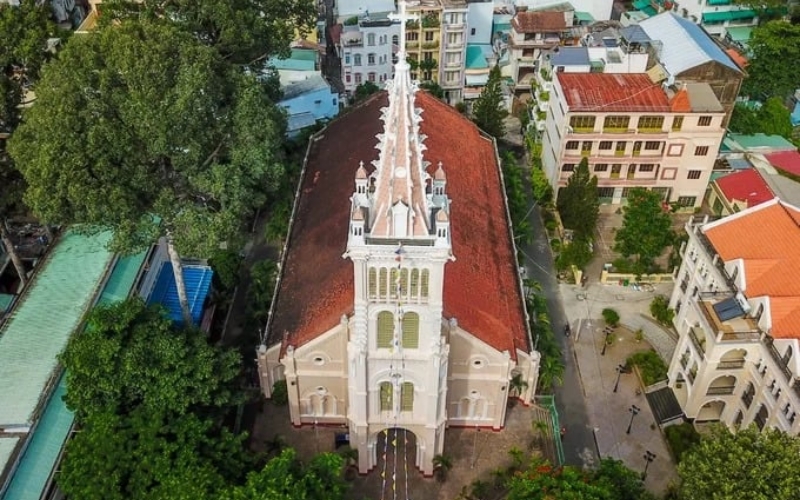
Aerial view of Cho Quan Church
While Notre Dame Cathedral in the centre tends to get the most attention from first-time visitors, Cho Quan has a documented history that stretches back further, with roots going to 1674 when the first small oratory was built on the site by parishioners who had migrated from northern and central Vietnam.
The Cho Quan Parish itself grew out of a settlement called Xom Bot, where Catholic migrants built a community around a local market. The Vietnamese name “Cho Quan” loosely translates to “market area”, which reflects this commercial and communal origin. Over the next two centuries, the church was destroyed and rebuilt multiple times before the present structure was inaugurated in 1896.
What makes this church unusual compared to most heritage sites in Vietnam is the continuity of its congregation. Cho Quan has been an active parish throughout its entire history. Even during the most difficult periods of Catholicism in Vietnam, under the reigns of Kings Minh Mang, Thieu Tri, and Tu Duc, when Catholic worship was actively suppressed, local parishioners collected timber from abandoned houses to keep some version of the church standing. That kind of communal commitment to a place over centuries is something you can feel when you walk through the gate.
Location of Cho Quan Church
- Address: 120 Tran Binh Trong Street, Binh Tay Ward, Ho Chi Minh City, Vietnam.
Cho Quan Church sits about 3 kilometers from the center of Ho Chi Minh City, placing it squarely in the Cholon area, Ho Chi Minh City’s historic Chinatown. The street itself, Tran Binh Trong, is a relatively quiet lane compared to the main Chinatown thoroughfares, which makes the church feel somewhat tucked away, though it is easy to find with a map or navigation app.
Getting there is straightforward:
- Grab or taxi is the easiest option from the centre.
- Bus lines 01, 46, and 68 stop near Cho Quan Parish at lower cost, though travel time is longer during peak hours.
- Walking or cycling from the Binh Tay Market area is a pleasant option if you are already exploring Chinatown on foot.
One practical note from travelers who have visited: the church entrance sits on a small lane and is easy to miss if you are looking for something that resembles the grand frontage of Notre Dame Cathedral. Look for the yellow walls and the tower, and you will find it.
What to Expect During Your Visit
Opening Hours
Cho Quan Church is open daily from 05:00 to 11:00 and 13:00 to 21:00. Mass is held daily, with Sunday services drawing the largest congregations. During major Catholic holidays, services extend across multiple sessions throughout the day.
Entrance and Costs
There is no entrance fee. Donations are accepted and go toward the upkeep of the church. Visitors are welcome to enter, observe the space, and photograph the architecture. Photography is generally permitted, though visitors are asked to be considerate of people attending services.
Dress Code and Conduct
As with any active place of worship in Vietnam, modest dress is expected. Shorts and sleeveless tops are not appropriate inside the church. Speaking quietly and stepping back from the altar area during services is the standard expectation. These are simple courtesies, but they matter in a church that still holds regular services for a large local congregation.
Best Time to Visit
The dry season from November to March is the most comfortable time for visiting Ho Chi Minh City overall, with temperatures averaging around 25 to 28 degrees Celsius (77 to 82 degrees Fahrenheit). During April and May, temperatures can climb to 35 degrees Celsius (95 degrees Fahrenheit), which makes outdoor exploration more demanding. Morning visits before 9 a.m. are generally cooler and quieter at the church itself.
For photography, the golden hour after sunrise gives the pale yellow facade a warm tone that photographs well. The light through the stained-glass windows is best captured between 8 and 10 a.m.
A History of Cho Quan Church Built on Resilience
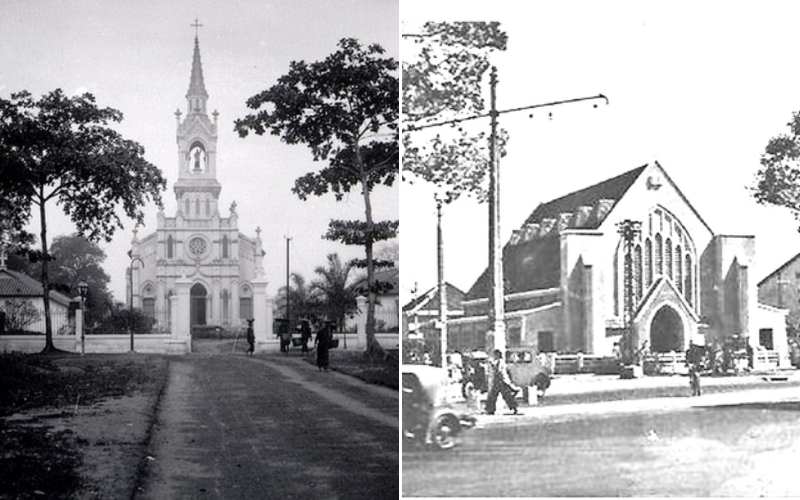
Cho Quan Parish in the past
The First Church: 1674 to the Early 18th Century
The original structure on this site was not a church at all.
In 1674, parishioners from northern and central Vietnam built a simple oratory, a small prayer space.
It was not until the early 1720s that Father Jose Garcia, having taken over the Cho Quan Parish, constructed the first proper church on the site.
In 1727, he rebuilt it on a larger footprint. That building did not last long.
In 1731, Chan Lap troops attacked Saigon and the church burned to the ground. Two years later, a new structure measuring 55 meters long and 20 meters wide replaced it, which made it the only church in the entire Saigon-Cho Lon area at the time.
Destruction, Suppression, and Survival
The church was rebuilt again in 1793, this time with support from Lord Nguyen Anh, who would later become Emperor Gia Long. But the 19th century brought its own difficulties. During the uprising of Le Van Khoi and the period of Catholic suppression under three successive kings, the church was once again destroyed. Local parishioners responded by doing what they had done before: gathering salvaged materials and rebuilding.
By 1882, Father Nicolas Ham had begun construction on the permanent structure that stands today. He died in 1886 and was buried under the foundation of the new church. Construction continued until 1897, and the church was formally inaugurated in 1896. A major restoration followed in 1926, with smaller repairs carried out regularly since then.
That history of loss and reconstruction is not just background information. It shapes the way the church feels today, and why the local community treats it with a degree of quiet reverence that visitors can pick up on quite easily.
Architecture: Gothic France Meets Vietnamese Tropical
The current structure at Cho Quan is primarily Gothic Revival in style, influenced by French ecclesiastical architecture of the late 19th century, though visitors who look closely will notice Vietnamese elements worked into the details.
The Exterior
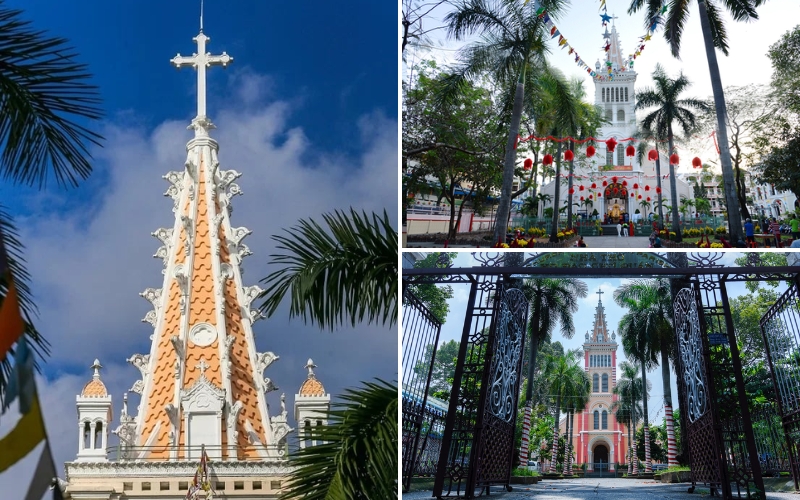
The Gothic architecture of the church from outside
The facade is immediately striking. Pointed arches are connected continuously across the front, giving the entrance a rhythm that draws the eye upward. The exterior walls are painted in pale yellow, which is common across Vietnamese churches and public buildings from the colonial era. Red clay tiles cover the roof, providing a visual warmth against the stone-colored columns.
The bell tower rises to approximately 20 meters, and it serves as the church’s main landmark. Crescent-shaped doors and windows punctuate the sides of the building, a detail that appears across multiple Vietnamese churches from this period.
The Interior
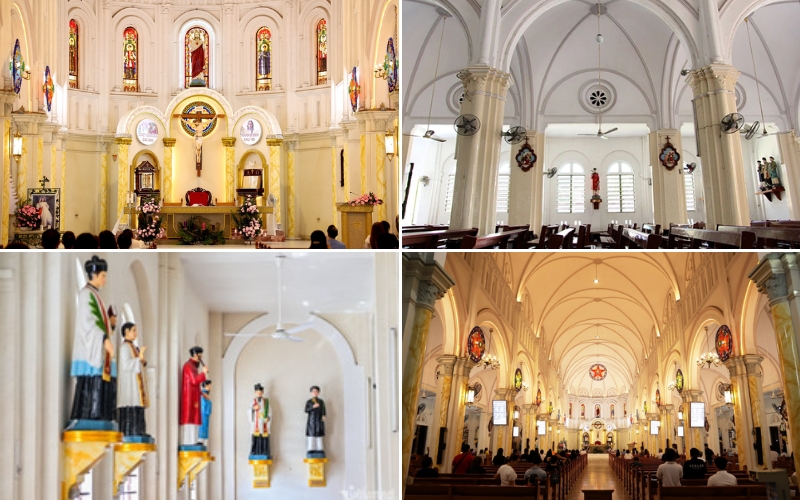
Inside Cho Quan Church
Inside, the church is large and relatively uncluttered. Curved vaulted ceilings sit above straight stone pillars that run the length of the nave. The walls are painted pale light yellow, matching the exterior, and statues of saints in varying sizes occupy niches along the interior walls.
The stained-glass windows are among the most memorable features of the interior. During morning hours in particular, light filters through them and shifts across the stone floor in a way that changes the atmosphere of the space considerably. Mass-goers and tourists who arrive in the early hours often remark on how different the church feels at 7 a.m. versus midday.
The church also houses colorful lighting installations along the main path, which are switched on during Christmas, Easter, and other Catholic feast days. Visiting during one of these periods gives a noticeably different experience from a regular weekday visit.
The Cho Quan Parish: More Than One Building
Cho Quan Church is the most visible part of a broader Cho Quan Parish that includes several other structures worth knowing about:
- Tu Duc Monastery: A religious community within the parish grounds that gives visitors a sense of the ongoing monastic life connected to the church.
- Cho Quan Cloister of the Congregation of the Lovers of the Holy Cross: A religious order with deep roots in Vietnam’s Catholic history, connected to the parish.
These additional buildings are not always open to general visitors, but the grounds around them are accessible and worth walking through if you want to understand how the parish functions as a living community rather than just a historical monument.
Attractions Nearby Cho Quan Church
Cho Quan Church is well-placed for a half-day exploration of Chinatown. Several other sites are within easy walking or cycling distance:
- Binh Tay Market (approximately 1 kilometer away) is the main wholesale market of Cholon, built in the early 20th century with a distinctive clock tower and courtyard. It is less crowded than Ben Thanh Market and gives a more authentic feel of how goods move through the city. Read more our guide about Binh Tay Market.
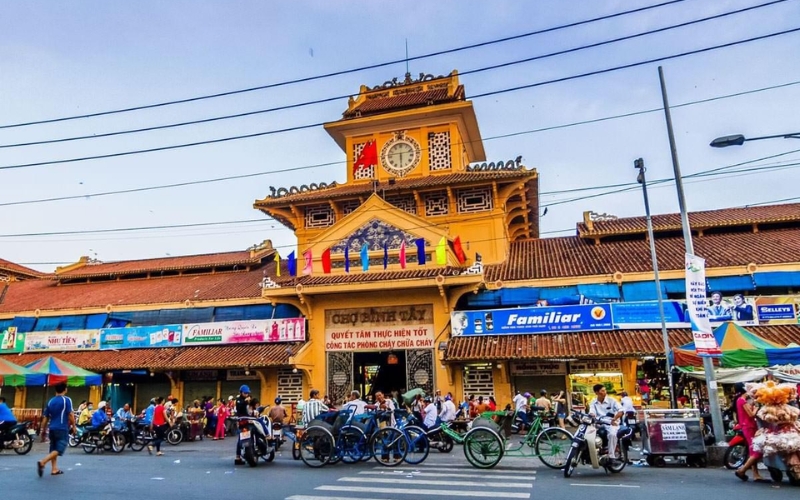
Binh Tay Market, one of the oldest markets in Saigon
- Cha Tam Church (Saint Francis Xavier Church) on Hoc Lac Street is another historically significant Catholic church in Binh Tay Ward, known for its yellow and white exterior and Vietnamese-style wooden shutters.
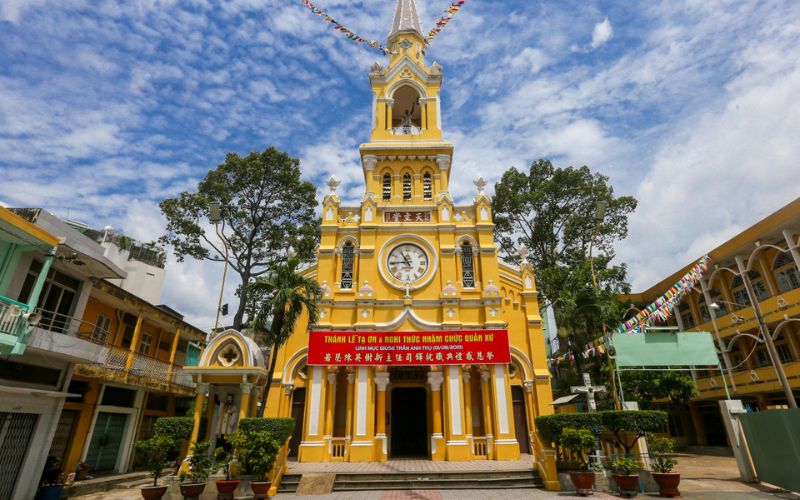
Cha Tam Church is a historic site in Saigon’s Chinatown, renowned for its multicultural architecture and its significance to the local Catholic community.
- Ba Thien Hau Pagoda is one of the most visited Chinese temples in Ho Chi Minh City, located on Nguyen Trai Street. The contrast between Buddhist and Catholic architecture within the same district is one of the genuinely interesting things about exploring this part of the city. Here is our full guide about Ba Thien Hau Pagoda.
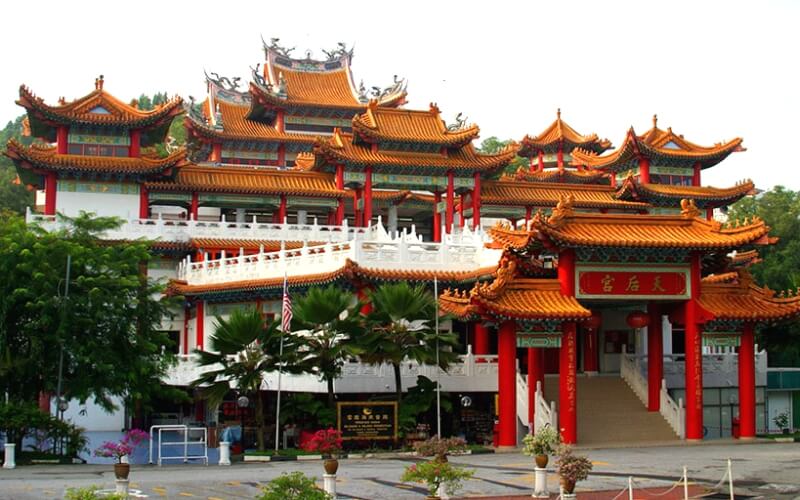
Thien Hau Pagoda
- Quan Am Pagoda on Lao Tu Street is smaller and less visited, which often makes it the more memorable stop. You wanna learn more about this pagoda? Explore our Quan Am Pagoda guide.
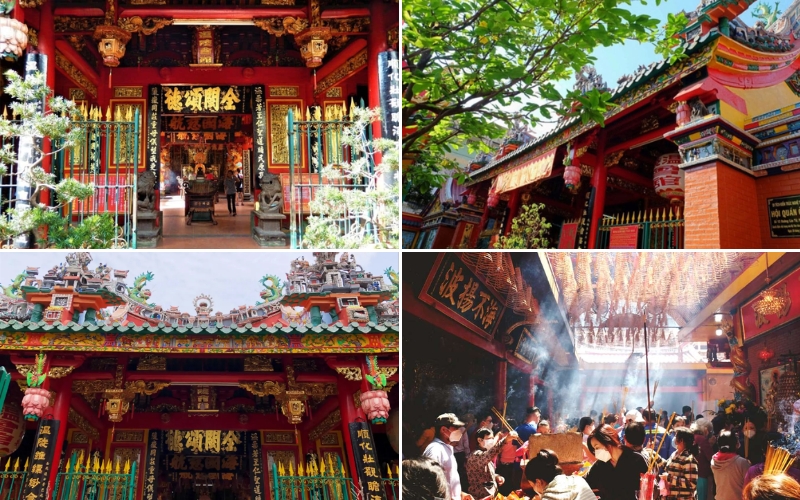
The sophisticated China-style architecture of Quan Am Pagoda
- Chua Van Phat (Temple of Ten Thousand Buddhas) is about 1 kilometer from Cho Quan and houses tens of thousands of Buddha statues filling every available surface.
Binh Tay Ward also has a well-earned reputation among locals for food. Street food options near Cho Quan and Binh Tay Market include popiah (fresh spring rolls), sweet soya curd, banh mi with Chinese-style fillings, and various dim sum-style items that reflect the Cantonese and Teochew influences of the Chinatown community.
Catholicism in Vietnam: Broader Context
Vietnam has one of the largest Catholic populations in Asia. According to the Catholic Bishops’ Conference of Vietnam, approximately 7% of the country’s population is Catholic, with the strongest concentrations in the south. Ho Chi Minh City has dozens of Catholic churches, many of them built during the French colonial period and still serving active congregations today.
The history of Catholicism in Vietnam is long and, at certain points, difficult. The religion was introduced by Portuguese and Spanish missionaries in the 16th century and expanded significantly under French influence in the 18th and 19th centuries. The periods of persecution under the Nguyen Dynasty kings, particularly Minh Mang and Tu Duc, resulted in the martyrdom of many Vietnamese Catholics, a number of whom were later canonized by the Vatican. Cho Quan Church’s own history of demolition and reconstruction during this period is part of this broader story.
Today, the relationship between the Catholic community and Vietnamese society is largely harmonious. Visitors to Cho Quan will find a church that functions as a neighborhood institution: holding daily mass, running community programs, and maintaining the kind of local presence that comes from 300 years of continuous activity in one place.
How to Include Cho Quan Church in Your Ho Chi Minh City Itinerary
Most visitors to Ho Chi Minh City spend one to three days in the city before or after exploring the rest of Vietnam. Cho Quan Church fits naturally into a Chinatown-focused half-day, paired with Binh Tay Market, Ba Thien Hau Pagoda, and lunch in the area.
For a fuller city itinerary, our Ho Chi Minh City tours cover the city’s main landmarks with private guides who can also take you into Binh Tay Ward on request.
If you are planning a longer trip that extends beyond the city, South Vietnam tours from IDC Travel combine Ho Chi Minh City with the Mekong Delta, Da Lat, Nha Trang, and Phu Quoc in various itinerary lengths.
For travelers coming from further afield, Vietnam tours covering the full country from Hanoi to Ho Chi Minh City give you enough time to see how the country’s Catholic heritage changes as you move from north to south, with different regional histories and architectural styles appearing along the way.
Conclusion: Overview of Cho Quan Church
Before you plan your visit, here is a quick reference table with the key information about Cho Quan Church:
| Detail | Information |
| Official Name | Cho Quan Church / Basilica of the Sacred Heart of Jesus (Nha tho Cho Quan) |
| Address | 120 Tran Binh Trong Street, Binh Tay Ward, Ho Chi Minh City |
| Phone | 028 3923 5067 |
| Opening Hours | 05:00 to 11:00 and 13:00 to 21:00 daily |
| Entrance Fee | Free (donations accepted) |
| Architectural Style | Gothic Revival with French colonial influence |
| Year Inaugurated | 1896 (current structure) |
| Historical Origin | 1674 (first oratory on the site) |
| Bell Tower Height | ~20 meters |
| Distance from the centre | ~3 kilometers |
| Best Time to Visit | November to March; mornings before 9 a.m. |
| Average Temperature | 25 to 28 degrees Celsius (77 to 82 degrees Fahrenheit) in dry season |
| Nearby Bus Lines | 01, 46, 68 |
Cho Quan Church is not the most prominent church in Ho Chi Minh City by name recognition, but it is the oldest, and that age comes with a character that more famous sites sometimes lack. The congregation is real, the history is documented, and the architecture holds up well under close inspection.
If you are visiting Binh Tay Ward for the markets and temples of Chinatown, the church is worth adding to the same morning. If you are specifically interested in the Catholic history of Vietnam, it deserves its own dedicated visit.
For help planning a trip to Ho Chi Minh City and beyond, we can put together a private, tailor-made itinerary that fits your schedule and interests.
>>> Refer to Nhà thờ Chợ Quán.
Read more: