Few museums in Vietnam stop visitors in their tracks quite like the Ao Dai Museum. Located in the Long Phuoc Ward, it is the only museum in the country dedicated entirely to Vietnam’s iconic national garment. Whether you are planning a Vietnam trip for the first time or returning to dig deeper into Southern Vietnamese culture, this guide covers everything you need to know before you go, from Ao Dai Museum opening hours and tickets to what you will actually see and do inside.
What Is the Ao Dai?
The “ao dai” is Vietnam’s national dress. It is a close-fitting silk tunic, worn over loose-fitting trousers, and it has been part of Vietnamese life since the 18th century.
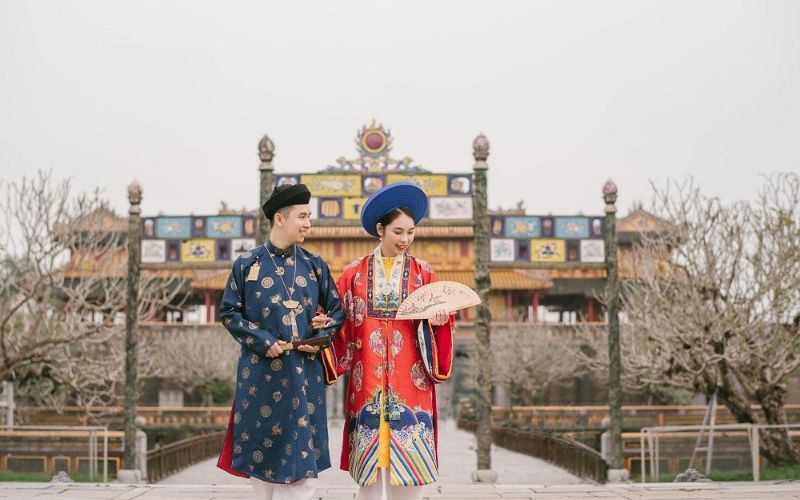
Taking photo at Hue Imperial City with Ao Dai.
The garment has gone through significant changes over the decades: the flowing four-panel and five-panel styles of the royal Nguyen dynasty, the Lemur “ao dai” of the 1930s (which narrowed the silhouette considerably), the raglan-sleeve designs of the 1960s, and the painted and brocade styles worn today. Men wore the “ao dai” too, though today it is mainly associated with women, particularly at formal events, weddings, and national celebrations.
What makes the “ao dai” culturally significant is not just how it looks but what it carries. Schoolgirls wear it as a uniform in many Vietnamese schools. Brides wear it at traditional ceremonies. Diplomats wear it at state functions. It has become shorthand for Vietnamese femininity and national identity in a way that few garments anywhere achieve.
Location of the Ao Dai Museum
- Address: 206/19/30 Long Thuan Street, Long Phuoc Ward, Ho Chi Minh City.
The museum sits roughly 22 km from central Ho Chi Minh City, and depending on traffic, the drive takes between 45 minutes and an hour.
Getting there is straightforward:
- By taxi or ride-hailing app (Grab): the most practical option for most visitors. Budget around 150,000-250,000 VND (~$6-$10) each way from the city center.
- By public bus: Bus routes 76 and 88 stop close to the museum. Bus fares are typically 6,000-8,000 VND (~$0.25-$0.32) per person. From the bus stop on Long Thuan Street, the museum is about a 10-minute walk.
- By private car: If you are on an organized tour by our team, your driver will take you directly to the gate.
One practical note: the museum is some distance from central Ho Chi Minh City, so most travelers combine it with other stops in the area, or join a guided day tour that handles the logistics.
Best Time to Visit
The museum is open year-round. For Ho Chi Minh City more broadly, the dry season from November to April is the most comfortable time to visit, with temperatures around 27-32°C (80-90°F) and little rain. The wet season from May to October brings afternoon downpours, though these tend to be short and the heat remains high (30-35°C / 86-95°F).
For the museum specifically, weekday mornings between 9:00 AM and noon tend to be quieter. Weekend afternoons can get busy, particularly when the museum hosts cultural performances or school group visits. If you plan to do a workshop, arriving early gives you more time without feeling rushed.
Ao Dai Museum Opening Hours and Tickets
| Detail | Information |
| Address | 206/19/30 Long Thuan, Long Phuoc Ward, Ho Chi Minh City |
| Opening hours | 8:30 AM to 5:30 PM, Tuesday to Sunday (closed Mondays) |
| Ticket |
|
| Group discount |
|
The museum is open on public holidays, but it is worth calling ahead if you plan to visit during Tet or major Vietnamese festivals, as special events sometimes affect standard hours. Tickets are purchased at the entrance; there is no need to book in advance for individual visitors.
History and Background
The Ao Dai Museum opened on January 22, 2014, the result of more than a decade of work by artist and fashion designer Le Si Hoang. Si Hoang had been collecting “ao dai”, garments, and cultural artifacts since the early 2000s, and he wanted a dedicated space where these could be properly preserved and displayed rather than sitting in private storage.
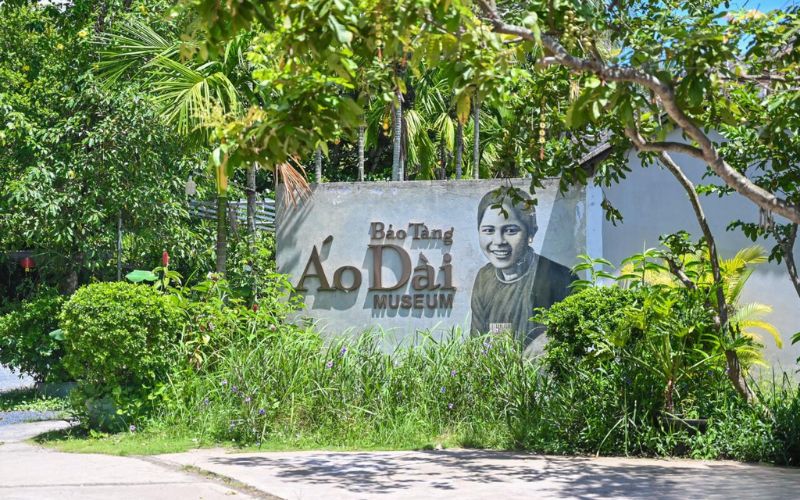
The Ao Dai Museum offers a tranquil garden setting to explore the history of Vietnam’s iconic national dress.
In 2015, the Dau An Joint Stock Company (also known as Vietnam Signature Corporation) took over ownership and management of the museum, expanding its programming and making it one of two thematic private museums in Ho Chi Minh City overseen by the city’s Department of Culture and Sports.
The museum sits on roughly two hectares of land in Long Thu Thuan Garden. The architecture draws heavily on traditional Southern Vietnamese wooden construction and the communal house style of the old Quang Nam province (Da Nang City now), with much of the woodwork carried out by craftsmen from the Kim Bong carpentry village in Hoi An. Walking through the grounds, you get a sense of a rural Southern Vietnam that has otherwise mostly disappeared from the city.
The Museum Grounds: What to Expect
This is one part of the Ao Dai Museum that most travel articles underplay. The grounds are genuinely good, and on a pleasant morning they are worth slowing down for.
The two-hectare site has rice paddies flanking the main entrance path, a lotus pond, water coconut trees, old banyan trees that provide real shade from the heat, a canal running along the property boundary (where motorboats occasionally pass), a small herb garden, and even a duck coop. A monkey bridge crosses one section of the grounds: a traditional bamboo and rope structure common in the rural Mekong Delta, and for most visitors this is the first time they have ever crossed one.
A floating wooden stage sits on Chan Lac Lake, designed to resemble a village communal house courtyard. The museum uses this stage for cultural performances, including “quan ho” folk singing, “don ca tai tu” (Southern Vietnamese chamber music), and folk opera. If you happen to visit on a day when a performance is scheduled, it is worth staying for.
The architecture clusters include reconstructed “nha ruong” houses (traditional long-houses from Quang Nam) and several Hoi An old town-style buildings. These are not replicas for show: they house the museum’s exhibitions and are stocked with authentic artifacts and furniture from the region.
The Ao Dai Museum’s Main Exhibitions
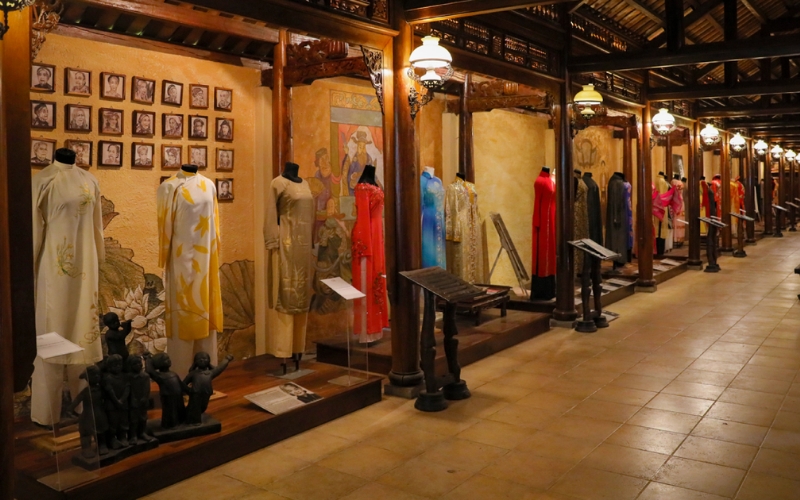
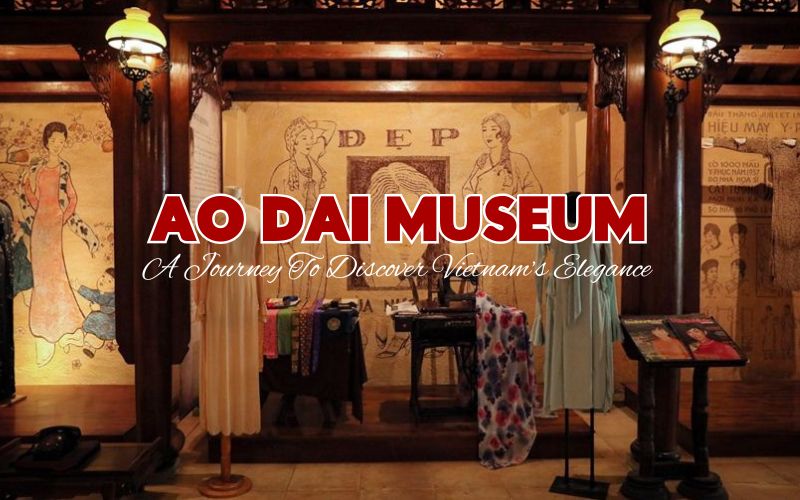
The Ao Dai Museum showcases the elegant evolution of Vietnam’s national costume through a rich collection of historical and contemporary designs.
The museum has three permanent exhibitions plus several smaller display spaces.
Exhibition 1: The History of the Ao Dai
This is the largest exhibition and the logical starting point. The right-hand aisle displays “ao dai” samples in chronological order, moving from the earliest multi-panel styles through the Lemur “ao dai” of the 1930s, the high-collar designs of the 1950s, the boat-neck and raglan styles of the 1960s and 70s, and into contemporary brocade and painted “ao dai”.
What makes this more than a standard fashion display is the inclusion of garments with specific provenance. The museum holds “ao dai” worn by Major General Nguyen Thi Dinh, former Vice Presidents Nguyen Thi Binh and Trong My Hoa, People’s Doctor Ta Thi Chung, and celebrated performers including singer Bach Tuyet and dancer Linh Nga. Each piece comes with notes on the person who wore it and the context in which it was worn.
At the front of this exhibition is a reconstruction of a traditional “ao dai” tailor’s workshop, complete with fabric samples (voile, brocade, silk, satin) and the hand tools used to cut and embroider the garments. Visitors get a clearer picture of why a hand-sewn “ao dai” costs what it does.
Exhibition 2: Ao Dai in Performance and Special Occasions
The second exhibition is built into several Hoi An old town-style houses and covers the role of “ao dai” in Vietnamese performing arts. Exhibits here focus on costumes worn during “quan ho” folk music performances, “vi giam” (a central Vietnamese singing tradition), “nha nhac cung dinh Hue” (the royal refined music of Hue, a UNESCO Intangible Cultural Heritage), and Vietnamese folk opera.
The display also includes variations of the conical “non la” hat and traditional wooden clogs (guoc moc), both of which are worn with “ao dai” for performances. The ASEAN flags “ao dai” collection is here too: a series of garments designed with patterns drawn from the national flags of Southeast Asian countries, created for a regional cultural diplomacy program.
Exhibition 3: Contemporary and International Ao Dai
The third exhibition covers modern “ao dai” design and international collaborations. Si Hoang’s award-winning competition pieces are displayed here, alongside collections produced in partnership with Japanese designers (the museum worked with the Tsumami Traditional Fabric Flower Association in 2018 and 2019 to create “ao dai” incorporating Japanese tsumami kanzashi fabric flowers). The “brocade and flowers” collection and garments inspired by the national flowers of ASEAN member states are displayed in this section.
Supporting Displays
Two smaller exhibitions round out the visit:
- Bau Truc Pottery Gallery: Cham pottery from Bau Truc Village in Ninh Thuan Province, now recognized by UNESCO as an Intangible Cultural Heritage in need of urgent protection. Si Hoang has been involved in documenting and promoting this craft since 1986. The pottery is hand-shaped without a wheel using an ancient technique unique to the Cham people.
- Vietnamese women’s undergarments through history: An unusual but well-regarded display that traces how women’s undergarments changed alongside ao dai styles. Many visitors mention this as an unexpected highlight.
Hands-On Activities at the Museum
The Ao Dai Museum is not a passive experience if you do not want it to be. Several workshops and activities run regularly:
- Ao dai sewing workshop: Skilled tailors guide visitors through the process of creating a basic “ao dai”. You work with a needle and thread on a real piece of fabric, and you leave with a finished souvenir. This takes roughly 60-90 minutes.
- Ao dai wearing and photography: Visitors can dress in a traditional “ao dai” of their choice (sizes available for adults and children), with staff on hand to help with accessories and styling. The museum grounds provide a very good backdrop for photos: the lotus pond, wooden houses, and rice paddies all photograph well, and the quiet setting is a genuine contrast from the chaos of central Ho Chi Minh City.
- Coconut leaf weaving: A traditional Southern Vietnamese craft where you shape palm fronds into small animal figures or household items. Popular with children and adults alike.
- Banh it cooking class: “Banh it” is a traditional glutinous rice cake filled with pork or mung bean and wrapped in banana leaves. The class covers choosing banana leaves, kneading dough, making the filling, and steaming the finished cakes. You eat what you make.
- Children’s creative workshop: The museum runs drawing, painting, “ao dai” lantern-making, and paper “ao dai” decoration activities specifically for younger visitors.
What to Wear and Bring
A few practical notes based on common visitor experiences:
- Wear comfortable walking shoes. The grounds involve uneven stone paths, wooden steps, and (if you try it) a bamboo monkey bridge.
- Bring sun protection. The walk from the entrance to the main buildings is across open ground, and midday sun in Ho Chi Minh City is genuinely strong.
- Flash photography is not permitted inside the exhibition rooms, as it damages the fabric. Standard photography without flash is fine throughout the rest of the museum.
- Light, modest clothing is appropriate. This is not a religious site, but it is a cultural one.
Other Vietnam Museums Worth Adding to Your Itinerary
The Ao Dai Museum works well as part of a broader Ho Chi Minh City itinerary that mixes war history, colonial architecture, and cultural heritage. Other museums in the city worth visiting include:
- War Remnants Museum (28 Vo Van Tan, Xuan Hoa Ward): Documents the Vietnam-American War through photographs, military hardware, and personal accounts. One of the most visited museums in the country.
- Ho Chi Minh City Museum (65 Ly Tu Trong, Ben Nghe Ward): Covers the city’s development from prehistoric times to the present, housed in a French colonial building.
- Ho Chi Minh City History Museum (2 Nguyen Binh Khiem, Ben Nghe Ward): Artifacts from Vietnam’s earliest civilizations through to the Nguyen dynasty.
- Fine Arts Museum (97 Pho Duc Chinh, Ben Thanh Ward): Vietnamese fine arts from the 20th century to the present, in another French colonial building.
If you want to see “ao dai” in a broader geographic context, the Vietnam Museum of Ethnology in Hanoi has a significant collection of traditional costumes from Vietnam’s 54 ethnic groups, including minority variations of the “ao dai” that rarely appear in southern collections.
Combining the Ao Dai Museum with a Ho Chi Minh City Day Tour
Given the Ao Dai Museum’s location roughly 22 km from the city center, most travelers include it as part of a guided Ho Chi Minh City day tour rather than making a standalone trip. A typical itinerary might cover:
- Morning: Ao Dai Museum (allow 2-3 hours including a workshop).
- Midday: Lunch at a local restaurant.
- Afternoon: War Remnants Museum, Reunification Palace, or Ben Thanh Market in the city center.
If you are building a longer trip through Southern Vietnam, the museum fits naturally into a route that also takes in the Mekong Delta, the Cu Chi Tunnels, and the historic sites of central Ho Chi Minh City. IDC Travel offers tailor-made Southern Vietnam tours that can incorporate the museum alongside these highlights.
Conclusion: Planning Your Vietnam Trip to Ao Dai Museum
| Category | Details |
| Full name | Ao Dai Museum (Bao Tang Ao Dai) |
| Address | 206/19/30 Long Thuan Street, Long Phuoc Ward, Ho Chi Minh City |
| Phone | +84 91 472 69 48 |
| info@baotangaodaivietnam.com | |
| Website | https://baotangaodai.com.vn/index.php?route=common/home |
| Opening hours | Tuesday to Sunday, 8:30 AM to 5:30 PM (closed Monday) |
| Entrance fees |
|
| Travel time from city center | 45-60 minutes by car, depending on traffic |
| Recommended visit duration | 2-3 hours |
| Best time to visit | November to April (dry season); weekday mornings are quietest |
| Photography | Allowed without flash |
| Parking | Available on site |
| Nearest bus routes | 76 and 88 (alight at Long Thuan Street stop) |
The Ao Dai Museum works for most traveler types: solo travelers interested in Vietnamese culture, families with children old enough to enjoy the hands-on activities, photography enthusiasts, and anyone who wants a break from the noise and density of central Ho Chi Minh City. The two-hectare grounds, the quiet ponds, and the old wooden architecture are a genuine contrast to the rest of the city.
For first-time visitors to Vietnam, the museum pairs naturally with a broader Vietnam holiday that combines Ho Chi Minh City, the Mekong Delta, and central Vietnam. For repeat visitors or those specifically interested in Vietnamese cultural heritage, it is worth building the visit around a workshop so you leave with something you made yourself. Contact us for more information!
Read more: