
When people picture Bangkok’s temples, they usually think of Wat Phra Kaew or Wat Pho. Wat Traimit deserves a spot on that list too. This is where you’ll find the world’s largest solid gold Buddha statue, a 5.5-ton image that spent centuries hidden under plain plaster before its true form was revealed by accident in 1955. If you’re planning a visit, here’s what you actually need to know before you go.
What Is Wat Traimit?
Wat Traimit, officially known as Wat Traimit Withayaram Worawihan, is a Buddhist temple in Bangkok’s Chinatown district. Its full name is a mouthful, so most visitors (and locals) just call it the Temple of the Golden Buddha. Alongside Wat Phra Kaew and Wat Pho, it is considered one of Thailand’s three national treasure temples, which puts it in serious company.
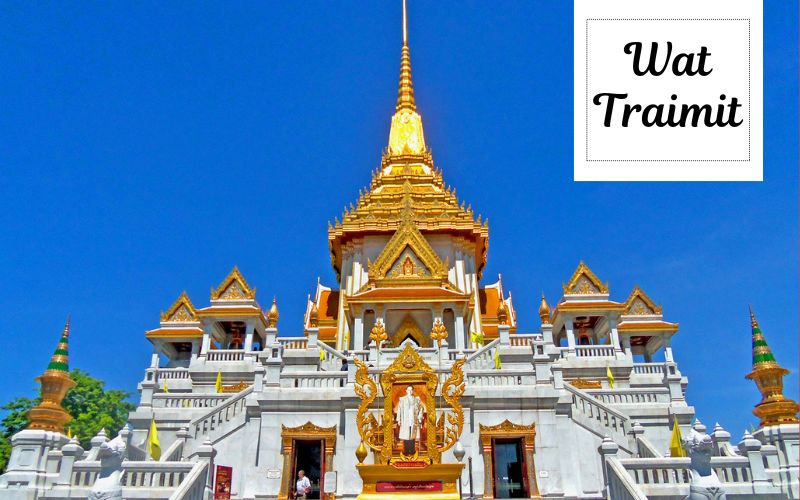
Wat Traimit in Bangkok Temple of the Golden Buddha
The temple’s main draw is the Phra Buddha Maha Suwanna Patimakorn, a seated Buddha image made of approximately 83% pure gold. It stands 3 meters (just under 10 feet) tall and weighs 5.5 tonnes. At current gold prices, the statue alone is worth tens of millions of dollars. Architecturally, the complex is a four-story marble-clad building called the Phra Maha Mondop, which also houses two museum floors below the statue itself.
Wat Traimit Location and How to Get There
Wat Traimit is at No. 661 Charoen Krung Road, Talat Noi, Samphanthawong, Bangkok. It sits right at the edge of Yaowarat Road, the main artery of Bangkok’s Chinatown.
Getting there is straightforward:
- MRT (subway): Take the Blue Line to Hua Lamphong Station. The temple is about a 10-minute walk from the exit, or a 5-minute tuk-tuk ride.
- River ferry: Take the Chao Phraya Express Boat to Marine Department Pier (Pier 4) or Rajawongse Pier (Pier 5). From Pier 4, it’s roughly an 800-meter walk.
- Bus: Multiple lines stop nearby, including routes 1, 4, 25, 73, 85, and 159. Route 159 runs from Khaosan Road through the Grand Palace area and into Chinatown, which makes it useful if you’re combining a few temple visits.
- Taxi / Grab: A ride from most central Bangkok hotels will take 15 to 30 minutes depending on traffic, which can be heavy in this part of the city.
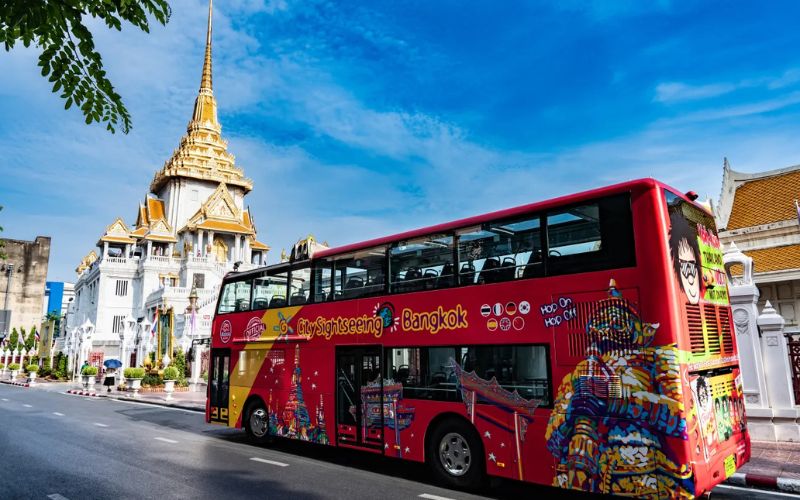
Bus in Bangkok
Note: parking in Chinatown is genuinely difficult. If you’re driving, factor in extra time. Most visitors find the MRT or a Grab ride the easier option.
Wat Traimit Entrance Fee and Opening Hours
The temple is open daily. Here’s what to budget for your visit:
| What You’re Visiting | Hours | Cost (Foreigners) |
| Temple grounds | 8:00 AM – 5:00 PM | Free |
| Golden Buddha (4th floor) | 8:00 AM – 5:00 PM | 40 THB (~$1.20) |
| Museum (floors 2-3) | 8:00 AM – 5:00 PM (closed Mon) | 100 THB (~$2.95) |
| Combined ticket (Buddha + Museum) | Same as above | 140 THB (~$4.15) |
| Audio guide (optional) | Available during opening hours | 100 THB (~$2.95) |
The museum is closed on Mondays. If you’re visiting on a Monday and the history is important to you, plan accordingly.
Most visitors spend 45 to 90 minutes total. If you’re doing the full building including both museum floors and the statue, plus the grounds, an hour and a half is realistic.
>>> Reach out to us for more information!
A Brief History of the Golden Buddha
The Golden Buddha’s story is genuinely strange, and that’s part of why this temple draws so many visitors.
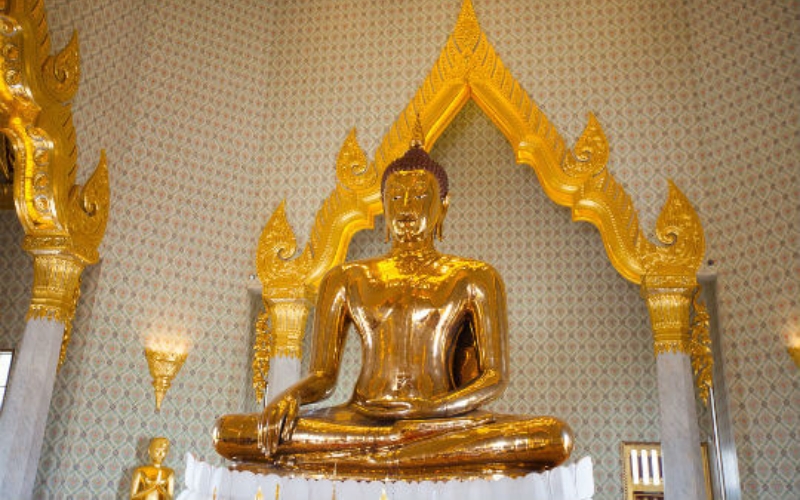
The golden Buddha statue at Wat Traimit
The statue was made during the Sukhothai period, somewhere in the 13th century. At some point, probably when Burmese forces were advancing on the Ayutthaya capital, it was covered in a thick layer of plaster. The intent was to hide its value. According to one account, the workers who carried out the concealment were killed afterward to preserve the secret. That’s how seriously people took it.
The statue eventually traveled to Bangkok during the reign of Rama III (1824-1851), still covered in plaster and looking unremarkable. It sat in a warehouse for years because no temple in Bangkok wanted it. Its size made it awkward, and without knowing what was underneath, nobody thought it was worth the trouble. The abbot at Wat Traimit eventually agreed to house it.
The secret was kept until 1955, when the statue was being moved to a new building. During the transfer, it slipped and fell. The impact cracked the plaster, and the abbot noticed something catching the light underneath. Workers stripped away the coating to find solid gold beneath. The statue moved to its current purpose-built home, the Phra Maha Mondop, in 2010.
What You’ll Find Inside the Wat Traimit Temple
This is the part most travel guides rush through. The temple is four floors, and each one is different enough to be worth your time.
The Golden Buddha (Fourth Floor)
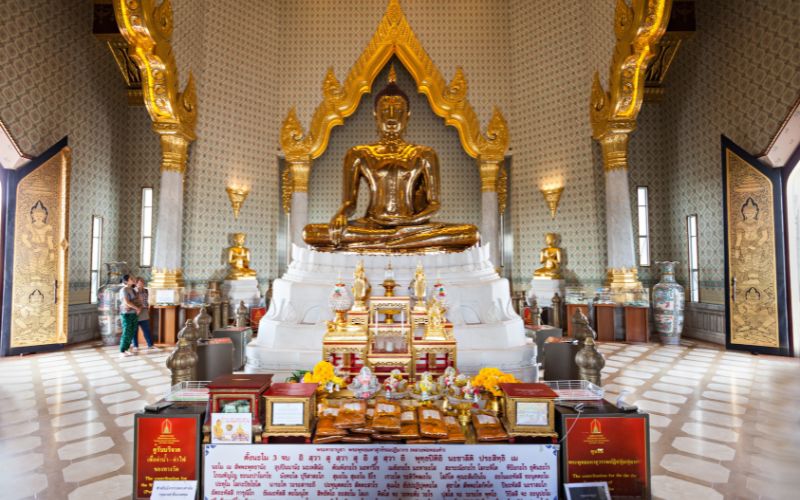
Golden Buddha Statue
The statue sits on the top floor of the Phra Maha Mondop, inside a chamber decorated with gold-accented pillars and traditional Thai ornamentation. You remove your shoes before entering, and the space is relatively compact. On busy days it gets crowded near the entrance as people stop to photograph the statue from the doorway.
The image itself is in the Subduing Mara pose, seated cross-legged with the right hand pointing toward the ground. It’s the same posture depicted in countless Thai Buddha images, but seeing it rendered entirely in gold at this scale is a different experience. The light inside the chamber makes the statue seem to glow rather than just reflect.
Photography is permitted, but the space is small enough that you’ll be aware of other worshippers and monks using the room for prayer. Give them space. Sitting quietly for a few minutes, rather than immediately reaching for your camera, gives you a better sense of how the room actually feels.
The views from this top floor extend over Chinatown’s rooftops and the surrounding old-town district. It’s worth pausing outside before heading back down.
The Golden Buddha History Museum (Third Floor)
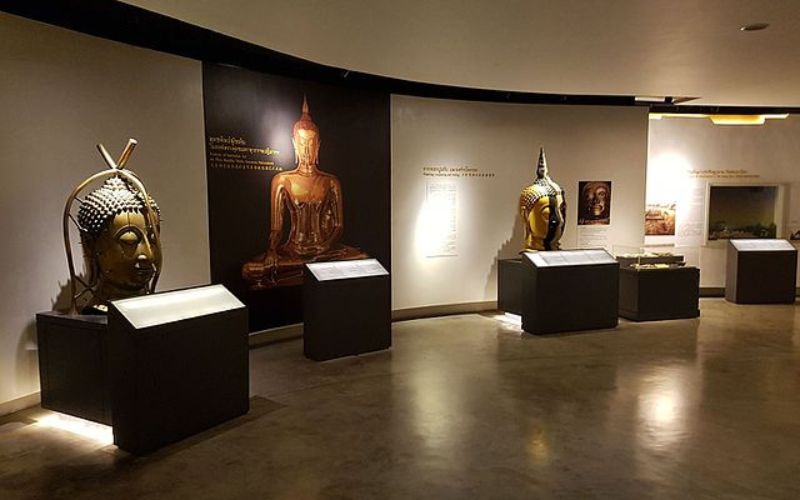
The fascinating museum exhibition at Wat Traimit detailing the discovery of the Golden Buddha.
The third floor focuses specifically on the statue’s history. There’s a video presentation at the entrance that covers the Sukhothai stylistic tradition, the “Subduing Mara” iconography, and the full story of how the image was made, lost, and rediscovered. The exhibits include fragments of the original plaster coating and the tools used to remove it in 1955.
This floor is where you get actual context for what you just saw upstairs. Skipping it in favor of going straight to the golden statue means missing a lot. The 1955 discovery is a genuinely interesting story, and seeing the physical pieces of plaster brings it home in a way that a written description doesn’t.
The Chinatown Heritage Center (Second Floor)
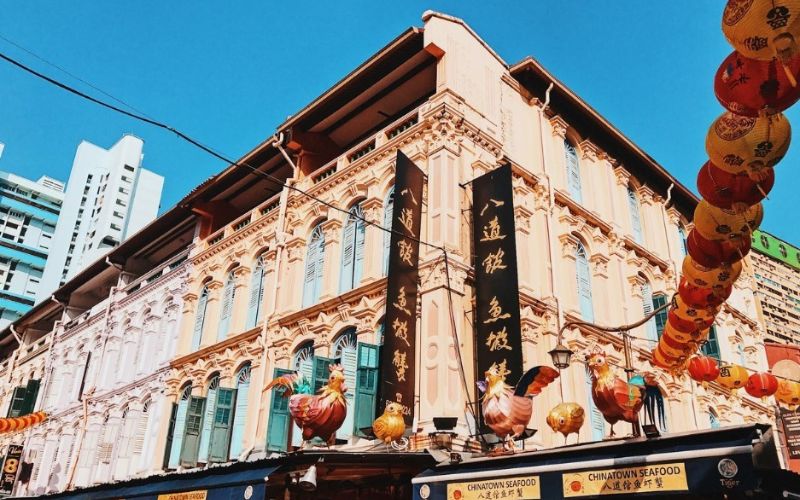
Chinatown Heritage Center
The second floor covers the history of Bangkok’s Chinese community, specifically the Yaowarat district that surrounds the temple. This is not a minor footnote. Bangkok’s Chinatown dates to the late 18th century, when Chinese immigrants settled in the area during the reign of Rama I. Many of the city’s wealthiest trading families came from this neighborhood.
The exhibits here use photography, reconstructed shop-house interiors, and multimedia presentations to show what life along Yaowarat Road looked like in the 19th and early 20th centuries. If you’re planning to walk Chinatown afterward (which you should), this floor gives you a much better read on what you’re looking at when you’re out on the street.
The Temple Grounds
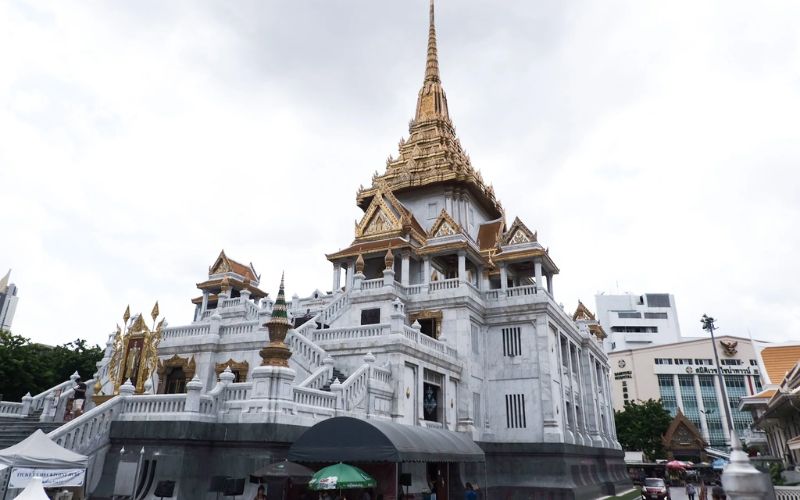
The magnificent Phra Maha Mondop at Wat Traimit, which houses the world’s largest solid gold Buddha statue.
Outside the Phra Maha Mondop, the broader temple compound is modest by Bangkok standards. There are several smaller shrines, resident monks, and bells scattered across the grounds. The marble exterior of the main building is the architectural focal point, and the contrast between the white stone and the gold accents on the upper floors is sharp in direct sunlight.
The grounds are generally calm even when the interior is busy. Many Thai visitors come here specifically to make merit and pray, and the atmosphere reflects that. This isn’t primarily a tourist attraction for the people who use it most.
Useful Tips for First-Time Travelers
A few things that are actually useful to know before you arrive:
- Dress code matters: You need covered shoulders and knees. Shorts, tank tops, and sleeveless shirts are not allowed. The temple usually has sarongs available at the entrance if you arrive underdressed, but it’s easier to plan ahead.
- Shoes come off: There are designated areas to leave them. This applies to the interior of the Phra Maha Mondop, not just the statue room.
- Go early: The temple opens at 8:00 AM. Arriving between 8:00 and 10:00 AM means smaller crowds and cooler temperatures. By midday the main building gets busy, and Bangkok heat in the afternoon is real.
- Photography is allowed throughout the grounds: Flash photography inside the statue chamber is best avoided out of respect for worshippers, but the building’s architecture, the exterior, and the museum floors are all fair game.
- Women should not touch monks: This is standard temple etiquette across Thailand.
- Walk into Chinatown afterward: Yaowarat Road is a 5-minute walk from the temple entrance. Some of Bangkok’s best street food, particularly at night but also during the day, is right there. Combining Wat Traimit with a Chinatown walk is one of the better half-day combinations in the city.
Conclusion: Planning Your Bangkok Visit to Wat Traimit
Quick Reference: Wat Traimit at a Glance
| Detail | Information |
| Official name | Wat Traimit Withayaram Worawihan, Temple of the Golden Buddha |
| Location | 661 Charoen Krung Rd, Talat Noi, Samphanthawong, Bangkok |
| Nearest MRT | Hua Lamphong (Blue Line), ~10 min walk |
| Opening hours | 8:00 AM – 5:00 PM daily (museum closed Mondays) |
| Entrance fee |
|
| Combined ticket | 140 THB (~$4.15) |
| The statue | 5.5 tonnes, ~83% pure gold, 3 meters tall, 13th century |
| Best time to visit | Early morning (8:00 – 10:00 AM) |
| Dress code | Covered shoulders and knees required |
| Photography | Permitted (avoid flash in the statue chamber) |
| Time needed | 45 to 90 minutes |
Wat Traimit is not the largest or most ornate temple in Bangkok, but the statue is genuinely extraordinary, and the story behind it is one of the better ones in the city. It’s also an easy anchor for an afternoon in Chinatown, which is reason enough to put it on the list.
Wat Traimit pairs well with other temples in this part of Bangkok. Wat Arun and Wat Pho are accessible by river ferry, and the Grand Palace is nearby enough to combine in a full-day itinerary. Most first-time visitors to Bangkok end up spending two or three days in the old-town and riverside area alone.
If you’d rather not figure out transport logistics on your own, we have Bangkok tours include Wat Traimit alongside other major sites, with English-speaking guides who can put each stop in context. For travelers covering more ground, our Thailand tour packages connect Bangkok with Chiang Mai, Phuket, and other regions in itineraries built around how people actually travel rather than just listing stops on a map. Let us design a unique and memorable trip to Thailand just for you!
>>> Refer to Wat Traimit – Wikipedia.
Read more: