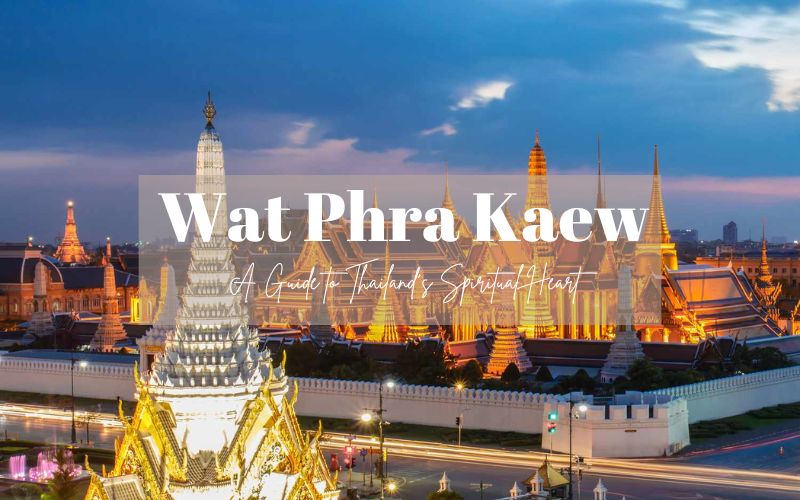
If you visit Bangkok and leave without seeing Wat Phra Kaew, you have missed the one place that most clearly explains why this city matters. The Temple of the Emerald Buddha is not just another temple on a tourist itinerary. It is where Thailand’s royal history, Buddhist devotion, and extraordinary craftsmanship exist together in a single compound. Whether you are planning your first trip to Thailand or coming back for more, Wat Phra Kaew Bangkok deserves the time and attention it asks of you.
What Is Wat Phra Kaew?
Wat Phra Kaew, officially known as Wat Phra Si Rattana Satsadaram, is the most sacred Buddhist temple in Thailand. It sits within the Grand Palace complex in the Phra Nakhon District of Bangkok and houses the Phra Kaew Buddha (Emerald Buddha), a jade statue that has been the spiritual symbol of the Thai nation for centuries.
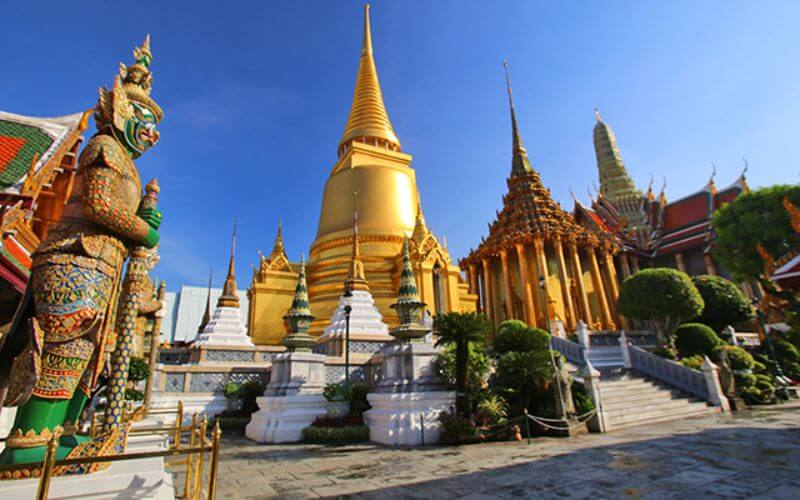
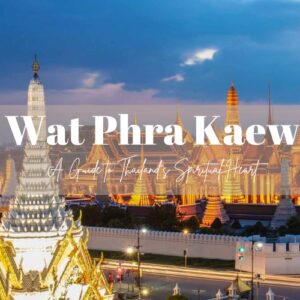
The golden splendor of Wat Phra Kaew, guarded by the towering Yaksha guardians.
Unlike most temples across Thailand, Wat Phra Kaew has no resident monks. It was built as a royal chapel, intended exclusively for royal religious ceremonies and state rituals. This distinction makes the temple unusual in Thai religious tradition. The experience of visiting feels more formal, more charged with history than a typical monastery visit.
Construction began in 1782 under King Rama I, the founder of the Chakri dynasty, to mark Bangkok’s establishment as the new capital of Siam. Each successive king has added to, restored, or refined the complex, making it a physical record of two and a half centuries of Thai royal ambition.
Wat Phra Kaew’s Location
Wat Phra Kaew is located at Na Phra Lan Road, Phra Nakhon District, Bangkok 10200, on the eastern bank of the Chao Phraya River within the Grand Palace grounds.
Getting there is straightforward from most parts of central Bangkok:
- Chao Phraya Express Boat: Take the boat to Tha Chang Pier (N9), then walk roughly 5 minutes to the main entrance. This is the most convenient and scenic option.
- BTS Skytrain + Boat: Ride the BTS Silom Line to Saphan Taksin Station, then transfer to the Chao Phraya Express Boat heading north to Tha Chang Pier.
- Taxi or tuk-tuk: Both work well from central Bangkok. Confirm the fare before boarding a tuk-tuk and make sure taxi meters are running.
- Public bus: Routes 1, 25, and 44 stop nearby, though Bangkok traffic can make this slow during peak hours.
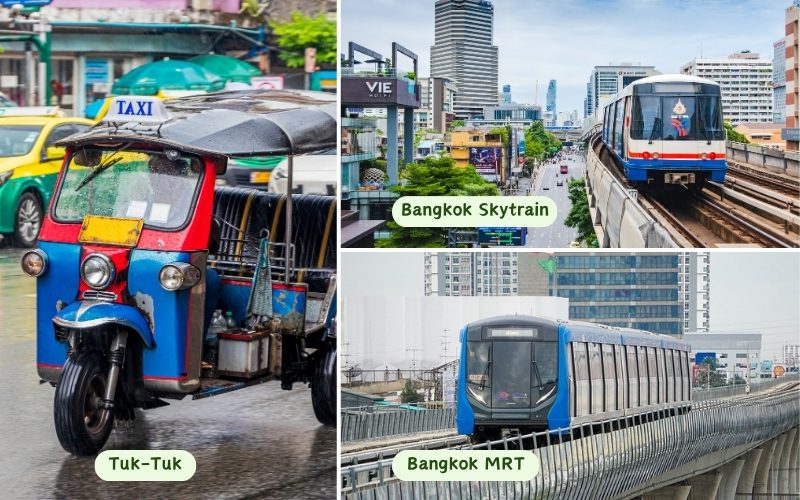
Tuk-Tuks, BTS Skytrain and MRT in Bangkok are the most popular means of transportation.
For visitors staying near Khao San Road or Banglamphu, walking to the temple is a genuine option and a pleasant way to see the surrounding old town before entering the compound.
Practical Information for Visitors
Opening Hours and Admission
Wat Phra Kaew and the Grand Palace are open daily from 8:30 AM to 3:30 PM, though the complex sometimes closes without advance notice for royal ceremonies. It is worth checking the official Grand Palace website before your visit.
Admission is 500 THB (~$14.60) per person. This ticket covers entry to Wat Phra Kaew, the Grand Palace buildings, the Queen Sirikit Museum of Textiles, and the Royal Thai Decorations and Coins Museum. Children under 120 cm enter free. Audio guide headsets are available for an additional 100 THB (~$2.93), in English, French, German, Spanish, Russian, Japanese, and Mandarin.
As of 2025, tickets must be booked online at least 24 hours in advance through the official Royal Grand Palace website.
Dress Code
The dress code is strictly enforced, and staff at the entrance gates will turn away visitors who do not meet requirements:
- Shoulders must be fully covered (no tank tops or sleeveless shirts)
- Knees must be covered (no shorts, short skirts, or cropped trousers)
- No see-through clothing, ripped jeans, or beachwear
- Closed-toe footwear is recommended
Sarongs and cover-ups are available to rent or borrow at the entrance for a refundable deposit. If you are arriving from a beach or market, a light scarf kept in your bag will save you time at the gate.
How Much Time to Allow
Plan for at least 1.5 to 2 hours inside Wat Phra Kaew, and more if you intend to explore the Grand Palace buildings in the Middle Court as well. A full visit to both Wat Phra Kaew and the Grand Palace is realistically 2.5 to 3 hours.
Best Time to Visit
Arrive as close to opening time (8:30 AM) as possible. By mid-morning, large tour groups arrive and the main hall becomes crowded. The late afternoon hours (after 2:00 PM) can also be quieter, but leave enough time before the 3:30 PM last entry.
The History Behind Wat Phra Kaew Bangkok
The story of Wat Phra Kaew and the story of Bangkok are inseparable. In 1782, King Rama I moved the Thai capital from Thonburi across the Chao Phraya River to establish Rattanakosin, what is now the historic heart of Bangkok. The Grand Palace and Wat Phra Kaew were among the first major structures built on this new ground.
The design of the temple drew heavily on Wat Phra Si Sanphet, the royal chapel of the former Ayutthaya capital. Since that older temple was destroyed by Burmese forces in 1767, Wat Phra Kaew effectively preserved and continued that architectural tradition.
The Emerald Buddha itself carries a longer history. According to Thai accounts, the jade image was discovered in 1434 at a temple in Chiang Rai, where lightning struck a stucco Buddha and revealed the green figure inside. Over the following centuries, the statue traveled through Lampang, Chiang Mai, and eventually Laos, where it remained for 214 years before General Chakri (later King Rama I) brought it back to Thailand. In 1785, it was installed at Wat Phra Kaew with great ceremony, and it has remained there ever since.
Highlights of Wat Phra Kaew
This is the heart of any visit. The temple complex covers a large area and contains dozens of structures, but several stand out as genuinely essential to see.
1. The Emerald Buddha (Phra Kaew Morakot)
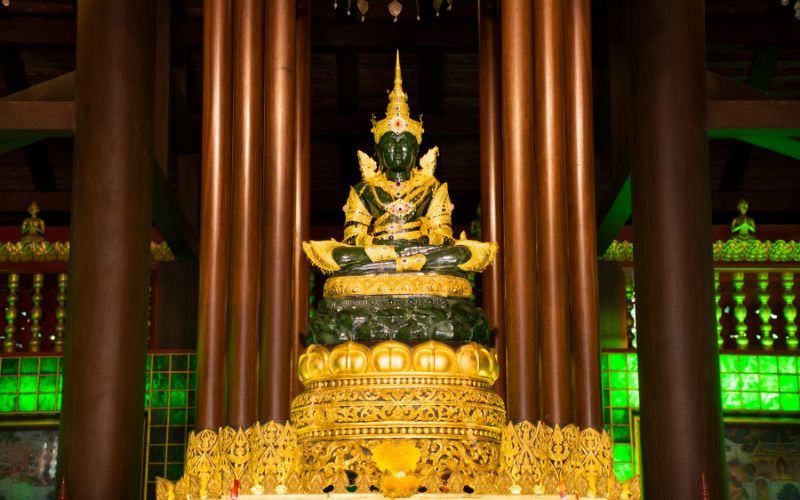
The Emerald Buddha, the spiritual palladium of Thailand, residing in its main ubosot.
The statue sits in the Ubosot, the main ordination hall, elevated on a golden throne 11 meters high and surrounded by glass orbs said to represent the sun and the moon. It is smaller than most visitors expect: 66 centimeters tall, carved from a single block of green jade. The intimacy of it is part of what makes it so affecting. You are looking at an object that millions of people have considered the protective soul of a nation.
Three times a year, the King of Thailand performs a private ceremony to change the statue’s gold robes, each set corresponding to one of the three Thai seasons: the hot season, the cool season, and the rainy season. Photography inside the Ubosot is not permitted, which means your only record is what you take in with your eyes.
2. The Ubosot (Ordination Hall)
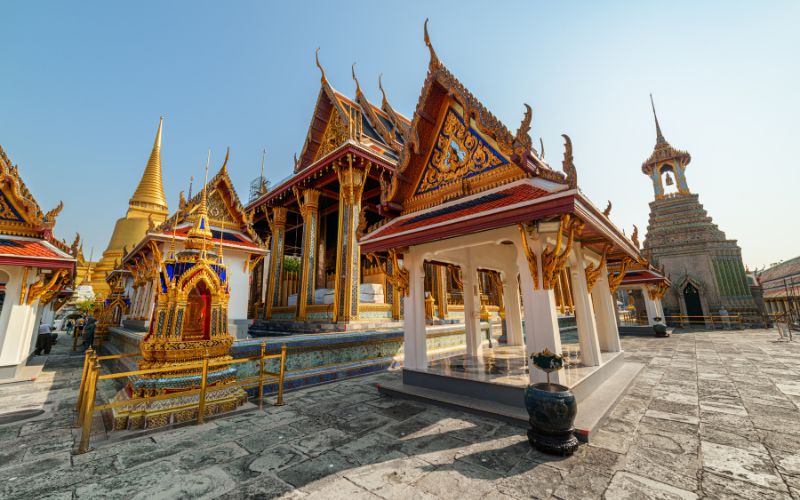
A quiet corner on the main terrace of Wat Phra Kaew – The Ubosot.
The ordination hall surrounding the Emerald Buddha is one of the finest examples of Thai religious architecture in existence. Its exterior is covered in gilded motifs, colored glass mosaics, and layered porcelain tile work. The pediments show Vishnu riding Garuda, a motif that links Thai kingship to Hindu cosmology and reflects the cultural complexity of this region. The building was modeled after Wat Phra Sri Sanphet in Ayutthaya, a structure that no longer exists. In that sense, the Ubosot preserves something irreplaceable.
3. The Ramakien Gallery Murals
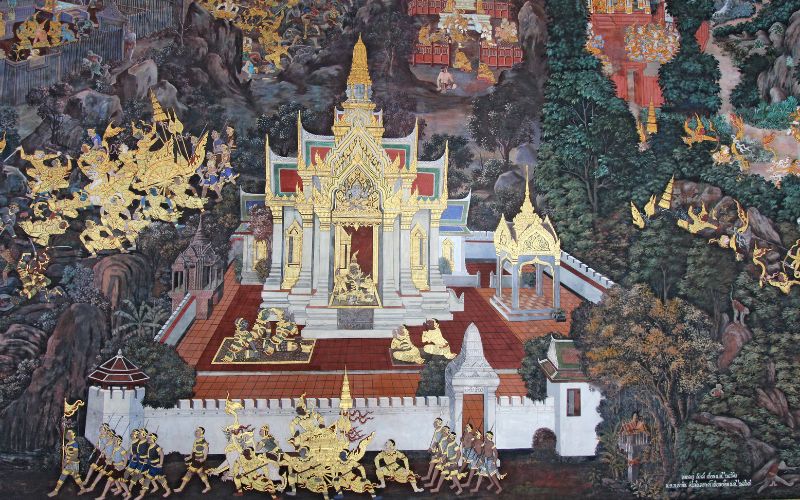
Vivid details from the historic Ramakien mural paintings that line the temple cloister.
Running around the entire inner perimeter of the complex is a gallery of 178 painted panels depicting the Ramakien, the Thai adaptation of the Indian epic Ramayana. The murals were originally commissioned by King Rama I and have been restored multiple times since. They show Prince Rama’s exile and battles in saturated color and precise detail, with every figure and landscape following strict iconographic conventions. Walking the full length of the gallery takes time, but it rewards careful attention. Each panel has a caption in Thai describing the scene.
4. Phra Mondop (Scripture Library)
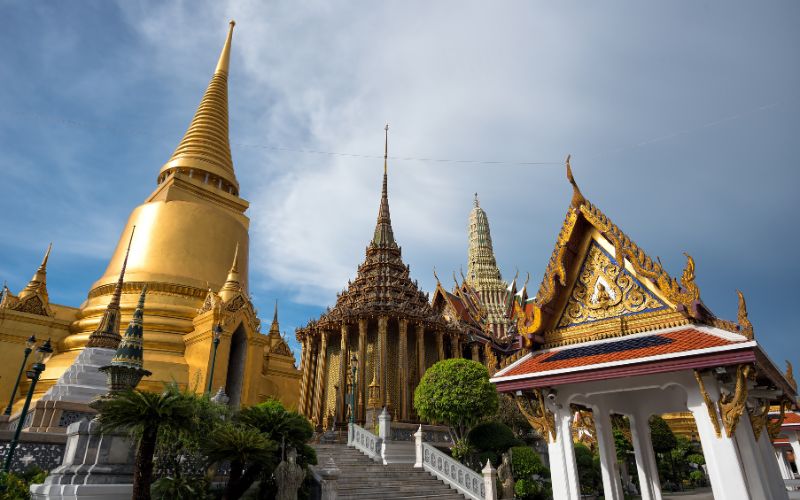
The diverse architectural styles of Wat Phra Kaew seen across the main terrace.
This elegant pavilion stores sacred Buddhist scriptures written on palm leaves. Its exterior is covered in tiny mosaic tiles that shimmer in the light, and it is surrounded by mythical guardian figures. Visitors cannot enter, but the exterior alone is worth studying closely.
5. Phra Si Ratana Chedi (Golden Stupa)
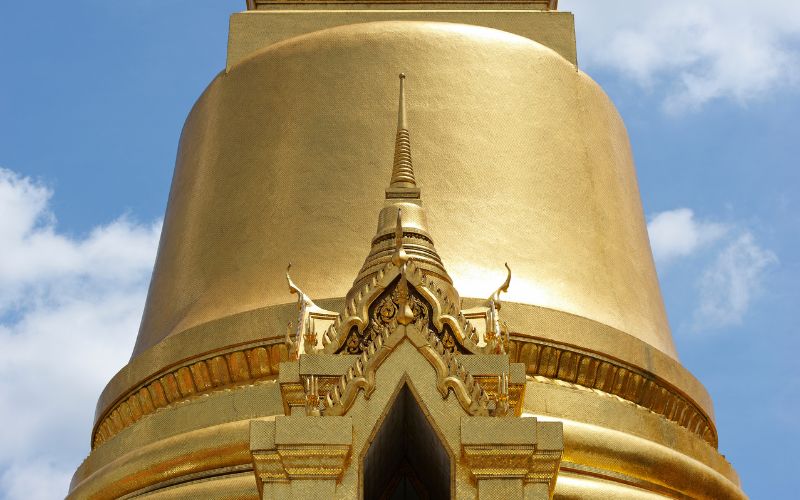
The monumental scale of the gold-tiled Phra Siratana Chedi.
The tall golden stupa to the west of the main hall is built in Sri Lankan style and contains relics of the Buddha. It is one of the most photographed structures in the entire compound and looks particularly striking in the early morning light.
6. Prasat Phra Thep Bidon (Royal Pantheon)
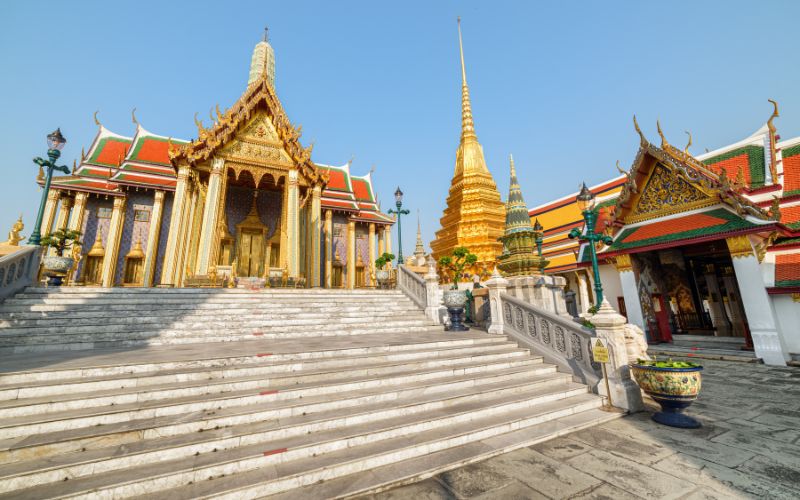
Ascending toward the intricate library, Phra Mondop, at Wat Phra Kaew.
This cruciform building was constructed by King Rama IV to enshrine life-sized statues of all Chakri dynasty kings. The building opens to the public only once a year, on Chakri Memorial Day (April 6), but its exterior with mythical creatures standing guard around its base is worth examining on any visit.
7. The Demon Guardians (Yakshas)
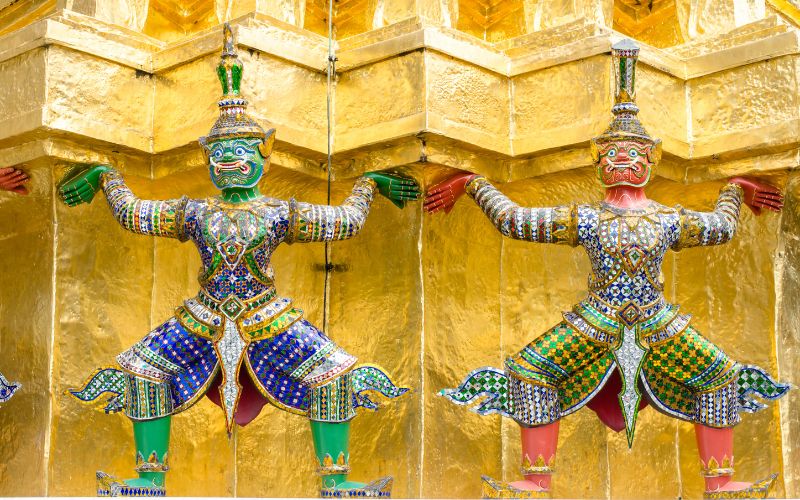
Imposing Yaksa guardians stand watch, protecting the sacred grounds of Wat Phra Kaew.
At each entrance to the temple compound, giant yaksha figures stand watch. These mythological giants from Hindu and Buddhist tradition come in different colors, each representing a different demon from the Ramakien. They are much taller than visitors expect and easy to photograph from multiple angles in the open courtyards.
8. The Model of Angkor Wat
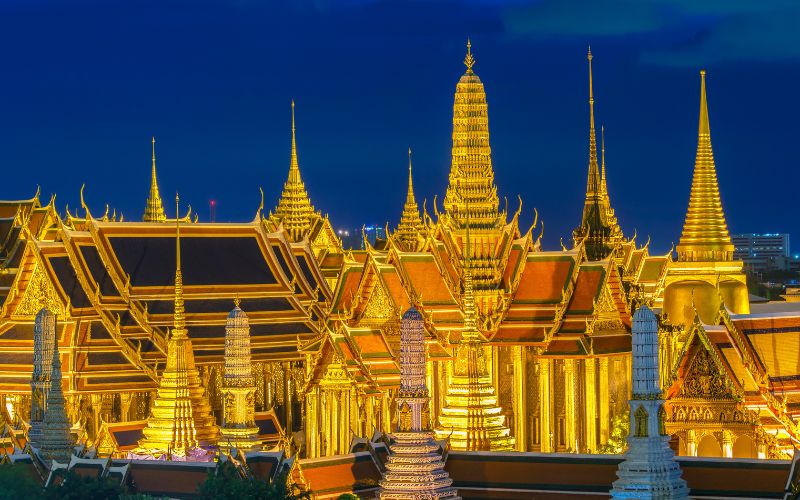
The breathtaking spectacle of Wat Phra Kaew and the Grand Palace illuminated at dusk.
Tucked into one part of the complex is a scaled model of Angkor Wat in Cambodia, commissioned during the reign of King Rama IV when Cambodia was under Thai suzerainty. It is an unusual and often overlooked feature, a reminder of how far Thai royal influence once extended across mainland Southeast Asia.
Combining Wat Phra Kaew with Other Bangkok Temples
The location of Wat Phra Kaew makes it easy to visit three major temples in a single day. Wat Pho, home to the 46-meter reclining Buddha, is roughly 700 meters south of the Grand Palace entrance and can be reached on foot in about 10 minutes. From there, Wat Arun (Temple of Dawn) sits directly across the Chao Phraya River and is accessible by a short ferry crossing from the Tha Tien pier.
This three-temple route covers a concentrated section of Bangkok’s religious history from the 17th century to the early Rattanakosin period, and it gives a clearer picture of how Thai Buddhist art evolved over time.
Planning Your Thailand Trip Around Wat Phra Kaew
Seeing the temple of the Emerald Buddha is one of those experiences that shapes how you understand the rest of Thailand. The royal traditions, the devotion to the Emerald Buddha, the care that has gone into maintaining every tile and mural across more than two centuries: all of it connects to something larger about what Thailand is and how it sees itself.
If you want to experience Wat Phra Kaew as part of a broader journey through Thailand, combining it with Chiang Mai’s mountain temples, the ancient ruins of Ayutthaya, or the islands of the south makes for a trip that covers the full range of what the country offers.
IDC Travel’s Thailand tours include visits to the Grand Palace and Wat Phra Kaew with English-speaking guides who can explain the iconography and history in real depth, which makes a considerable difference in a place this layered. For those who want to combine Bangkok’s temple circuit with the beaches of Phuket or the culture of Chiang Mai, the Bangkok Pattaya 7 Days package and Thailand Classic Tours offer well-structured options that include time at Wat Phra Kaew alongside the floating markets and the Chao Phraya River.
Conclusion: Essential Information at a Glance
| Detail | Information |
| Official name | Wat Phra Si Rattana Satsadaram (Wat Phra Kaew – Temple of the Emerald Buddha) |
| Location | Na Phra Lan Road, Phra Nakhon District, Bangkok 10200 |
| Opening hours | 8:30 AM to 3:30 PM, daily |
| Admission | 500 THB (~$14.60) per person |
| Audio guide | 100 THB (~$2.93) additional |
| Children under 120 cm | Free |
| Nearest pier | Tha Chang Pier (N9), Chao Phraya Express Boat |
| Best time to arrive | 8:30 AM (opening time) |
| Dress code | Shoulders and knees covered, closed-toe shoes recommended |
| Photography | Allowed outdoors; prohibited inside the Ubosot |
Wat Phra Kaew rewards visitors who come prepared and come early. The crowds are real, the dress code is firm, and the heat can be significant by late morning. But the temple itself, the murals, the jade statue on its golden throne, the golden stupa catching morning light, delivers something that most Bangkok visitors describe as genuinely unlike anything else they have seen in Southeast Asia. Give it the time it deserves.
If you’re planning a trip to Thailand, let us customize an itinerary that includes Wat Phra Kaew and other attractions you’d like to see.
>>> Refer to Wat Phra Kaew – Wikipedia.
Read more: