
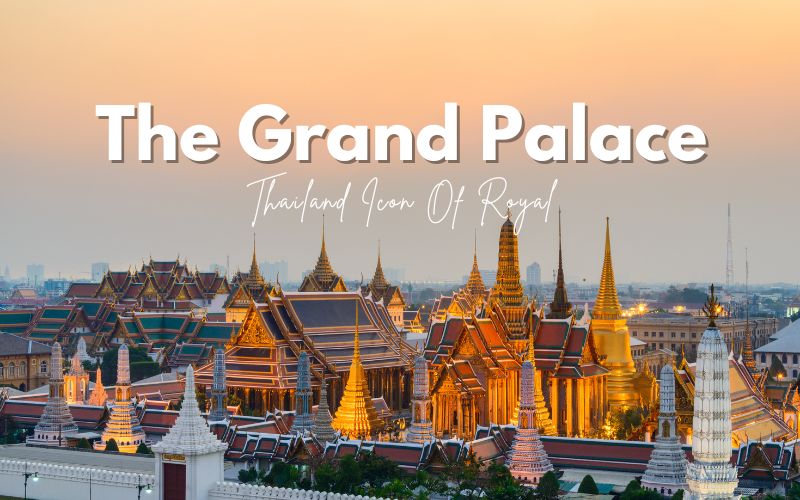
Few sights in Southeast Asia leave the same impression as the Grand Palace in Bangkok. The moment you step through the main gate on Na Phra Lan Road, the scale of the place stops you. Gilded spires, mirror-encrusted towers, and intricately painted temple walls fill the entire compound. If Bangkok Thailand Grand Palace is on your itinerary, this guide covers everything you need to know before you go: what it is, where it is, what to see, how to get in, and how to get the most out of your visit.
What Is the Grand Palace?
The Grand Palace (known in Thai as “Phra Borom Maha Ratcha Wang” or พระบรมมหาราชวัง) is the former official residence of the Thai royal family, located on the banks of the Chao Phraya River in Bangkok’s Rattanakosin Island area.
The magnificent Grand Palace in Bangkok – a historic symbol of Thailand’s royal heritage and architectural splendor.
Construction began in 1782 under King Rama I, who moved the capital from Thonburi to Bangkok after founding the Chakri dynasty. The palace compound covers 218,400 square meters (roughly 54 acres) and contains dozens of buildings, throne halls, courtyards, and temples.
It served as the primary royal residence until King Rama VIII’s reign in the mid-20th century, after which the royal family moved to Chitralada Palace. Today the Thai Palace Bangkok remains a working royal ceremonial site, used for state functions, coronations, and royal funerals. Visitors are welcomed into the outer sections of the compound, while certain inner areas remain reserved for official use.
The full name in Thai, “Phra Borom Maha Ratcha Wang”, translates roughly to “The Great Royal Palace”, and the complex is sometimes referred to as the Bangkok Kings Palace or King Palace Bangkok in tourism materials. Whatever name you use, it refers to the same walled complex that has been the spiritual and ceremonial heart of Bangkok for over two centuries.
Grand Palace Bangkok’s Location
The Royal Grand Palace Bangkok sits within the historic Rattanakosin Island district in the Phra Nakhon area of central Bangkok. The island is not a true island but a peninsula created by the Chao Phraya River to the west and a series of canals to the east.
- Address: Na Phra Lan Road, Phra Borom Maha Ratchawang, Phra Nakhon District, Bangkok 10200.
The palace grounds share this historic neighborhood with several other major sites. Wat Pho (the Temple of the Reclining Buddha) is a short walk south. Wat Arun (the Temple of Dawn) is directly across the Chao Phraya River and visible from the palace’s outer walls.
Getting there is straightforward from most parts of Bangkok:
- Chao Phraya Express Boat: Alight at Tha Chang Pier (N9). The palace entrance is about a 5-minute walk from the pier. This is the most scenic and often the most practical option during rush hour.
- BTS Skytrain: The nearest station is Saphan Taksin. From there, take an express boat north to Tha Chang Pier.
- Taxi or Grab: Taxis will drop you on Na Phra Lan Road. Budget for extra time during peak Bangkok traffic hours (7-9am and 5-8pm).
- Tuk-tuk: Convenient from nearby areas like Khao San Road, though agree on a price before getting in.
One practical note worth knowing: tuk-tuk drivers near the palace sometimes tell tourists the palace is “closed” and offer to take them somewhere else instead. It almost certainly is not closed. Check the official hours before you go and ignore unsolicited advice from drivers waiting near the entrance.
Admission Fees and Opening Hours
| Detail | Information |
| Opening hours | 8:30 AM to 3:30 PM daily |
| Admission fee |
|
| Children under 12 (with adult) | Free |
| Audio guide rental | 200 THB (~$5.90) |
| Guided tour (included) | Available at the entrance on select days |
The 500 THB ticket includes entry to Wat Phra Kaew, the Grand Palace buildings, and the Queen Sirikit Museum of Textiles, located in the compound’s former Royal Mint building. The museum is worth the time if you have any interest in Thai textile traditions.
There are no student discounts, and the fee applies to all foreign visitors regardless of age (except children under 12). Thai nationals enter free.
Dress Code
This is non-negotiable. Visitors wearing shorts, sleeveless tops, short skirts, or see-through clothing will not be allowed entry. The dress code applies to everyone, regardless of how hot the weather is.
Required clothing:
- Shoulders must be covered
- Knees must be covered
- No flip-flops in some inner areas (though sandals are fine)
- No tight-fitting or see-through fabrics
If you arrive underprepared, sarong wraps are available for loan at no charge near the entrance. They must be returned when you exit. Many visitors plan ahead and pack a light scarf or lightweight pants in their bag specifically for temple visits in Thailand.
Best Time to Visit
Arrive when the gates open at 8:30 AM. By 10:00 AM, tour groups from cruise ships and organized Bangkok tours begin to fill the compound, and by midday the main temple areas get genuinely crowded. The late afternoon slot (2:00-3:30 PM) is sometimes quieter but leaves little buffer before closing.
In terms of weather, November through February is the coolest and driest period in Bangkok. Visiting during this window means more comfortable walking conditions. The compound has limited shade, and the stone and marble surfaces reflect heat intensely from March through May, which is Bangkok’s hottest season.
Mondays are generally the least crowded day of the week, though this varies depending on whether large group tours are scheduled.
The Main Highlights Inside the Grand Palace
This is the section that matters most for planning your visit. The compound is large and can feel overwhelming without some sense of what to prioritize. Below are the areas that consistently reward the most attention.
1. Wat Phra Kaew (Temple of the Emerald Buddha)
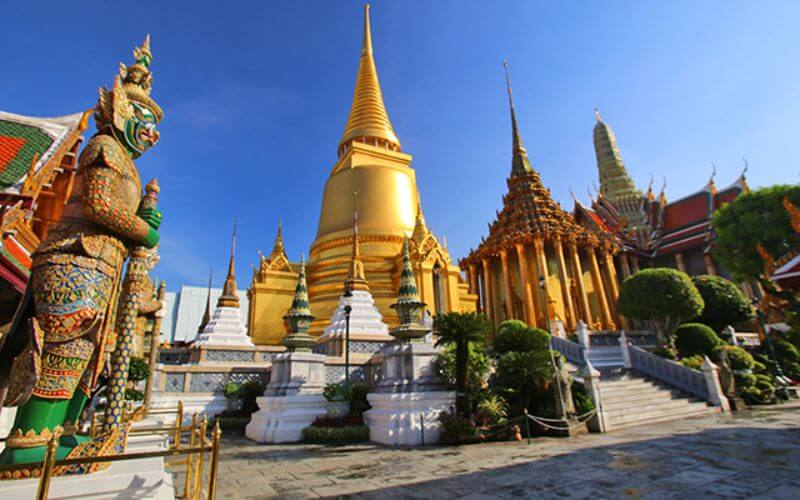
The golden splendor of Wat Phra Kaew, guarded by the towering Yaksha guardians.
This temple, located within the palace compound, houses Thailand’s most sacred Buddhist image: a seated Buddha carved from a single piece of jade (not emerald, despite the name), measuring just 66 centimeters tall. The image dates to the 14th century and was brought to Bangkok by King Rama I in 1784.
Three times a year, the Thai king traditionally changes the Buddha’s seasonal robes in a ceremony closed to the general public. The robes correspond to the three Thai seasons: hot season, rainy season, and cool season. The figurine is kept behind glass on a high gilded throne, visible from the entrance hall.
The surrounding cloister walls are painted with murals depicting the Ramakien epic, the Thai version of the Hindu Ramayana. The full mural runs 178 panels around the entire inner gallery. Most visitors walk a section of it, though seeing the complete sequence takes considerable time.
What strikes many visitors is not the size of the Emerald Buddha itself, which is surprisingly small for its fame, but the atmosphere of the hall. Visitors are asked to sit quietly and not turn their backs to the image when leaving. The reverence in the room is genuine and worth matching with your own demeanor.
2. The Outer Court and Grand Palace Buildings
Beyond Wat Phra Kaew, the outer court contains several throne halls and administrative buildings that were central to the running of the Thai royal court.
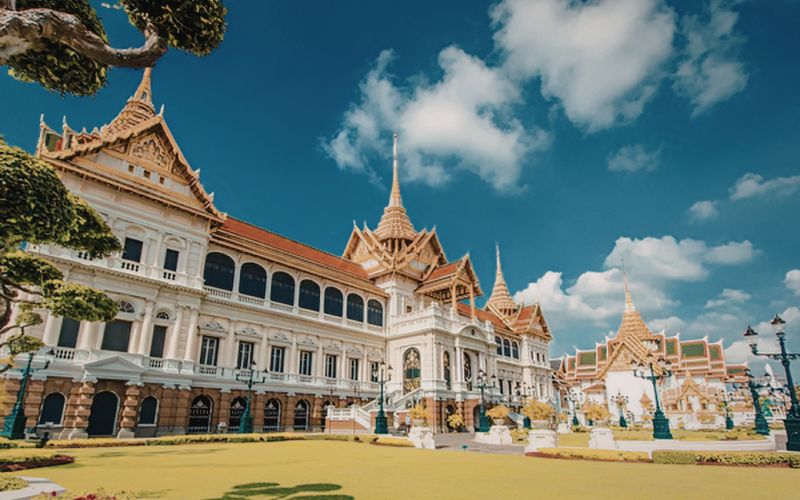
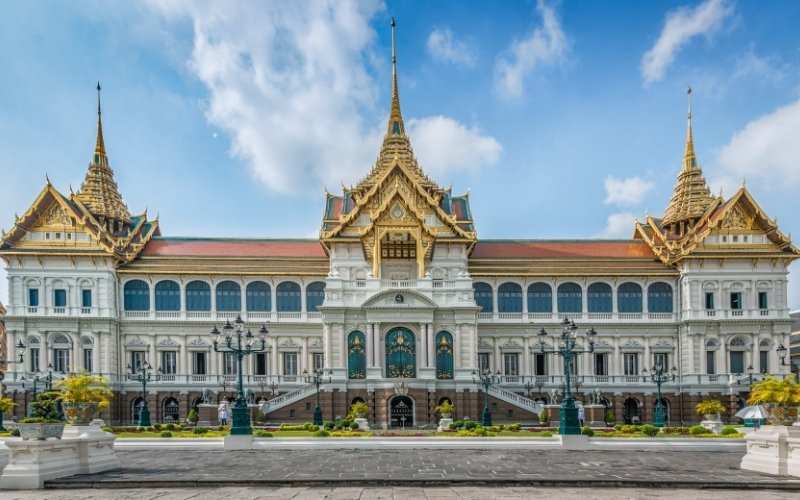
The magnificent blend of European and Thai architecture at the Chakri Maha Prasat Throne Hall in the Grand Palace, Bangkok.
Chakri Maha Prasat Throne Hall is the most photographed of these buildings. Built during the reign of Rama V in 1882, it combines a European-style Renaissance facade with traditional Thai peaked spires on the roof. The hybrid look was controversial at the time; critics nicknamed it “a Thai dancer wearing a Western suit.” The ground floor is open to visitors, displaying regalia and royal portraits. The upper floors and the hall’s interior rooms are used for state functions.
Dusit Maha Prasat Throne Hall is an older, more purely Thai structure built by Rama I. The four-tiered roof with its nine-spired tower is regarded as one of the best examples of Rattanakosin-era Thai architectural style. This hall has historically been used to lie in state for members of the royal family. The interior contains a mother-of-pearl throne.
Aphorn Phimok Prasat (Disrobing Pavilion) is a smaller structure near the Dusit Hall that the king would use to dismount from his palanquin and change robes before entering the main throne room. It is finely decorated and often less crowded than the main buildings.
Amarin Winichai Throne Hall houses the Busabok Mala throne under a nine-tiered white canopy, used during audiences with the king. The hall is one of the oldest in the compound and retains much of its original interior.
3. The Outer Decoration and Architecture
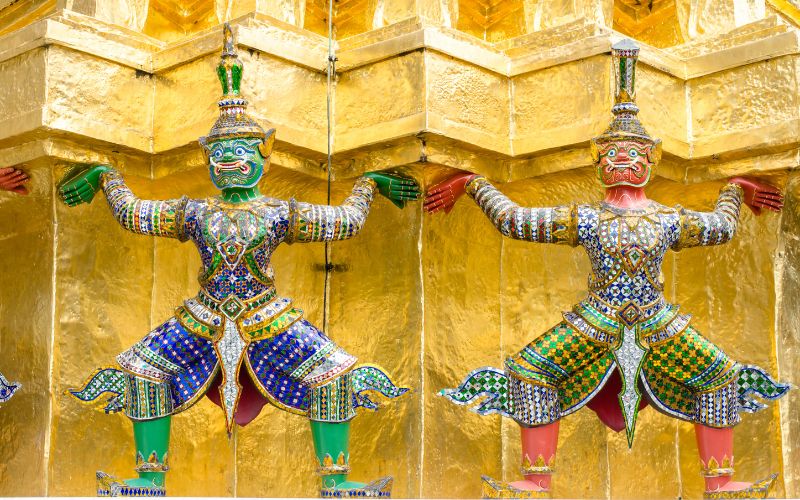
Imposing Yaksa guardians stand watch, protecting the sacred grounds of Wat Phra Kaew.
Even walking between buildings, there is no shortage to look at. Giant Yaksha demon guardian statues stand at the gates between different sections of the compound. These figures, often painted in gold, red, and green, represent characters from the Ramakien. There are twelve in total around the temple complex.
The rooflines throughout the compound feature chofa (sky tassels), decorative finials that curl skyward at the ends of each gable. The exact origin and symbolism of the chofa is debated among Thai art historians, but they are one of the most distinctive elements of Thai temple architecture.
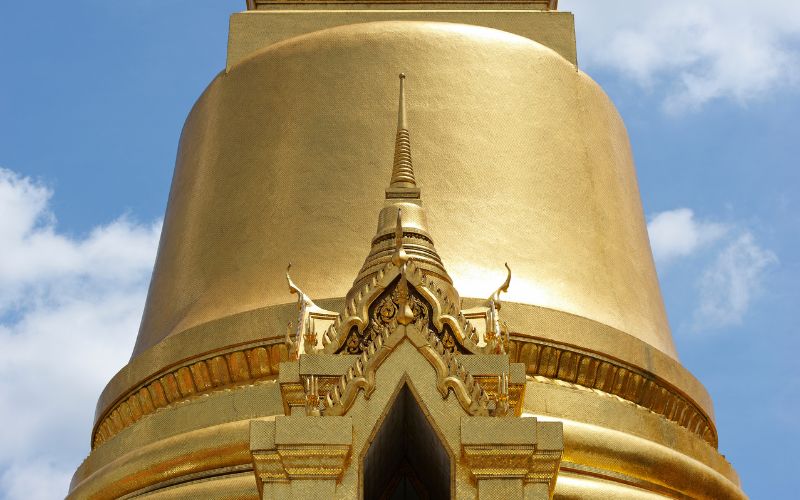
The monumental scale of the gold-tiled Phra Siratana Chedi.
The Phra Sri Rattana Chedi, a large golden stupa in the Wat Phra Kaew compound, contains a piece of the Buddha’s breastbone according to Thai Buddhist belief. It was modeled on the Phra Pathom Chedi in Nakhon Pathom and was built during the reign of Rama IV.
Grand Palace Bangkok Tour Options
Many visitors choose to explore the palace with a guide, and there are a few formats available.
- The official guided tours run several times a day and depart from a meeting point near the ticket office. These are included in the entry fee on select days. Check at the information desk when you arrive.
- Private guided tours through tour operators give you more flexibility in pacing and depth of coverage. A good guide will explain the iconography of the murals, the significance of the ritual spaces, and the architectural differences between buildings of different reigns. Without that context, some sections of the compound can feel decorative but opaque.
- Self-guided visits work well if you rent the audio guide at the entrance (200 THB / ~$5.90). It covers the main areas systematically and gives enough historical context to make sense of what you are seeing.
>>> Contact us now if you’re interesting with one of these options!
If you want to combine the Grand Palace Bangkok visit with nearby sites like Wat Pho or a boat trip to Wat Arun, a half-day organized Bangkok tour typically covers all three in a logical sequence, which saves the confusion of navigating between them independently.
Travelers who are planning a broader trip to Thailand might find it useful to look at IDC Travel’s Thailand Tours or Thailand Classic Tours, which often include the Grand Palace as part of a Bangkok day itinerary alongside other city highlights.
What to Combine With Your Visit
The Rattanakosin Island area is dense with historical sites, and a half-day here can reasonably cover several of them.
Wat Pho is about a 10-minute walk south of the Grand Palace exit. It contains the famous Reclining Buddha, which is 46 meters long and covered in gold leaf. Wat Pho also houses one of Thailand’s oldest massage schools, and a traditional Thai massage on site after a morning of walking is a reasonable option. Entry is 200 THB (~$5.90).
Wat Arun is across the river. A short ferry (4 THB / ~$0.12 one way) runs from Tha Tien Pier, just below Wat Pho. The temple’s central Khmer-style prang is decorated with colorful porcelain fragments and is particularly worth seeing in the afternoon light. Entry is 100 THB (~$2.95).
The National Museum Bangkok is a short walk north from the palace entrance. It has one of the most comprehensive collections of Thai art and artifacts in the country and provides useful context for everything you saw at the Grand Palace. Entry is 200 THB (~$5.90).
For travelers arriving in Bangkok for the first time, the Bangkok Travel Guide on IDC Travel covers the broader city layout, transport options, and how to structure time across different neighborhoods.
Practical Tips Before You Go
A few things that regularly catch first-time visitors off guard:
- Photography inside Wat Phra Kaew: Permitted inside the gallery and around the exterior, but check signs before pointing a camera at the Emerald Buddha. Rules about photographing the image directly have changed at various points.
- Bag size restrictions: Large backpacks and bags over a certain size must be deposited in the cloakroom near the entrance. There is no fee for this.
- Water and food: Not available inside the compound. Drink water before entering and carry a small bottle. Food stalls are plentiful just outside the main gate.
- Currency: The ticket counters accept cash in Thai Baht only. There is an ATM near the entrance area.
- Time needed: Budget at least 2 hours for a basic visit. Three hours if you want to take the Wat Phra Kaew murals seriously and explore all the open throne halls.
Conclusion: Key Information at a Glance
Planning a Grand Palace Bangkok visit is straightforward once you know the basics. Here is a quick reference table:
| Category | Details |
| Official name (Thai) | Phra Borom Maha Ratcha Wang (พระบรมมหาราชวัง) |
| Also known as | Bangkok Kings Palace, Thai Palace Bangkok, King Palace Bangkok, Royal Grand Palace |
| Location | Na Phra Lan Rd, Phra Nakhon, Bangkok 10200 |
| Website | https://www.royalgrandpalace.th/en/home |
| ticket@palaces.mail.go.th | |
| Tel. | +66-2-623-5500 |
| Nearest pier | Tha Chang Pier (Chao Phraya Express Boat, N9) |
| Opening hours | 8:30 AM to 3:30 PM |
| Admission | 500 THB (~$14.70); children under 12 free |
| Audio guide | 200 THB (~$5.90) |
| Time needed | 2 to 3 hours |
| Best months | November to February |
| Dress code | Shoulders and knees must be covered |
| Compound size | 218,400 square meters |
The Grand Palace is not the kind of place you understand from a single quick walk-through. It rewards attention. The murals alone took years to paint, and the architectural details across different reign periods tell a coherent story of how Thai royal culture absorbed and adapted outside influences while maintaining its own traditions. Whether you go with a private guide, join a Bangkok Grand Palace tour, or rent the audio guide and walk it yourself, come with enough time to actually look at things.
For travelers planning a wider itinerary across Thailand, IDC Travel offers tailor-made travel packages that include Bangkok alongside Chiang Mai, Phuket, and other destinations. If you are combining multiple countries, the Vietnam and Thailand tour options are worth reviewing as well.
Read more:
I visited the Grand Palace last year, and it was an unforgettable experience. The place is so rich in history and culture. Just make sure to dress modestly because they are very strict about the dress code. If you forget, there are sarongs for rent near the entrance.
Dear Alice,
Thank you for sharing your experience! We’re so glad you had an unforgettable visit to the Grand Palace. You’re absolutely right about the dress code because dressing modestly is essential to respect the cultural and religious significance of this iconic site. It’s great to know the sarong rental service is helpful for visitors who may not be aware of the requirements.
If you’re planning another trip to Bangkok, we’d be happy to assist you with a tailored tour that includes the Grand Palace and other nearby cultural gems. Let us know how we can make your next visit even more memorable!
Best regards,
IDC Travel Team.