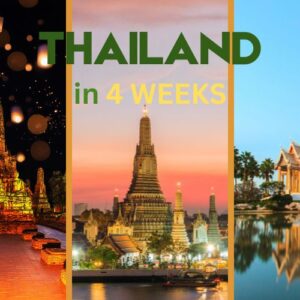
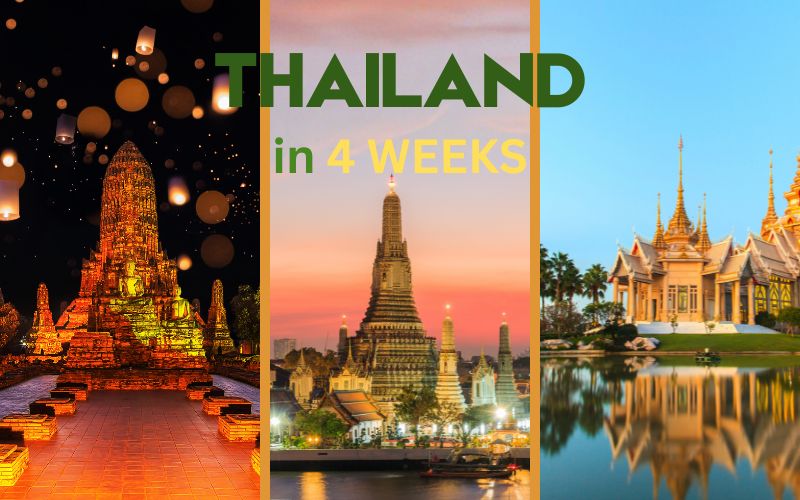
Thailand is one of Southeast Asia’s most compelling destinations thanks to its balance of cultural depth, natural diversity and accessible travel infrastructure. From ancient temples and mountainous landscapes in the north to vibrant cities and world-class beaches in the south, the country delivers a wide range of experiences that fit comfortably into a four-week journey. A month in Thailand is ideal for travelers who want to understand the country beyond the highlights, enjoy a slower pace, and combine culture, food, nature and island life in a single itinerary.
A Thailand itinerary of 4 weeks suits many types of travelers, including families seeking a safe and flexible route, couples looking for a well-rounded adventure, solo travelers who value ease of movement, and groups of friends wanting variety without rushing. This guide brings together essential insights on weather, destinations and logistics to help you structure a smooth and rewarding month-long experience. Let’s explore this complete Thailand 4-week itinerary together with IDC Travel.
When Is the Best Time to Spend 4 Weeks in Thailand?
Choosing the right time for a four-week Thailand getaway depends on the experience you prefer, but most travelers find November to March the most comfortable. This is the cool and dry season across much of the country, ideal for city visits, trekking and island hopping. That said, a full month in Thailand is doable year-round as long as you understand the regional weather differences.
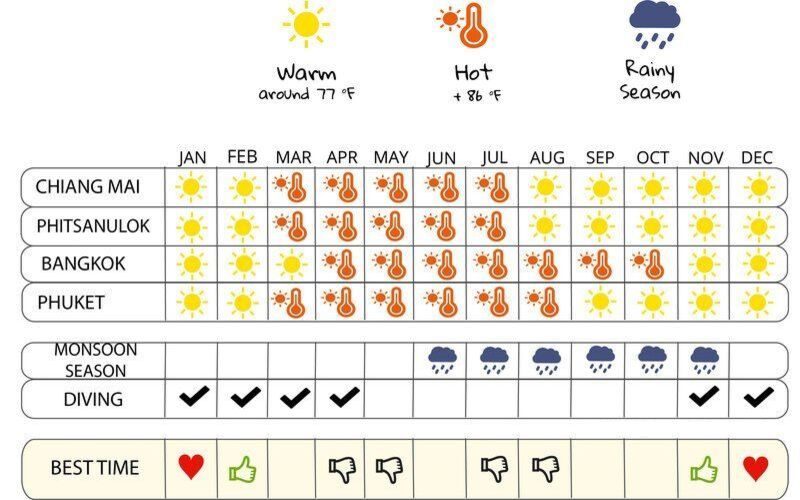
Regional weather and tourist affluence in Thailand
Travel Seasons in Thailand
- High season (Nov-Mar): dry weather, mild temperatures and clear skies. Best overall conditions for beaches, cultural sites and outdoor activities.
- Shoulder season (Apr-May, Sep-Oct): reasonable weather, fewer crowds, better prices. Some short rain showers can appear, especially in the late afternoon.
- Low season (Jun-Oct): more frequent rainfall and rougher seas on certain coasts. However, landscapes are lush, crowds are minimal and long-stay travelers benefit from lower rates.
With four weeks, you can adapt your route to weather patterns instead of avoiding Thailand entirely during certain months.
>>> You can find more information in here.
Suggested Itinerary for 4 Weeks in Thailand
Spending four weeks in Thailand allows travelers to move beyond “ticking off” highlights and experience the country at a realistic, enjoyable pace. Instead of rushing between destinations, both itineraries below follow Thailand’s geography, balancing culture, nature, and downtime.
To suit different travel styles, we recommend two distinct 4-week routes:
- Classic Tour: best for first-time visitors who want a complete overview
- Extended Tour: best for travelers who want more destinations and deeper regional coverage
Both itineraries are designed as operable, real-world tours, not theoretical wish lists.
Classic tour
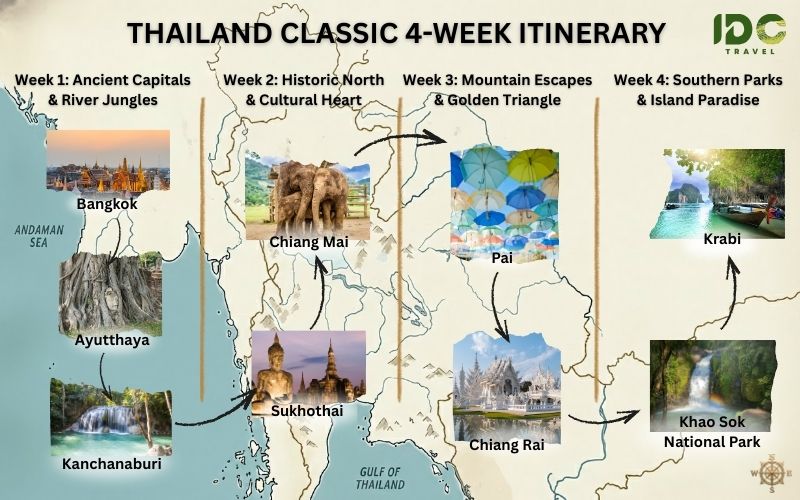
Thailand itinerary designed for first-time travelers seeking a balanced journey through culture, history, nature, and beaches.
Week 1: Ancient Capitals & River Jungles
Main stops: Bangkok – Ayutthaya – Kanchanaburi
1. Bangkok (4 days)
Start your journey in Bangkok, where Thailand’s modern life and traditional culture meet. Spend a few days exploring major temples, riverside neighborhoods, and the city’s famous street-food scene. Bangkok is more than a stopover; it deserves time. Four nights allow travelers to recover from jet lag and experience different sides of the city.
Recommended experiences:
- Visiting Grand Palace & Wat Phra Kaew
- Experience Wat Pho (Reclining Buddha) and traditional Thai massage
- Watching Wat Arun at sunset, crossing the Chao Phraya by local ferry
- Walking around in street food in Chinatown (Yaowarat)
- Spending half-day on Chao Phraya river cruise to see local life along the canals
Tip: staying near the river or Old Town reduces traffic stress and keeps most sights within easy reach.
2. Ayutthaya (1 day)
Once you’re familiar with the rhythm of the country, head north for a day trip or overnight stay in Ayutthaya to discover the ruins of Thailand’s former royal capital.
Highlights:
- Wat Mahathat (Buddha head in tree roots)
- Wat Chaiwatthanaram at sunset
- Optional boat ride around the island city
Why overnight? Staying one night allows visitors to explore temples early morning or late afternoon, when day-trippers are gone.
3. Kanchanaburi (2 days)
From there, continue west to Kanchanaburi, a quieter region known for jungle landscapes, waterfalls, and historical sites linked to World War II. This gradual transition from city to nature helps travelers adjust to Thailand without feeling overwhelmed in the first days.
Highlights:
- Bridge over the River Kwai & WWII railway history
- Erawan Waterfalls (7-tiered jungle waterfalls)
- Riverside accommodation for a slower pace
Week 2: Historic North & Cultural Heart
Main stops: Sukhothai – Chiang Mai
4. Sukhothai (2 days)
Week two focuses on Thailand’s cultural roots. Sukhothai, the birthplace of the Thai kingdom, offers a calm and scenic contrast to Bangkok, with temple ruins spread across a green historical park best explored by bicycle.
Recommended experiences:
- Cycling through Sukhothai Historical Park
- Sunrise or sunset among temple ruins
- Visit local villages around the old city
Compared to Ayutthaya, Sukhothai is quieter and more contemplative—ideal for travelers interested in Thai history rather than crowds.
5. Chiang Mai (5 days)
Continue north to Chiang Mai, the cultural heart of northern Thailand. Here, you’ll find mountain scenery, centuries-old temples, local markets, and opportunities to experience ethical elephant sanctuaries or Thai cooking classes. The slower pace makes Chiang Mai ideal for longer stays.
Recommended experiences:
- Old City temples & Doi Suthep viewpoint
- Ethical elephant sanctuary (no riding, no performances)
- Thai cooking class in the countryside
- Night markets and café culture
Five nights allow at least one free day, which many travelers appreciate after several location changes.
Week 3: Mountain Escapes & Golden Triangle
Main stops: Pai – Chiang Rai
6. Pai (3 days)
This week is about landscapes and local diversity. Pai offers a peaceful mountain setting with hot springs, canyons, and a laid-back atmosphere that appeals to slow travelers.
Highlights:
- Pai Canyon at sunset
- Hot springs and bamboo bridges
- Relaxed evenings at the night market
7. Chiang Rai (4 days)
From there, head to Chiang Rai near the borders of Laos and Myanmar, where contemporary temples like the White Temple sit alongside traditional villages and Mekong River viewpoints. Traveling here feels more rural and less touristy, giving a deeper look at life in northern Thailand beyond the main cities.
Recommended experiences:
- White Temple (Wat Rong Khun) & Blue Temple
- Golden Triangle viewpoint (Thailand-Laos-Myanmar)
- Mekong River landscapes and hill-tribe areas
Distances are longer, and sights are spread out, extra nights prevent rushed days.
Week 4: Southern Parks & Island Paradise
Main stops: Khao Sok National Park – Krabi
8. Khao Sok National Park (3 days)
Finish your four-week journey in the south. Khao Sok National Park offers a completely different environment, with dense rainforest, limestone cliffs, and tranquil lakes. Spending a few nights here provides a unique nature experience before heading to the coast.
Highlights:
- Cheow Lan Lake & floating bungalows
- Jungle trekking and wildlife spotting
- Early-morning lake mist experiences
Many tours only spend 1 night here; 2-3 nights offer a far more immersive experience.
9. Krabi (4 days)
End the trip in Krabi, where dramatic limestone formations meet calm beaches and nearby islands. It’s an ideal place to relax after weeks of travel, with options ranging from light adventure to pure beach time.
Recommended experiences:
- Railay Beach & limestone cliffs
- Island hopping (Chicken, Poda, Tup Islands)
- Emerald Pool & hot springs
>>> You might find the following tours interesting:
- 12 Days Thailand: Ultimate Thailand Tour For 2 Weeks
- Heritages of Vietnam, Laos and Thailand in 15 days
- Explore Highlights of Thailand in 19 Days Tour
Extended tour
This extended 4-week Thailand itinerary is designed for travelers who want to see more regions and experience deeper local contrasts. Compared to the Classic tour, this route adds lesser-visited destinations in Central and Northern Thailand, offering richer cultural context while still ending in Krabi for a relaxed coastal finish and convenient international departure.
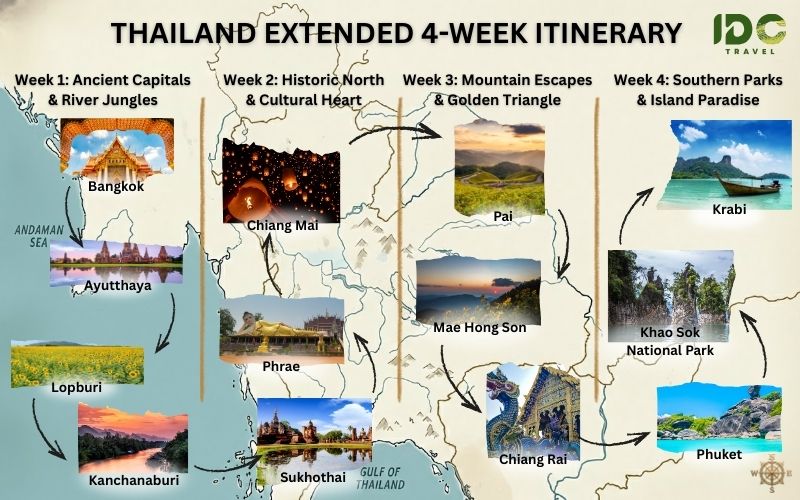
Thailand itinerary created for experienced travelers who want deeper regional exploration and a varied north-to-south journey.
Week 1: Bangkok & Central Thailand
Main stops: Bangkok – Ayutthaya – Lopburi – Kanchanaburi
1. Bangkok (3 days)
Begin your journey in Bangkok, Thailand’s dynamic capital where royal heritage, daily life, and modern culture intersect. Three days provide a solid introduction without overwhelming first-time visitors.
Recommended experiences:
- Visiting the Grand Palace & Wat Phra Kaew
- Exploring Wat Pho (Reclining Buddha) and enjoying a traditional Thai massage
- Watching sunset at Wat Arun, crossing the Chao Phraya by local ferry
- Joining a Chinatown (Yaowarat) street food tour
Taking a canal or short river boat ride to observe local life
Tip: Choose accommodation near the Old Town or riverside to reduce travel time and traffic fatigue.
2. Ayutthaya (1 day)
Continue north to Ayutthaya, Thailand’s former royal capital and a UNESCO World Heritage Site.
Highlights:
- Wat Mahathat (Buddha head entwined in tree roots)
- Wat Chaiwatthanaram at sunset
- Optional short boat ride around the island city
A full day is sufficient when combined with early departure from Bangkok.
3. Lopburi (1 day)
Stop in Lopburi, a lesser-visited historical town known for its Khmer-era architecture and relaxed provincial atmosphere.
Highlights:
- Phra Prang Sam Yot and other Khmer-influenced temples
- Walking through the old town and local markets
This stop adds historical variety between Ayutthaya and Kanchanaburi.
4. Kanchanaburi (2 days)
Travel west to Kanchanaburi, where history and nature meet.
Highlights:
- Bridge over the River Kwai and WWII railway history
- Erawan Waterfalls, one of Thailand’s most beautiful waterfall systems
- Overnight stay at a riverside or jungle lodge
This slower-paced region provides a natural break from city travel.
Week 2: Ancient Thailand & Living Northern Culture
Main stops: Sukhothai – Phrae – Chiang Mai
5. Sukhothai (2 days)
Sukhothai marks the birthplace of the Thai kingdom and offers a calm, open setting ideal for cultural exploration.
Recommended experiences:
- Cycling through Sukhothai Historical Park
- Sunrise or sunset among temple ruins
- Visiting villages around the old city
Compared to Ayutthaya, Sukhothai feels more spacious and contemplative.
6. Phrae (2 days)
Phrae is a quiet northern town rarely included in standard itineraries, making it ideal for travelers seeking everyday Thai life.
Highlights:
- Traditional teakwood houses
- Peaceful streets and local cafés
Insight into northern Thai culture away from mass tourism
7. Chiang Mai (3 days)
Continue to Chiang Mai, the cultural center of Northern Thailand.
Recommended experiences:
- Old City temples and Doi Suthep viewpoint
- Visiting an ethical elephant sanctuary (no riding)
- Participating in a Thai cooking class
Three days provide a focused introduction, balancing culture and nature.
Week 3: Northern Highlands & Border Regions
Main stops: Pai – Mae Hong Son – Chiang Rai
8. Pai (2 days)
Pai offers a relaxed mountain atmosphere ideal for slowing down.
Highlights:
- Pai Canyon at sunset
- Natural hot springs
- Casual evenings at the night market
9. Mae Hong Son (2 days)
Travel deeper into the mountains to Mae Hong Son, a remote provincial town near the Myanmar border.
Highlights:
- Scenic mountain roads and viewpoints
- Visits to ethnic villages
- Quiet lakes and temples reflecting local life
This stop adds geographic and cultural depth to the northern loop.
10. Chiang Rai (3 days)
End the northern journey in Chiang Rai, a region shaped by border cultures.
Recommended experiences:
- White Temple (Wat Rong Khun) and Blue Temple
- Golden Triangle viewpoint (Thailand – Laos – Myanmar)
- Mekong River landscapes and rural surroundings
Extra nights help manage longer travel distances comfortably.
Week 4: Southern Thailand
Main stops: Phuket – Khao Sok National Park – Krabi
11. Phuket (2 days)
Begin the southern section in Phuket for a mix of culture and coastal scenery.
Highlights:
- Exploring Phuket Old Town
- Short island or bay excursions nearby
12. Khao Sok National Park (2 days)
Transition from coast to rainforest in one of Thailand’s most diverse natural areas.
Highlights:
- Cheow Lan Lake and floating bungalows
- Light jungle trekking
- Morning mist and wildlife observation
13. Krabi (4 days)
End the journey in Krabi, a relaxed coastal destination ideal for unwinding after an active itinerary.
Recommended experiences:
- Railay Beach and limestone cliffs
- Island hopping (Chicken, Poda, Tup Islands)
- Emerald Pool and hot springs
Krabi’s location makes it a practical and scenic final stop for international departures.
>>> The following tours might please you:
- Best of Thailand: 10 Days Itinerary
- Thailand highlights tour in 12 Days
- Thailand 14 Days Tour: Best Thailand 2-week Itinerary
Is these itineraries flexible?
Yes. Travelers who prefer beaches earlier can reverse the route, while others may shorten or extend certain regions. The strength of this itinerary lies in its geographical logic and balanced pacing, making it easy to adapt without losing coherence. This Thailand 4 weeks itinerary is ideal for travelers who want depth, variety, and a realistic travel rhythm without feeling rushed from one highlight to the next.
What Can You Do in Thailand in 4 Weeks?
Spending a month in Thailand opens up far more possibilities than a short holiday. Instead of choosing between culture, nature, or beaches, travelers can experience all of them at a comfortable pace, with time to slow down, learn, and truly connect with the country. Below are the key experiences you can realistically enjoy during a 4-week stay based on our experience.
1. Immerse Yourself in Thai Culture & History
Four weeks allow travelers to explore Thailand’s cultural layers without rushing from one landmark to another.
- Visit Thailand’s former capitals such as Ayutthaya and Sukhothai, understanding how Thai architecture, religion, and royal power evolved over centuries.
- Explore temples in both major cities and small towns, from Bangkok’s royal complexes to quiet provincial shrines in the north.
- Learn the meaning behind Buddhist rituals, not just see the buildings.
- History-heavy destinations feel more meaningful when spaced out, giving travelers time to absorb rather than overload.
2. Experience Thailand Through Food
Thailand’s cuisine is diverse, regional, and deeply connected to daily life.
- Join a street food tour in Bangkok, where dishes change by neighborhood and time of day.
- Take a Thai cooking class in Chiang Mai, often combined with market visits and farm ingredients.
- Taste regional differences, from central Thai flavors to milder northern dishes and seafood-rich southern cuisine.
- With time, travelers move beyond “famous dishes” and start recognizing flavors, ingredients, and cooking styles.
3. Slow Down in Northern Thailand’s Mountains
Northern Thailand rewards travelers who don’t rush.
- Spend time in mountain towns like Pai or rural areas near Chiang Rai.
- Walk through local villages, meet ethnic communities, and observe daily routines.
- Enjoy cooler weather, scenic roads, and quiet evenings that contrast strongly with Bangkok.
- Short trips rarely allow for meaningful mountain time, longer stays make these regions a highlight rather than a side trip.
4. Connect with Nature Beyond the Beaches
Thailand’s natural landscapes go far beyond islands and resorts.
- Explore rainforest ecosystems in Khao Sok National Park, with lake cruises, jungle walks, and overnight stays in nature.
- Swim in waterfalls, walk through limestone valleys, and experience early-morning mist in protected areas.
- Nature experiences often require overnight stays and flexible pacing, which shorter itineraries usually can’t afford.
5. Enjoy Thailand’s Coastline Without Rushing
A long itinerary allows beach time without sacrificing inland destinations.
- Relax on the Andaman Coast around Krabi, mixing beach days with island hopping and light adventure.
- Balance active days (snorkeling, boat trips) with rest days on quieter beaches.
- Instead of squeezing beaches into the final days, travelers can properly unwind after weeks of exploration.
6. Experience Daily Life, Not Just Attractions
One of the biggest advantages of a four-week stay is time for unplanned moments.
- Sit in cafés, explore local markets, and observe daily routines.
- Take rest days between long travel segments.
- Adjust plans based on weather, energy, or personal interests.
- Thailand reveals itself most clearly in everyday moments, something rushed itineraries rarely capture.
With a month in Thailand, you can feel like a checklist and starts feeling like a journey. Travelers gain context, understand regional differences, and return home with a deeper appreciation of the country’s culture, landscapes, and people. This is why a Thailand 4 weeks itinerary is often recommended for travelers seeking depth, balance, and authenticity, rather than just highlights.
Safety and Cultural Awareness Tips
Thailand is generally safe for international travelers, but understanding local customs enhances both safety and cultural respect.
- Dress Code for Temples: visitors should dress modestly when entering temples. Shoulders and knees must be covered, and shoes removed before entering temple buildings. Lightweight scarves or long pants are useful for spontaneous visits.
- Common Tourist Scams: typical scams include gem scams, jet ski damage claims, and unofficial tour operators. Using licensed services, avoiding unsolicited offers, and confirming prices in advance help minimize risks.
- Transportation and Taxis: metered taxis should always use the meter, particularly in Bangkok. Ride-hailing apps are reliable alternatives. Tuk-tuks can be fun but should be negotiated clearly before the ride begins.
- Full Moon Party Considerations: for travelers attending the Full Moon Party on Koh Phangan, personal safety is important. Avoid carrying valuables, watch drinks closely, and arrange transport in advance. Wearing footwear is strongly advised due to broken glass on the beach.
- Cultural Etiquette: respect for the monarchy, polite behavior, and avoiding physical contact with monks are essential cultural norms. A calm and respectful attitude is highly valued in Thai society.
A 4-week Thailand tour is the ideal way to experience the country in depth, allowing enough time to explore vibrant cities, historical landmarks, mountain regions, and tropical islands without rushing. This guide has outlined a practical itinerary, transportation options, regional cuisine, safety tips, seasonal weather insights, and essential preparation advice to help travelers plan a smooth and rewarding long-term journey. If you are considering a trip to Thailand and want a well-organized, personalized experience, contact us for expert support and tailored travel solutions designed for international travelers.
Read more