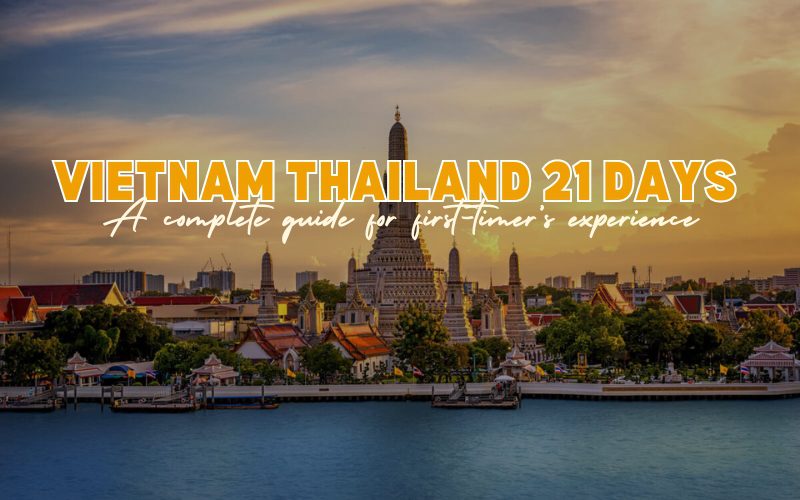
A well planned 21 days in Vietnam and Thailand can give you a rich, balanced trip without feeling rushed. In three weeks, you can combine major cities, cultural landmarks, nature, food, and beach time in a way that feels rewarding rather than exhausting. The key is not trying to see everything, but choosing a route that matches the seasons, your budget, and your travel style.
This guide is designed for international travelers who want clear and practical advice before visiting Vietnam and Thailand. It covers when to go, how to prepare, what budget to expect, and which itinerary styles work best for a three week trip. Instead of giving a generic plan, this guide helps you make realistic decisions based on weather patterns, travel distances, and the kind of experience you want most.
When Is the Best Time to Visit Vietnam And Thailand in 21 Days?
- 19 Days in Vietnam and Thailand: A Tale of Splendid Discovery
- A Trip of Cultural Marvels and Natural Beauty to Southeast Asia 20 Days
- Vietnam Thailand 21 Days Authentic Experience
- 21 Days Vietnam – Thailand: From the City to the Mountain
- Explore the Majestic Beauty of Vietnam – Cambodia – Thailand in 21 Days
For most travelers, the best time for 21 days in Vietnam and Thailand is from November to early April, when many major destinations in both countries have more comfortable conditions for sightseeing. However, there is no single perfect month for every route because Vietnam has strong regional weather differences, while Thailand’s climate also changes by season and by coast. The smartest approach is to match your itinerary to the weather in each area rather than rely on one broad seasonal rule. Official tourism sources in both countries also note these regional differences clearly.
Vietnam Weather
Vietnam does not have one uniform travel season from north to south. Weather conditions vary significantly by region, so the best time depends on which parts of the country you want to include.
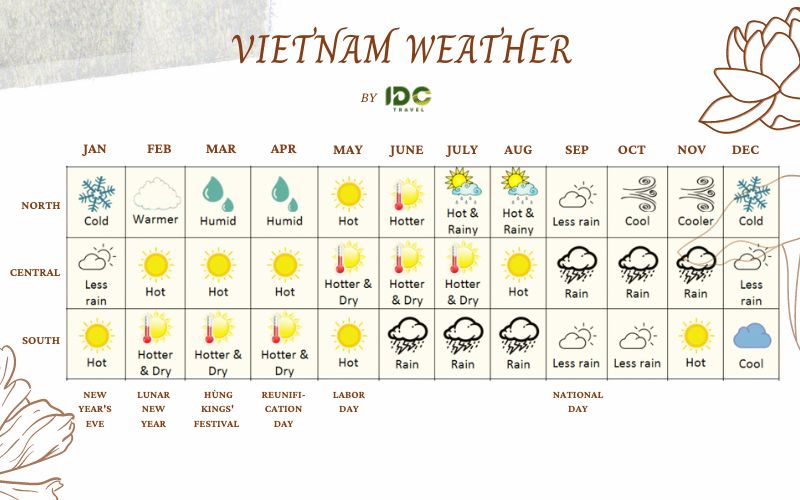
Vietnam weather by region throughout the year.
In northern Vietnam, places such as Hanoi, Ha Long Bay, and Sapa are usually most comfortable in spring and autumn. Official Vietnam tourism guidance generally highlights April to June and September to December as especially good periods for Hanoi, while broader national guidance also points to regional variation rather than one fixed nationwide season.
In central Vietnam, destinations such as Hue, Da Nang, and Hoi An often have their better beach and sightseeing months earlier in the year, while the later months can be wetter and more storm affected. This matters a lot when building a 21 day route, because central Vietnam may not match the same “best season” as the north at every time of year.
In southern Vietnam, including Ho Chi Minh City and the Mekong Delta, the dry season usually runs from about November to April, which is often the easiest period for city visits, river excursions, and general travel comfort.
For many first time visitors planning to see several parts of Vietnam in one trip, March to April and October to early December are often the most practical windows because they can offer a better balance across the country.
Even so, local conditions can shift from year to year, especially during storm and flood periods in central Vietnam. Recent severe weather events are a reminder that seasonal timing should always be checked closer to departure.
Note: Weather patterns, especially in central Vietnam, can change because of storms, flooding, and local seasonal variation. If your trip includes beach time, cruises, or mountain travel, it is best to confirm current conditions before booking. Please contact us for the most accurate advice for your exact travel dates.
Thailand Weather
Thailand is easier to understand at a national level, but it still has important regional differences. According to the Tourism Authority of Thailand, the country generally has three main seasons: a rainy season, a cooler dry season, and a hotter season. In broad terms, November to February is the most popular period because temperatures are more comfortable in many destinations.
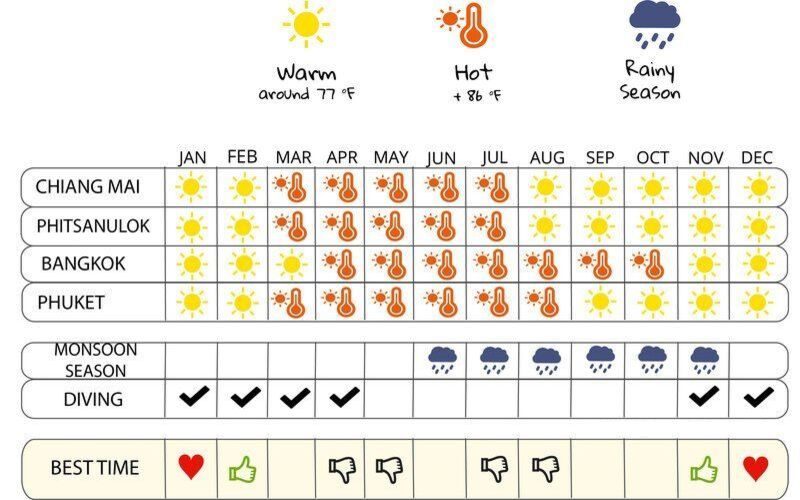
Thailand weather and best travel months.
For Bangkok and much of central Thailand, the cooler months are usually the most comfortable for sightseeing. This is also a strong time for visiting Chiang Mai and other northern destinations, where the weather is often more pleasant for city exploration, countryside trips, and mountain scenery.
For southern Thailand, travelers should pay attention to which coast they plan to visit. Beach conditions are not identical throughout the year, and rainfall patterns can differ between the Andaman side and the Gulf side. This is important when adding places such as Phuket, Krabi, Khao Lak, or Koh Samui to a Vietnam and Thailand itinerary.
Overall, if you want one practical answer for both countries in a single multi destination trip, November to early April remains the safest planning window for most classic routes. It is not the cheapest season, but it is often the easiest for combining cities, cultural sites, cruises, and beaches with fewer weather related disruptions.
Suggested Itineraries for 3 Weeks in Vietnam and Thailand
Itinerary 1: Discover Vietnam and Thailand from the City to the Mountain
Day 1: Arrive in Hanoi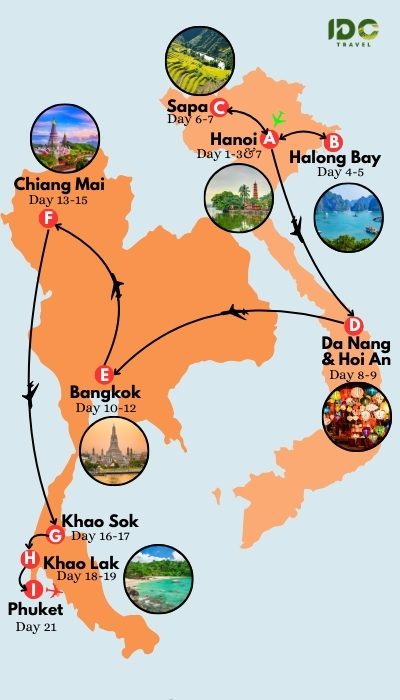
Day 2: Hanoi city tour
Day 3: Visit Bat Trang Pottery Village & Hanoi night street food tour
Day 4: Transfer to Ha Long Bay & embark on an overnight cruise to discover this UNESCO World Heritage Site of Vietnam
Day 5: Return to Hanoi & Overnight train to Lao Cai
Day 6: Drive to Sapa & visit hill tribe villages
Day 7: Climb Mount Fansipan & Overnight train to Hanoi
Day 8: Fly to Da Nang, Visit Ba Na Hills & the Golden Bridge
Day 9: Day tour to Hoi An Ancient Town
Day 10: Fly to Bangkok
Day 11: Bangkok city tour
Day 12: Day tour to Ayutthaya Historical Park
Day 13: Fly to Chiang Mai & Join an evening food tour
Day 14: Day trip to Doi Inthanon National Park
Day 15: Day tour to Lamphun
Day 16: Fly to Surat Thani & Travel to Khao Sok National Park
Day 17: River rafting at Khao Sok National Park
Day 18: Transfer to Khao Lak
Day 19: Discover Similan Islands
Day 20: Kayak in the mangrove forest of Khao Lak
Day 21: Transfer to Phuket & Departure.
>>> Check 21 Days Vietnam Thailand for the detailed itinerary of this tour.
Itinerary 2: Authentic Vietnam and Thailand in 3 Weeks
Day 1: Arrive in Ho Chi Minh City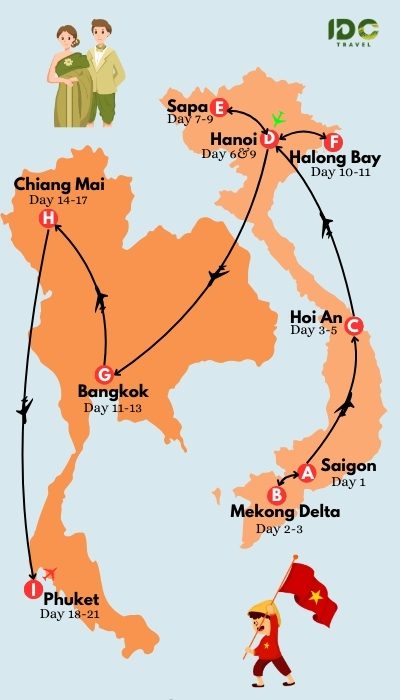
Day 2: Ho Chi Minh City – Mekong Delta
Day 3: Visit a floating market, return to Ho Chi Minh City, fly to Da Nang & travel to Hoi An Ancient Town
Day 4: Hoi An city tour
Day 5: Visit Tra Que Herbal Village & join a cooking class
Day 6: Transfer to Da Nang, fly to Hanoi & embark on a half-day city tour
Day 7: Drive to Sapa & Visit Ta Giang Phinh Village
Day 8: Trekking in Sapa
Day 9: Discover the Heaven’s Gate & Return to Hanoi
Day 10: Hanoi – Ha Long Bay, embark on an overnight cruise
Day 11: Return to Hanoi & Fly to Bangkok
Day 12: Bangkok city tour
Day 13: Visit Damnoen Saduak & Mae Klong markets
Day 14: Fly to Chiang Mai & Join a cooking class
Day 15: Chiang Mai temple tour
Day 16: Visit an elephant sanctuary in Chiang Mai
Day 17: Discover Chiang Mai’s countryside & visit hill tribe villages
Day 18: Fly to Phuket
Day 19: Day tour to Phi Phi & Khai Islands
Day 20: Free day in Phuket
Day 21: Depart Phuket.
>>> Detailed itinerary: Vietnam Thailand 21 Days Authentic Experience
Itinerary 3: Extend to Cambodia for a Rounded Experience
Day 1: Arrive in Hanoi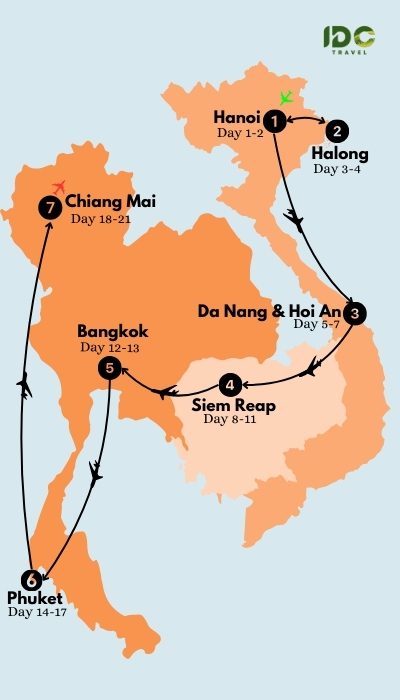
Day 2: Hanoi city tour
Day 3: Hanoi – Ha Long Bay & embark on an overnight cruise
Day 4: Return to Hanoi & fly to Da Nang
Day 5: Visit Ba Na Hills & the Golden Bridge
Day 6: Day tour to Hoi An Ancient Town & Bay Mau Coconut Forest
Day 7: Free day in Da Nang
Day 8: Fly to Siem Reap & Join a half-day Angkor tour
Day 9: Angkor temple tour
Day 10: Discover Phnom Kulen Mountains & Banteay Srei
Day 11: Explore Tonle Sap Lake & Fly to Bangkok
Day 12: Bangkok city tour
Day 13: Day tour to Ayutthaya
Day 14: Fly to Phuket & Join a half-day city tour
Day 15: Discover Koh Phi Phi by speedboat
Day 16: Discover James Bond Island
Day 17: Free day in Phuket
Day 18: Fly to Chiang Mai
Day 19: Chiang Mai city tour
Day 20: Visit a hill tribe village and the Golden Triangle
Day 21: Depart Chiang Mai.
>>> If you are interested in this itinerary, please refer to our Vietnam Cambodia Thailand 21 Days
What Is the Estimated Cost of 21 Days in Vietnam And Thailand?
For most travelers, the estimated cost of 21 days in Vietnam and Thailand depends less on the number of days and more on three things: hotel standard, flight choices, and whether you travel independently or use organized tours. As a practical rule, a careful budget trip often starts from around $1,600-2,500/person, a comfortable mid range trip usually falls around $2,800-4,800/person, and a more upscale private trip can easily start from $6,000/person and go much higher. Thailand is usually the more expensive country for resort stays and tourist area dining, while Vietnam often gives better value for hotels, food, and day to day spending.
A Breakdown of Cost
The table below gives a realistic estimate per person for a 21 day trip covering both countries. It assumes a classic route with city stays, a few domestic or regional flights, sightseeing, and normal daily spending.
| Cost category | Budget | Mid range | Luxury |
| Accommodation | $450-900 | $1,200-2,400 | $3,500-7,500+ |
| Food and drinks | $250-450 | $700-1,200 | $1,800-3,800+ |
| Flights | $300-650 | $500-1,000 | $900-2,200+ |
| Local transport | $120-250 | $250-550 | $700-1,500+ |
| Activities & entrance fees | $250-600 | $700-1,500 | $1,800-4,500+ |
| Insurance & personal spending | $150-300 | $250-500 | $500-1,200+ |
| Estimated total | $1,520-3,150 | $3,600-7,150 | $9,200-20,700+ |
These are planning ranges, not fixed package prices. They are designed to help readers estimate the right travel level before they start choosing hotels and destinations.
For many international travelers, the mid range level is the best balance. It gives enough comfort for a three-week multi-country trip without making the budget too heavy.
Note: Prices can change depending on season, flight demand, exchange rates, hotel category, baggage rules, and how early you book. Beach areas in Thailand and premium cruise dates in Vietnam can raise the total significantly. If you want an exact estimate for your travel month and preferred hotel standard, please contact us for the most accurate quotation.
Money-Saving Tip to Travel to Vietnam and Thailand in 21 Days
The best way to save money on 21 days in Vietnam and Thailand is not to cut every cost. It is to spend carefully on the parts that matter most and avoid the common mistakes that quietly raise the total, such as last minute flights, too many one night stops, resort areas in peak season, and baggage fees on low cost airlines. In most cases, travelers save more by planning the route well than by choosing the absolute cheapest hotel. A simpler itinerary, a better travel month, and early booking usually make the biggest difference.
- Book flights early and check baggage rules carefully
Flights between Vietnam and Thailand, plus domestic flights inside each country, can take a large share of your budget. Booking earlier usually gives you better base fares, but you also need to look at baggage costs before you compare prices. Vietjet clearly lists separate baggage charges, and Vietnam Airlines also publishes detailed baggage rules depending on route and fare conditions. This matters because a ticket that looks cheap at first can become much more expensive once checked baggage is added.
A practical rule is to compare the full price, not just the headline fare. For a three week trip, one checked bag may still be worth it, but only if you plan it in advance.
- Travel in the shoulder season when possible
If your dates are flexible, traveling just outside the busiest peak months can reduce hotel and flight costs while still giving you good conditions. Thailand’s official seasonal guidance continues to show that the cooler months are the most popular, which is one reason prices often rise from late November through February. For many travelers, late October, early November, late February, or March can offer a better balance of weather and cost than the absolute peak holiday window. This is especially useful if your route includes Bangkok, Chiang Mai, Phuket, or other high demand places.
- Keep your route simple instead of trying to do too much
One of the most expensive mistakes is overbuilding the itinerary. Every extra stop can mean another flight, another transfer, another hotel check in, and another day where you spend more than you expected. A three week trip already gives you good coverage of Vietnam and Thailand, so you do not need to add every famous place. In cost terms, it is often better to spend three nights in one place than to split the same time into two short stops. You save on transport, reduce wasted travel time, and usually enjoy the destination more.
- Use ride hailing and local transport where it makes sense
In both countries, local transport costs add up slowly if you rely on hotel cars or negotiate every short trip by taxi. Grab operates across Vietnam and Thailand, and it is often one of the easiest ways for international visitors to manage short urban transport with clearer pricing. This does not mean public transport is always better in every situation, but for city transfers in places like Bangkok, Hanoi, Ho Chi Minh City, Chiang Mai, or Phuket town areas, app based transport often helps travelers avoid overpaying.
- Stay in good value hotels, not only the cheapest hotels
Very cheap hotels can sometimes cost more in the long run if they are badly located, uncomfortable, or force you to spend more on transport. In most cases, the best value comes from clean, well located mid range hotels rather than the lowest priced option. This is especially true in large cities where a hotel near public transport, old town areas, or major sights can save time and daily transport costs. In beach destinations, staying slightly away from the most famous strip can also reduce the room price without hurting the experience too much.
- Eat local food regularly, but choose busy places
Food is one of the easiest ways to keep daily costs low without reducing trip quality. Vietnam and Thailand both offer excellent local food at reasonable prices, and many travelers spend far more than necessary when they eat mostly in tourist area restaurants or hotel venues. A good balance is to enjoy local restaurants and busy street food areas for most meals, then leave room for a few special dining experiences. This keeps the budget under control while still allowing you to enjoy the trip fully.
- Be selective with tours and paid activities
Not every day needs a full paid excursion. Some of the best travel experiences in Vietnam and Thailand are simple: walking through an Old Quarter, spending time in a local market, watching city life from a café, visiting a temple, or enjoying a beach afternoon without a tour. Choose a few paid experiences that truly add value, such as an overnight Ha Long Bay cruise, a cooking class, or one well chosen island day trip. Then balance them with lighter independent days. This makes the overall budget much easier to manage.
>>> Read more: Vietnamese Dishes & Thai Food
- Limit one night stops and frequent hotel changes
Short stays often look efficient on paper but cost more in reality. Every hotel change brings extra transport, possible early check out and late check in downtime, and less chance to benefit from good local knowledge around your accommodation area. For a 21 day route, two to four nights per stop is usually much better than moving every day. It is easier on the budget and much easier on the traveler.
- Shop carefully in tourist markets
Markets can be enjoyable, but they are also one of the easiest places to overspend, especially when you buy quickly in the first few days. If you plan to shop, compare prices first, carry small cash, and avoid buying large or fragile items unless you really want them. A simple rule is to leave most souvenir shopping until later in the trip. You will usually have a better sense of fair prices and what you actually want to bring home.
- Carry a reusable water bottle and small daily essentials
Small repeated purchases add up over three weeks. A reusable bottle, basic toiletries, tissues, sunscreen, and a compact umbrella can save you from paying tourist area prices again and again. This will not transform the whole budget, but it helps reduce unnecessary spending.
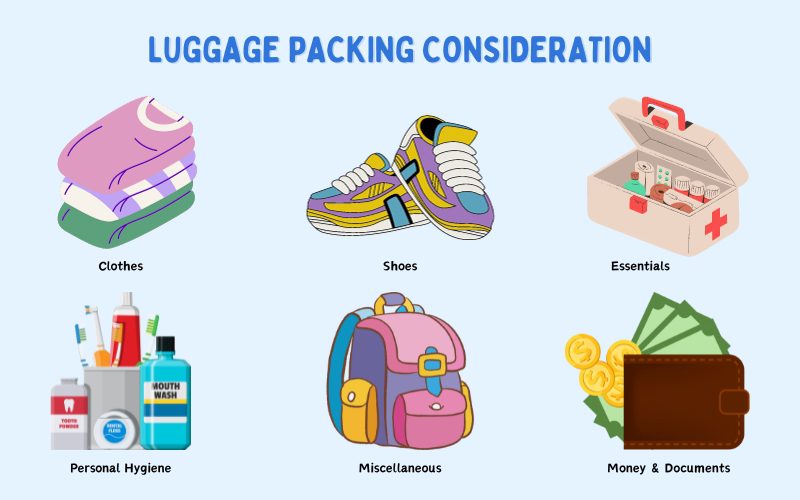
Travel packing essentials checklist.
- Focus on value, not just on low prices
The smartest way to save money is to protect the parts of the trip that matter most to you and cut the parts that do not. For some travelers, that means choosing better hotels but fewer flights. For others, it means eating local food and spending more on a premium cruise or a beach stay.
Conclusion
A good Vietnam and Thailand trip needs to be well planned. For most travelers, 21 days is enough to see the highlights of Vietnam and Thailand at a comfortable pace. You can combine major cities, cultural sites, food experiences, nature, and some beach time without making the trip feel too rushed. The key is to plan realistically. Both countries are large and varied, so a good itinerary should focus on the places that matter most to you instead of trying to cover everything. Weather, flight connections, and travel style also make a big difference.
If you are planning 21 days in Vietnam and Thailand and want a route that fits your budget, interests, and travel dates, contact us. We can help you build a trip that is practical, well paced, and more enjoyable from start to finish.
Read more: