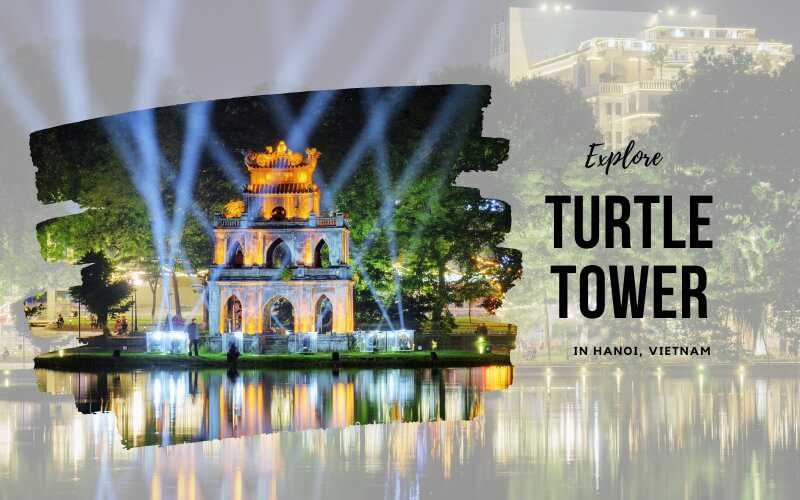
Few sights in Vietnam stop people mid-step the way the Turtle Tower does. Standing on a small islet at the southern end of Hoan Kiem Lake, this centuries-old stone tower has been part of Hanoi’s skyline so long that locals barely notice it anymore. Visitors, though, tend to stop, point, and reach for their cameras. If you are planning a Vietnam trip that includes Hanoi, understanding what the Turtle Tower actually is, and why it matters, will make the moment you see it land a little differently.
What Is the Turtle Tower?
The Turtle Tower (Thap Rua in Vietnamese, literally “Tortoise Tower”) is a small stone tower built on a natural rock islet near the southern bank of Hoan Kiem Lake in central Hanoi.
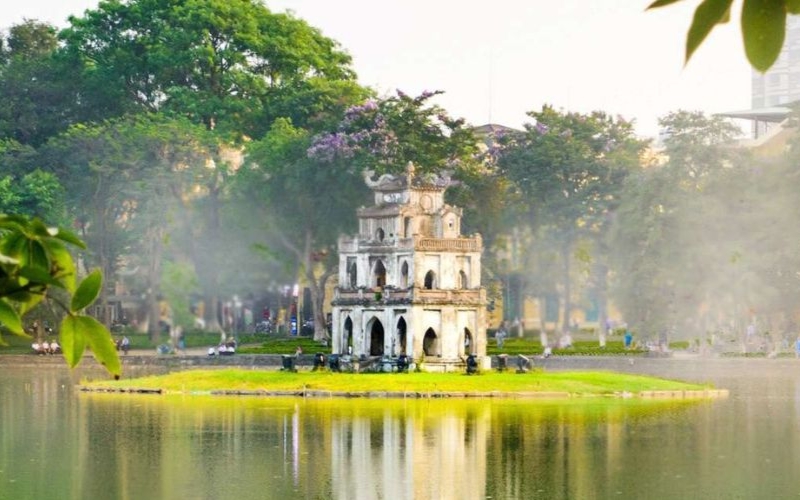
The iconic Turtle Tower at the heart of Hoan Kiem Lake
It stands roughly 8 to 9 meters tall and consists of three progressively smaller stories, each decorated with arched windows and traditional Vietnamese architectural detailing. The structure sits just a few meters above the water surface, which gives it a quality that photographs struggle to capture: it appears to float.
The tower was built in the late 19th century, during the French colonial period, though its exact construction date is debated among historians. Some sources suggest it was completed around 1886. The design combines elements of traditional Vietnamese and French Gothic architecture, which was fairly common for civic structures built during that era. The base is solid masonry; the upper floors have open arched windows that give the tower a lighter appearance despite its stone construction.
The Vietnamese name “Thap Rua” connects the tower to one of Hanoi’s most well-known legends: the story of a giant sacred turtle said to inhabit Hoan Kiem Lake and to guard a magical sword given to the 15th-century Vietnamese king Le Loi by the god Kim Qui.
According to the legend, after King Le Loi used the sword to drive out Chinese forces, the turtle reclaimed the blade on behalf of the gods. “Hoan Kiem” translates to “Lake of the Restored Sword,” and the tower has been associated with this story ever since. The lake’s actual giant softshell turtles, a critically endangered species, were considered living manifestations of this legend until the last known specimen died in 2016.
Turtle Tower’s Location
The Turtle Tower is on Hoan Kiem Lake, in Hoan Kiem Ward, central Hanoi. The lake itself is easy to reach from most parts of the city’s Old Quarter (Pho Co), which borders the lake to the north. The islet where the tower stands is not accessible to visitors. You view the tower from the lake’s pedestrian promenade, which rings the entire shoreline. The closest point for viewing and photography is the southern end of the lake, near the intersection of Dinh Tien Hoang Street and Le Thai To Street.
Getting there:
- From the Old Quarter, the lake is a 5 to 10-minute walk heading south on Hang Dao or Dinh Tien Hoang Street.
- From Hoan Kiem Lake Metro Station (Metro Line 2, opening progressively from 2025), it is a short walk of under 5 minutes.
- By taxi or ride-hailing app (Grab): ask for “Ho Hoan Kiem” (Hoan Kiem Lake).
On weekends and public holidays, Dinh Tien Hoang Street becomes a pedestrian zone from Friday evening to Sunday night, making the walk around the lake especially pleasant and uncrowded by traffic.
Best Time to Visit Hoan Kiem Lake and the Turtle Tower
Hanoi has a distinct seasonal character that affects the experience of visiting the lake.
October to April is generally the most comfortable period for walking around the lake. Temperatures range from around 15 to 25 degrees Celsius, humidity is manageable, and the light tends to be clearer. February and March can bring drizzle and cool grey weather, which actually suits the atmospheric, misty look of the tower quite well.
May to September brings Hanoi’s hot and humid summer, with temperatures regularly above 35 degrees Celsius and frequent afternoon thunderstorms. The lake is still worth visiting, but early mornings become even more important, and heat management matters.
The Tet holiday period (usually late January or early February) brings the lake area to life with decorations, flowers, and celebrations. The surrounding streets are filled with ornamental kumquat trees and peach blossoms. This is one of the most visually interesting times to see the lake, though Hanoi itself is quieter during the holiday as many residents travel home.
>>> Find out the best time to visit Vietnam for the best trip!
What to Do Around Hoan Kiem Lake
The lake is not just a photo stop. The surrounding area is one of the most walkable and food-rich parts of Hanoi, and it connects easily with the Old Quarter to the north.

Savoring the essential flavors of Hanoi near Hoan Kiem Lake, from savory Bun Cha to the legendary Cafe Giang egg coffee.
Nearby food worth trying:
- Banh mi stands on the lakeside promenade (morning only, typically 5,000 to 20,000 VND / ~$0.20 to $0.80).
- Bun cha (grilled pork noodle soup) on Hang Manh Street, about a 10-minute walk from the lake’s northern end.
- Ca phe trung (egg coffee) at several small cafes on Dinh Tien Hoang Street. One long-standing spot is Cafe Giang on Nguyen Huu Huan Street, opened in 1946.
Nearby attractions:
- Hoan Kiem Lake promenade (free, open at all times).
- Ngoc Son Temple (30,000 VND / ~$1.20, open daily).
- Hanoi Old Quarter (Pho Co), directly north of the lake.
- Dong Kinh Nghia Thuc Square, just north of the lake, a good spot for street photography on weekend evenings.
Most visitors combine the lake with a half-day walking tour of the Old Quarter. If you are doing a Hanoi city tour, Hoan Kiem Lake is almost always the first or last stop. Contact us for more detail!
What Makes the Turtle Tower Worth Your Time
1. The Hoan Kiem Lake Promenade and Early Morning Atmosphere
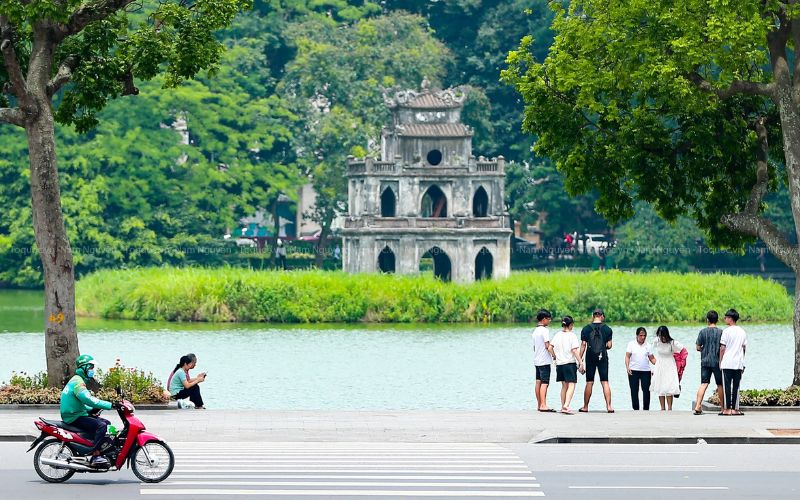
The peaceful early morning atmosphere along the Hoan Kiem Lake promenade, a favorite spot for locals and visitors in Hanoi.
The Hoan Kiem Lake promenade is one of the few places in central Hanoi where the city slows down. Early morning, from roughly 5:30 to 7:30 a.m., is when the lake is at its most local. Older Hanoians come out in force: groups doing tai chi on the grass, couples walking laps, vendors selling banh mi and fresh soy milk from carts near the park benches. The Turtle Tower sits in the middle distance during all of this, half-veiled in morning mist on cooler days.
This time of day is worth experiencing even if you have no interest in the tower itself. You see how Hanoians actually use this space. The lake is not a tourist destination for them; it is a neighborhood park. Coming at 7 a.m. rather than 10 a.m. makes a real difference in what you observe.
2. Light and Photography
The tower faces roughly west, which means afternoon and evening light hits the facade directly. Golden hour before sunset produces the most photographed version of the tower: warm orange stone against the green-grey water, with the distant Old Quarter roofline behind. Early morning works differently; the misty backlit silhouette reads more atmospheric than architectural.
Good positions for Turtle Tower photos:
- The low stone terrace on the lake’s southeastern shore, near the Ngoc Son Temple entrance road.
- The western bank (Le Thai To Street side) for afternoon light.
- The Huc Bridge viewpoint looking south, for a composition that includes both the bridge’s red railings and the tower in the distance.
Midday light is flat and harsh. If photography matters to you, plan your visit before 9 a.m. or after 4 p.m.
3. The Hoan Kiem Lake Ecosystem
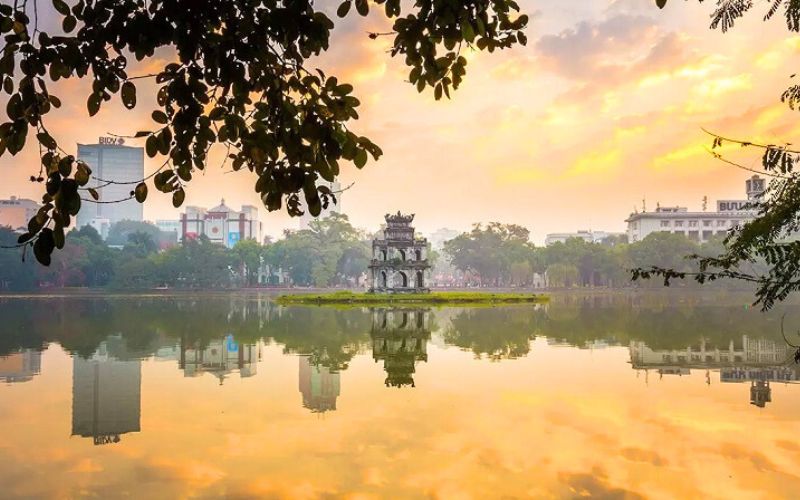
The serene beauty of Turtle Tower at sunrise, reflecting perfectly on the calm waters of Hoan Kiem Lake.
The lake covers about 12 hectares and has been shaped by centuries of urban development around it. Its most famous former residents were the giant Yangtze softshell turtles (Rafetus swinhoei), believed to be the rarest turtle species on earth. The last confirmed specimen in Hoan Kiem Lake, known affectionately as Cu Rua (“Great-Grandfather Turtle”) by Hanoians, died in January 2016. Its preserved body is displayed at the Ngoc Son Temple on the northern islet of the lake. Seeing it in person is oddly moving: the animal was estimated to be over 100 years old.
Today the lake supports fish, frogs, and a variety of migratory and resident birds. On quiet mornings you may see cormorants sitting on the stone walls near the water’s edge.
4. Ngoc Son Temple
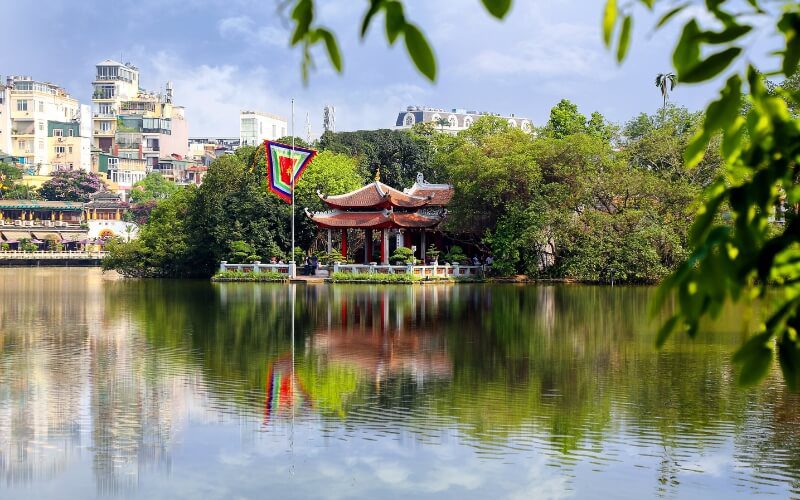
The historic Ngoc Son Temple sits peacefully on Hoan Kiem Lake, offering a quiet escape in the heart of Hanoi.
On the northeastern side of Hoan Kiem Lake, accessible via the distinctive red Huc Bridge (The Huc, or “Sunbeam Bridge”), Ngoc Son Temple is a compact 19th-century temple complex worth the 30,000 VND (~$1.20) entrance fee. The temple houses several altars, and one room contains the preserved body of “Cu Rua”, the last giant turtle. The Huc Bridge itself, painted vivid red, is one of the most photographed structures in Hanoi and pairs naturally with a visit to the Turtle Tower area.
Ngoc Son Temple hours: Open daily, ~7:00 a.m. to 6:00 p.m. Admission: 30,000 VND (~$1.20) for adults.
5. Weekend Walking Street
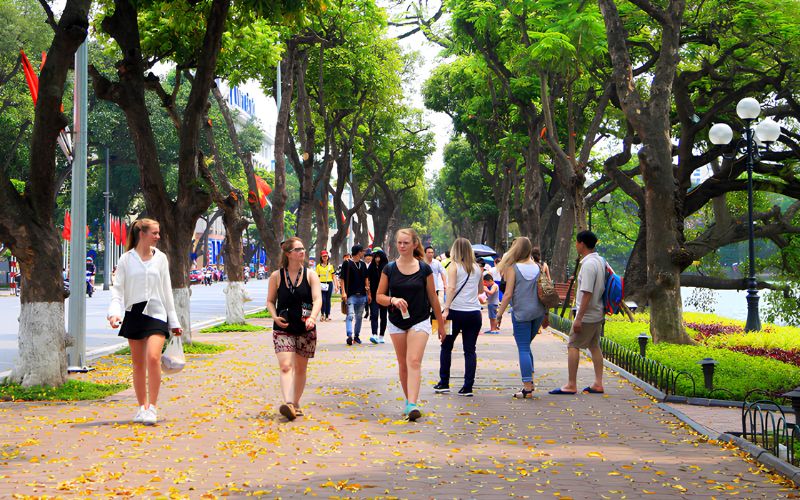
Strolling through the vibrant atmosphere of the Hoan Kiem Lake walking street under a canopy of lush green trees.
From Friday evening until Sunday night, the streets surrounding Hoan Kiem Lake (Dinh Tien Hoang, Le Thai To, and connecting roads) close to vehicle traffic. The area becomes a large outdoor gathering space with street food stalls, performances, outdoor games, and a general festive energy that feels unlike any other part of the city. The Turtle Tower is visible from several points along the walking street route, and the combination of seeing the tower with the animated weekend crowd around the lake is something that is hard to replicate elsewhere in Hanoi.
6. The Legend of the Restored Sword

The legendary moment when King Le Loi returned the sacred sword to the Golden Turtle God in the waters of Hoan Kiem Lake.
The story tied to the Turtle Tower is one of the better-known legends in Vietnamese culture, and it is worth knowing before you visit because guides and locals will reference it constantly.
In the early 15th century, Vietnam was under Ming Chinese occupation. According to legend, a fisherman named Le Loi found a magical sword in the lake, sent by the divine turtle Kim Qui. Using the sword, Le Loi led a successful resistance movement over 10 years, eventually driving out the occupying forces and establishing the Later Le dynasty in 1428.
Shortly after his victory, while boating on the lake, a giant turtle surfaced and reclaimed the sword, returning it to the gods. The lake was renamed Hoan Kiem in memory of this event. Le Loi later became Emperor Le Thai To, one of the most respected figures in Vietnamese history. The tower, built some 400 years after these events, was given the name “Thap Rua” partly to evoke this connection, though the structure itself has no direct historical link to the legend.
How to Include the Turtle Tower in Your Vietnam Itinerary
The Turtle Tower itself takes about 20 to 30 minutes to visit properly, including a slow walk around the lake’s perimeter and time at Ngoc Son Temple. Most people work it into a broader Hanoi half-day or full-day schedule.
For travelers on short Northern Vietnam tours, Hanoi is usually the start or end point of a route that includes Ha Long Bay, Ninh Binh, or Sapa. The lake fits naturally into an arrival evening or departure morning. You do not need to dedicate a full day to it, but you also do not want to rush past it.
If you are building a longer itinerary, IDC Travel’s tailor-made Vietnam tours can be designed to include proper time in Hanoi alongside the rest of the country. Northern Vietnam itineraries in particular tend to allocate one to two full days in Hanoi, which gives plenty of time for Hoan Kiem Lake and the neighborhoods around it.
For travelers interested specifically in Hanoi’s cultural sites, a dedicated Hanoi city tour covers the lake, Ngoc Son Temple, Ho Chi Minh Mausoleum, the Temple of Literature, and the Old Quarter in a single day.
Conclusion: Practical Information for Visiting Turtle Tower
| Category | Details |
| Name | Turtle Tower (Vietnamese: Thap Rua) |
| Location | Hoan Kiem Lake, Hoan Kiem Ward, Hanoi |
| Access | Lakeside promenade (free, open 24 hours) |
| Tower access | Closed to public (view from shore only) |
| Ngoc Son Temple | 30,000 VND (~$1.20), open daily ~7:00 a.m. to 6:00 p.m. |
| Weekend walking street | Friday 7 p.m. to Sunday 11 p.m. |
| Best visiting time | Early morning (5:30 to 8:00 a.m.) or late afternoon (4:00 to 6:00 p.m.) |
| Best season | October to April |
| Nearest landmark | Ngoc Son Temple, Hanoi Old Quarter |
The Turtle Tower is a small structure, physically. Eight or nine meters of old stone on a rock in the middle of a city lake. But it is the kind of thing that stays with people. Part of it is the legend. Part of it is how the tower sits in the water, belonging neither to the lake nor to the shore. And part of it is the contrast: the old stone tower, the morning mist, the tai chi groups, the motorbikes on Dinh Tien Hoang a hundred meters away. Hanoi holds these things together without trying to explain them, and the Turtle Tower has been at the center of that for well over a century.
If your Vietnam trip is still in the planning stage, IDC Travel builds private, tailor-made Vietnam tours from scratch, including Hanoi and points across the country. Whether you want a focused Hanoi city tour or a longer journey through Northern Vietnam, the team at IDC can put together an itinerary that works around your actual schedule and interests.
>>> Refer to Hoan Kiem Lake – Wikipedia.
Read more: