Few buildings in Ho Chi Minh City get as much camera time as the Saigon Central Post Office. It has appeared on postcards, travel blogs, and tourist itineraries for decades, and for good reason: it is one of the best-preserved French colonial buildings in all of Southeast Asia, and it still works. You can walk in, buy a stamp, and mail a letter home from a building that has been doing exactly that since 1891.
This guide covers everything you need to know before visiting, from its history and architecture to what to do once you are inside, plus tips on where to go nearby.
What Is the Saigon Central Post Office?
The Saigon Central Post Office (also called the Ho Chi Minh City Post Office or HCMC Post Office) is a working post office and one of the most visited historical landmarks in southern Vietnam.
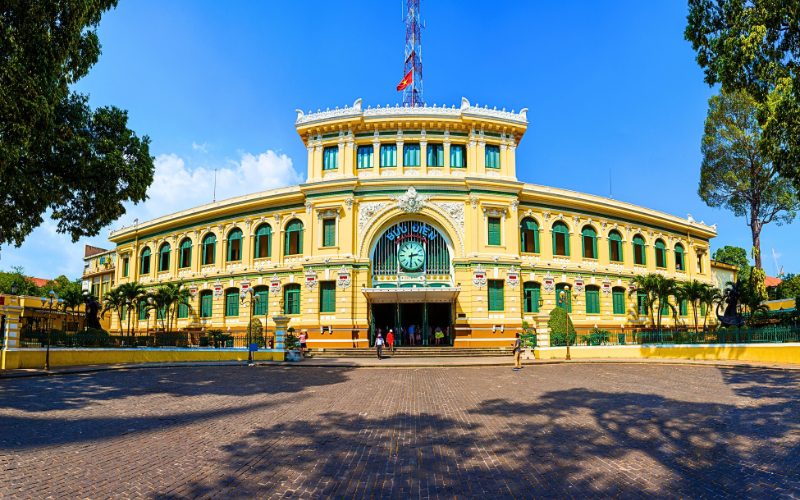
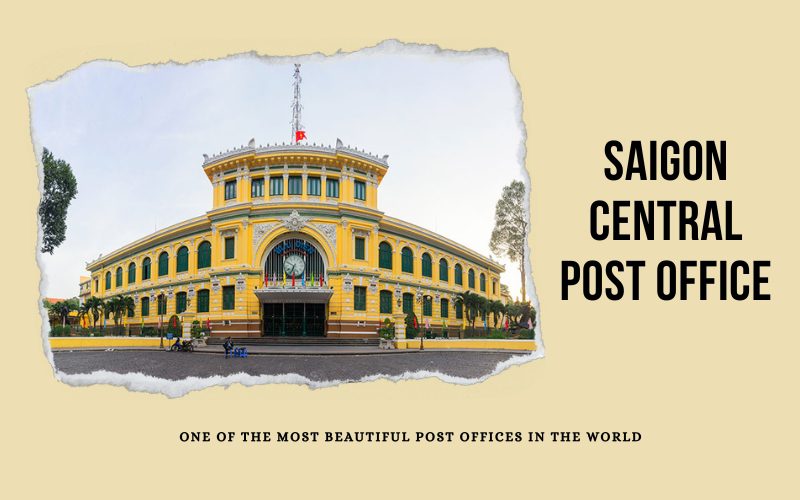
Marveling at the stunning colonial architecture and vibrant yellow facade of the historic Saigon Central Post Office.
It sits in Sai Gon Ward, the historic center of the city, directly across from the Notre-Dame Cathedral Basilica of Saigon.
The building dates to the late 19th century, when Saigon was the administrative capital of French Indochina. Construction ran from 1886 to 1891, and what visitors see today is largely the same structure that opened over 130 years ago. In 2023, Architectural Digest ranked it second on its list of the most beautiful post offices in the world.
What makes it different from most “historic” attractions is that it is not a museum. Real postal staff work behind the counters. Locals come in to send packages. You can buy stamps, postcards, and souvenirs without paying any entrance fee. That combination of living function and genuine age gives it an atmosphere that is hard to fake.
Location of the Saigon Central Post Office
- Address: 2 Cong Xa Paris Street, Sai Gon Ward, Ho Chi Minh City, Vietnam.
It sits on Paris Square (Cong Xa Paris), directly opposite Notre Dame Cathedral, in the heart of the old colonial quarter.
The area is walkable from most hotels in Sai Gon Ward. Ben Thanh Market is about 10 to 15 minutes on foot, the Reunification Palace is roughly 700 meters away, and the War Remnants Museum is around 1.5 kilometers. If you are planning a half-day walking tour of the city’s colonial landmarks, this neighborhood is where you should start.
Best Time to Visit Ho Chi Minh City Post Office
The city itself has a tropical climate with two seasons: dry (November to April) and rainy (May to October). For general sightseeing, the dry season is more comfortable, with temperatures between 25°C and 32°C (77°F and 90°F). The hotter months run from March through May, when temperatures regularly hit 35°C (95°F) or higher.
For visiting the post office specifically, the indoor environment is air-conditioned, so the heat outside is less of a factor than it is for open-air sites. That said, since most visitors combine the post office with a walking tour of the surrounding colonial quarter, the coolest months from December to February are the most comfortable for the whole outing.
Avoid visiting during the Tet holiday period (late January or early February, depending on the lunar calendar), when many services operate on reduced hours or close entirely.
Saigon Central Post Office Opening Hours
Opening hours vary slightly by source, and may shift on public holidays, so it is worth checking locally on the day. Based on current information:
- Monday to Friday: 7:00 AM to 7:00 PM
- Saturday: 7:00 AM to 6:00 PM
- Sunday: 8:00 AM to 6:00 PM
There is no entrance fee. The building is free to enter and explore. Postal and souvenir services are available during business hours.
The quietest time to visit is in the morning between 7:30 AM and 9:00 AM. The busiest periods are mid-morning (around 8:30 AM to 10:00 AM) and late afternoon (4:00 PM to 6:00 PM). If photography is your goal, early morning light also comes through the side windows at a good angle for interior shots.
What to Do at the Vietnam Post Office in Saigon
Most visitors spend 20 to 45 minutes here, depending on how long they want to sit and look around. Here is what is worth doing:
Send a postcard or letter: This is genuinely worth doing. Postcards are sold at stalls inside for around 10,000 to 30,000 VND (~$0.38 to $1.15), and stamps are available at the counters. Mailing a postcard internationally costs roughly 12,000 to 15,000 VND (~$0.46 to $0.57). Getting a letter postmarked from this building is a small but satisfying thing to bring home.
Discover French Colonial Architecture: The building was constructed by the French from 1886-1891 in an eclectic style based on architect Marie-Alfred Foulhoux’s design. Take a closer look at the building, can you recognize the architectural style? It’s a blend of Gothic, Renaissance, and French architecture. This is a work of architecture that combines Western styles with Eastern decorative elements and attracts many tourists who appreciate cultural diversity and social lifestyles.
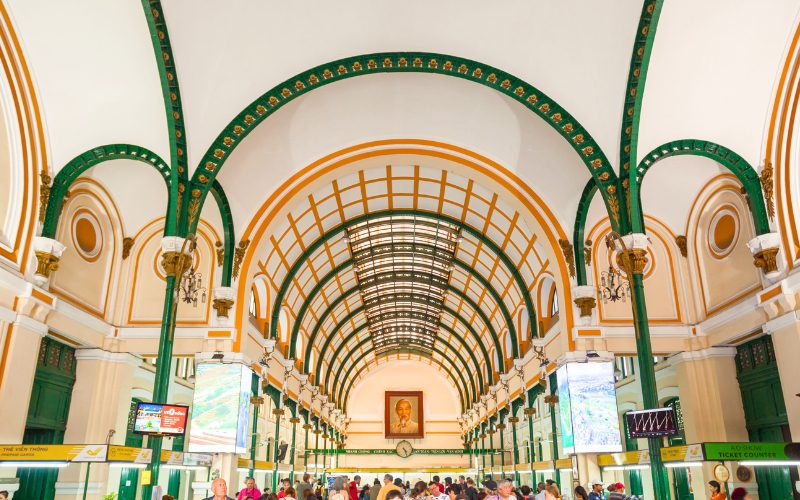
An Inside View of the Post Office
Browse the souvenir stalls: A row of small stalls along the interior sells lacquerware, silk items, bookmarks, postcards, and other souvenirs. Prices are slightly higher than street markets but fair for the location. Book our service so you can comfortably enjoy your trip.
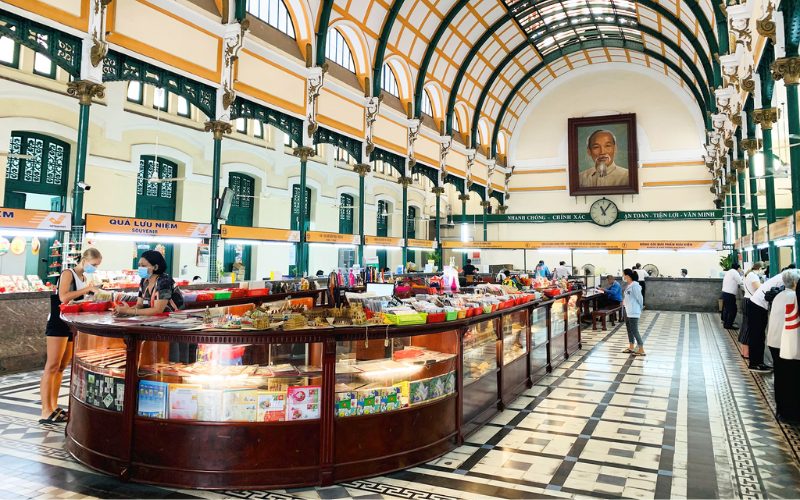
Souvenirs Sold in the Post Office
Photograph the exterior from across the street: The best exterior shot requires stepping back to the far side of Paris Square, near the cathedral gates. From there you can frame the full facade without distortion. Early morning gives the cleanest light and fewest pedestrians in frame.
Saigon Central Post Office Architecture: What You Are Actually Looking At
The exterior is the first thing most visitors photograph, and it is worth stopping to look carefully before going in.
The facade is symmetrical, with two two-storey side blocks flanking a taller three-storey central section. The front is detailed with arched windows, stone carvings, and decorative moldings in the French colonial style. Above the main entrance, a large clock imported from Paris is still in working order. The names of scientists and engineers are inscribed along the top of the facade, a common feature of French civic buildings of the period.
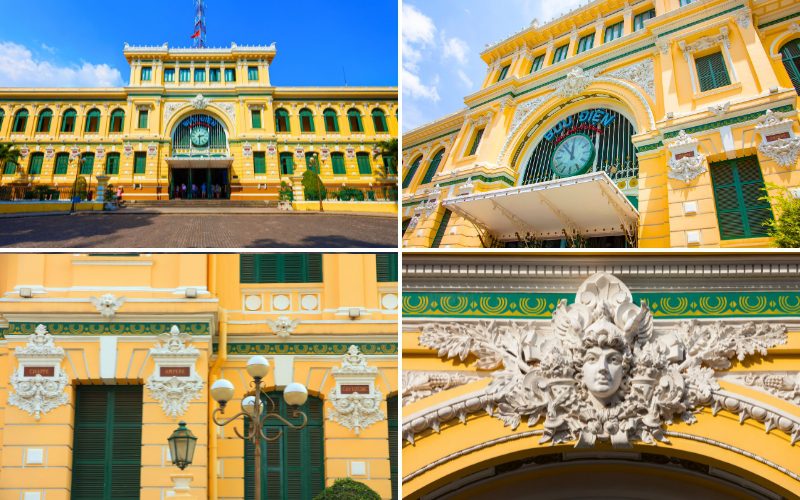
Impressive Architecture
The interior is where the building really earns its reputation. Step through the doors and you are standing inside a vast barrel-vaulted hall that runs the full length of the building. The ceiling is supported by rows of cast-iron arches, and the light comes in through high windows along the sides. The overall effect is closer to a 19th-century European railway station than anything you would expect from a tropical post office.
Key things to look for inside:
- Two large painted maps on the entrance walls. One shows Saigon and its surroundings as they were in 1892. The other shows the telegraph line network across southern Vietnam and Cambodia in 1936.
- A mosaic portrait of Ho Chi Minh at the far end of the central hall, the most prominent post-1975 addition to the original interior.
- Original wooden service counters along both sides of the hall, still in use today.
- Old telephone booths and vintage stamp-gluing equipment tucked into corners of the space.
- Marble floors and green-painted wrought iron railings throughout.
The building combines European neo-classical and Gothic elements with subtle Eastern details in its decorative work. Two symbols appear on the exterior: an olive branch on the left side (representing wisdom and peace in Greek mythology) and an oak branch on the right (associated with protection and knowledge). These are consistent with late 19th-century French civic symbolism.
A Short History of the Post Office Saigon
The story of this building goes back further than the current structure. On January 13, 1863, the French colonial administration opened an early postal facility in Saigon and issued the city’s first stamp, known as the “stork” stamp. The French had captured Saigon in 1859, and building a communications infrastructure was one of their first priorities.
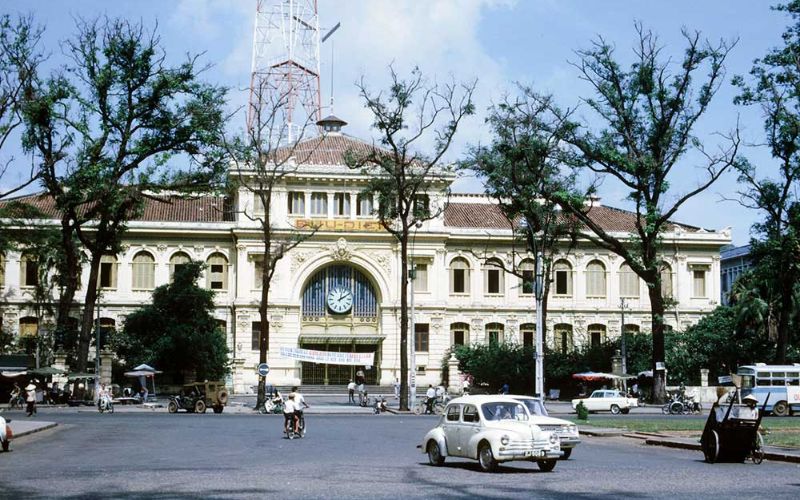
Completed in the late XIX, the Saigon Central Post Office stands as a majestic testament to French architectural influence.
By the 1880s, the original facilities could not keep up with demand. A new, larger building was commissioned and constructed between 1886 and 1891. The architect most consistently credited with the final design is Marie-Alfred Foulhoux (1840-1892), who served as Saigon’s Architect-in-Chief and designed several of the city’s major colonial buildings, including the Palais de Justice and the Customs Department building.
The post office was his last major work. Some sources also attribute involvement to Gustave Eiffel’s engineering firm, which supplied the prefabricated cast-iron frame used in the structure, though the design credit remains primarily Foulhoux’s.
After Vietnamese reunification in 1975, the building continued operating without significant alteration. The Ho Chi Minh portrait on the far wall and a few cosmetic changes are about the extent of what changed. The building’s basic layout, materials, and proportions have stayed the same for well over a century.
The Letter Writer of Saigon Central Post Office
For many years, one of the most memorable things about the post office was a man named Duong Van Ngo. He started working here at age 17 and spent over 70 years at the post office, offering a handwriting service for visitors and locals who wanted letters written in French or English. He charged around 50 cents per page and became something of an institution in his own right.
He passed away in 2023, but his story is worth knowing before you visit. Several accounts of his work still circulate online, and some of the staff can point to where he used to sit.
Nearby Attractions: What to Combine with Your Visit
The post office sits at the center of the most walkable heritage cluster in Sai Gon Ward. A half-day loop from Paris Square can cover:
- Notre Dame Cathedral: directly across the street. Built between 1863 and 1880, it uses red bricks imported from Marseille and has twin bell towers that are visible from much of central Sai Gon Ward. Currently undergoing restoration work, but still open for viewing from the exterior.
- Reunification Palace: about 700 meters southwest. The former Presidential Palace of South Vietnam, frozen largely in its 1960s state. The basement bunker, war rooms, and rooftop helipad are all accessible. The entrance fee is 40,000 VND (~$1.53).
- War Remnants Museum: roughly 1.5 kilometers west. One of the most visited museums in Vietnam. The ground-level courtyard has captured American military hardware; the upper floors document the Vietnam War from the Vietnamese perspective. Entry is 40,000 VND (~$1.53).
- Ben Thanh Market: about 10 to 15 minutes on foot south. The covered market is particularly good in the morning when fresh produce fills the stalls. Bargaining is expected for most goods.
- Hanoi Opera House: 600 meters east, on Dong Khoi Street. Another French colonial building from 1897. Evening performances are available and worth booking if your schedule allows.
Practical Tips Before You Go
A few things that will make the visit smoother:
- Dress appropriately. The post office is not a religious site, so there are no formal dress requirements, but as a public government building, neat casual clothing is appropriate.
- Keep valuables secure. Sai Gon Ward is generally safe, but the tourist concentration around Paris Square makes it an area where bag-snatching occurs. Keep your phone in a secure pocket rather than in hand when walking outside.
- Bring small bills. If you plan to buy postcards or stamps, smaller VND denominations (5,000 to 50,000 VND notes, equivalent to about $0.19 to $1.92) are easier to use at the stalls.
- Photography is welcome inside. No restrictions on personal photography. Tripods are generally not allowed.
- The square outside gets busy. The area between the post office and the cathedral can become congested with tour groups from late morning onwards. If you want a quiet look at both buildings, 7:30 AM to 8:30 AM is the window.
Quick Reference: Plan Your Saigon Visit with IDC Travel
| Detail | Information |
| Full name | Ho Chi Minh City Central Post Office / Saigon Central Post Office (Vietnamese: Buu dien Trung tam Sai Gon) |
| Address | 2 Cong Xa Paris Street, Sai Gon Ward, Ho Chi Minh City, Vietnam |
| Opening hours | Mon-Fri: 7:00 AM – 7:00 PM / Sat: 7:00 AM – 6:00 PM / Sun: 8:00 AM – 6:00 PM |
| Entrance fee | Free |
| Architect | Marie-Alfred Foulhoux (Gustave Eiffel’s firm involved in ironwork) |
| Year built | 1886-1891 |
| Notable feature | Fully operational post office with 130+ year-old interior intact |
| Nearest landmark | Notre-Dame Cathedral (directly opposite) |
| Best time to visit | 7:30 AM – 9:00 AM (quietest, best light) |
| Recommended visit time | 20 to 45 minutes |
| Postcard price | 10,000-30,000 VND (~$0.38-$1.15) |
| International postage | ~12,000-15,000 VND (~$0.46-$0.57) |
The post office is one stop on what is, genuinely, one of the better walking circuits in the city. If you want to cover the colonial quarter properly alongside the Cu Chi Tunnels, Mekong Delta, or further afield, IDC Travel’s Ho Chi Minh City tours offer both half-day and full-day private options with English-speaking guides who know the area well.
For travelers planning a longer trip through the south, the post office fits naturally into any Southern Vietnam tours itinerary. IDC Travel also offers tailor-made Vietnam holidays that can combine Ho Chi Minh City with the Mekong Delta, Phu Quoc, and destinations further north, all with private transportation and flexible scheduling.
>>> Refer to Saigon Central Post Office – Wikipedia.
Read more: