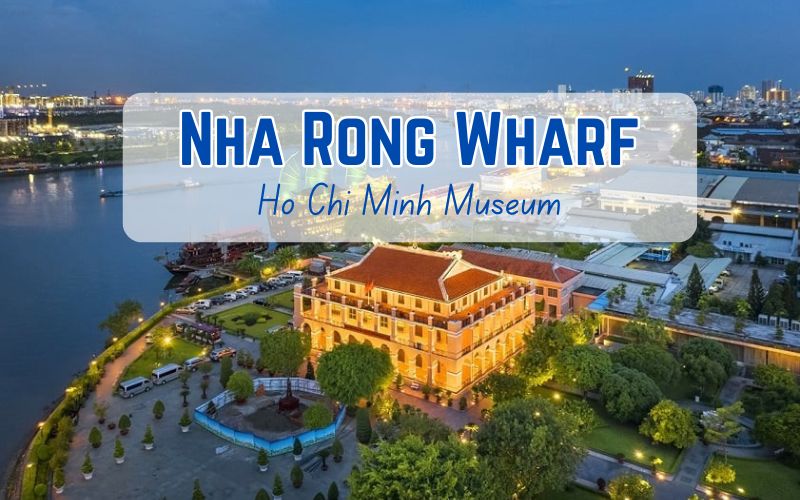
Few places in Ho Chi Minh City carry as much historical weight as Nha Rong Wharf. On June 5, 1911, a 21-year-old man named Nguyen Tat Thanh boarded a French steamship here and left Vietnam with almost nothing. Thirty years later, he returned as Ho Chi Minh and led the country to independence. That single departure is why millions of people visit this riverside site every year, and why it still stops you cold when you actually stand there and think about it.
This guide covers everything you need to know about Nha Rong Wharf in Ho Chi Minh City: its location, history, architecture, what to see inside the museum, and how to fit it into a broader Vietnam itinerary.
What Is Nha Rong Wharf?
Nha Rong Wharf (Ben Nha Rong) is officially known as the Ho Chi Minh Museum, Ho Chi Minh City Branch. It is a riverside museum and architectural heritage complex built by French colonialists between 1862 and 1863, originally as the headquarters of the Messageries Imperiales shipping company.
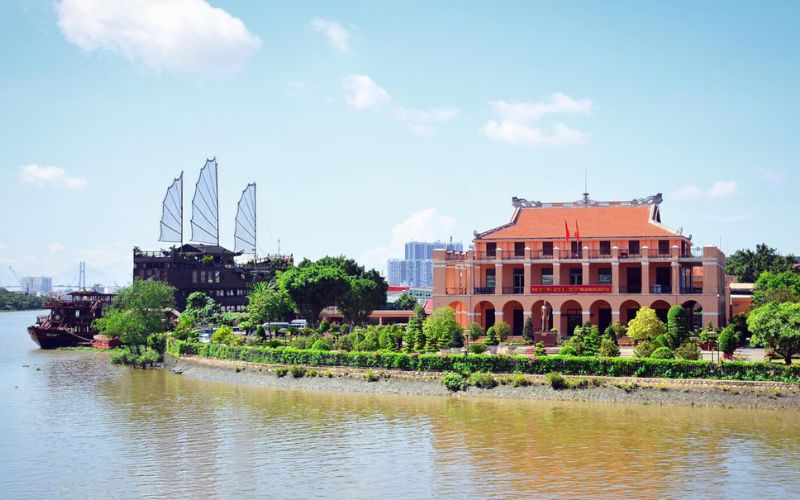
Nha Rong Wharf in Ho Chi Minh City
“Nha Rong” translates directly to “Dragon House”. The name comes from the two large ceramic dragon sculptures on the roof, a deliberate blend of European colonial construction with Vietnamese decorative motifs. The building started as a commercial port, later became a US military facility, and today houses over 11,300 documents, photographs, and artifacts related to President Ho Chi Minh’s life and revolutionary journey.
It is one of two symbols most closely associated with Ho Chi Minh City (the other is Ben Thanh Market), and it appeared on the Vietnamese 50,000-dong banknote for decades.
Location of Nha Rong Wharf
- Address: 1 Nguyen Tat Thanh Street, Phu Lam Ward, Ho Chi Minh City, Vietnam (at the confluence of the Ben Nghe Channel and the Saigon River)
The address puts it just across the river from the centre of Saigon, about 1.2 kilometers from Bach Dang Wharf and roughly 2.3 kilometers from Ben Thanh Market.
Getting there is straightforward:
- By bus: Lines 02, 03, 19, and 56 all stop directly at Nha Rong Wharf.
- By motorbike or car: The museum has a designated private parking area on site.
- By taxi or ride-hailing app: Use Grab, Be, or Green SM for convenient, metered trips from anywhere in the city center.
- On foot from the centre: Cross the Khanh Hoi Bridge and walk south along Nguyen Tat Thanh Street. It takes about 15 minutes and gives you a good view of the Saigon River along the way.
Practical Visit Information to Nha Rong Wharf
Opening Hours and Admission
The museum opens Tuesday through Sunday. It is closed on Mondays.
- Morning session: 7:30 AM to 11:30 AM
- Afternoon session: 1:30 PM to 5:00 PM
Admission fees are low. The standard adult entrance fee is 20,000 to 40,000 VND (roughly $0.76 to $1.53), with reduced rates for children and students at 10,000 VND (approximately $0.38). Confirm the current rate at the entrance, as pricing can be adjusted.
Best Time to Visit
For photography and outdoor time: Early morning (7:30 AM to 9:00 AM) gives you the softest light and the smallest crowds. The riverside is at its calmest before tour buses arrive.
For the interior exhibitions: Midday is fine, as the galleries are air-conditioned. If the outdoor heat is a concern (temperatures regularly reach 33-35 degrees Celsius / 91-95 degrees Fahrenheit from March to May), use the indoor hours for the museum and save the garden for morning or late afternoon.
Season: Ho Chi Minh City has a dry season from November to April and a rainy season from May to October. The dry season makes outdoor exploration more comfortable. During the rainy season, showers are usually concentrated in the afternoon, so a morning visit is the practical choice.
Best overall months: December through March offer temperatures around 25-28 degrees Celsius (77-82 degrees Fahrenheit) with low humidity. April and May push into the mid-30s Celsius (roughly 93-95 degrees Fahrenheit), which makes the outdoor grounds uncomfortable for extended visits.
Visitor Guidelines
The museum asks visitors to follow a few standard rules:
- Do not touch the exhibits
- Keep noise to a minimum inside the galleries
- Follow photography restrictions in designated areas
- Leave large bags and backpacks at the entrance storage
Guided tours are available and genuinely useful here. The historical context is dense, and a knowledgeable guide can connect the artifacts to specific events in ways that the exhibit labels alone do not always convey.
The History of Nha Rong Wharf
From French Trading Port to National Landmark (1862 to 1975)
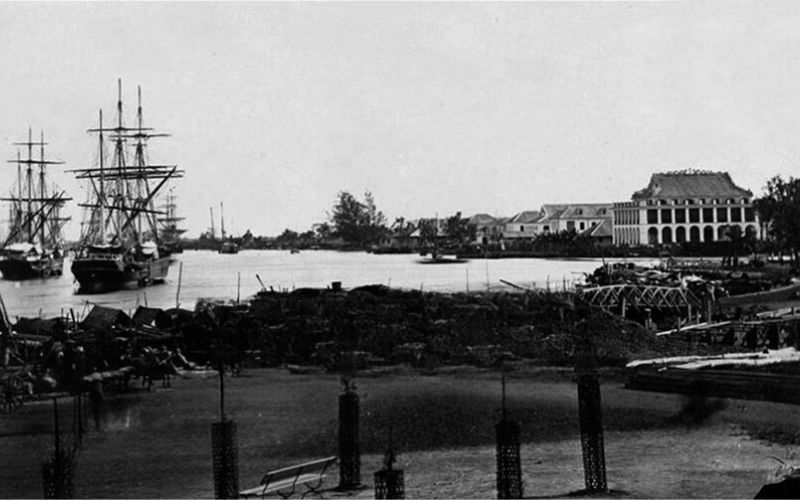
The black and white picture of Nha Rong Pier
Construction began on March 4, 1863, when the French shipping company Messageries Maritimes built the facility to manage maritime trade across southern Vietnam. Rice, rubber, coffee, and military supplies moved through this port during the colonial period, making it one of the busiest commercial hubs on the Saigon River.
The building’s roof originally displayed a French company emblem: a horse head (referencing the company’s earlier road transport business) and an anchor (symbolizing its shipping operations). Two ceramic dragons facing a moon emblem were later added, giving the structure its Vietnamese name.
The moment that changed everything happened on June 5, 1911. Using the alias Van Ba, a young Nguyen Tat Thanh signed on as a kitchen assistant aboard the French steamship Admiral Latouche Treville and departed from this very wharf to seek a path to national salvation. He would travel through France, the United States, England, the Soviet Union, China, and dozens of other countries before returning to Vietnam in 1941.
After France withdrew from Vietnam in 1954, the South Vietnamese government took over the wharf and carried out renovations, replacing the original dragons with two new sculptures facing outward. In 1965, the US military used the building as the headquarters of its Military Aid Receiving Agency. After reunification in 1975, the Vietnam Seaway Department assumed management.
The Museum Era (1979 to Present)
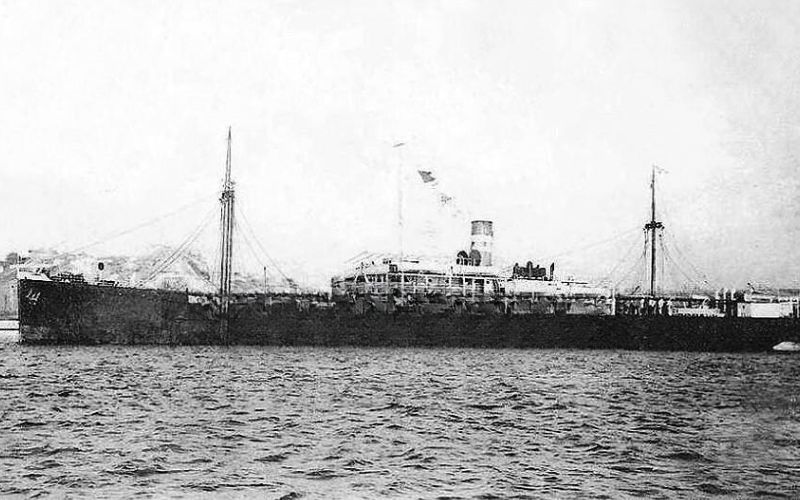
Admiral Latouche Treville ship according to history
On September 2, 1979, to mark the 10th anniversary of Ho Chi Minh’s death, authorities opened Nha Rong Wharf to the public as an exhibition site dedicated to the president’s revolutionary career. The Ho Chi Minh City People’s Committee officially renamed it the Ho Chi Minh Museum (Saigon Branch) in 1982, and in 1995, it was upgraded to a full branch of the national Ho Chi Minh Museum system.
What started as a 250-square-meter space with three exhibition rooms has grown into a complex with nine exhibition halls covering more than 1,480 square meters. Today, the museum holds 11,300 documents and artifacts, 3,300 specialized books, and six storage facilities preserving 23,888 items in total, including 3,691 originals and 1,889 confidential documents.
Architecture: Where East Meets West
The building’s design is worth paying attention to before you go inside. It is not your typical French colonial structure.
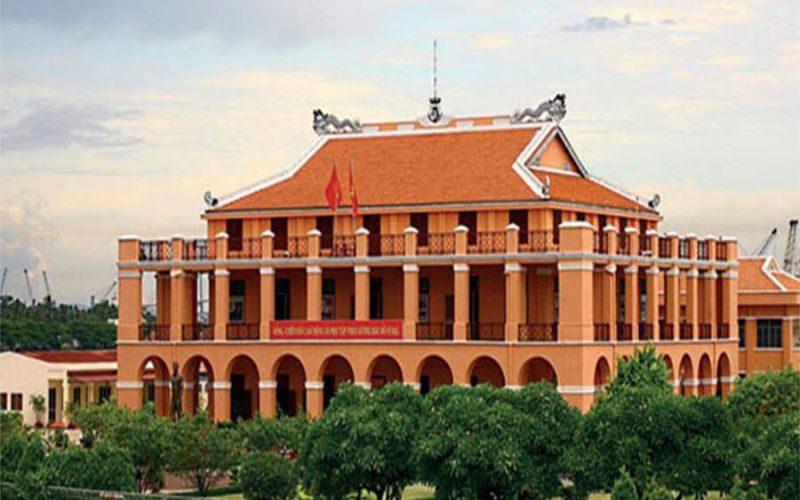
The unique roof with two ceramic dragons
The main framework follows 19th-century Western construction methods: rectangular layout, arched windows, thick brickwork, and a solid two-story frame. What sets it apart are the two large Vietnamese ceramic dragons on the rooftop, flanking a central insignia. In Vietnamese culture, dragons symbolize power and good fortune. Their presence on a French commercial building was an unusual concession to local taste, and it is the detail that gave the entire facility its identity.
This architectural combination appeared on postcards circulated throughout Indochina for decades. If you have seen images of old Saigon, you have probably seen this building. Up close, the textural contrast between the European brickwork and the painted ceramic dragons is genuinely striking, especially in the morning light when the facade catches the river glare.
The surrounding grounds include approximately 400 trees, some over two centuries old. Among them: a fig tree planted by the President of India during a 1991 state visit, and bodhi trees gifted from Thailand. The outdoor space is one of the quieter spots along this stretch of the Saigon River.
What to See at Nha Rong Wharf
This is the part that matters most for planning your visit. The museum has nine exhibition halls, seven themed rooms, and eight permanent exhibition areas. Here is what to focus on:
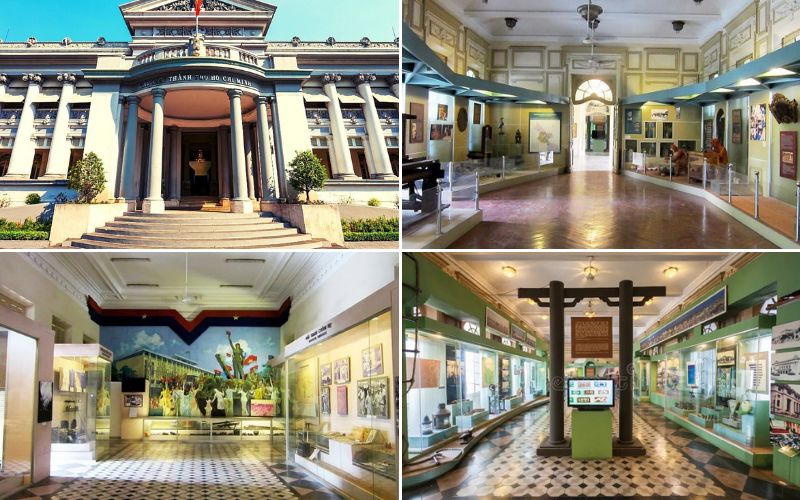
Exhibition halls at Ho Chi Minh Museum
The Ho Chi Minh Museum Galleries
The permanent collection walks visitors through the major stages of Ho Chi Minh’s life, from his early years in Nghe An province through his overseas journey, his years organizing resistance movements across Asia and Europe, and his return to lead Vietnamese independence. Key items include:
- Original photographs of the young Nguyen Tat Thanh aboard and at port
- Documents from his time in France, where he submitted proposals to the Versailles Peace Conference in 1919
- Personal items, letters, and clothing from different periods of his life
- Maps and battle documents from the resistance period
- Artifacts from his final years, including the desk where he wrote key political texts
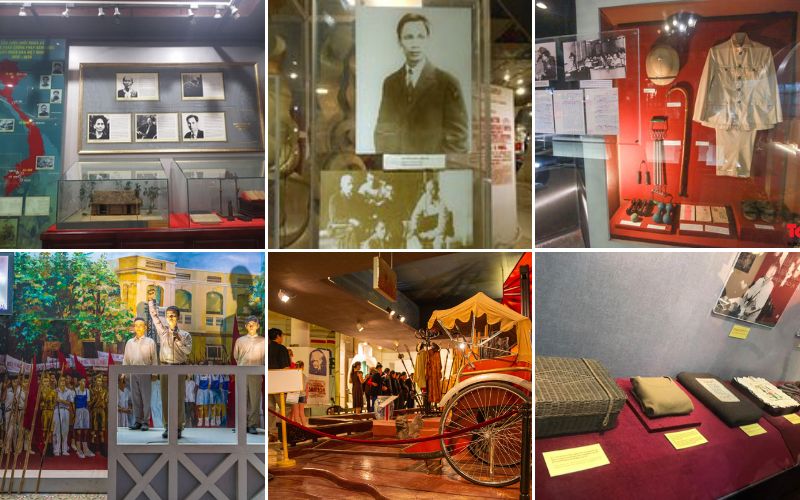
Historical objects and documents at Ho Chi Minh Museum
The collection spans six core halls dedicated to historical materials, with three additional rooms used for temporary and contemporary exhibitions. Plan at least 90 minutes to get through the permanent collection properly.
The “Nguyen Tat Thanh Seeking the Path to National Salvation” Statue
Outside the main building, sculptor Pham Muoi’s bronze statue of the young Ho Chi Minh stands 3.3 meters tall and weighs 1,000 kilograms. It depicts him as a young man at the moment of departure, before history caught up with him. Most visitors stop here for photographs. It is one of the more photographed spots along the entire Saigon River waterfront.
The Saigon River Views
The grounds run right along the riverbank. In the early morning, before the tour groups arrive, the view across the Saigon River to the centre skyline is genuinely good. The Bitexco Financial Tower, the newer riverside towers, and the movement of river traffic make for an interesting contrast with a building that predates all of it by over 150 years.
The late afternoon is worth considering too. The facade catches warm light from the west, and the riverside gets a breeze that cuts through the city heat. Many visitors who arrive just before 5:00 PM (17:00) get the added bonus of the illuminated facade after closing, which looks different again in the evening.
Temporary and Educational Exhibitions
The museum regularly organizes workshops, film screenings, seminars, and cross-generational discussions tied to Ho Chi Minh’s philosophy and Vietnam’s revolutionary history. If your travel dates align with a scheduled exhibition, it is worth checking the museum’s official schedule in advance.
Nha Rong Wharf Saigon: The Broader Riverside Context
Standing at Nha Rong Wharf, you are looking at a stretch of the Saigon River that has been central to the city’s commercial and political life for over 150 years. The French chose this location deliberately because of its deep-water access and strategic position relative to the city center.
Today, the surrounding area has changed considerably. The Saigon River waterfront has developed significantly since the early 2000s, with new hotels, the Thu Thiem urban district across the river, and expanded river cruise operations. Nha Rong Wharf sits at the older, quieter end of this riverfront, where the architecture and the trees create a more measured atmosphere than the tourist-heavy Nguyen Hue Walking Street area further north.
The closest major attractions within easy walking distance:
- Bach Dang Wharf Park (1.2 km): A good riverside park for a walk before or after the museum.
- Ho Chi Minh City Museum of Fine Arts (1.5 km): Strong permanent collection of Vietnamese art, worth half a day.
- Ben Thanh Market (2.3 km): Best reached by taxi or ride-hailing app rather than on foot. Read more in Ben Thanh Market best guide
- Reunification Palace (3 km): An essential stop on any Ho Chi Minh City itinerary, showing the opposite end of the city’s 20th-century political history. Visit our guide about Reunification Palace.
What to Eat and Drink Nearby
The area around Nha Rong Wharf is not a restaurant district, but there are solid options within a short distance.
Banh mi stalls appear along Nguyen Tat Thanh Street and the surrounding blocks from early morning. A filled banh mi costs 25,000 to 40,000 VND (roughly $0.96 to $1.53) and is one of the better quick breakfasts before the museum opens.

Crispy on the outside, packed with flavor inside. Banh mi is proof that Vietnam turns simple street food into something unforgettable.
Com tam (broken rice) is the classic Saigon lunch. Dozens of small com tam restaurants operate within a few minutes by motorbike taxi from the wharf. Expect to pay 50,000 to 80,000 VND (approximately $1.91 to $3.07) for a full plate with grilled pork, egg, and pickled vegetables.
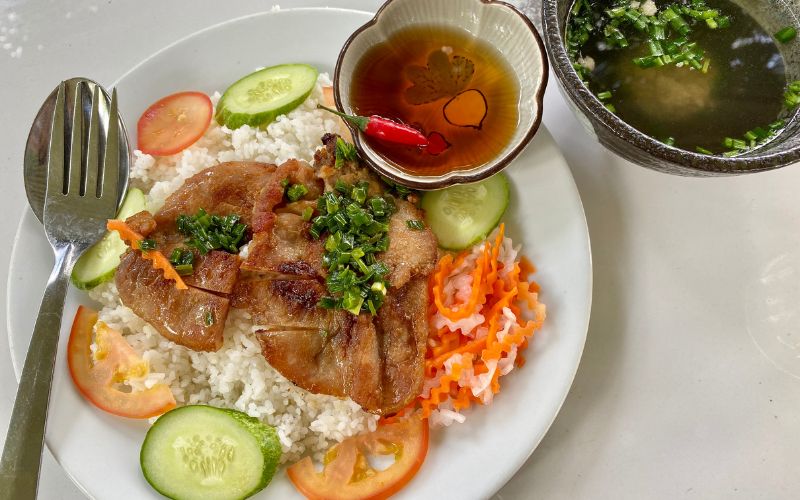
A simple plate of com tam, grilled pork, fragrant rice, and fresh sides. Sometimes the best way to understand Vietnam is through its everyday meals.
Ca phe sua da (Vietnamese iced coffee with condensed milk) is available at almost every small cafe in the neighborhood. It costs 20,000 to 35,000 VND ($0.76 to $1.34) and is considerably stronger than most coffee you have encountered elsewhere.

Ca Phe Sua Da
For a more organized dining experience, the riverside restaurants along Bach Dang Wharf (1.2 km away) have better views and sit-down service, though at higher prices.
Nha Rong Wharf in the Context of Vietnam History
For travelers interested in Vietnam’s 20th-century history, Nha Rong Wharf makes the most sense as part of a broader circuit through Ho Chi Minh City’s historical sites, rather than as a standalone visit.
A logical one-day sequence:
- Morning: Nha Rong Wharf and the Ho Chi Minh Museum
- Late morning: War Remnants Museum for documentation of the Vietnam War
- Afternoon: Reunification Palace for the political history of unified Vietnam
- Late afternoon: Notre-Dame Cathedral and the Central Post Office as examples of French colonial architecture in a different context
This sequence moves roughly from the colonial era forward through the 20th century, giving you a coherent narrative across a single day.
For travelers who want to spend more than a day in the south, Ho Chi Minh City tours from IDC Travel cover all the major historical sites with private guides who can provide context across multiple locations. For a deeper look at the broader region, Southern Vietnam tours extend from the city to the Mekong Delta, the beaches of Phu Quoc, and the highlands of Da Lat. Those planning a longer trip across the country should look at Vietnam tours and Vietnam holidays that cover multiple regions.
Conclusion: Visiting Nha Rong Wharf
| Detail | Information |
| Official name | Ho Chi Minh Museum, Ho Chi Minh City Branch (Vietnamese: Ben Nha Rong) |
| Address | 1 Nguyen Tat Thanh Street, Phu Lam Ward, Ho Chi Minh City, Vietnam |
| Website | https://bennharong.hochiminh.vn/ |
| Opening hours | Tue to Sun: 7:30-11:30 AM and 1:30-5:00 PM; Closed Monday |
| Entrance fee |
|
| Best time to visit | November to March; mornings for photography |
| Average temperature | 25-35 degrees Celsius (77-95 degrees Fahrenheit) year-round |
| Recommended visit duration | 1.5 to 2 hours |
| Nearest transport | Bus lines 02, 03, 19, 56; Grab/Be taxi; private car parking on site |
| Distance from the centre | Approx. 1.5 km (10-15 min by taxi) |
| Historical significance | Departure point of Ho Chi Minh, June 5, 1911 |
| Collection size | 11,300+ documents and artifacts; 3,300 books |
Nha Rong Wharf is a place where the facts are more interesting than any description of them. A 21-year-old left from here in 1911, worked as a kitchen hand on a French ship, spent three decades abroad, and came back to found a country. The building is well-preserved, the collection is extensive, and the riverside setting makes it worth the trip on its own. If you are putting together a Ho Chi Minh City itinerary, this one deserves a morning.
To plan a trip that includes Nha Rong Wharf alongside the best of southern Vietnam, get in touch with IDC Travel’s local advisors for a tailor-made itinerary.
Read more: