
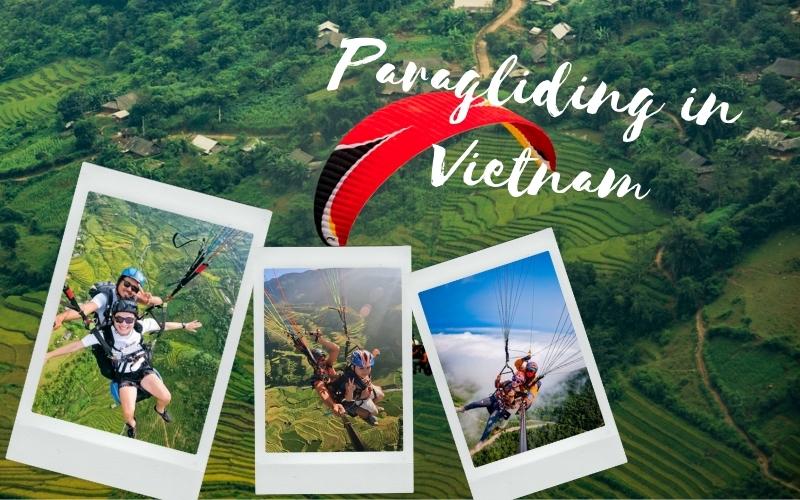
If you’ve been scrolling through videos of people soaring over rice terraces and turquoise coastlines and wondering whether paragliding in Vietnam is actually worth doing, the answer is yes. It’s genuinely one of those experiences that earns its reputation. Vietnam’s geography does most of the work: coastal ridges, mountainous terrain, and consistent seasonal winds give pilots reliable lift conditions across several regions.
This guide covers the best locations for Vietnam paragliding, the best time to fly, what a typical session looks like, safety considerations, and how to fit it into a broader Vietnam itinerary.
Best Places for Paragliding in Vietnam
Vietnam’s geography covers more paragliding ground than most travelers expect. From golden rice terraces in the northwest mountains to coastal ridgelines above turquoise bays, the country has more than 50 active flying sites, the most prominent locations include Da Nang, Hanoi, Sapa, Mu Cang Chai, and Da Lat. Below is a location-by-location breakdown, including where exactly to launch, how to book, and honest notes on the pros and cons of each spot.
1. Paragliding Da Nang (and Danang): Son Tra Peninsula
- Launch site: Ban Co Peak, Son Tra Peninsula (~400-600m elevation). Most operators pick up passengers at Buu Dai Son Pagoda, No. 31 Hoang Sa Street, Son Tra District, then drive up to the summit.
- Landing zone: Man Thai Beach, at sea level.
- How to book: Operators like Da Nang Paragliding Club handle bookings via WhatsApp, Zalo, and online booking platforms at Danang Paragliding Club. Book at least 2-4 hours in advance; during peak season, 1-2 days ahead is smarter. Flights typically last 10-15 minutes and include a GoPro video and photo package, with the meeting point at Buu Dai Son Pagoda before transport to the Ban Co Peak take-off site.
- Approximate price: $100-$115, including transport, GoPro footage, and travel insurance.
- Best months: March to September. October and November are the rainy season on the central coast; most operators suspend flights.
- What you’ll see: Son Tra Peninsula’s green headland, Linh Ung Pagoda and the Lady Buddha statue, My Khe Beach stretching south, the Han River delta, and Da Nang city from a bird’s-eye angle that no cable car gives you.
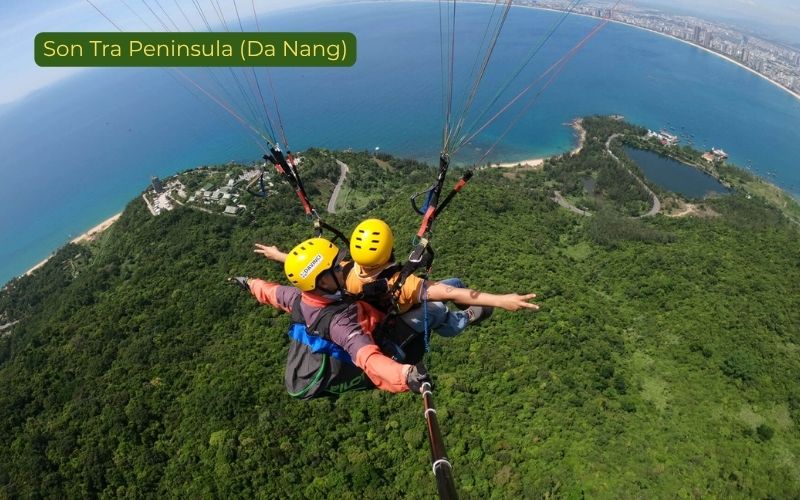
Tandem paragliding above Son Tra Peninsula in Da Nang.
| Pros | Cons |
| Most commercially developed paragliding scene in Vietnam, so operators are experienced and competitive on price. | Can feel crowded in high season, especially on weekends. |
| Easy logistics: operators handle all transport, and the meet point is accessible from the city center. | The weather window is seasonal; the rainy season (Oct-Nov) shuts things down entirely. |
| Long flight times (up to 30 minutes if conditions allow), since the ridge is reliable for soaring. | The peninsula road up to Ban Co Peak is winding; some passengers feel motion sickness before the flight even starts. |
First-timer advice: Go early morning (before 9 a.m.) for smoother air and better light for photos. Wear closed shoes, not sandals. The wind at the summit is colder than it looks from below, so bring a light layer.
>>> Already planning time in central Vietnam? See what else IDC Travel has arranged for travelers doing Da Nang and Hoi An day tours to fit paragliding alongside a full day on the ground.
2. Paragliding Hanoi: Doi Bu Mountain, Hoa Binh Province
- Launch site: Doi Bu (Bu Hill), Cao Son Commune, Luong Son District, Hoa Binh Province. The mountain sits about 35-45km southwest of central Hanoi, near Ba Vi National Park. The standard meetup point for transport packages is Highlands Coffee BigC, 222 Tran Duy Hung, Cau Giay, Hanoi; the alternative for those going directly is May Paragliding School.
- How to book: Operators like Ascendia Sports and local Hanoi-based paragliding schools offer online booking with hotel pickup options. Book at least 24-48 hours in advance.
- Approximate price: $63 to meet at the mountain, $75 with round-trip transport from Hanoi, or $132 for hotel door-to-door pickup and return.
- Best months: October through April (cool, dry air from the north). May-September brings monsoon rains that affect flying frequency.
- What you’ll see: Rolling green hills of Hoa Binh province, Ba Vi’s peaks in the distance, patchwork rice paddies in the valley below, and the winding route of the Da River.
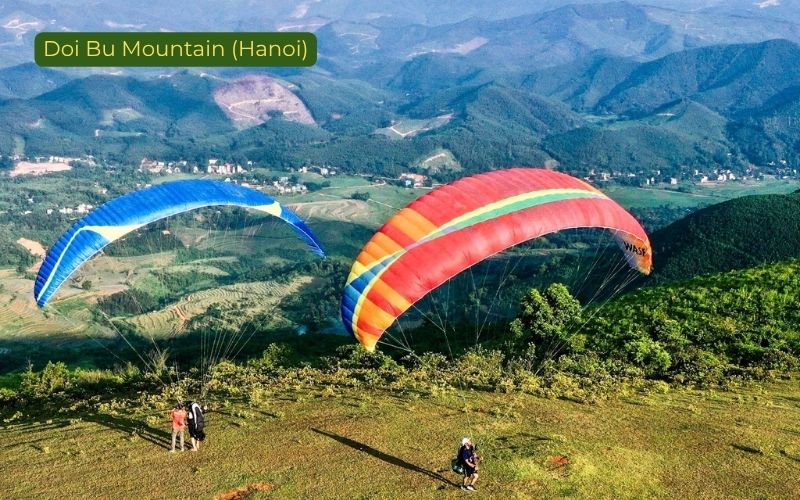
Paragliding at Doi Bu Mountain near Hanoi.
| Pros | Cons |
| Doi Bu, 45 minutes from Hanoi, is one of the busiest flying sites in Asia, with people flying almost daily. | The scenery isn’t as dramatic as Sapa or Mu Cang Chai; it’s rolling hills, not mountain ridges. |
| A half-day round trip from the city, so it works even with a tight itinerary. | Weather changes fast in the Hoa Binh hills; flights can be canceled without much notice. |
| Less crowded than Da Nang’s peninsula and a more rural, authentic countryside feel. | Transport logistics require planning; going independently without a pickup package adds complexity. |
First-timer advice: Go in early morning or late afternoon for smoother flights; midday thermals are more turbulent regardless of pilot skill. If you get motion sickness easily, keep your eyes on the horizon, not straight down.
>>> Combining paragliding with a broader Hanoi itinerary? Hanoi city tours can build in a day for the Doi Bu flight alongside Old Quarter, Hoan Kiem Lake, and temple visits.
3. Paragliding Sapa: Ham Rong Peak, 1,750 Meters
Sapa is where paragliding in Vietnam genuinely earns its “bucket list” reputation. Ham Rong take-off point, located at nearly 1,800 meters above sea level, is considered the highest launch site, operated by Fly Sapa Paragliding.
- Launch site: Ham Rong Peak, Sapa town. Take-off is at Ham Rong Mountain at 1,750 meters, with the landing zone at Ban Ta Van village in Muong Hoa Valley.
- Alternative launch: Hang Da Village, also above Muong Hoa Valley, used by some operators as a second site.
- How to book: Fly Sapa operates primarily via WhatsApp/Zalo at +84 58 414 6688, and via their website at Fly Sapa Paragliding. Book at least 3-4 days in advance to ensure pilot availability; last-minute bookings within 1 day may not be guaranteed.
- Approximate price: Flights start from approximately 2,390,000 VND/person (~$95), including hotel pickup, GoPro footage, insurance, and a flight certificate. Optional drone filming costs extra.
- Best months: April-May for the water season when terraces glisten like mirrors; August-September for golden rice fields. Flights operate year-round, each season offering different scenery.
- What you’ll see: Muong Hoa Valley’s layered rice terraces, the rooftops of Ta Van village far below, mist-covered peaks of the Hoang Lien Son range, and on clear days, the full sweep of the valley down toward Lao Cai.
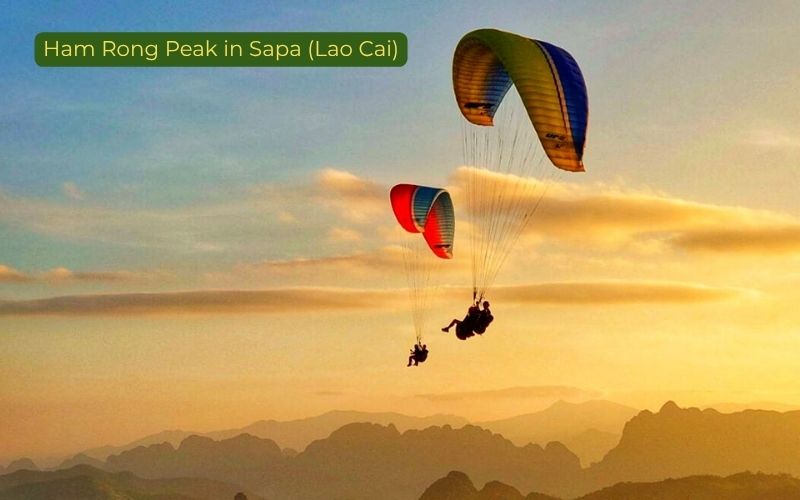
Sunset paragliding at Ham Rong Peak in Sapa.
| Pros | Cons |
| The highest commercial launch site in Vietnam (and higher than most sites globally); more altitude means longer potential flight time. | Sapa’s mountain weather is unpredictable; fog and low clouds frequently roll in and cancel flights, sometimes with little warning. |
| The 750m height difference between take-off and landing means even in neutral conditions, a typical tandem flight lasts around 12 minutes; on thermal days, significantly longer. | Getting to Sapa from Hanoi takes 5-6 hours by train and bus (or 30 minutes by flight to Lao Cai); it’s not a day trip from the capital. |
| Operators like Fly Sapa have built a strong reputation and handle logistics smoothly, including hotel pickup. | Weekend and holiday slots book out weeks in advance; flexibility is limited if your travel dates are fixed. |
First-timer advice: Don’t count on flying on your first afternoon in Sapa. Weather conditions often improve or clear later in the morning, and good operators will delay rather than rush a flight. Build one or two buffer days into your Sapa schedule.
>>> Sapa tours combine trekking, hill tribe village visits, and enough time to make a paragliding attempt realistic rather than rushed.
4. Paragliding Mu Cang Chai: Flying Over the Rice Terraces
If Sapa is the most famous name in northern Vietnam paragliding, Mu Cang Chai is the one that photographers and pilots consistently rate higher. The appeal of adventure tourism in Mu Cang Chai has been affirmed, with over 40-50% of visitors coming specifically for paragliding each year. Vietnam News
- Launch site: Khau Pha Mountain Pass, at 1,200-1,500 meters above sea level, one of the “four great peaks” of Vietnam’s northwest. To find it on Google Maps, search “Khau Pha Paragliding Site, Khau Pha Pass, Mu Cang Chai, Yen Bai” or click this address Khau Pha Paragliding Site.
- Landing zone: Lim Mong village, Cao Pha Commune (also the location of the annual paragliding festival landing area at Ban Lim Thai village).
- How to book: Nano Travel is one of the main operators running tandem flights, with ticket prices starting from around 2,190,000 VND (~$83). They offer GoPro recording, shuttle between landing and take-off, a homestay clubhouse, and flight insurance of up to 100,000,000 VND (~$3,795). Book online or via WhatsApp; advance booking is strongly recommended due to high demand.
- Approximate price: 1,500,000-2,200,000 VND/person (~$60-$90) depending on the package.
- Best months: Autumn (September-November) for golden terraces; spring (March-July) for lush green fields. The golden harvest season in late September is in peak demand.
- The annual festival: The Mu Cang Chai Paragliding Festival is held annually, drawing adventure enthusiasts and photographers eager to capture the terraced rice fields from the sky as they turn golden in the harvest season. It typically runs in late August to early September. During the festival window, spots fill up fast; book months in advance if this is your target.
- What you’ll see: The layered rice terraces of La Pan Tan, Che Cu Nha, and De Xu Phinh spreading across steep hillsides; the Hmong villages tucked in the valleys; the Khau Pha pass road winding far below.
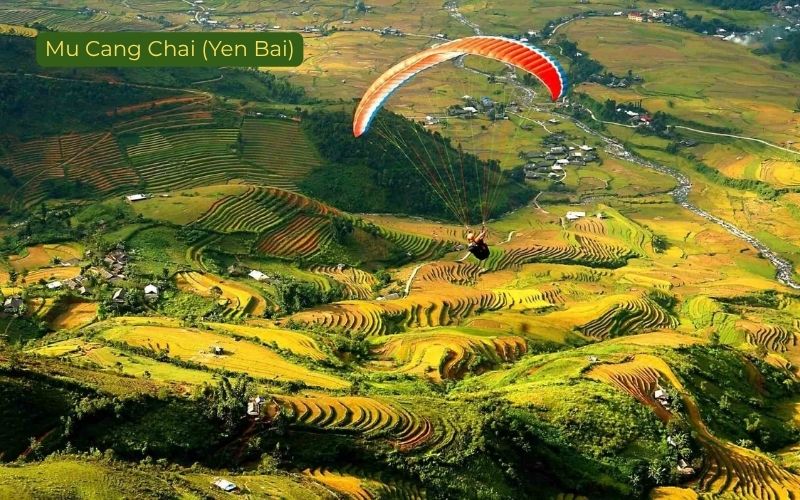
Paragliding over Mu Cang Chai rice terraces.
| Pros | Cons |
| The scenery below is simply exceptional; few flying sites anywhere in Southeast Asia can match the visual scale. | Flights are canceled on rainy, windy, or foggy days, and customers are notified at least before the flight date, but mountain weather can shift with little warning. |
| Less commercialized than Da Nang or Sapa, which means smaller crowds outside of the festival period. | Getting to Mu Cang Chai from Hanoi takes roughly 4-5 hours by road; it’s not a comfortable day trip. |
| The local cultural dimension (Hmong villages, harvest festivals) adds context to the experience that purely coastal flying lacks. | Infrastructure and accommodation options are limited; expect basic homestays rather than hotel comforts. |
First-timer advice: Combine the paragliding with at least one overnight in Mu Cang Chai. The light on the terraces at sunrise and sunset is worth the extra time, and trying to do it as a rushed day trip means spending more hours in a vehicle than in the air.
5. Paragliding Da Lat: Lang Biang Mountain
Da Lat is Vietnam’s “City of Flowers” and sits at around 1,500 meters elevation in the Central Highlands, which creates naturally cool conditions for flying.
- Launch site: Radar Peak of Lang Biang Mountain, with the landing zone at Dan Kia Lake. Lang Biang is located at No. 305 Lang Biang Street, Lac Duong Town, Lac Duong District, Lam Dong Province about 12km north of Da Lat city center.
- How to get there: Take a jeep up to Radar Peak from the Lang Biang tourist area entrance gate. The jeep service is available at the site.
- How to book: Paragliding at Lang Biang is managed through the Lang Biang tourist area and affiliated operators on-site. Unlike the coastal and northern mountain operators, walk-up booking is often possible (especially outside peak season), but weekends and holidays at Lang Biang fill up early.
- Approximate price: Ticket price for one flight is approximately 600,000 VND (~$25), making this one of the more affordable paragliding experiences in Vietnam.
- Best months: November to April (the dry season in the Central Highlands). The rainy season (May to October) brings frequent afternoon downpours that cancel afternoon flights.
- What you’ll see: Da Lat’s pine-covered hills rolling in every direction, Dan Kia Lake glinting below, Suoi Vang Lake on clear days, and the city’s distinctive French colonial rooftops peeking through the tree canopy.
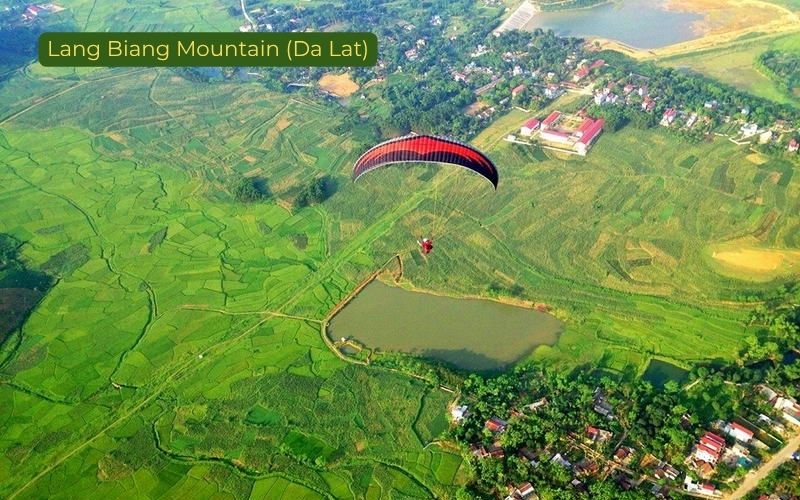
Paragliding over Lang Biang Mountain in Da Lat.
| Pros | Cons |
| Most affordable paragliding option among Vietnam’s major destinations. | The experience is more basic compared to northern mountain operators; GoPro video and shuttle services may not always be included at the base price. |
| Da Lat’s altitude means cooler temperatures year-round, which makes for a more comfortable experience than flying in humid coastal heat. | Radar Peak altitude (~2,100m) is high, but the actual flying height above the landing zone is more modest compared to Sapa’s Ham Rong. |
| Lang Biang is already a popular day trip from Da Lat, so adding paragliding fits naturally into a broader itinerary. | Lang Biang is a busy domestic tourist site, so the paragliding area can feel hectic on Vietnamese national holidays. |
First-timer advice: Go on a weekday if possible. Lang Biang draws large weekend crowds of local tourists, and the paragliding queue moves slower when it’s busy. Morning flights before 10am also tend to have calmer winds.
6. Paragliding Near Ho Chi Minh City: Da Teh, Lam Dong Province
Ho Chi Minh City itself has no suitable terrain for paragliding, but the southern highlands offer a workable option for travelers based in the south who don’t want to commit to a full northern circuit.
- The main site: Dateh or Da Teh, near Ho Chi Minh City, is one of the well-regarded southern flying sites, with the dry season (December to April) offering cloudbase over 2,500m, strong thermals, and reliable flying conditions. Da Teh is in Lam Dong Province, roughly 200km north of Ho Chi Minh City, making it a long day trip or a short overnight trip.
- What makes it different: Paragliding in Da Teh includes views of Da Teh Lake, a large turquoise reservoir surrounded by coffee plantations. The combination of highland terrain, lake views, and agricultural scenery below is genuinely different from coastal flying or the rice terrace landscape of the north.
- How to book: Da Teh is less developed for international tourists than Da Nang or Sapa. Most bookings happen through Vietnamese-language local operators or adventure sports agencies based in Ho Chi Minh City (our guide can help you solve this issue). Platforms like Klook and Viator list some southern Vietnam paragliding options; filtering by location will show available operators.
- Approximate price: In the range of 1,200,000-1,800,000 VND (~$48-$72) depending on the operator and what’s included.
- Best months: December to April. The southern dry season brings thermals that are strong, wide, and relatively soft-edged, similar in character to conditions in northern Thailand.
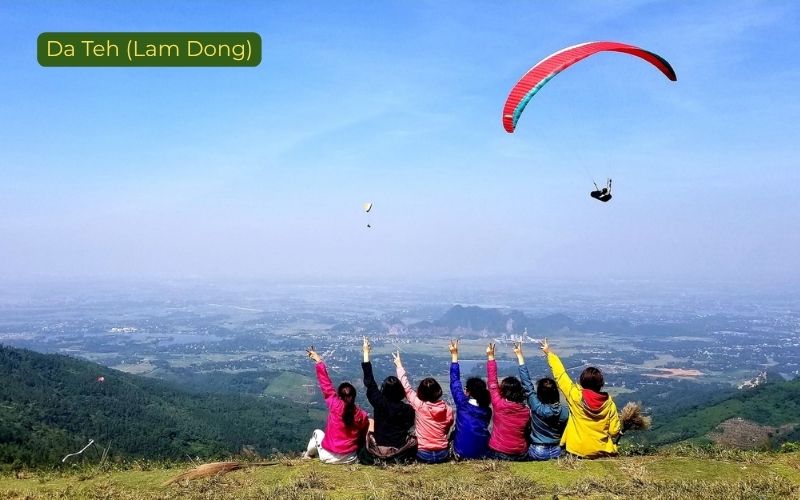
Paragliding in Da Teh, Lam Dong.
| Pros | Cons |
| The most practical option for travelers spending their trip in the south without time to reach central or northern sites. | Operator quality and infrastructure are less developed than at the major tourist sites; vetting your operator carefully matters more here. |
| Da Teh’s coffee and lake scenery is less photographed than Sapa or Mu Cang Chai, which appeals to travelers looking for something off the standard trail. | The journey from Ho Chi Minh City (around 3-4 hours each way) makes it a full day commitment. |
| Southern dry season is long and reliable (five solid months), giving more scheduling flexibility. | Limited English-language booking resources; communication can require patience. |
First-timer advice: If you’re based in Ho Chi Minh City and keen on paragliding, Da Lat is an easier alternative. The city has direct flights or an overnight bus, the Lang Biang site is well-established, and you can pair the flight with Da Lat’s other attractions rather than spending a full day in transit for Da Teh alone.
Quick Comparison: Vietnam Paragliding Locations at a Glance
| Location (Province/City – Destination) | Best Season | Price (USD) | Best For |
| Da Nang – Son Tra | Mar-Sep | $100-$115 | Coastal views, easy logistics |
| Hanoi – Doi Bu | Oct-Apr | $63-$132 | Half-day from city, convenient |
| Lao Cai – Sapa | Year-round | ~$95 | Highest launch, dramatic scenery |
| Yen Bai – Mu Cang Chai | Sep-Nov | $60-$90 | Rice terraces, festival atmosphere |
| Da Lat – Lang Biang | Nov-Apr | ~$25 | Budget-friendly, highland cool |
| Lam Dong – Da Teh | Dec-Apr | $48-$72 | Southern travelers, lake views |
Best Time to Go Paragliding in Vietnam
Vietnam’s weather is regional, and this matters a lot for paragliding. The country is long and narrow, so conditions that are ideal in Da Nang may be poor in Hanoi at the same time.
- Northern Vietnam (Hanoi, Sapa, Mu Cang Chai): October through April offers the clearest skies and most stable thermals in the mountains. The summer monsoon season (May through September) brings heavy rainfall that disrupts flying.
- Central Vietnam (Da Nang, Nha Trang, Da Lat): The best flying window runs March through September. October and November bring the rainy season to the central coast, which closes most operations.
- Southern Vietnam: January through August is generally reliable. The short rainy season here (October through December) is less severe than the north or center.
If your Vietnam trip is already planned around a fixed date, check which region aligns best with your window rather than assuming conditions everywhere are the same.
What a Tandem Paragliding Session Actually Involves
Most visitors to Vietnam do tandem flights rather than solo. Here’s what to expect from a typical session:
- Briefing (10 to 15 minutes): the pilot walks you through the harness, take-off procedure, and what to do with your body during launch and landing. It’s straightforward, not technical.
- Gearing up: You’re fitted into a harness that connects directly to the pilot’s. The total setup takes a few minutes.
- Launch: Most launches in Vietnam are slope launches. You run a few steps downhill into the wind, the canopy fills, and you’re airborne within seconds. It’s less dramatic than it sounds.
- The flight: You’re seated in the harness, which is more comfortable than standing. Good pilots will explain what they’re doing and point out landmarks.
- Landing: Controlled, slow, and usually in a flat field or beach area. First-timers consistently describe it as anticlimactic in the best way.
The whole experience from gear-up to landing typically takes 30 to 45 minutes. Flight time in the air is usually 10 to 20 minutes depending on conditions.
What to Know Before You Book
Vietnam paragliding has grown quickly, and operator quality varies. A few things that separate reliable operators from those worth avoiding:
- Certification matters: pilots should hold certification from recognized bodies like the BHPA (British Hang Gliding and Paragliding Association) or equivalent. Don’t be shy about asking to see it.
- Equipment age: modern certified wings have a lifespan. Ask when the equipment was last inspected or replaced.
- Weather judgment: a good operator will cancel or delay flights without hesitation if conditions aren’t right. If they’re pushing to fly in questionable weather, that’s a reason to walk away.
- Insurance: most standard travel insurance excludes adventure sports by default. Check your policy before you go, or upgrade to a plan that covers paragliding.
Vietnam doesn’t have a national regulatory body that governs paragliding the same way some countries do, so due diligence falls more on the traveler. Reputable operators working with established tour agencies are a safer starting point than booking through a random listing.
Why Vietnam Works So Well for Paragliding
Most people don’t associate Vietnam with adventure sports, but the country’s topography is quietly well-suited to it. The central coast in particular has a ridge-and-sea setup that produces reliable thermal and dynamic lift. In the north, dramatic mountain ranges around Hanoi create conditions that attract experienced pilots. In the south, Nha Trang’s bay geography funnels consistent coastal winds.
Beyond the flying itself, the views are what travelers remember. Coming off a ridge and seeing a bay, a fishing village, or a valley of green fields below isn’t something you replicate on a beach chair.
Final Conclusion to Plan Your Vietnam Adventure
IDC Travel specializes in private, tailor-made Vietnam itineraries that can incorporate adventure activities like paragliding alongside cultural visits, beach stays, and regional travel. If you want to build a trip that actually fits your interests rather than following a preset schedule, their team can put together a route based on where you want to fly and what else you want to see.
Read more




This sounds like such an incredible adventure! I had no idea Vietnam had so many paragliding spots with views this stunning, especially Khau Pha Pass and Bai Nha Trang. Definitely adding this to my bucket list. Thanks for the tips on the best season too; super helpful for planning. Can’t wait to see Vietnam from the sky one day!
Hi Daniel, thank you so much for reaching us! Vietnam’s landscapes are breathtaking from the ground, but witnessing them from the sky elevates them to a whole new level! I hope you have the opportunity to experience this once in your lifetime! If you need any support for your paragliding experience in Vietnam in the foreseeable future, do not hesitate to contact us!
Best regards,
IDC Travel Team.
I am in Danang from the end of February and the whole of March and would like to learn paragliding. I already have the flight licenses for paragliders, trikes, gyrocopters and ultralight aircraft. Please contact us
Dear Mr.Thomas,
Thank you so much for your interest!
Our specialist will be sure to email you as soon as possible.
Best regards,
IDC Travel Team.