
Laos might be the quietest country in Southeast Asia, but during festival season it’s a different story. Festivals in Laos are where you see the real character of the place: monks in candlelit processions, entire villages launching homemade rockets skyward, and the Mekong lit up with thousands of floating banana-leaf boats after dark. These celebrations are tied to the Buddhist calendar and to agricultural traditions that go back centuries, and most of them are still genuinely community events rather than tourist productions.
Whether you’re planning a dedicated Laos tour around a specific date or just want to time your trip well, this guide covers the ten most important Lao festivals, what actually happens at each one, and everything you need to know before you go.
1. Pi Mai Lao – Laos New Year
Laos New Year, locally known as Pi Mai Lao or Boun Pi Mai, is the biggest celebration on the Lao calendar. It marks both the traditional solar new year and the Lunar New Year in Laos, shared across mainland Southeast Asia alongside Thailand’s Songkran and Cambodia’s Khmer New Year. If you only catch one festival during your Laos travel, make it this one.
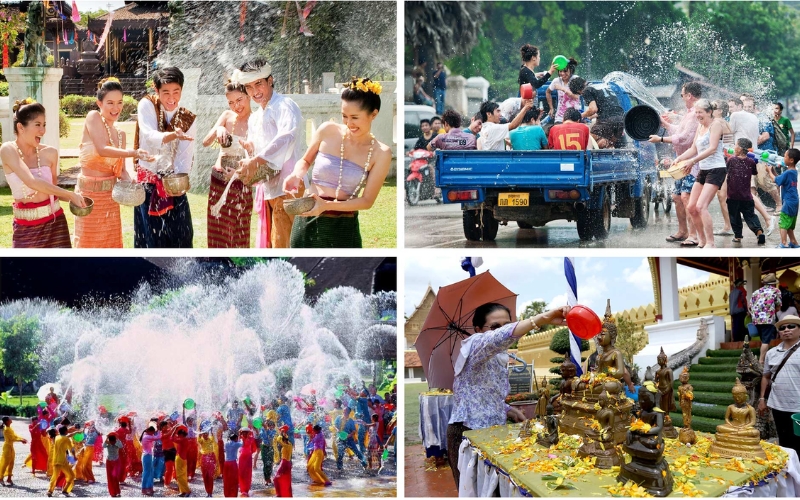
The biggest festival in Laos, Boun Pi Mai
- Date: April 13-15 (dates vary slightly by year)
- Location: Luang Prabang (most ceremonial), Vientiane (most lively)
- Duration: 3 days officially, often 5-7 days in practice
- Cost: Free to attend; budget for accommodation booked 2+ months ahead
- Crowd level: Very high, Luang Prabang fills up fast
- Best for: Culture seekers, families, first-time visitors to Laos
The centerpiece in Luang Prabang is the procession carrying the sacred Prabang Buddha image through the old town, with locals lining the streets to pour scented water over it as an act of purification. Sand stupas rise up in every temple courtyard, decorated with flags and incense sticks. And then there are the water fights: cheerful, unavoidable, and part of the ritual logic of washing away the old year.
Luang Prabang and Vientiane have different atmospheres for Pi Mai. The capital leans into the street party side of things. Luang Prabang is more ceremonial, slower, and the processions are given real weight. If you want the visual spectacle of the Buddhist traditions rather than just the water throwing, Luang Prabang is the better call.
Traveler tip: ATMs in Luang Prabang run dry during the holiday. Arrive with enough cash for the full three days. Wearing a traditional Lao “sinh” (sarong) or white clothing to temple events is genuinely appreciated by locals.
2. Boun That Luang – That Luang Festival
The That Luang Festival in Laos is the country’s national religious festival, the closest thing Laos has to a state celebration. It takes place at Pha That Luang, the great golden stupa in Vientiane that appears on the national seal, and draws pilgrims from across the country and from Lao communities throughout the region.
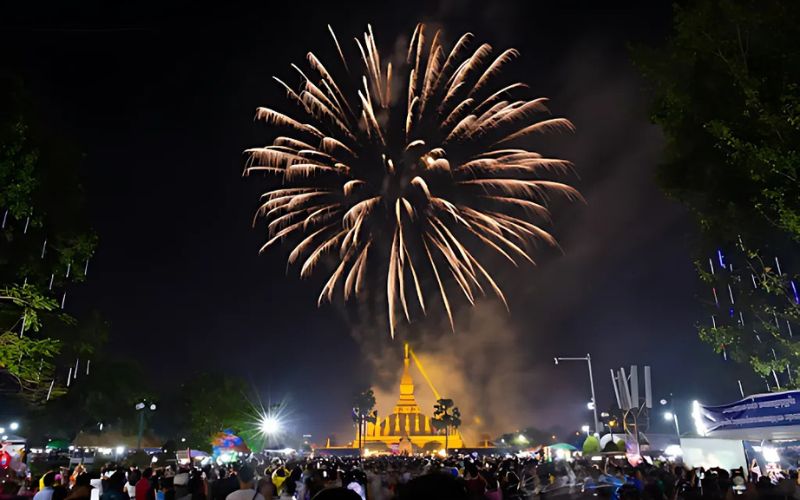
Lao people Celebrate That Luang Festival
- Date: Full moon of the 12th lunar month (usually November)
- Location: Pha That Luang, Vientiane
- Duration: 7 days
- Cost: Free; trade fair stalls, food, and carnival rides at the fairground
- Crowd level: High, particularly on the full moon night
- Best for: Travelers based in Vientiane, anyone interested in Lao Buddhism
The week has two distinct moods. The first half is devoted to religious observance: monks circle the stupa in candlelit processions at dawn, laypeople bring offerings of flowers and incense, and the golden tower is bathed in soft light from thousands of candles. The second half shifts into a full trade fair, with food stalls, craft vendors, carnival rides, and live performances running through the night around the temple complex.
The full moon night procession is the moment to be there. Thousands of people walk slowly around That Luang holding candles and flowers, low chanting drifting over the crowd. It’s quiet in the way that large gatherings sometimes are when everyone is paying attention to the same thing.
Traveler tip: The fairground outside the stupa gets chaotic and fun from day four onward. If you want the solemn side, arrive for the first two days of the festival.
>>> If you still wonder why Boun That Luang is the festival you can’t miss in Laos, read more our guide for more information.
3. Boun Suang Heua – Boat Racing Festival
The boat racing festival in Laos, Boun Suang Heua, marks the end of Buddhist Lent (Ok Phansa) and takes place at rivers across the country. It’s one of those festivals that feels like it belongs entirely to the Lao people: the stands are full of local families, the food stalls are running on homemade recipes, and the racing itself is genuinely competitive.
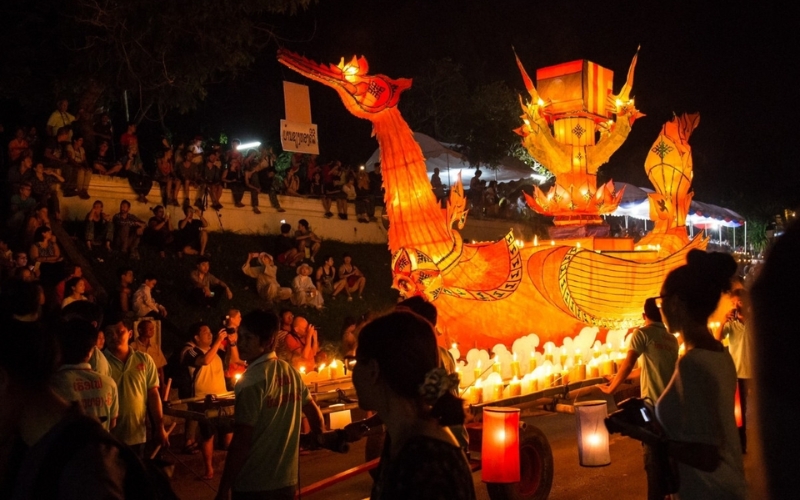
Boun Suang Heua in Luang Prabang
- Date: 15th day of the 11th lunar month (October)
- Location: Vientiane (Mekong riverfront), Luang Prabang, Savannakhet
- Duration: 2-3 days
- Cost: Free to watch from the riverbanks
- Crowd level: Moderate to high; more local than tourist
- Best for: Travelers who want an authentic, non-touristy Lao experience
Long wooden boats carved from single tree trunks carry crews of up to 50 paddlers. Drums beat the stroke rhythm, the boats move fast, and the noise from both banks is constant. Between races, the riverside turns into one long food market.
What makes the Vientiane event stand out is how local it stays. Even at the main event on the Mekong, the atmosphere is the city celebrating for itself, not performing for visitors. You’re a guest at someone else’s party, which is the best way to experience a festival.
4. Lai Heua Fai – Fire Boat Festival, Luang Prabang
The fire boat festival in Luang Prabang, known as Lai Heua Fai, is one of the most photographed events in Southeast Asia, and one of those rare cases where the reality matches the pictures. It happens at the same time as the boat racing festival and is tied to the same Ok Phansa celebrations, but the mood is completely different – quieter, more spiritual, and entirely about the river.
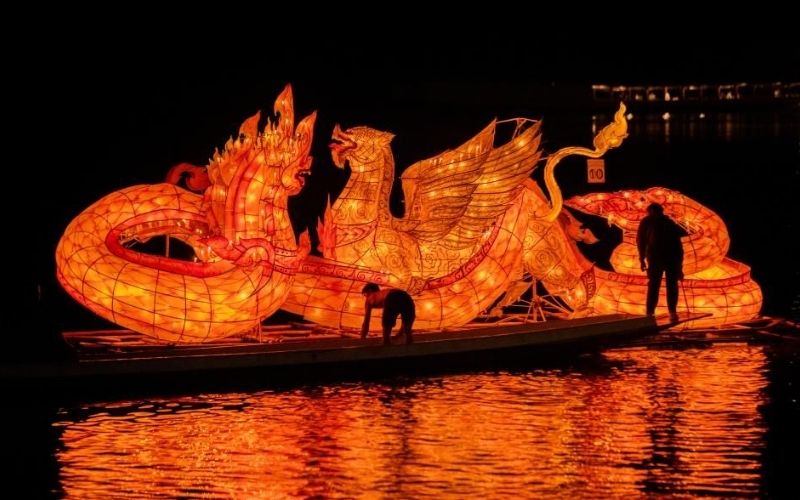
Lai Heua Fai in Luang Prabang
- Date: End of Buddhist Lent, coinciding with Boun Suang Heua (October)
- Location: Mekong riverfront, Luang Prabang
- Duration: 1-2 evenings
- Cost: Free; small banana-leaf boats available to purchase and release (a few thousand kip)
- Crowd level: Moderate – busy but not overwhelming
- Best for: Photographers, couples, travelers seeking a quieter Laos experience
After dark, thousands of small banana-leaf boats carrying candles and incense are released onto the Mekong. They drift downstream in long glowing lines. Larger illuminated floats built by local temples and community groups follow behind them. Standing on the bank and watching the river fill with light is an experience that’s hard to prepare for.
Monks bless the boats from nearby temples before the release, and visitors are welcome to release their own as a way of sending away bad luck and honoring the river spirits. If you only do one evening event during your time in Laos, this is the one.
>>> Let’s discover Lai Heua Fai, an unmissable Lao cultural experience with us!
5. Boun Bang Fai – Rocket Festival
The rocket festival in Laos, Boun Bang Fai, is the most fun you’ll have at a Lao festival. It’s pre-monsoon season, the logic being that firing rockets into the sky persuades the rain gods to send water for the rice harvest. The execution is chaotic, loud, and genuinely joyful.
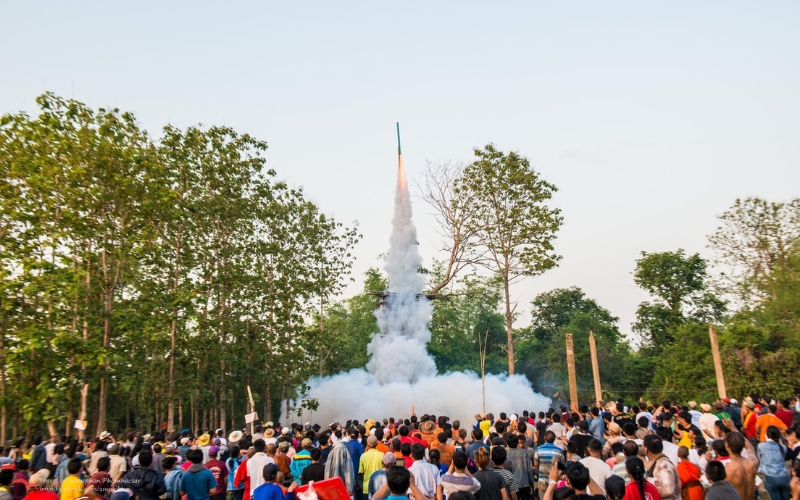
A rocket launch during Boun Bang Fai
- Date: May (before the rainy season; dates vary by village)
- Location: Khammouane Province, Vientiane, and rural villages across central and southern Laos
- Duration: 2 days
- Cost: Free to attend; food and “lao-lao” (rice whiskey) available throughout
- Crowd level: Moderate; more local than international
- Best for: Travelers who want something different from temple festivals; adventure types
Villages and towns spend weeks building their rockets, some of them enormous bamboo constructions. The competition is fierce. A rocket that fails to launch is a bad omen for the village and the team responsible gets thrown into the mud. This is not metaphorical. Alongside the launches, there are dance performances, traditional music, and a general carnival atmosphere that goes well into the night.
Khammouane Province hosts one of the largest celebrations and pairs well with a visit to the Konglor Cave, making it a natural addition to a broader central Laos itinerary.
Traveler tip: This festival has a raucous energy that’s very different from the Buddhist ceremonies. It’s a good balance if your trip has been heavy on temple visits.
>>> We updated information of this festival, check out Bun Bang Fai Thailand – Laos 2026 if you want to know more.
6. Boun Khao Padap Din – Festival of the Dead
Boun Khao Padap Din is one of the quieter festivals on this list, but it rewards the travelers who seek it out. It’s a Buddhist merit-making festival when offerings are made for the spirits of the deceased, and it’s still observed primarily by Lao people rather than international visitors.
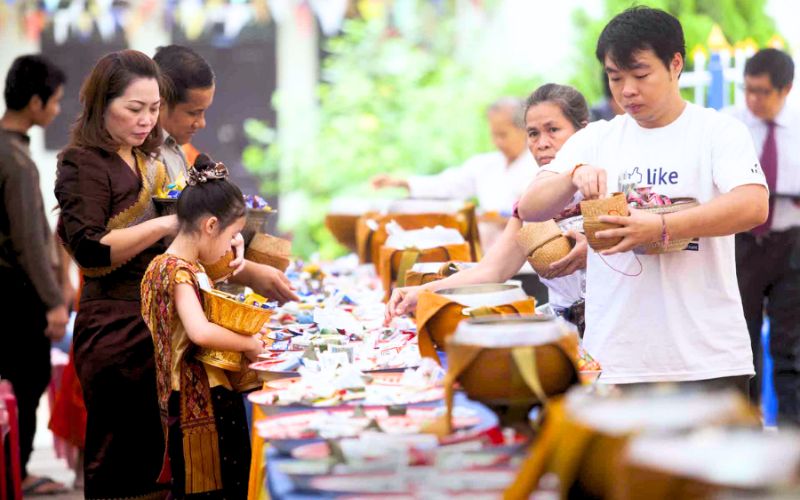
People making merit and offering food during Boun Khao Padap Din, the festival of the dead in Laos.
- Date: Waning moon of the 9th lunar month (August-September)
- Location: Temples across Luang Prabang and Vientiane
- Duration: 15 days (observance period); most activity in final days
- Cost: Free
- Crowd level: Low tourist presence; primarily a local religious event
- Best for: Travelers interested in Buddhist traditions and everyday Lao life
Families bring food offerings to temples for monks to share with the spirits of ancestors. The temple ceremonies in Luang Prabang are particularly atmospheric in the early morning, when incense smoke drifts through the old quarter and monks receive alms in near silence. It’s a side of Laos holidays and traditions that most visitors never see.
7. Nopee – Hmong New Year
The Hmong New Year, celebrated in December across the northern highlands, feels unlike any other festival in Laos. The Hmong are one of the country’s largest ethnic minority groups, and their new year celebration is a major social and cultural event tied to the end of the harvest season.
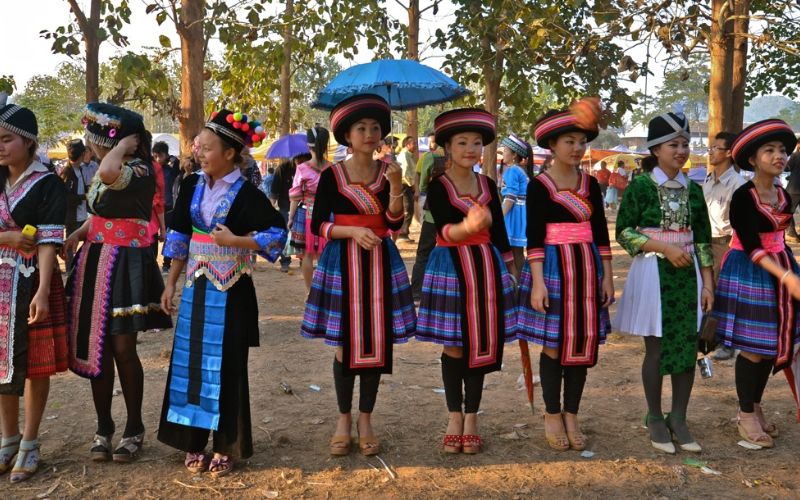
Women dressed in traditional Hmong attire for New Year celebrations in Laos.
- Date: December (after harvest; exact dates vary by community)
- Location: Luang Namtha, Phonsali, Xieng Khouang; largest celebrations in Luang Prabang province
- Duration: Several days
- Cost: Free to observe
- Crowd level: Very low tourist presence
- Best for: Cultural travelers, those already in northern Laos
Young men and women dress in intricate embroidered costumes and participate in “pov pob”, a traditional courtship ritual involving tossing small cloth balls back and forth. Buffalo racing and top spinning competitions run through the day. The food is different from lowland Lao cuisine, richer, with more use of corn and local herbs.
Getting to the Hmong New Year requires some planning. A Laos adventure tour through the northern highlands can be timed around this period and combined with trekking in Luang Namtha or visits to the Plain of Jars in Xieng Khouang.
8. Boun Pha Wet
Boun Pha Wet is a temple festival based on the Jataka tale of the Bodhisattva Vestantara – one of the Buddha’s previous lives and is mainly observed in rural communities and smaller towns. It’s not on most travelers’ radar, which is exactly what makes it worth finding.
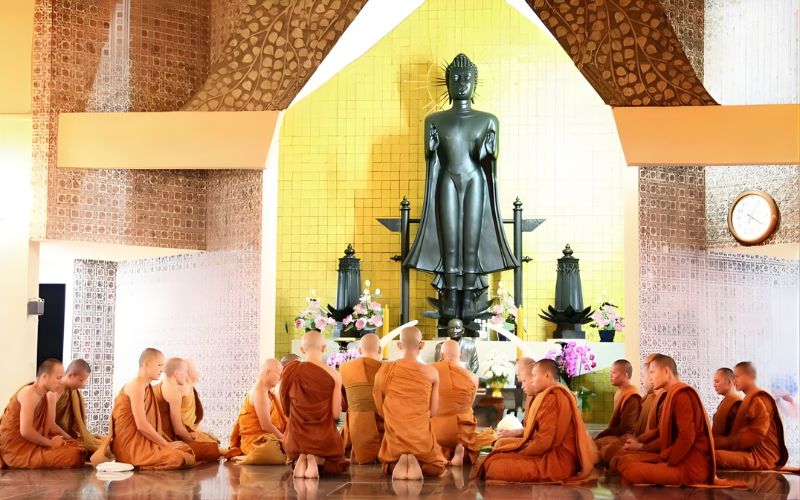
Monks gathered at a temple in Laos for Boun Pha Wet ceremonies.
- Date: February-March (lunar calendar; varies by village)
- Location: Rural temples across Laos; most active in the Mekong valley towns
- Duration: 1-3 days per community
- Cost: Free
- Crowd level: Almost entirely local
- Best for: Off-the-beaten-path travelers; those staying in smaller towns
All-night chanting sessions fill the temple halls while laypeople bring food and flowers. Temple facades are decorated with elaborate banana leaf and bamboo arrangements. The festival marks the last great act of generosity in Buddhist tradition, and participating communities take the preparation seriously. Stumbling across Boun Pha Wet during a slow riverside journey through the Mekong corridor is one of those Laos experiences that doesn’t make it into most travel blogs.
9. Boun Khao Salak – Spirit Festival
Boun Khao Salak follows closely after Boun Khao Padap Din and completes the two-part cycle of ancestor-honoring festivals. Where Padap Din is for all the dead, Khao Salak is specifically for those who died without family, unknown souls with no one to make offerings for them.
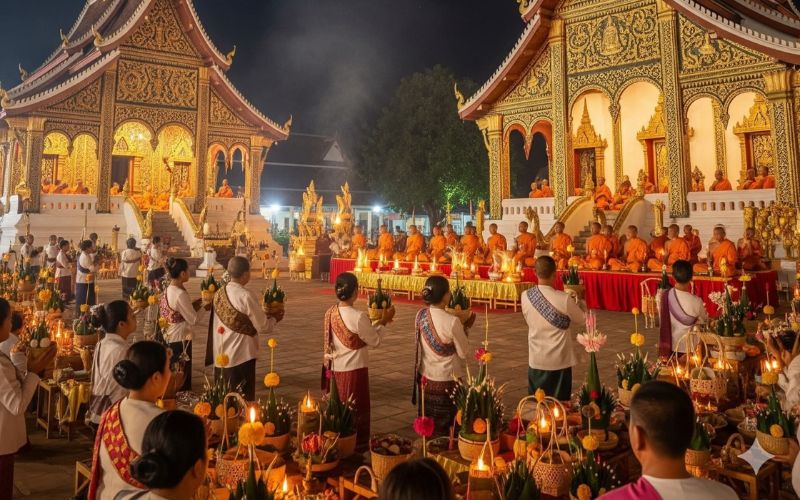
Lao people and monks gather at a temple for Boun Khao Salak, the autumn festival for making merit for ancestors.
- Date: Full moon of the 10th lunar month (September-October)
- Location: Buddhist temples nationwide; particularly observed in Vientiane and Luang Prabang
- Duration: 1-2 days
- Cost: Free
- Crowd level: Very low; almost entirely a local religious observance
- Best for: Travelers seeking authentic Buddhist culture off the festival circuit
Monks chant through the night while laypeople bring rice and food parcels tied to bamboo sticks – the “khao salak”, which give the festival its name. The parcels are distributed by lot among the monks, representing merit being shared with wandering spirits. It’s a deeply compassionate ritual that says something about how Lao Buddhism thinks about community and obligation.
10. Christmas and New Year Celebrations in Vientiane
Laos has a small but significant Catholic community, and Vientiane has a lively end-of-year atmosphere that surprises many first-time visitors. The Laos travel scene in December and January has grown considerably, and the capital’s riverfront and night markets take on a festive character that pairs well with the Hmong New Year happening in the north at the same time.
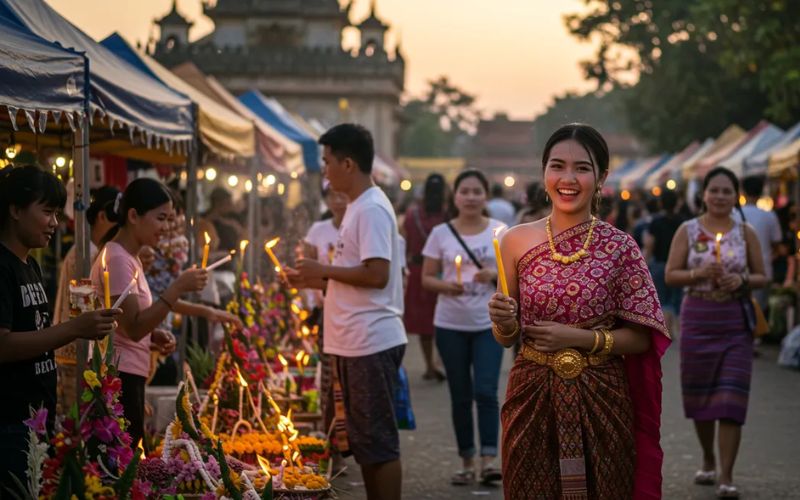
Crowds gather at Patuxai Park in Vientiane for the 2026 New Year countdown, featuring light shows and fireworks.
- Date: Late December through early January
- Location: Vientiane (Nam Phu Fountain area, Mekong riverfront)
- Duration: 2-3 weeks of festivities
- Cost: Free; dining and market spending variable
- Crowd level: Moderate; increasing number of international visitors
- Best for: Travelers combining Laos with a broader regional trip; families
The Vientiane night market along the Mekong is filled with food stalls and local crafts. Restaurants around Nam Phu Square run special menus. It’s not a Lao Buddhist festival, but it’s a reminder that Vientiane is a real city with its own cosmopolitan character.
Travel Tips for the Best Experience in Laos festivals
By following these tips, you can fully immerse yourself in the vibrant and spiritual atmosphere of Laos festivals, creating unforgettable memories and a deeper connection to this beautiful country.
- Plan your trip in advance: research festival dates in advance as they are often based on the lunar calendar and can change from year to year. Popular festivals such as That Luang and Boun Wat Phou attract visitors from all over Laos and beyond, so book your accommodation and transport in advance to avoid last-minute hassles.
- Respect temple etiquette and local customs: dress appropriately, especially when visiting temples or taking part in ceremonies. Take off your shoes before entering temples or sacred sites. Avoid touching Buddha statues or monks and follow any specific instructions given by temple staff or locals.
- Interact with locals: Participate in activities such as giving alms to monks, ceremonies or learning traditional dances. Learn a few simple phrases like “Sabaidee” (Hello) or “Khawp Jai” (Thank you) to communicate more friendly with locals and show respect. Interacting with locals can provide more insight into the cultural and spiritual significance of the festival.
- Prepare for crowds: Large festivals can attract large crowds, especially in popular cities like Vientiane and Luang Prabang. Arrive early to ensure a good spot for parades, festivals or cultural performances. Always carry important personal items to avoid losing or being stolen.
- Stay hydrated and protect yourself from the sun: Bring a reusable water bottle to stay hydrated and apply sunscreen, a wide-brimmed hat and sunglasses to protect yourself from the sun.
Conclusion for Your Laos Trip Around a Festival
Quick Reference: Festivals in Laos by Month
| Month | Festival | Location |
| February-March | Boun Pha Wet | Rural temples |
| April | Pi Mai Lao (Laos New Year) | Luang Prabang / Vientiane |
| May | Boun Bang Fai (Rocket Festival) | Khammouane / Vientiane |
| August-September | Boun Khao Padap Din | Nationwide |
| September-October | Boun Khao Salak | Nationwide |
| October | Boun Suang Heua (Boat Racing) | Vientiane / Luang Prabang |
| October-November | Lai Heua Fai (Fire Boats) | Luang Prabang |
| November | That Luang Festival | Vientiane |
| December | Hmong New Year | Northern highlands |
| December-January | New Year Celebrations | Vientiane |
Most festivals in Laos follow the lunar calendar, so dates shift each year. Checking the exact dates for the year you’re traveling matters, especially for Pi Mai and That Luang, which are the two events that fill up accommodation fastest.
If you’re planning a Laos tour built around a specific celebration, the itinerary needs some flexibility, festivals sometimes run a day longer or shorter than expected, and getting to some locations (northern highlands for Hmong New Year, Khammouane for Boun Bang Fai) takes travel time. Our Laos classic tours and Laos family holidays are fully private and tailor-made, which means departure dates and pacing can be built around the festival calendar rather than the other way around.
For travelers combining Laos with Vietnam or Cambodia, the Vietnam and Laos tours work well for April (catching Pi Mai in Luang Prabang) or November (That Luang in Vientiane before heading south). Contact to us to find the right match for your dates.
>>> Refer to Lao PDR Travel.
Read more:

Great read! Which of these would you say is most family-friendly? I’ll be traveling with kids.
Dear Jade,
Thank you for your kind words! We’re glad you enjoyed the read.
For a family-friendly experience, we highly recommend the That Luang Festival in Vientiane. It offers a vibrant yet respectful cultural atmosphere, with beautiful processions, traditional music, and activities that are suitable for all ages. The setting around That Luang Stupa is also spacious and safe for children to explore. If your kids enjoy visual spectacles, the Lai Heua Fai (Boat Racing and Fire Festival) in Luang Prabang is another great option. It’s colorful, engaging, and held along the river, making for a truly memorable evening.
If you’d like help planning a family-friendly itinerary around one of these festivals, feel free to reach out — we’d be happy to assist!
Best regards,
IDC Travel Team
I had the chance to experience the Pi Mai Lao festival, and it was unforgettable! The water fights, cultural performances, and warm hospitality made it such a joyful celebration. Laos truly knows how to bring people together during its festivals!
Dear Peter,
Thank you for sharing your experience! The Pi Mai Lao festival truly captures the vibrant spirit and warm hospitality of Laos. If you plan to visit again, we’d love to help you explore more festivals or cultural highlights. Feel free to reach out for tailored travel experiences!
Best regards,
IDC Travel Team