The famous pagodas and temples in Vietnam map the country’s soul as accurately as any history book: a 1,500-year-old pagoda on a Hanoi lake, a shrine reached by river and mountain cave, a seven-story tower that became a symbol of resistance, and incense-black halls in Saigon’s Chinatown where the Jade Emperor still receives petitions. As a Hanoi-based team, we have taken travelers to every site on this list, usually more than once, and learned which reward a dawn visit, which hide their best corners, and which small rules matter.
This guide ranks fifteen of the most famous, arranged north to south so it doubles as a route, with entry details, the stories behind them, and one useful distinction up front.
Pagoda or Temple: What Is the Difference in Vietnam?
Visitors use the words interchangeably; Vietnamese does not. The distinction takes one sentence each:
- A pagoda (chua) is Buddhist: it houses Buddha images, monks or nuns, and active worship
- A temple (den, dinh, or mieu) honors someone or something else: national heroes, Confucius, spirits, or deities like the Jade Emperor
Knowing the difference explains what you are seeing: the Temple of Literature has no Buddha because it venerates Confucius and Vietnam’s scholars; Tran Quoc Pagoda has monks because it is a working Buddhist monastery.
The 15 Most Famous Pagodas and Temples in Vietnam
1. Chua Tran Quoc (Tran Quoc Pagoda)
Chua Tran Quoc (Tran Quoc Pagoda)
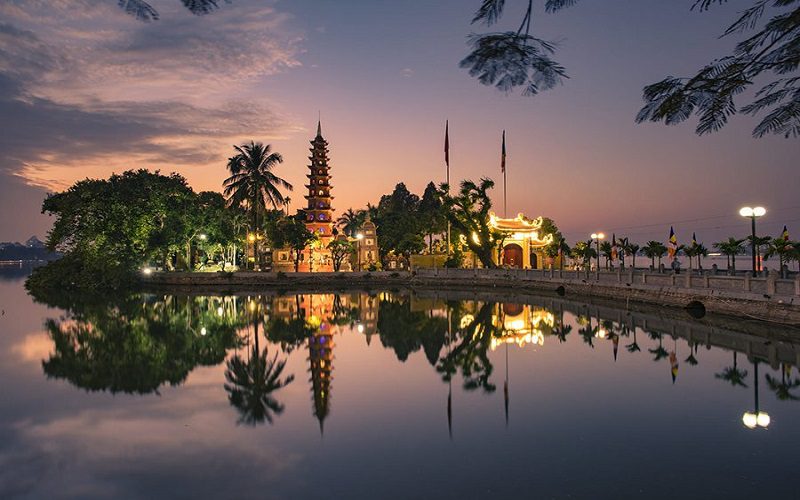
Tran Quoc Pagoda, Vietnam’s oldest pagoda, founded in the 6th century under King Ly Nam De and moved to its islet on West Lake in 1615, where its 11-story red-brick stupa now doubles in the water at sunset in Hanoi’s most photographed pagoda view. The bodhi tree in the courtyard grew from a cutting of the very tree in Bodh Gaya under which the Buddha reached enlightenment, a 1959 gift from India, and monks still live and chant here daily; arrive near 5:00 PM and you get both the golden light and the evening bells.
- Location: Thanh Nien Road, Tay Ho Ward, Hanoi
- Hours: daily, roughly 7:30 AM to 5:30 PM, sometimes with a midday pause; open later on the 1st and 15th of the lunar month
- Entry: free; modest dress required
- Getting there: 10-15 minutes by Grab from the Old Quarter (around 30,000-50,000 VND, ~$1.15-1.90)
- Time needed: 30-45 minutes
- Best moment: the hour before sunset, when the stupa lights up against the lake
2. Chua Mot Cot (One Pillar Pagoda)
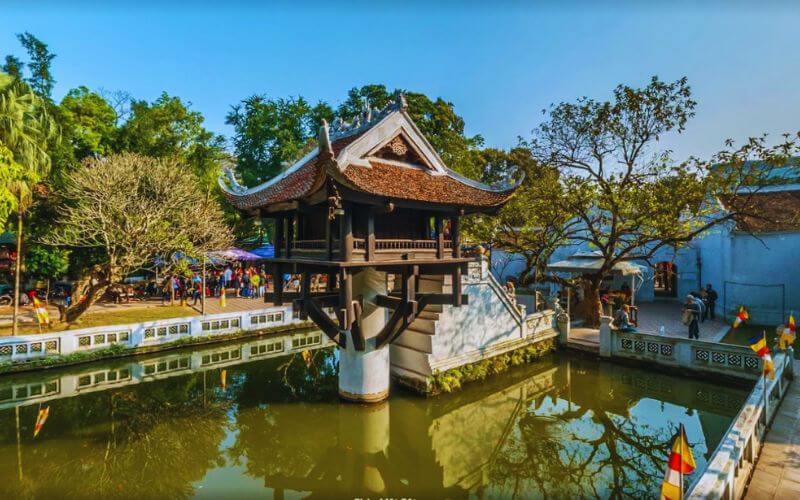
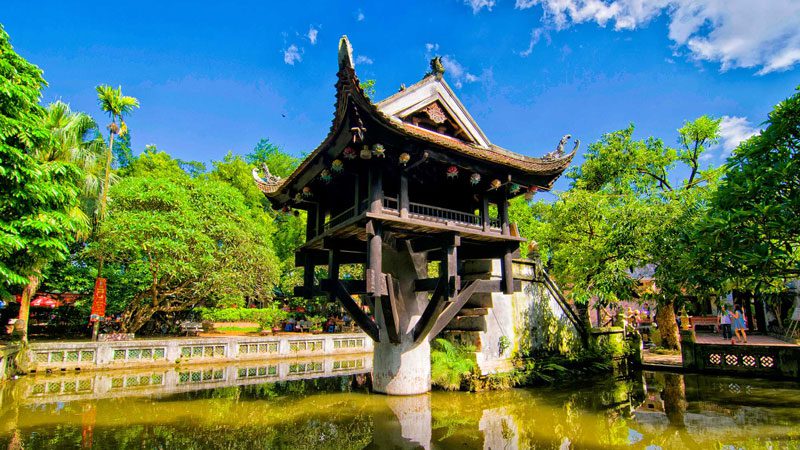
The One Pillar Pagoda is an iconic architectural symbol of Hanoi, renowned for its unique design resembling a lotus blossom rising from the water.
A tiny wooden shrine rising from a lotus pond on a single stone pillar, built by Emperor Ly Thai Tong in 1049 after he dreamed of the Goddess of Mercy handing him a son while seated on a lotus flower; the pagoda is his thank-you, shaped like the bloom itself. French forces demolished it in 1954 and Vietnam rebuilt it immediately, which tells you what it means here. It takes five minutes to see and sits inside the Ho Chi Minh Mausoleum complex, so one visit covers the mausoleum, the presidential palace grounds, and the One Pillar pagoda together.
- Location: Ong Ich Khiem Street, Ba Dinh Ward, Hanoi (within the mausoleum complex)
- Hours: daily, roughly 7:00 AM to 6:00 PM
- Entry: free
- Getting there: on foot within the Ba Dinh complex; 10 minutes by Grab from the Old Quarter
- Time needed: 15 minutes, within a 2-hour complex visit
- Note: the mausoleum itself keeps strict morning-only hours and closes some months for maintenance; the pagoda stays accessible
3. Van Mieu – Quoc Tu Giam (Temple of Literature)
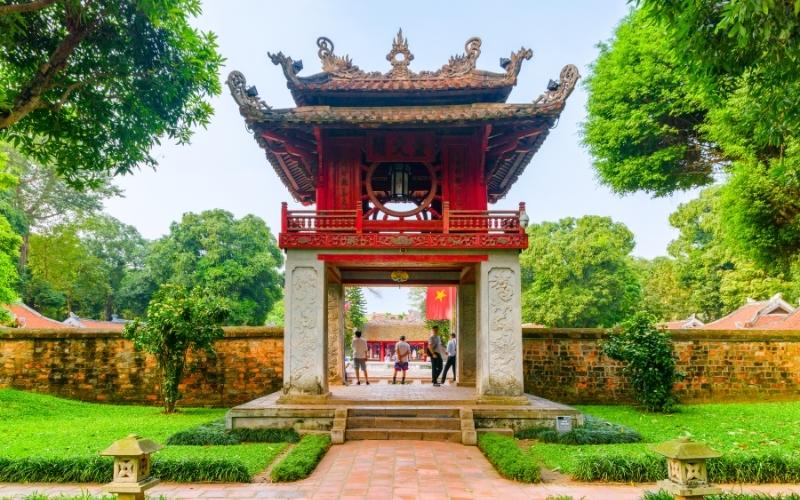
Van Mieu – Quoc Tu Giam (Temple of Literature)
Vietnam’s first national university, founded in 1070 to honor Confucius and educate the kingdom’s mandarins, its five walled courtyards progressing from gardens to the famous stone stelae, 82 tablets carried on the backs of stone turtles, each recording a class of doctoral graduates from centuries of royal examinations. Students still come before exams to pay respects, and the whole compound is the best-preserved piece of imperial Hanoi. Go early or late; midday brings school groups by the busload.
- Location: 58 Quoc Tu Giam Street, Van Mieu – Quoc Tu Giam Ward, Hanoi
- Hours: daily, roughly 8:00 AM to 5:30 PM
- Entry: around 70,000 VND (~$2.70)
- Getting there: 10 minutes by Grab from the Old Quarter, or on foot from the mausoleum complex
- Time needed: 1-1.5 hours
- Look for: the Khue Van Cac pavilion in the second courtyard, the symbol printed on Vietnam’s 100,000 VND banknote
4. Den Ngoc Son (Ngoc Son Temple)
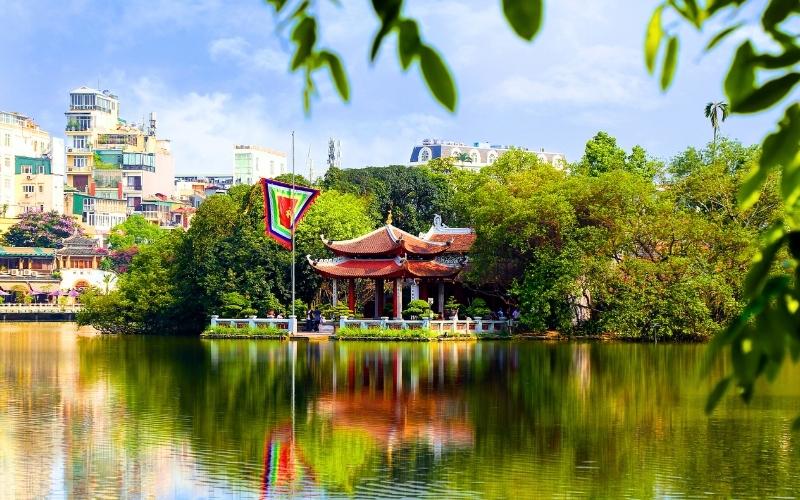
Den Ngoc Son (Ngoc Son Temple)
The temple on the jade islet of Hoan Kiem Lake, reached by the scarlet Huc (Rising Sun) Bridge, honoring the 13th-century general Tran Hung Dao, who repelled the Mongols, alongside the scholar-saint Van Xuong. Inside, a preserved giant softshell turtle recalls the lake’s legend of the restored sword, the founding myth of the city around you. At 7:00 AM the bridge belongs to tai chi practitioners; by 10:00 AM it belongs to everyone, so this is the classic first-morning stop of any Hanoi visit.
- Location: Hoan Kiem Lake, Hoan Kiem Ward, Hanoi
- Hours: daily, roughly 7:30 AM to 6:00 PM, later on weekends
- Entry: around 50,000 VND (~$1.90)
- Getting there: on foot from anywhere in the Old Quarter
- Time needed: 30 minutes
- Combine with: a lake loop walk and an egg coffee on a balcony overlooking the water
5. Chua Huong (Perfume Pagoda)
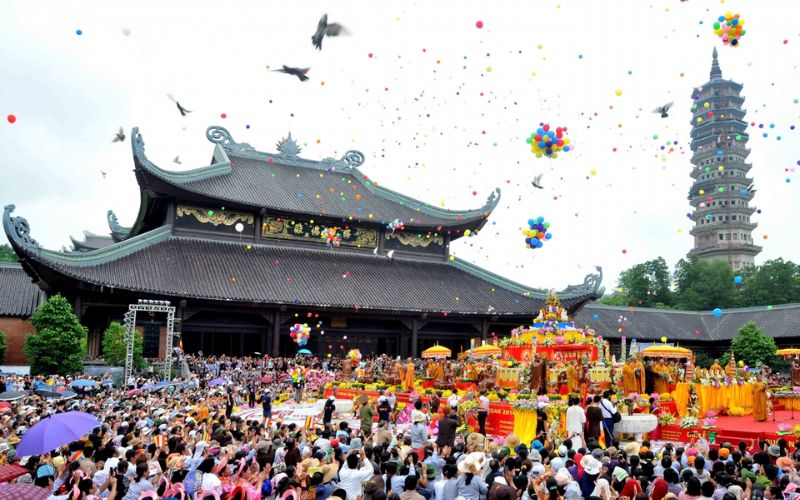
A massive crowd of pilgrims and colorful balloons filling the air in front of a grand temple and stone pagoda during the Perfume Pagoda Festival.
Less a pagoda than a pilgrimage: a flat rowing-boat journey down the Yen Stream between flooded rice paddies and karst hills, then a climb (or cable car) to the Huong Tich cave, declared “the most beautiful grotto under the Southern sky” by an 18th-century lord whose calligraphy still marks the entrance. Inside, stalactites named for prosperity and fertility receive offerings as they have for centuries. During the spring festival, roughly February to April, millions of Vietnamese pilgrims make the journey and the river becomes a procession; outside those months you may share the stream with herons and little else.
- Location: Huong Son Commune, Hanoi
- Hours: boats run daylight hours, roughly 7:00 AM onward; go early
- Entry: combined entry and boat around 150,000-180,000 VND (~$5.80-6.90); optional cable car around 200,000-260,000 VND (~$7.70-10) return
- Getting there: 1.5-2 hours by car from Hanoi; almost everyone books it as a guided day trip with lunch
- Time needed: a full day, roughly 8-10 hours door to door
- Honest note: the climb without the cable car takes a sweaty hour; the cable car is not cheating, it is sensible
6. Chua Bai Dinh (Bai Dinh Pagoda)
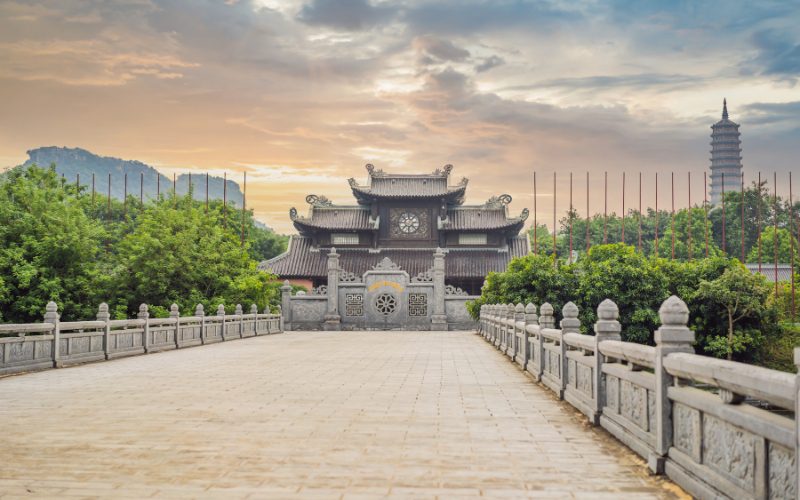
Chua Bai Dinh (Bai Dinh Pagoda)
Southeast Asia’s largest Buddhist complex, built across a hillside beside the ancient cave-pagoda it grew from: a covered corridor of 500 individually carved stone arhat statues, a 36-ton bronze bell, a 100-meter stupa you can ascend for valley views, and bronze Buddhas on a scale Vietnam had never attempted. It is monumental rather than intimate, and pairing it with the Trang An boat ride next door, the combination we map in our 6 days in Vietnam itineraries, gives you both moods of Ninh Binh in one day.
- Location: Gia Sinh, Ninh Binh province, about 100 km south of Hanoi
- Hours: daily, roughly 6:00 AM to 9:00 PM
- Entry: grounds free; electric cart around 60,000 VND (~$2.30) round trip (the site is genuinely vast); stupa ascent around 50,000 VND (~$1.90)
- Getting there: 2 hours from Hanoi by car or limousine bus; 20 minutes from Tam Coc
- Time needed: 2-3 hours
- Wear: proper walking shoes; even with the cart, you will cover kilometers
7. Quan the Di tich va Danh thang Yen Tu (Yen Tu Pagoda Complex)
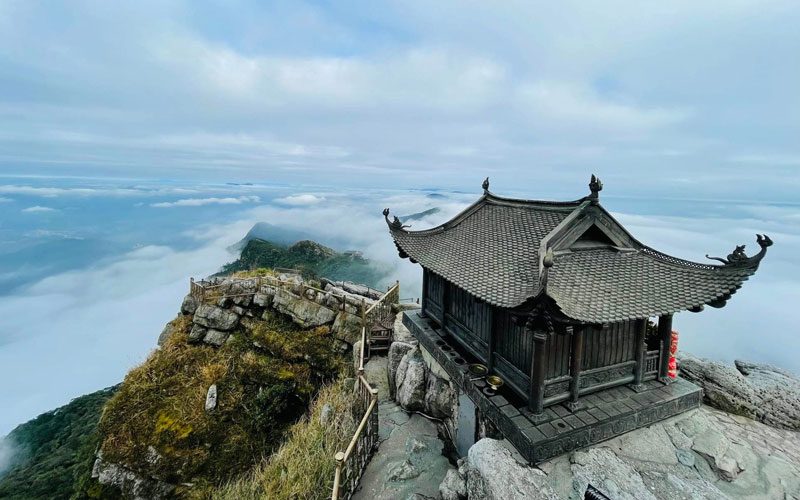
Yen Tu Pagoda
The sacred mountain where Emperor Tran Nhan Tong, having twice defeated the Mongols, renounced his throne in 1299 to found the Truc Lam Zen school, Vietnam’s own branch of Buddhism. Stone paths and a two-stage cable car climb through ancient pine and bamboo forest, past hermitages and the graceful Hue Quang tower garden, to the small bronze Dong Pagoda at 1,068 meters, often standing alone above the clouds. This is Vietnamese Buddhism’s holiest mountain, and on a misty morning it feels exactly like what it is.
- Location: Yen Tu Ward (Uong Bi area), Quang Ninh province; about 50 minutes from Ha Long, 2.5 hours from Hanoi
- Hours: daylight; start early, last cable cars descend late afternoon
- Entry: around 40,000 VND (~$1.55); cable car packages roughly 250,000-350,000 VND (~$9.60-13.50) return for both stages
- Getting there: by car en route between Hanoi and Ha Long Bay, which is how our routes slot it in
- Time needed: half a day; a full day if you walk the whole pilgrim path
- Season note: the spring festival (roughly February to March) brings vast pilgrim crowds; magnificent, but not quiet
8. Chua Thien Mu (Thien Mu Pagoda)
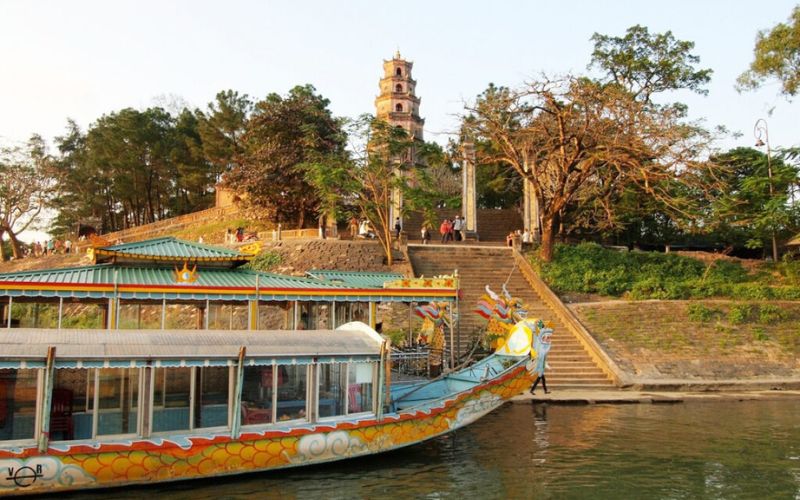
Getting to Thien Mu Pagoda by dragon boat
The seven-story Phuoc Duyen tower above the Perfume River is Hue’s unofficial emblem, built in 1601 after a prophecy delivered by a celestial lady (Thien Mu) on this hill. Its modern history is heavier: the pagoda’s garage preserves the pale blue Austin car that carried the monk Thich Quang Duc to Saigon in 1963, where his self-immolation against religious persecution produced one of the century’s defining photographs. Monks still garden, study, and chant here; arriving by dragon boat up the river, the way emperors did, remains the correct approach.
- Location: Ha Khe hill, Kim Long Ward, 5 km west of Hue city center, on the Perfume River’s north bank
- Hours: daily, roughly 8:00 AM to 6:00 PM
- Entry: free
- Getting there: dragon boat from the city quay (30-45 minutes), bicycle along the river, or a 15-minute taxi
- Time needed: 45-60 minutes
- Combine with: the Imperial Citadel and a royal tomb for the classic Hue day
9. Chua Linh Ung (Linh Ung Pagoda / Lady Buddha)
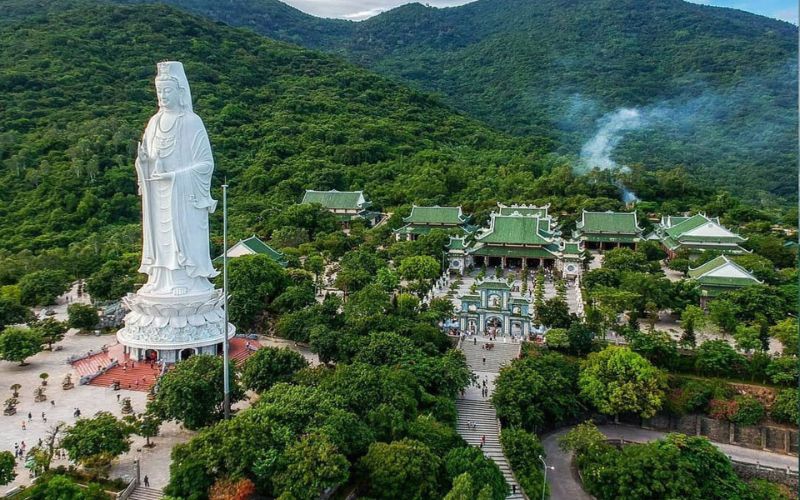
Linh Ung Pagoda
On the forested Son Tra Peninsula stands Vietnam’s tallest Buddha statue: the 67-meter white Lady Buddha (Quan Am), gazing across Da Nang’s bay and visible from the entire coastline, especially at night when she is lit. Locals credit her with calming the typhoons since her completion in 2010. The terrace beneath offers the coast’s best free view, resident monkeys offer comic relief, and the pagoda’s bonsai gardens reward a slow loop. It slots naturally into any Da Nang and Hoi An itinerary.
- Location: Son Tra Peninsula, Son Tra Ward, Da Nang City, 10 km northeast of My Khe Beach
- Hours: daily, roughly 6:30 AM to 6:00 PM
- Entry: free
- Getting there: 20-25 minutes by Grab or taxi from central Da Nang (around 100,000-150,000 VND, ~$3.85-5.80 each way); confident riders take the coast road by scooter
- Time needed: 1 hour
- Timing: early morning for cool air and clear bay views
10. Chua Cau (Japanese Covered Bridge Pagoda)
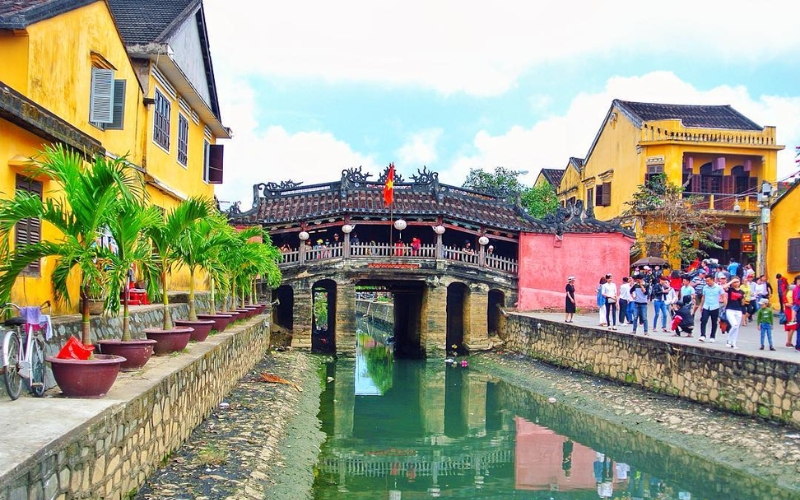
The Japanese Covered Bridge in Hoi An
A 400-year-old covered bridge with a tiny temple at its center, built by Hoi An’s Japanese merchant community around 1600 and guarded at its ends by dog and monkey statues said to mark its construction years. The small shrine honors Tran Vo Bac De, a Taoist weather deity merchants prayed to before sea voyages. Freshly restored in 2024, it remains the Ancient Town’s icon, appears on the 20,000 VND banknote (compare in hand for the obligatory photo), and is at its best before 8:00 AM, when the town still belongs to the people who live there.
- Location: western end of Tran Phu Street, Hoi An Ancient Town, Hoi An Ward, Da Nang City
- Hours: the bridge is open all day; the shrine roughly 8:00 AM to 6:00 PM
- Entry: included in the Hoi An Ancient Town ticket, 120,000 VND (~$4.60), which covers five heritage sites
- Getting there: on foot; the Ancient Town is pedestrianized most of the day
- Time needed: 20 minutes, within a town wander
- Photo tip: the classic angle is from the river side at dawn or after 9:00 PM
11. Thap Po Nagar Cham (Po Nagar Cham Towers)
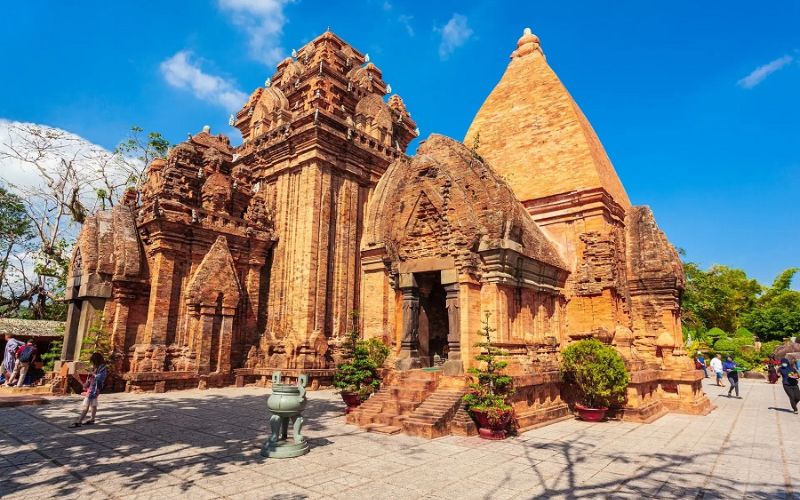
Cham Ponagar Tower
Not Vietnamese Buddhist but Cham Hindu, and the oldest continuously used religious site on this list: brick tower-temples from the 8th to 12th centuries, built without visible mortar by the seafaring Champa kingdom, honoring the goddess Yan Po Nagar. Uniquely, worship never stopped; ethnic Cham and Vietnamese devotees still bring offerings into the incense-dark main tower, where the goddess sits crowned in silk. Come for the architecture, stay for the living ritual, and time it before 9:00 AM to beat the beach-resort tour groups.
- Location: 2 Thang 4 Street, Bac Nha Trang Ward, 2 km north of Nha Trang center
- Hours: daily, roughly 6:00 AM to 5:30 PM
- Entry: around 30,000 VND (~$1.15)
- Getting there: 10 minutes by taxi or Grab from central Nha Trang
- Time needed: 45-60 minutes
- Dress note: shoulders covered inside the towers; robes are lent free at the entrance
12. Chua Ngoc Hoang (Jade Emperor Pagoda)
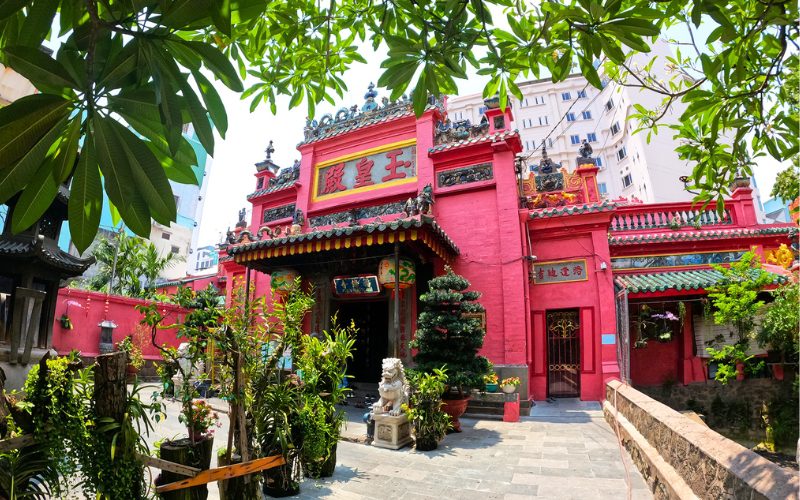
A View of Jade Emperor Pagoda
Saigon’s most atmospheric temple: a 1909 Cantonese-built hall permanently hazed with incense smoke, where the Jade Emperor, the Taoist ruler of heaven, presides over carved wooden panels of the Ten Hells whose demons reward slow, close looking. The side hall of Kim Hoa, goddess of fertility, receives a constant stream of hopeful parents, and the turtle pond outside receives the grateful ones. President Obama’s 2016 visit made it internationally famous; the smoke, carvings, and murmured petitions are what keep it worth the trip.
- Location: 73 Mai Thi Luu, Tan Dinh Ward, Ho Chi Minh City, 2 km from the Ben Thanh area
- Hours: daily, roughly 7:00 AM to 6:00 PM; busiest and most atmospheric on the 1st and 15th of the lunar month
- Entry: free; donations welcome
- Getting there: 10 minutes by Grab from downtown
- Time needed: 45 minutes
- Etiquette: photography is tolerated but keep it discreet; this is a heavily used working temple
13. Chua Giac Lam (Giac Lam Pagoda)
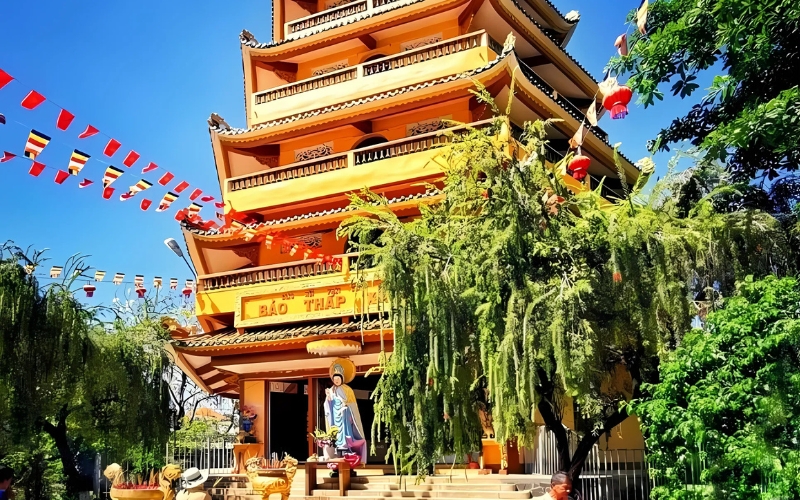
The stupa at Giac Lam Pagoda
The city’s oldest pagoda, founded in 1744, three decades before Saigon fell to the Nguyen lords, and still wearing its centuries lightly: a low wooden compound of 98 carved hardwood pillars, gilded ancestor tablets, more than a hundred antique statues, and a 32-meter seven-story stupa you can climb for a neighborhood panorama. Almost no tour buses come, which makes it the best place in the city to feel southern Vietnamese Buddhism as a living neighborhood practice rather than a sight.
- Location: 565 Lac Long Quan, Bay Hien Ward, Ho Chi Minh City, on the city’s west side, about 8 km from downtown
- Hours: daily, roughly 7:00 AM to 8:00 PM, with a midday pause at some halls
- Entry: free
- Getting there: 20-30 minutes by Grab from the center (around 60,000-100,000 VND, ~$2.30-3.85)
- Time needed: 45-60 minutes
- Pairs with: Chinatown’s temples below for a half-day western-districts loop
14. Den chua Ba Thien Hau (Ba Thien Hau Temple)
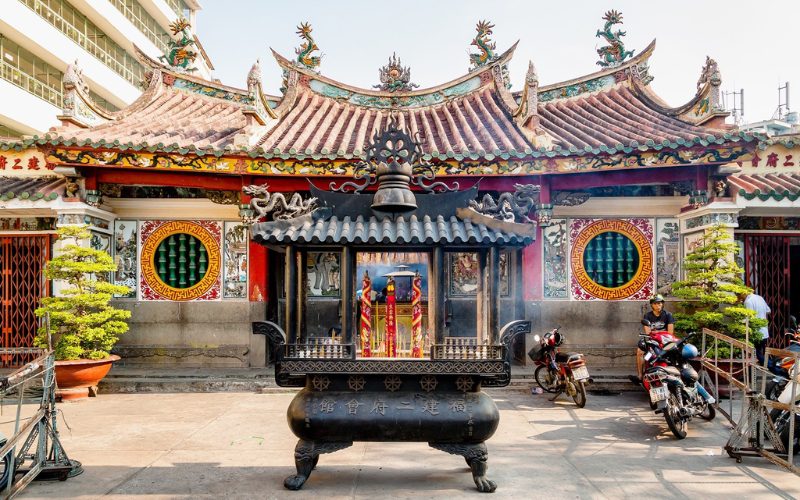
An outside view of Thien Hau Temple
Chinatown’s 1760 temple to Mazu (Thien Hau), goddess of the sea, built by Cantonese migrants who credited her with their safe crossing. Its roofline is a riot of miniature ceramic dioramas, hundreds of figures acting out opera scenes above your head, and the courtyard air stays permanently sweet with giant incense coils, each burning for weeks and carrying a family’s written wish on a red tag. Combine it with a Cho Lon food walk; our guide to the best restaurants in Ho Chi Minh City covers the neighborhood’s eating essentials.
- Location: 710 Nguyen Trai, Cho Lon Ward (Chinatown), Ho Chi Minh City
- Hours: daily, roughly 6:30 AM to 5:30 PM
- Entry: free; buying an incense coil (around 50,000 VND, ~$1.90) supports the temple and gets your own wish into the rafters
- Getting there: 20 minutes by Grab from downtown
- Time needed: 30-45 minutes
- Photo note: the light shafts through the open roof and incense smoke are best mid-morning
15. Chua Vinh Trang (Vinh Trang Pagoda)
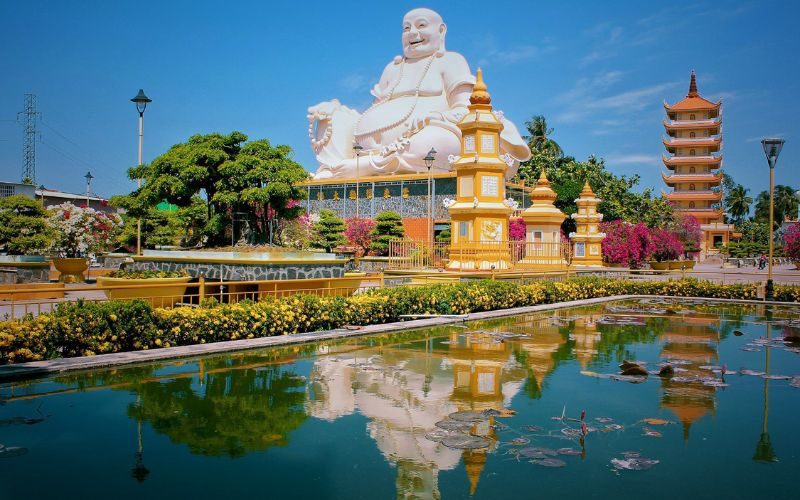
Vinh Trang Pagoda
The delta’s grandest pagoda and a cheerful architectural collision: Khmer, Chinese, French colonial, and Vietnamese elements fused into one 19th-century compound, guarded outside by three giant Buddhas, standing Amitabha, laughing Maitreya, and a serene reclining Buddha, all visible above the fruit orchards from across the fields. It is the standard first stop on Mekong Delta day trips from Saigon and considerably better than “standard first stop” suggests; the bonsai gardens and the monks’ unhurried courtesy set the delta’s tone for the day.
- Location: My Tho, Dong Thap province, about 70 km southwest of Ho Chi Minh City
- Hours: daily, roughly 7:30 AM to 5:00 PM
- Entry: free; donations welcome
- Getting there: 1.5 hours by car; included in nearly every Mekong day tour
- Time needed: 45 minutes
- Combine with: sampan rides and fruit orchards on the standard My Tho-Ben Tre circuit
A One-Day Pagoda Route in Hanoi (Walk + Two Short Rides)
Four of the north’s fifteen sit within one relaxed Hanoi day, and this is the order we run it:
- 7:30 AM: Ngoc Son Temple across the red bridge, before the crowds
- 8:30 AM: Grab to the Ba Dinh complex: One Pillar Pagoda within the mausoleum grounds
- 10:00 AM: walk to the Temple of Literature; allow the full hour
- 12:00 PM: lunch and rest through the heat
- 4:30 PM: Tran Quoc Pagoda for the sunset hour on West Lake
Total entry spend: around 120,000 VND (~$4.60). Add the Perfume Pagoda as its own separate day, and Bai Dinh plus Yen Tu as stops on the road south and east.
Visiting Tips for Vietnam’s Pagodas and Temples
- Dress code: shoulders and knees covered at every site; a fold-up scarf or sarong in the day bag solves the entire list, and the stricter sites lend robes
- Shoes off where signed, always at interior worship halls
- Incense etiquette: light sticks in odd numbers (usually three), bow, and plant them in the central urn; or simply observe, which is always acceptable
- Photography: fine outdoors nearly everywhere; ask or look for signs before photographing interiors or worshippers, and never use flash at altars
- Small notes for donation boxes (10,000-20,000 VND) do more good than they cost
- Lunar timing: the 1st and 15th of each lunar month fill the working temples with worshippers, offerings, and atmosphere; festivals (Tet, the Perfume Pagoda season) multiply that by ten in both directions
- Weather: northern sites are gentlest October to April; the center runs driest February to August; pairing pagodas with the broader route is mapped in our 10 days in Vietnam itineraries
Plan Your Vietnam Temple and Pagoda Journey with Us
Every route we design threads through these sites naturally: Tran Quoc at sunset on a Hanoi evening, Thien Mu by dragon boat on the Hue day, the Jade Emperor before a Cho Lon lunch, Vinh Trang opening the Mekong morning. As a local operator we also know the quiet hours, the lunar dates worth chasing or avoiding, and guides who can read a temple’s carvings back into stories. Browse our Vietnam tours or tell us your dates through Create My Holiday and we will build the journey around them.
Vietnam’s Famous Pagodas and Temples at a Glance
The summary, north to south, for planning in one look:
| Site | Location | Hours (approx.) | Entry | Time needed |
| 1. Tran Quoc Pagoda | Hanoi | 7:30 AM-5:30 PM | Free | 30-45 min |
| 2. One Pillar Pagoda | Hanoi | 7:00 AM-6:00 PM | Free | 15 min |
| 3. Temple of Literature | Hanoi | 8:00 AM-5:30 PM | 70,000 VND (~$2.70) | 1-1.5 h |
| 4. Ngoc Son Temple | Hanoi | 7:30 AM-6:00 PM | 50,000 VND (~$1.90) | 30 min |
| 5. Perfume Pagoda | Hanoi | Daylight, full day | 150,000-180,000 VND (~$5.80-6.90) + options | Full day |
| 6. Bai Dinh Pagoda | Ninh Binh | 6:00 AM-9:00 PM | Free + cart/stupa fees | 2-3 h |
| 7. Yen Tu Complex | Quang Ninh | Daylight | 40,000 VND + cable car | Half-full day |
| 8. Thien Mu Pagoda | Hue | 8:00 AM-6:00 PM | Free | 45-60 min |
| 9. Linh Ung Pagoda | Da Nang | 6:30 AM-6:00 PM | Free | 1 h |
| 10. Cau Pagoda | Hoi An | Town hours | Ancient Town ticket 120,000 VND (~$4.60) | 20 min |
| 11. Po Nagar Cham Towers | Nha Trang | 6:00 AM-5:30 PM | 30,000 VND (~$1.15) | 45-60 min |
| 12. Jade Emperor Pagoda | HCMC | 7:00 AM-6:00 PM | Free | 45 min |
| 13. Giac Lam Pagoda | HCMC | 7:00 AM-8:00 PM | Free | 45-60 min |
| 14. Ba Thien Hau Temple | HCMC | 6:30 AM-5:30 PM | Free | 30-45 min |
| 15. Vinh Trang Pagoda | Dong Thap | 7:30 AM-5:00 PM | Free | 45 min |
Wrapping Up
The famous pagodas and temples in Vietnam are not a checklist so much as a conversation the country has been holding for fifteen centuries: with the Buddha at Tran Quoc and Yen Tu, with Confucius at the Temple of Literature, with the sea goddess in Cholon, and with its own modern history at Thien Mu. Travel them north to south and the story assembles itself, mostly for free: eleven of the fifteen charge nothing at all. Cover your shoulders, carry small notes for the donation box, learn the pagoda-versus-temple distinction once, and give at least one site the slow hour it deserves. That is when the incense smoke starts meaning something. Contact us!
Read More: