Few places in Hoi An stop you in your tracks the way the Fujian Assembly Hall does. You are walking down Tran Phu Street, past the usual mix of tailor shops and coffee stops, and then this triple gate just appears, completely different from everything around it, inlaid with porcelain and crowned with curved tile roofs where dragons coil along the ridgeline. It earns its reputation as the largest and most visited of all the Chinese assembly halls in Hoi An Ancient Town.
Whether you are here for the architecture, the religious rituals, or simply trying to understand how a community of Chinese immigrants left such a deep mark on a Vietnamese port town, this guide covers what you need to know before you go.
What Is the Fujian Assembly Hall?
The Fujian Assembly Hall, known in Vietnamese as Hoi Quan Phuc Kien, is a historic communal hall and active temple built by Chinese immigrants from Fujian Province (also written as Fukien), a coastal region in southeastern China.
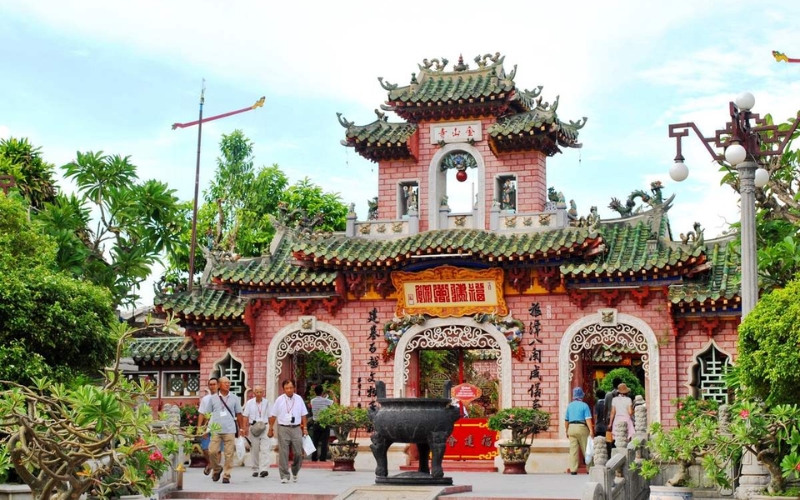
Fujian Assembly Hall in Hoi An
The Fujian people, known as the Hokkien or Minnan, were among the most commercially active Chinese communities in Southeast Asia and made up the largest concentration of Chinese residents in Hoi An at the time of the hall’s founding.
The hall was originally a thatched-roof Buddhist pagoda called Kim Son, built by locals in 1692. Within a few years, the Fujian community transformed it into a formal assembly hall to serve as a gathering point, a place of worship, and a support center for new arrivals. Over the following centuries, the community funded repeated renovations that expanded the structure into the sprawling compound you can visit today.
In 1990, the Vietnamese government recognized it as a National Historical and Cultural Relic, one of only a handful of sites in Hoi An to receive that designation.
Location and How to Get There
- Address: 46 Tran Phu Street, Hoi An Dong Ward, Da Nang City, Vietnam.
The hall sits on Tran Phu Street, the main artery running through Hoi An Old Town, roughly in the middle of the historic district. Its position makes it easy to combine with several other landmarks on the same street: the Japanese Covered Bridge (Chua Cau) to the west and Quan Cong Temple a short walk to the east.
Getting there:
- On foot: If you are staying in or near the Old Town, this is the most practical option. The street is partly pedestrianized, and walking lets you absorb the atmosphere at your own pace.
- By bicycle: Many hotels in Hoi An provide bicycles for free or at minimal cost. The Old Town is flat, compact, and well suited to cycling. Motorbikes are restricted inside the pedestrian zone during peak hours (from 9 AM to 11:30 AM and again from 3 PM onward), so park near Hoi An Central Market and walk the remaining two to three minutes.
- From Da Nang City: Hoi An is about 28 km from Da Nang city center. A taxi or private car takes around 40 to 50 minutes. Grab is also available if you have a local SIM card. If you are on a Da Nang or Hoi An day tour, your driver will drop you near the Old Town entrance.
Best Time to Visit Hoi An
The weather in central Vietnam follows a pattern worth understanding before you book. The months from February to April are the most comfortable, with dry conditions, temperatures around 24 to 28°C (75 to 82°F), and lower humidity. This period is consistently regarded as the best time for walking tours and outdoor sightseeing in Hoi An.
From May to August, temperatures climb to 32 to 35°C (90 to 95°F), and while the skies stay largely clear, the heat is significant midday.
September to November is the rainy season. Heavy rainfall and periodic flooding are common, particularly in October and November. Some travelers find the off-season appealing for lower prices and fewer crowds, but it requires flexibility.
December to January sits in between, with cooler temperatures (around 20 to 23°C / 68 to 73°F) and some rain, but generally more manageable conditions than the flood season.
Entrance Fee and Opening Hours
| Detail | Information |
| Opening Hours | 8:00 AM to 5:00 PM daily |
| Entry to Fujian Assembly Hall | Free (included with Hoi An Old Town ticket) |
| Hoi An Old Town Ticket |
|
| Ticket covers | Access to 5 sites within the Ancient Town |
| Ticket validity | 24 hours from purchase |
Entry to the Fujian Assembly Hall itself is free, but you need the Hoi An Ancient Town ticket to pass through the outer gate. This ticket covers five sites of your choice within the old quarter. Children under 15 enter for free.
Architecture and Layout: What to Look For
This is where the Fujian Assembly Hall earns its reputation. Within a 2,500 square meter compound, the architecture layers one courtyard, hall, and garden after another in a progression that feels carefully staged rather than crowded.
The Outer Gate (Tam Quan)
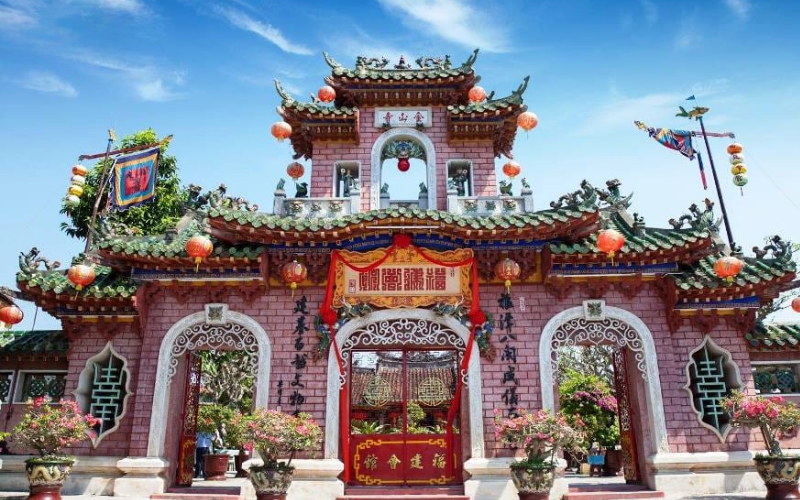
The entrance gate is a favorite photograph spot of visitors coming here
The outer gate, built in 1975, faces directly onto Tran Phu Street. It has one entrance, with a name board bearing four Chinese characters that translate as “Assembly Hall of the Chinese Fujian Congregation”. The tile roof carries zoomorphic ornaments along its ridges.
The Triple Gate
A few steps inside, the triple gate is the most photographed structure in the complex. Inlaid entirely with porcelain fragments, it carries a curved yin-yang tile roof decorated with coiling dragons along the ridgeline. The three entrances follow the traditional “male left, female right” arrangement, but also carry a deeper symbolic meaning: Heaven, Earth, and Human. The central door is kept closed on ordinary days and only opens for major ceremonies, funerals, and weddings, a practice rooted in the belief that keeping it shut blocks negative energy from entering.
The Courtyards and Gardens
Past the triple gate, you enter a series of open courtyards separated by decorative elements. The lower courtyard holds the most striking feature: a pond with a rockery depicting a carp transforming into a dragon, a symbol drawn from Chinese folklore about perseverance and transformation. Bonsai trees, ornamental rocks, and carved stone tables line the path. The tables were historically used by Fujian merchants to conduct meetings and negotiate trade.
The Main Hall
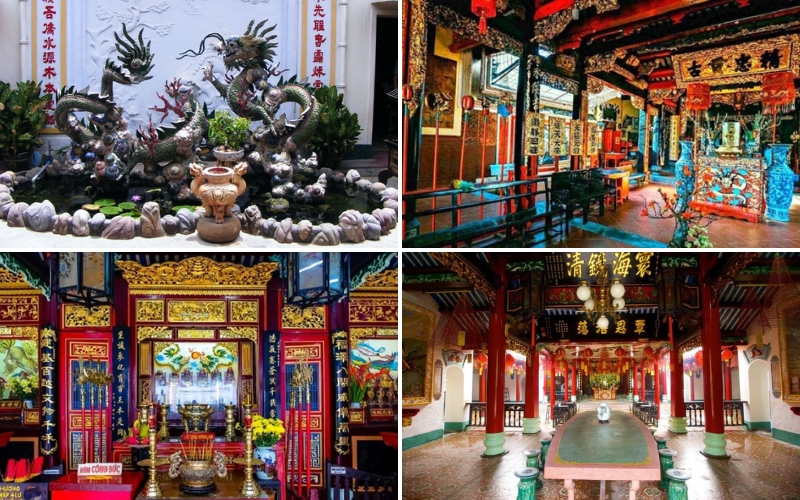
The sophisticated architecture of the main hall
The main hall is the religious heart of the complex. Its altars are dedicated to several deities:
- Thien Hau Thanh Mau (Mazu): The sea goddess, protector of sailors and traders. This is the primary deity and the focal point of the hall’s annual festivals.
- The God of Wealth (Tsai Shen): Draws business owners and traders who come to pray for prosperity, particularly on the 2nd day of the 2nd lunar month.
- The God of Children and Midwives: On the right-hand side of the main hall, the altar dedicated to 12 midwives and the Goddess of Childbirth attracts couples praying for children.
Suspended from the ceiling are large coiled incense rings, sometimes written with names and wishes, each burning for up to 30 days. When the incense burns out, the staff at the hall ceremonially burns the written wishes so they will be carried upward.
The hall also preserves a collection of antiques: bronze bells, bronze drums, wooden lacquered boards with Han characters, 14 ornate horizontal panels, and incense burners that have been in continuous use for generations.
The 1875 Merchant Boat Model
One of the most unusual exhibits is a scale model of a trading boat from 1875, displayed on the left side of the main hall. The boat has two eyes painted on its sides, following the Hoi An belief that objects bound to human destiny should have eyes to see the dangers of the world. It is a physical record of the kind of vessel that the Fujian merchants used for ocean trade.
The Rear Sanctuary
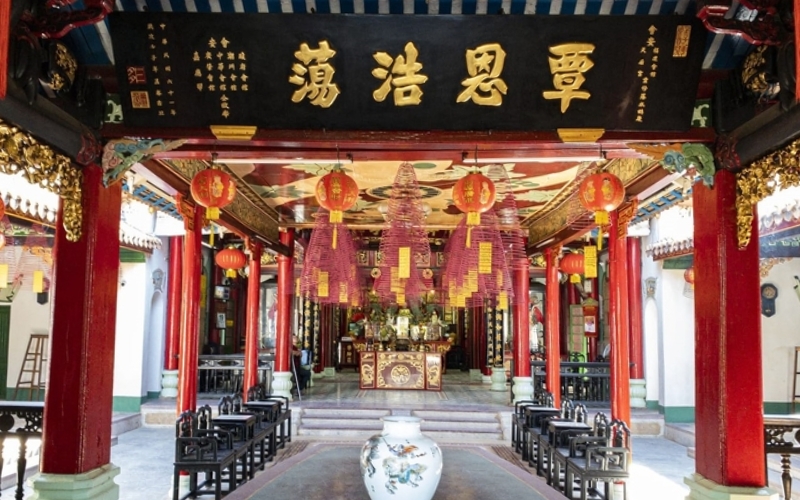
There are many large incense rings in the back of the hall
The back chamber is dedicated to six Fujian generals who led a failed uprising to restore the Ming Dynasty and ultimately brought their families to Hoi An by sea. A rock garden in this area also features the carp-to-dragon motif, reinforcing the theme of perseverance that runs through the entire complex. Surrounding carvings of dragons, qilins (kylins), and other symbolic animals fill the walls.
Festivals and Ceremonies
The Fujian Assembly Hall is a working religious site, not a museum, and the difference is clear when you visit on a festival day. The hall is most crowded on full moon days and on three main annual celebrations:
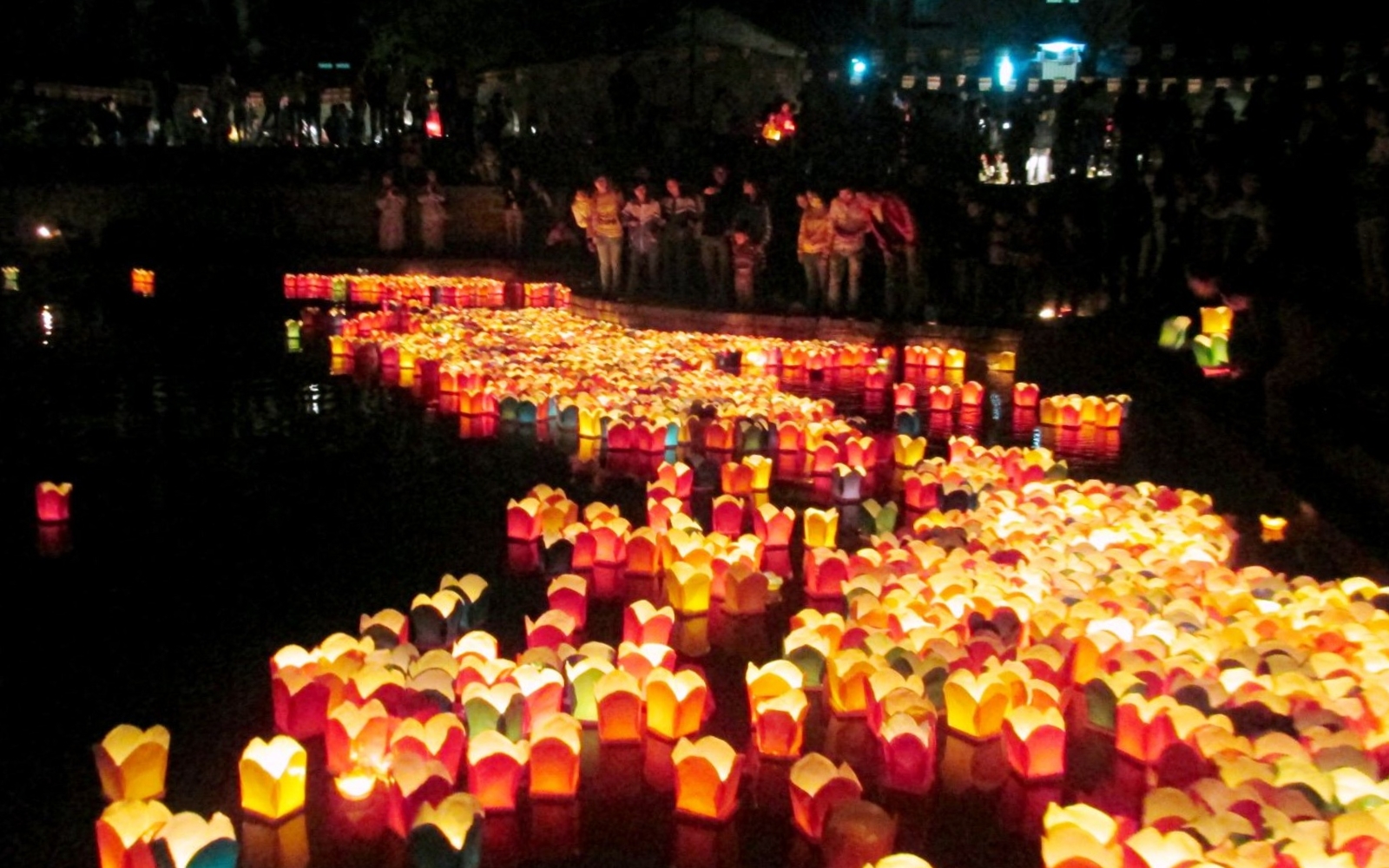
Lantern reflections on Thu Bon River, Hoi An
- Lantern Festival (15th day of the 1st lunar month): The first full moon of the Lunar New Year, marked by prayers for peace, offerings, and lion or dragon dances.
- Six General Lords Festival (16th day of the 2nd lunar month): A ceremony honoring the six Fujian generals who settled in Hoi An, combining traditional rituals with communal offerings.
- Thien Hau Festival (23rd day of the 3rd lunar month): The largest event in the hall’s calendar, dedicated to the sea goddess. The ceremony involves bathing the statue, vegetarian offerings, incense, and a full processional festival with music and cultural performances.
If your Vietnam trip overlaps with any of these dates, the experience is considerably richer than a regular visit.
A Brief History of Fujian Assembly Hall
The story behind the hall goes back to 1649, when the Qing Dynasty defeated the Ming government in China. A group of Ming loyalists, unwilling to submit to the new rulers, gathered their families and headed south by sea. Lord Nguyen, the ruler of central and southern Vietnam at the time, allowed them to settle in Hoi An, where they established Minh Huong Village.
By 1697, the Fujian community had claimed the Kim Son pagoda site and begun reshaping it into a proper assembly hall. The core function was practical: a place where merchants could meet, resolve disputes, support one another, and maintain ties to their homeland culture. But the spiritual dimension ran just as deep. The hall became a temple for Thien Hau (Mazu), the Goddess of the Sea, who sailors and traders credited with protection on ocean voyages. A statue of the deity, reportedly discovered on Hoi An Beach in 1697, became the hall’s most sacred object and remains at the center of worship today.
The building you see now took its definitive form through 19th-century renovations, funded over generations by the Fujian merchant community. The layout follows the Chinese character “TAM” (meaning “three”), with the structure stretching about 120 meters in depth from Tran Phu Street all the way to Phan Chu Trinh Street.
What to Know Before You Visit
- Dress code: The hall is an active place of worship. Shoulders and knees should be covered. If you are not prepared, lightweight scarves or sarongs are available from nearby shops at around 30,000 to 50,000 VND (~$1.15 to $1.90).
- Timing: The hall gets busy from mid-morning onward. Arriving before 9 AM gives you quieter photographs and a calmer atmosphere. The light through the courtyards is also considerably better in the early morning.
- Wet season: Hoi An floods between October and December. Tran Phu Street is one of the lower-lying streets in the Old Town, and the hall has been known to take on water during heavy rains. Check the forecast if you are traveling in this period and bring waterproof sandals or shoes so you do not mind getting wet.
- Incense offerings: Incense rings are sold on-site but cannot be lit inside the hall itself. If you want to make an offering, ask the staff about the correct procedure.
- Photography: Photography is generally permitted in the courtyards and exterior spaces. Inside the main hall, be discreet and respectful, particularly if prayers or ceremonies are in progress.
- Accessibility: The hall has a few steps at the entrance and uneven stone surfaces throughout. Much of the compound can be explored with assistance, but full access is not guaranteed for wheelchair users.
>>> Are you ready for your trip to Hoi An Old Town in Vietnam? Don’t hesitate to contact us! We would like to help you prepare everything you need to get an amazing journey in this beautiful country.
Nearby Attractions on Tran Phu Street
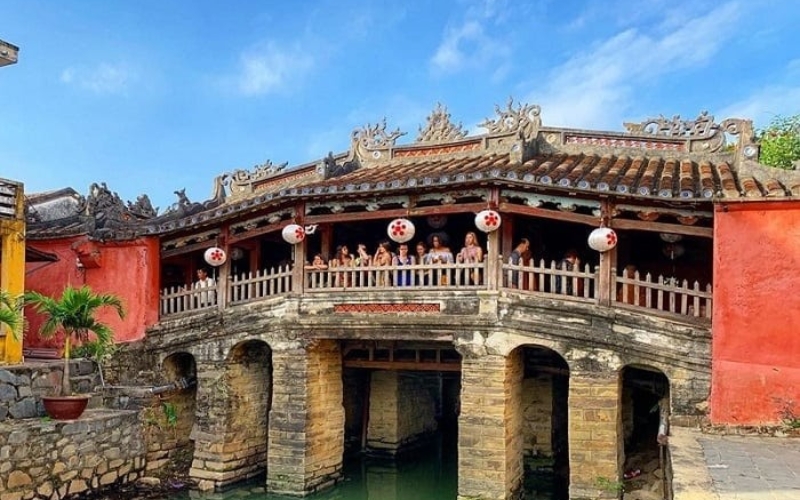
Japanese Covered Bridge, the timeless symbol of Hoi An
The Fujian Assembly Hall works well as part of a walking route along Tran Phu Street. From the hall, you can continue to:
- Japanese Covered Bridge (Chua Cau): The most recognizable structure in Hoi An, about 800 meters west of the hall. Built by Japanese merchants in the early 17th century, it carries a small temple inside and connects the Japanese and Chinese quarters of the old town.
- Tan Ky Old House: A well-preserved merchant house built over two centuries ago, showing the architectural blend of Japanese, Chinese, and Vietnamese styles that defines Hoi An.
- Cantonese Assembly Hall: One of four other assembly halls in the old town, built in 1776, and worth comparing with the Fujian hall for the differences in scale and decoration.
- Hoi An Market: A few minutes’ walk toward the river, good for fresh food, local produce, and a more everyday side of the town.
- Museum of Folk Culture: A collection of objects from Hoi An’s trading past, with well-presented context on the town’s commercial history.
Planning Your Vietnam Trip Around Hoi An
The Fujian Assembly Hall takes between 30 minutes and one hour to explore properly. Most visitors pair it with a half-day or full-day walk through the old town, which fits naturally into a broader central Vietnam itinerary. Hoi An is about 28 km from Da Nang, making it a practical day trip from the coast, and it sits roughly 130 km south of Hue, which is the other major historical stop in the region.
If you are planning a Central Vietnam tour that covers Da Nang, Hoi An, and Hue together, three to four days in this stretch gives you enough time to visit the assembly halls, the Japanese Covered Bridge, Marble Mountain, My Son Sanctuary, and the Imperial City in Hue without feeling rushed.
For a longer itinerary combining central Vietnam with the north or south, Vietnam tours from IDC Travel include Hoi An as a core stop, with local guides who can provide the historical context that a solo visit often lacks.
For travelers flying in from another country and arriving at Da Nang International Airport first, Da Nang tours that include a Hoi An day trip are a common way to cover both cities in a single visit. The transfer between the two takes under an hour.
Practical Summary
| Category | Information |
| Full name | Fujian Assembly Hall (Vietnamese: Hoi Quan Phuc Kien) |
| Best months to visit | February to April |
| Recommended time at the site | 45 to 60 minutes |
| Entrance fee (Old Town ticket) | 120,000 VND (~$5) for international visitors |
| Opening hours | 8:00 AM to 5:00 PM daily |
| Distance from Da Nang City | Approx. 28 km (~40 to 50 min by car) |
| Distance from Hue City | Approx. 130 km (~2.5 to 3 hours by car) |
| Dress code | Covered shoulders and knees required |
| Payment | Cash recommended; many sites do not accept cards |
| Nearby landmark | Japanese Covered Bridge, 800m west |
| UNESCO status | Part of Hoi An Ancient Town (listed 1999) |
The Fujian Assembly Hall is worth the visit not just as a photo stop, but as a way to understand what Hoi An actually was: a genuinely international port town where Chinese, Japanese, Vietnamese, and European merchants all left marks that you can still see today. The hall is the most concentrated expression of the Fujian community’s contribution to that history, and it is still in active use three centuries after its founding.
If you are planning a Vietnam trip and want help building an itinerary that includes Hoi An alongside other key stops, IDC Travel’s local team can put together a plan based on your dates and interests.
>>> Refer to Fujian Assembly Hall – Danang Fantasticity – Da Nang City Tourism Information Portal.
Read more: