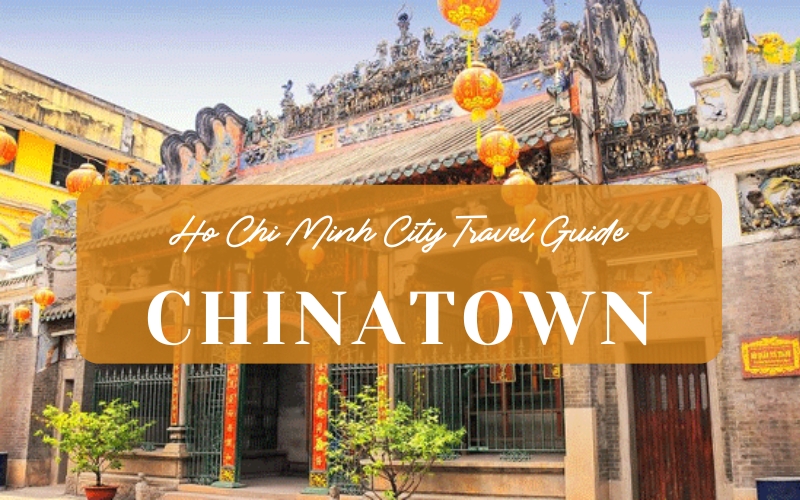
Every first-time visitor to Ho Chi Minh City Travel eventually finds their way to Saigon Chinatown, whether by curiosity or by the pull of the smell alone: roasted pork fat, dried herbs, and incense smoke drifting through the morning air. Known locally as Cho Lon, this is the largest Chinatown in the world by area, and it operates on its own rhythm, quite different from the rest of the city.
This guide covers everything you need to explore it properly: the history, the location, the streets worth walking, the food worth eating, and the logistics worth knowing.
What Is Saigon Chinatown (Cho Lon)?
Saigon Chinatown, a.k.a. Cho Lon is a sprawling Chinese-Vietnamese market in Ho Chi Minh City. The name comes directly from the Vietnamese words for “big market” (“cho” = market, “lon” = big), a nod to how its Chinese traders’ market was significantly larger than the surrounding Vietnamese ones.
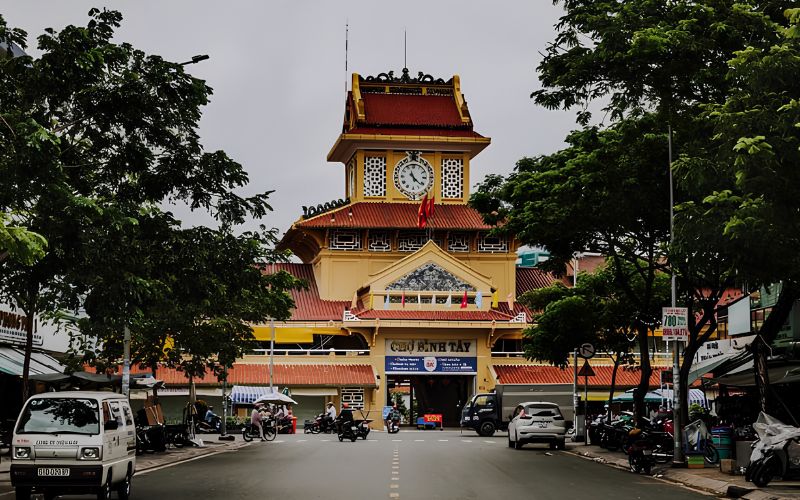
Binh Tay Market stands as a historical symbol and a bustling center of trade within the Cho Lon area.
Today, the name Cho Lon no longer appears on any official administrative map. Following Vietnam’s provincial mergers in 2025, the area now falls under Cho Lon Ward of Ho Chi Minh City’s expanded administrative structure. But ask any local where Cho Lon is and they’ll point you west without hesitation. The name has outlasted every government reorganization.
What makes Chinatown in Ho Chi Minh City distinct is its sheer scale. This is not a single street with red lanterns and dim sum restaurants. It covers much of what was formerly District 5 and extends into parts of what were Districts 6 and 11 (before Vietnam provincial merger in 2025). Walking one end to the other takes hours. There are temple complexes, wholesale markets, medicine streets, lantern alleys, and French-Chinese shophouses in various states of beautiful decay, all mixed together without much concern for tourism.
Location and How to Get There
Cho Lon sits roughly of Cho Lon Ward (the former District 1 city center). The geographical heart of the area is around Binh Tay Market, near the intersection of Thap Muoi, Le Tan Ke, and Phan Van Khoe streets.
Getting there from central Ho Chi Minh City:
- By Grab (ride-hailing app): The most practical option. Grab is reliable, metered, and avoids the negotiation that comes with traditional taxis.
- By public bus: Routes 01, 10, 11, and 96 all pass near Binh Tay Market. A bus ticket costs around 7,000 VND (~$0.27 USD). It takes longer but gives a proper ground-level view of the city.
- By cyclo (three-wheeled bicycle taxi): Slower and more scenic. Good for short distances within Cho Lon itself. Agree on the price before you start.
- By Metro Line 1: The recently extended Metro Line 1 connects central Ho Chi Minh City to areas near Cho Lon. Check current station maps, as the network was still expanding at the time of writing.
A practical tip: don’t try to navigate Cho Lon with Google Maps as your only guide. The streets are dense, the signage is often in Chinese and Vietnamese only, and some of the best things to see are down alleys that don’t appear on any app.
A Brief History of Ho Chi Minh Chinatown
The story of Cho Lon begins in the 17th century, when a group of Chinese who refused to submit to the Qing Dynasty left China and settled in what was then called Dang Trong (Cochinchina). They founded a settlement called Minh Huong Village. As waves of Chinese immigration continued, driven by political upheaval and economic opportunity, the settlement grew. By the 18th century, a large commercial market had formed, far bigger than the local Vietnamese markets nearby. That size difference gave it the name Cho Lon.
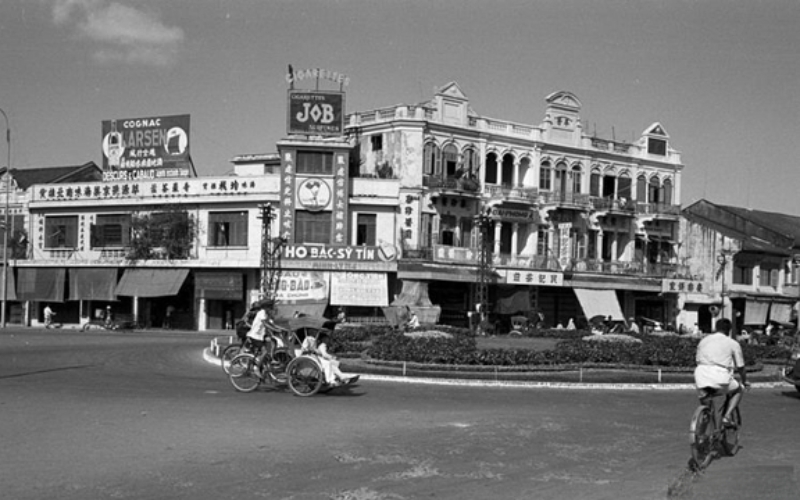
Cho Lon in 1950s
In 1865, Cho Lon was officially established as a city in its own right, separate from Saigon. For much of the 19th and early 20th centuries, Saigon was the political center of French Cochinchina while Cho Lon was the commercial engine, driven by the Hoa community (overseas Chinese Vietnamese). The two cities grew toward each other, and in 1931, the French colonial administration merged them into a single administrative unit called Saigon-Cholon. The name “Cholon” was eventually dropped from official use in 1956, but the area’s identity held.
The Hoa community in Cho Lon came from several distinct Chinese groups: the Cantonese (Guangdong), the Hakka, the Teochew (Chaozhou), the Fujian (Hokkien), and the Hainanese. Each group maintained its own assembly hall and temple, which is why you’ll find different architectural styles and different deities worshipped across the district. That diversity is part of what makes Chinatown Ho Chi Minh City worth more than one visit.
The Streets of Cho Lon: What to See and Where to Go
This is where Saigon Chinatown gets interesting. The temples and markets get most of the attention, but the streets themselves are the real draw. Here is a close look at what each one offers.
1. Hai Thuong Lan Ong Street (Traditional Medicine Street)
- Address: Hai Thuong Lan Ong Street, Cho Lon Ward, Ho Chi Minh City.
If you walk only one street in Cho Lon, make it this one. Hai Thuong Lan Ong is lined with traditional Chinese medicine shops, most of them old enough to have been passed down through two or three generations of the same family. The shops display hundreds of jars filled with dried roots, bark, seeds, and herbs, organized behind glass counters or stacked floor-to-ceiling in wooden shelving units that look like they haven’t moved in fifty years.
The smell hits you before you see the shops: earthy, bitter, and slightly sweet, all at once. Practitioners behind the counters weigh out prescriptions by hand using small brass scales. Locals come here for treatments ranging from digestive issues to fatigue remedies. Tourists come for the visual experience, which is genuinely unlike anything else in the city.
The street is also historically important. Hai Thuong Lan Ong was a Vietnamese physician born in 1724, considered one of the fathers of traditional Vietnamese medicine, and the street takes his name. The irony that it is now lined almost exclusively with Chinese medicine shops is a small piece of Saigon’s layered history.
2. Luong Nhu Hoc Street (Lantern Street)
- Address: Luong Nhu Hoc Street (also listed at 118 Trieu Quang Phuc Street vicinity), Cho Lon Ward, Ho Chi Minh City.
Luong Nhu Hoc is where Cho Lon goes quiet during the day and comes alive at night. The street is known for lantern-making, a craft passed down through generations of the Chinese community. During the day, shops display lanterns of every size and shape: round paper ones in red and gold, diamond-shaped ones, polygon frames with colored fabric, and modern LED versions that can be programmed to change color.
At night, especially during the Lunar New Year (January or February) and the Mid-Autumn Festival (August or September), the street transforms. Every lantern is lit at once. The effect is hard to describe in a useful way, so if you are planning a Vietnam trip around a festival season, this is worth building an itinerary around.
Outside festival seasons, the street is still worth visiting in the early evening when shop owners begin switching on the display lanterns as the light fades. It’s much less crowded than the festival weeks.
3. Tran Hung Dao Street
- Address: Tran Hung Dao Street, Cho Lon Ward, Ho Chi Minh City
Tran Hung Dao is Cho Lon’s main artery, a wide boulevard running east to west through the area. It’s where the shophouses are, many of them two or three stories with first floors converted into retail, pharmacies, or fabric sellers. The street connects the Cho Lon area to central Ho Chi Minh City, which makes it busier and louder than the smaller alleys, but it’s also where you get the clearest sense of how seamlessly the Chinese and Vietnamese commercial cultures have merged here.
Named after the 13th-century Vietnamese general who repelled the Mongol invasions, Tran Hung Dao in Cho Lon looks nothing like the formal boulevard in Ward. It’s noisier, less organized, and considerably more interesting.
Some of the area’s assembly halls are just off this street or within a short walk. The Phuoc An Hoi Quan Pagoda is at 184 Hung Vuong Street nearby, and it was the first stop President Obama made during his 2016 visit to Ho Chi Minh City.
4. Hong Bang Street
- Address: Hong Bang Street, Cho Lon Ward, Ho Chi Minh City.
Hong Bang is a long commercial road that runs parallel to Tran Hung Dao. It’s less famous with tourists but more representative of everyday Cho Lon commerce. The street is lined with wholesale suppliers of packaging materials, dried goods, and food-service equipment. Early mornings, it feels more like a loading dock than a street, with motorbike carts carrying stacked goods between market stalls.
Hong Bang Street is where Cho Lon’s function as a wholesale distribution center becomes most visible. If Binh Tay Market is the front of house, Hong Bang is the supply chain.
5. Hao Si Phuong Alley
- Address: 276 Tran Hung Dao B Street (near Trieu Quang Phuc), Cho Lon Ward, Ho Chi Minh City.
This is the most photographed spot in Cho Lon and the most Hong Kong-like. Hao Si Phuong is a residential alley built in 1910 by a wealthy businessman named Hua Bon Hoa. The complex has 68 apartments arranged around a central corridor, with two-story buildings in faded yellow plaster and green shutters. It looks exactly like a back alley in 1970s Hong Kong, which is why local photographers come here in the early morning before the tourists arrive.
The families who live here are both Vietnamese and Chinese-Vietnamese. It’s a working residential space, not a museum, so visiting respectfully matters. Don’t enter buildings or photograph people without permission.
Cho Lon Market Saigon: The Markets of Chinatown
1. Binh Tay Market
- Address: 57A Thap Muoi Street, Cho Lon Ward, Ho Chi Minh City.
- Opening hours: ~6:00 AM to 7:00 PM daily.
Binh Tay is the heart of Chinatown market Ho Chi Minh City, and it operates differently from the tourist-oriented Ben Thanh Market in Ben Thanh Ward. This is a wholesale market. Most of the 1,446 stalls are selling to other vendors and shop owners, not to individual buyers. That doesn’t mean it’s off-limits to visitors, but the energy is different: faster, less patient, less inclined toward English.
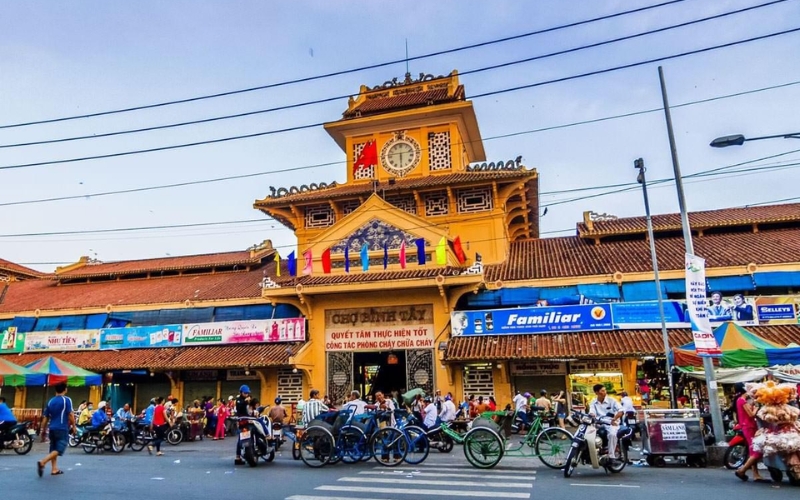
Binh Tay Market, one of the oldest markets in Saigon
Built in the 1920s by Quach Dam, a Guangdong-born merchant who reportedly donated the land and construction costs to the city, the market covers roughly 25,000 square meters and is split across five trading areas. The ground floor handles dishes, incense, spices, dried goods, and handicrafts. The upper floor carries ready-made clothing, pastries, and groceries. Around the market’s perimeter, outdoor stalls open very early (some by 5:00 AM) with fresh produce, meat, and seafood.
The food court at the back of the market deserves its own mention. It’s a row of small stalls, most of them serving Chinese-Vietnamese dishes. Go for the stalls with the most locals sitting at them. A bowl of noodles with stir-fried beef or a plate of Yangzhou fried rice runs between 30,000 and 60,000 VND (~$1.15 to $2.30). The food is not designed for tourists. It’s just good.
2. Phung Hung Market
Less known than Binh Tay but easier to browse at a relaxed pace, Phung Hung stretches along the alley of the same name. It’s more of a local wet market, with fresh produce, street snacks, and household goods. Good for early morning wandering if you’re staying anywhere in the Cho Lon area.
Temples and Pagodas in Chinatown Ho Chi Minh City
Cho Lon has more active Chinese temples than any other area in Vietnam. These are not heritage sites frozen in time. They are busy places of worship, often full of incense smoke and people genuinely praying. The architecture varies by the community that built each one.
1. Thien Hau Pagoda is the most visited. Built by Cantonese migrants in the early 19th century, it honors Thien Hau, the Goddess of the Sea, believed to have protected Chinese sailors during their journey to Vietnam. The massive coils of incense hanging from the ceiling and burning for weeks at a time are a sight that doesn’t photograph well but stays with you in person.
- Address: 710 Nguyen Trai Street, Cho Lon Ward, Ho Chi Minh City.
2. Phuoc An Hoi Quan Pagoda honors Quan Cong (Guan Yu), the deified general of Chinese history. It was Obama’s first stop in Ho Chi Minh City in 2016. The gold-crusted Chinese characters across the front entrance are some of the most detailed in Cho Lon.
- Address: 184 Hung Vuong Street, Cho Lon Ward, Ho Chi Minh City.
3. Ong Bon Pagoda (Nhi Phu Temple) is the only temple in the city where Ong Bon, a Yuan Dynasty official revered as the guardian of Cho Lon, is worshipped. Built in the early 18th century by the Fujian community, it uses green-glazed roof tiles and houses ancient drums, bells, and stone statues.
- Address: 264 Hai Thuong Lan Ong Street, Cho Lon Ward, Ho Chi Minh City.
4. Quan Am Pagoda dates to 1740, making it one of the oldest Chinese temples in Saigon. It now worships 16 deities and features remarkably detailed ceramic figurines along the rooflines.
- Address: 12 Lao Tu Street, Cho lon Ward, Ho Chi Minh City.
Ho Chi Minh Chinatown Food: What to Eat in Cho Lon
The food in Cho Lon is one of its strongest arguments for a full-day visit. These are Chinese dishes that have been made in Saigon for generations, adapted slightly to local ingredients and tastes.
- Dim sum is everywhere, from modest street carts to sit-down restaurants with aluminum steamer racks stacked on tables. Look for har gow (shrimp dumplings), siu mai (pork and shrimp), and cheung fun (rice noodle rolls). Prices range from 15,000 to 50,000 VND (~$0.58 to $1.92) per basket.
- Hand-pulled noodles are made fresh in front of you. The chef stretches and folds the dough repeatedly before dropping it into boiling broth. The noodles have a chewier texture than machine-made ones and hold the soup differently.
- Pha lau is braised offal (pig or chicken) served either as a stew or alongside banh mi. It’s a Cho Lon staple that you either fall for immediately or avoid entirely. If you’re curious, try a small portion with banh mi first.
- Tao pho (tofu pudding) is sold by wandering vendors and from small carts near Binh Tay Market. A cup costs around 10,000 to 15,000 VND (~$0.38 to $0.58). It’s soft, slightly sweet, and good at any hour.
- Teochew porridge (chao) is thick rice porridge served with small dishes of salted egg, preserved vegetables, and fish. Several old restaurants near the market still serve this for breakfast. Prices are typically 30,000 to 50,000 VND (~$1.15 to $1.92) for a full breakfast.
For anyone doing a Ho Chi Minh City food tour, Cho Lon is worth half a day on its own, separate from the Cho Lon Ward attractions.
Festivals in Saigon Chinatown
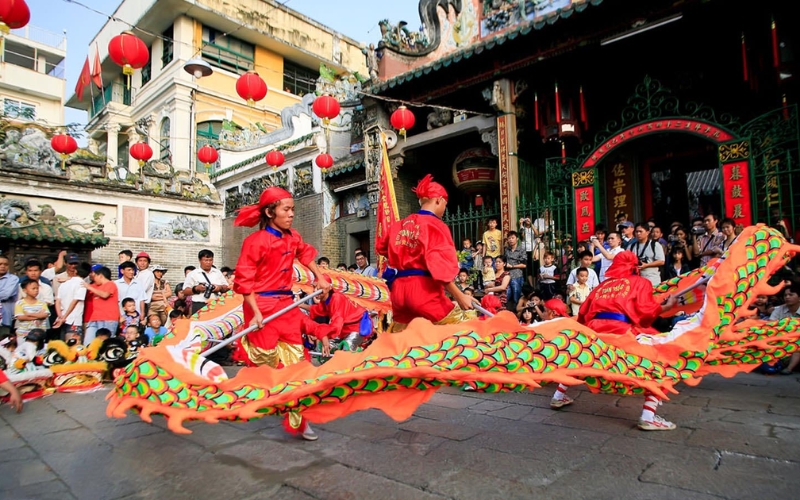
Chinatown in Ho Chi Minh City
Cho Lon is at its most visually intense during Chinese festivals. Two are worth planning around if your Vietnam trip dates are flexible.
- Lunar New Year (Tet Nguyen Dan / Chinese New Year): January or February, depending on the lunar calendar. Cho Lon transforms for about two weeks before and after the holiday. Luong Nhu Hoc Street lights up entirely. Lion and dragon dances move through the streets. Fireworks are less common now due to city regulations, but the general noise level more than compensates.
- Mid-Autumn Festival (Tet Trung Thu): August or September. This is when the lantern shops on Luong Nhu Hoc Street reach peak activity. Children carry lanterns through the streets in the evening. The food stalls shift to moon cakes, which are sold in elaborate gift boxes from around six weeks before the festival.
- Qingming (Tomb-Sweeping Day): April. Families visit ancestral graves to clean and maintain them. Less visually dramatic than Tet, but important culturally and a time when the temples are particularly active.
Practical Travel Tips for Chinatown in Ho Chi Minh City
- Best time to visit: The dry season runs from December to April, with temperatures between 25°C and 35°C (77°F to 95°F). This is the most comfortable time for walking the streets for extended periods. The rainy season (May to November) brings temperatures of 23°C to 32°C (73.4°F to 89.6°F) with afternoon showers, usually short but heavy. Markets and temples are covered, so rain doesn’t stop exploration entirely.
- Best time of day: Early morning (6:00 to 9:00 AM) for the outdoor wet markets and a quieter version of the streets. Late afternoon into evening (4:00 to 8:00 PM) for the food stalls and, during festival periods, the lantern-lit alleys.
- Budget: Street food and market snacks run between 10,000 and 60,000 VND (~$0.38 to $2.30 USD) per item. Sit-down restaurant meals in Cho Lon cost between 80,000 and 200,000 VND (~$3.07 to $7.69 USD) per person. Grab rides from the center are 50,000 to 100,000 VND (~$1.92 to $3.84 USD) each way.
- Safety: Cho Lon is generally safe for tourists, but standard city precautions apply. Keep phones in a bag or pocket rather than in hand when walking crowded streets. Motorcycles move fast even on narrow lanes.
- Language: Many older residents speak Cantonese or other Chinese dialects as their primary language, with Vietnamese second. English is limited outside tourist-facing businesses. A translation app is useful. Google Translate’s camera function handles Chinese and Vietnamese signage reasonably well.
- Dress code: Temples require covered shoulders and knees. Carry a light scarf if you are wearing shorts or a tank top.
Connecting Chinatown to the Rest of Your Vietnam Trip
Most visitors spend half a day in Cho Lon as part of a longer Saigon tours. That works, but a full day gives you enough time to actually slow down in the market, sit somewhere for a proper meal, and walk multiple streets without feeling rushed.
Ho Chi Minh City pairs well with the Mekong Delta to the south (a one-day or two-day trip from the city) and with Central Vietnam destinations like Hoi An and Hue for travelers doing a longer Southern Vietnam tour.
For those doing a full north-to-south route, Cho Lon often gets skipped in favor of the Cho Lon Ward’s landmarks. That’s a reasonable trade-off for a three-day city stop, but if you have four or more days in Ho Chi Minh City, the Chinatown area warrants its own morning or afternoon.
Conclusion: Saigon Chinatown at a Glance
| Category | Details |
| Name | Saigon Chinatown (Vietnamese: Cho Lon) |
| Location | Cho Lon Ward, Ho Chi Minh City, Vietnam |
| Size | Largest Chinatown in the world by area |
| Population | Over 500,000 Chinese-Vietnamese residents |
| Main market | Binh Tay Market (57A Thap Muoi Street, Cho Lon Ward) |
| Best streets | Hai Thuong Lan Ong, Luong Nhu Hoc, Tran Hung Dao, Hong Bang, Hao Si Phuong Alley |
| Key temples | Thien Hau Pagoda, Phuoc An Hoi Quan, Ong Bon Pagoda, Quan Am Pagoda |
| Best time to visit | December to April (dry season); early morning or late afternoon daily |
| Temperature range | 25°C to 35°C (77°F to 95°F) dry season; 23°C to 32°C (73.4°F to 89.6°F) wet season |
| Average street food cost | 10,000 to 60,000 VND (~$0.38 to $2.30) |
| Top festivals | Lunar New Year (Jan/Feb), Mid-Autumn Festival (Aug/Sep) |
| Languages spoken | Vietnamese, Cantonese, Teochew, Mandarin |
Cho Lon is not a polished tourist attraction. It’s a working district with 300 years of Chinese-Vietnamese history still functioning at street level. The temples are still worshipped in. The medicine shops still fill prescriptions. The market still opens before dawn. That’s what makes it worth visiting: it doesn’t perform for you. You just walk into it, pay attention, and it shows you what it is.
IDC Travel offers customizable Vietnam tours that can include dedicated time in Cho Lon, with local guides who speak the history of the area rather than just pointing at it. If you are putting together a Vietnam holiday and want Cho Lon included properly, that is worth requesting specifically when you contact us.
Read more: