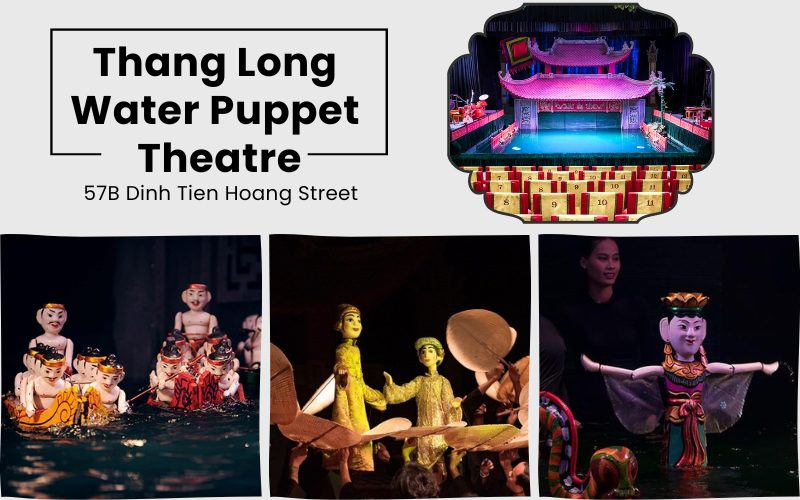
Every traveler who has watched a water puppet show in Hanoi comes away with the same look on their face: part confusion, part wonder, part “why didn’t I know this existed sooner?”. The Thang Long Water Puppet Theatre is one of those rare attractions that manages to be genuinely surprising even after you’ve read about it, watched clips online, and thought you knew what to expect.
This guide covers everything you need to plan your visit: what the art form actually is, where the theatre sits, what the show looks like from the inside, how much tickets cost, and what the scheduling looks like throughout the week. Whether you’re booking a Vietnam holiday package that includes Hanoi or planning a standalone evening out, the water puppet show deserves a confirmed spot on your itinerary.
What Is the Thang Long Water Puppet Theatre?
The Thang Long Water Puppet Theatre (Vietnamese: Nha Hat Mua Roi Thang Long) is the most attended water puppetry venue in Vietnam.
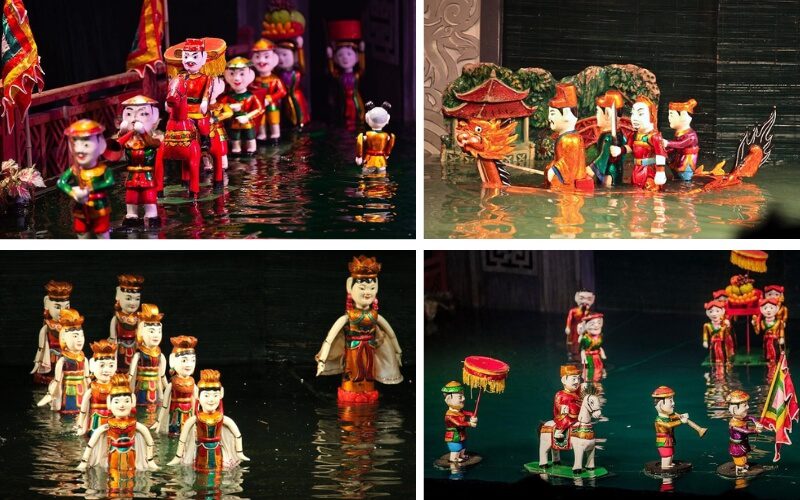
These hand-carved wooden puppets bring ancient Vietnamese folklore and daily rural life to life on a unique liquid stage.
The theatre was established on October 10, 1969, and today holds the Asia record for performing water puppetry continuously 365 days a year. That record is not a small thing. Most cultural performance venues in Southeast Asia close during holidays, low seasons, or bad weather weeks. This one doesn’t.
The theatre presents approximately 500 shows annually to around 150,000 attendees, and the art of water puppetry has reached over 40 countries, including Japan, France, the United States, Australia, and Spain, through performance tours and cultural exchange programs.
The shows run 45 to 60 minutes. The stage is a pool of water, not a wooden platform. The performers are hidden behind a bamboo curtain, standing waist-deep, controlling lacquered wooden puppets through a system of long rods submerged beneath the surface. Live musicians sit on both sides of the pool and play traditional Vietnamese instruments throughout. The whole setup is unusual enough that most first-time visitors spend the opening minutes simply processing what they’re watching before the storytelling draws them in.
Location: Where to Find the Thang Long Water Puppet Theatre
- Address: 57B Dinh Tien Hoang Street, Hoan Kiem Ward, Hanoi, Vietnam.
The theatre’s location is just a short walk from the iconic Hoan Kiem Lake. That position is genuinely convenient. The Old Quarter is right there. Hoan Kiem Lake is visible from the street. The weekend walking street runs nearby. Most visitors staying anywhere near the lake can walk to the theatre in under ten minutes, which makes it easy to combine with an evening stroll around the lake before or after the show.
Getting there by other means is straightforward:
- Walking: direct route from the Old Quarter, typically 5 to 10 minutes depending on your hotel’s position
- Taxi or Grab: a ride from anywhere in central Hanoi generally costs 50,000 to 80,000 VND (roughly $2 to $3)
- Bus: several bus routes pass by the theatre, including bus numbers 04, 09B, 14, 34, and 55A, with fares ranging from approximately 7,000 VND to 20,000 VND (~$0.28 to $0.77).
- Cyclo: its services are available throughout the Old Quarter, and a typical ride to the theatre costs around 50,000 VND (~$1.90).
The theatre’s location places it within walking distance of other cultural landmarks, including the historic Hanoi Opera House, making it easy for visitors to explore multiple attractions in one trip. Nearby attractions also include Hoa Lo Prison, the Temple of Literature, and the St. Joseph Cathedral, so a full cultural day in this part of the city is entirely doable.
Thang Long Water Puppet Theatre Tickets: Prices and Categories
Ticket prices are divided into three seating categories:
- VIP seats at 200,000 VND (~$7.70) per person
- Standard seats at 150,000 VND (~$5.77) per person
- Economy seats at 100,000 VND (~$3.85) per person.
By any international standard, these are low prices for a professional cultural performance with live music. The difference between seat categories comes down to proximity to the stage and angle of view.
A few things to know before you purchase:
- Front-row VIP seats put you close to the action but also in the splash zone. The water effects in some scenes genuinely reach the front rows.
- Middle rows (roughly rows 4 through 7) give a clear view of the full stage without the water risk. Most experienced visitors end up preferring this position.
- If you want to take pictures during the show, there is an extra fee of 20,000 VND (~$0.77) for cameras and 60,000 VND (~$2.31) for video recorders.
- Children under 4 years old are admitted free and share seats with an adult.
- Audio guides are available for rental at the theatre entrance at an additional cost of 50,000 VND (~$1.92) payable on the day. For non-Vietnamese speakers, the audio guide adds context that makes individual scenes more legible.
Tickets can be purchased directly at the theatre’s ticket counter on the day, or booked in advance through the official website https://nhahatmuaroithanglong.vn/en/ticket-book/, or contact us. During peak tourist seasons (October to April and major Vietnamese holidays), advance booking is the only reliable way to get the seat category you want. The venue holds 300 people and regularly sells out, particularly for the 6:30 PM and 8:00 PM shows on weekends.
What the Show Is Actually Like
This is the section most guides skip over in favor of generic praise. The honest version is more interesting.
The theatre holds 300 people. Each show lasts approximately 45 minutes. There are no intermissions. The show moves through a series of short scenes, each one depicting a different story, legend, or slice of Vietnamese rural life. A small digital display board at the side of the stage shows a brief description of each scene in English and Vietnamese, which helps considerably if you don’t speak the language.
The musicians on both sides of the pool play throughout. Traditional Vietnamese instruments such as the “dan tranh”, “dan nhi”, and “dan bau” accompany melodious “Cheo” singing of skilled artisans and the lively movements of puppets on the water, creating a mesmerizing stage experience for visitors.
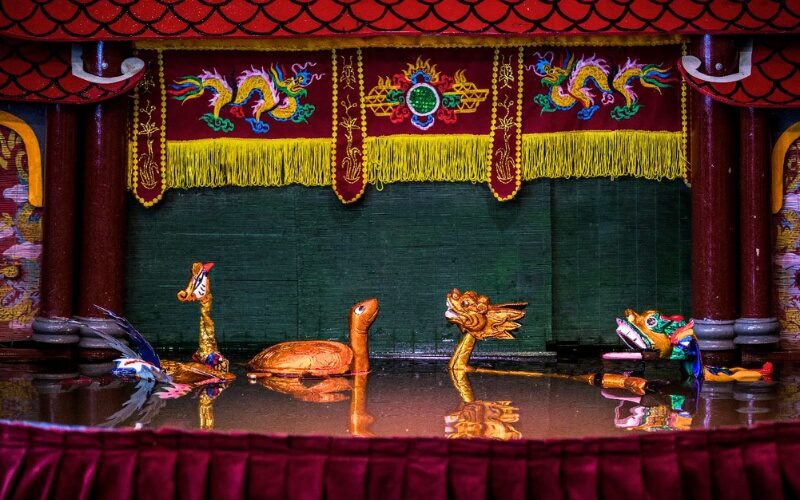
The intricate embroidery and dragon motifs of the stage decorations reflect the deep cultural roots and royal influences of Vietnamese puppetry.
Scenes in a typical performance include:
- The Legend of the Restored Sword: The story of King Le Loi and the golden turtle at Hoan Kiem Lake, played out directly above the water where the actual legend is said to have happened.
- Dragon Dance: Dragons are major characters in many scenes, and the puppet masters who control the multi-section dragon figures have clearly spent years on this particular skill.
- Farming and Harvest: Scenes showing rice planting, buffalo herding, and communal work that reflect the agricultural origins of the art form.
- Fairy Dance: Based on the creation legend of Lac Long Quan and Au Co, the founding ancestors of the Vietnamese people.
- Boat Racing: A fast-paced sequence that gets a visible reaction from most audiences.
- Four Sacred Animals: The dragon, unicorn, tortoise, and phoenix (Tu Linh), all appearing in an elaborate closing sequence.
The show was touching, funny, cheeky, and had amazing visual storytelling. The visual storytelling was easy to understand even without speaking Vietnamese, and the experience was so unbelievably unique and enjoyable.
The one real friction point that comes up in visitor accounts is phone usage. People film extensively throughout, and if you’re seated behind someone with their arm raised through most of the performance, it can become distracting. Arriving early enough to choose an end-of-row seat gives you more flexibility in that situation.
Show Schedule and Best Times to Visit
Regular showtimes from Monday to Saturday are at 3:00 PM, 4:10 PM, 5:20 PM, 6:30 PM, and 8:00 PM. On Sundays, additional performances are available at 9:30 AM and 1:45 PM, giving a full lineup from morning through evening.
The 6:30 PM and 8:00 PM shows are generally considered the best options for most travelers. You can spend the afternoon at Hoan Kiem Lake or the Old Quarter, then walk to the theatre in the early evening. After the show, the surrounding area has plenty of restaurants and cafes open late, so an evening around the theatre fits naturally into a full Hanoi day.
Sunday morning shows (9:30 AM) are a good option for travelers with afternoon flights or those who prefer to avoid the evening crowds. The theatre is less packed at that hour, and the atmosphere is noticeably quieter.
If you’re visiting during Tet (Vietnamese Lunar New Year, usually late January or early February) or national holidays like National Day (September 2), shows often sell out days in advance. Book early.
What to Do Before and After the Show
The location makes this easy. Right outside the theatre is a coffee lounge with views over Hoan Kiem Lake, which works well for a pre-show drink. The lake itself is worth a slow walk around at any hour, but the evening light on the water has its own quality.
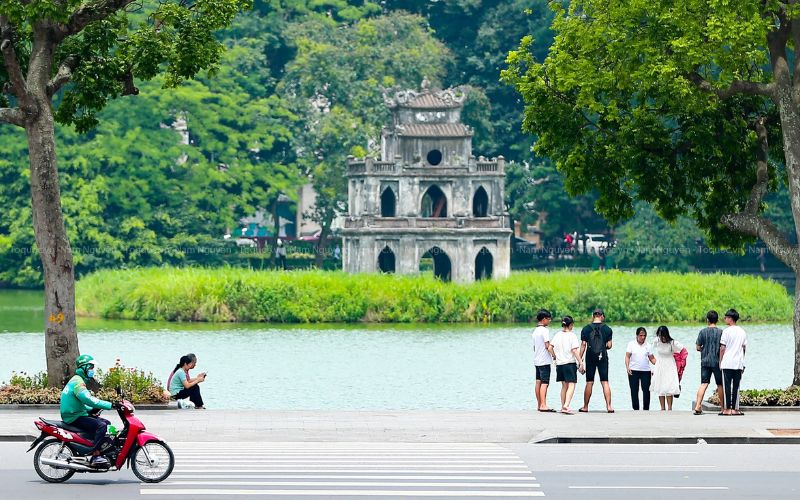
The peaceful early morning atmosphere along the Hoan Kiem Lake promenade, a favorite spot for locals and visitors in Hanoi.
The Hoan Kiem Lake walking street opens on Friday and Saturday evenings and all day Sunday. If your show falls on one of those nights, the streets immediately around the theatre are filled with street food vendors, musicians, and local families. Walking through that before or after the show makes the whole evening feel more coherent as a Hanoi experience.
For dinner, the Old Quarter is directly adjacent. The streets around Hang Be Market and Ta Hien Street have dozens of options ranging from “pho” stalls to mid-range Vietnamese restaurants with full menus. Most are within a 10-minute walk of the theatre.
The History of Water Puppetry
Water puppetry as an art form is old. It originated in the Red River Delta over a millennium ago, beginning when flooded rice paddies became stages for village entertainment, where performers stood in waist-deep water to control puppets above the surface. Farmers developed the technique to perform during harvest festivals and communal celebrations, telling stories about daily life, local legends, and the agricultural rhythms that shaped northern Vietnamese society.
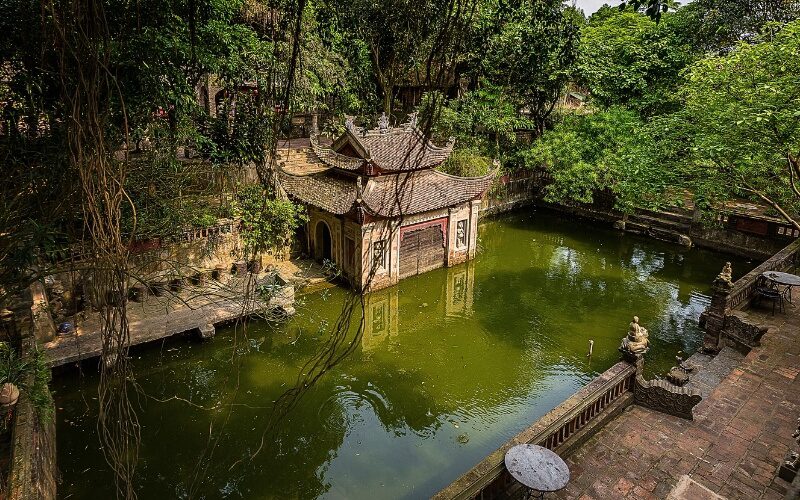
Traditional water puppet shows were historically performed in outdoor ponds.
Water puppetry once depicted the daily life of villagers such as farming, fishing, and romance, and has evolved to showcase plays based on ancient Vietnamese legends, myths, and history. The art form moved from village ponds and flooded fields into formal theatres over several centuries, eventually becoming a state-recognized cultural practice.
What makes water puppetry different from other puppet traditions is the water itself. The surface conceals the mechanical rods that control movement, which means the puppets appear to float and swim independently. The puppets are made from wood and then lacquered, and the bamboo rod that supports each puppet under the water is used by puppeteers who hide behind a curtain on stage, making viewers feel like the puppets move on their own.
The Thang Long theatre selects its repertoire from a pool of over 400 traditional folk water puppet plays, performed by professional artists who spend years learning the techniques of movement, buoyancy, and storytelling through gesture.
Practical Tips for Visiting the Thang Long Theatre
A few things worth knowing before you arrive:
- Arrive early. The theatre recommends arriving at least 20 to 30 minutes before showtime to collect booked tickets and find your seat. On busy evenings, the queue at the ticket window moves slowly.
- No flash photography. Standard rule inside the theatre, and the staff enforces it.
- Dress code is relaxed. There is none. Comfortable clothes are fine. The theatre is air-conditioned, so a light layer helps if you run cold.
- The theatre is not wheelchair accessible. Worth checking with the venue in advance if accessibility is a concern.
- Pets are not permitted inside.
- The seats can be short on knee room for tall audience members, so grabbing an edge seat if you’re tall is a good practical move.
Planning Your Hanoi Visit Around the Show
The Thang Long water puppet show fits naturally into almost any Hanoi itinerary. A standard Hanoi day might start at the Ho Chi Minh Mausoleum and Temple of Literature in the morning, move to Hoa Lo Prison and the Old Quarter in the afternoon, and end with the evening water puppet show and dinner in the Old Quarter. That’s a full day without feeling rushed.
For travelers who want a broader experience of northern Vietnam, IDC Travel’s northern Vietnam tours include Hanoi as a starting point and typically build in time for an evening water puppet show. Tours that continue on to Ha Long Bay, Ninh Binh, or Sapa often spend two nights in Hanoi, which gives enough time to visit the major sites and still catch the show at a relaxed pace.
The Vietnam discovery tours that run the full length of the country also pass through Hanoi, and the water puppet show is a standard first-evening activity for many itineraries.
Conclusion: Quick Reference Overview
| Detail | Information |
| Name | Thang Long Water Puppet Theatre |
| Address | 57B Dinh Tien Hoang Street, Hoan Kiem District, Hanoi, Vietnam |
| Phone | 024 382 49494 / 024 382 55450 |
| Official website | https://nhahatmuaroithanglong.vn/en/ |
| Show duration | Approximately 45 to 60 minutes |
| Theatre capacity | 300 seats |
| Days open | Every day of the year |
| Showtimes |
|
| Seats |
|
| Audio guide | 50,000 VND (~$1.92) extra, available at entrance |
| Camera fee | 20,000 VND (~$0.77) |
| Best time to book | At least 2 to 3 days in advance during peak season |
| Nearest landmark | Hoan Kiem Lake (2-minute walk) |
The Thang Long Water Puppet Theatre has run 365 days a year for over 55 years. It has performed for audiences across 40 countries and still sells out most evenings in high season. That track record says something. If you’re spending any time in Hanoi, an evening at the theatre is one of the few activities that almost universally delivers on what it promises: something you haven’t seen anywhere else and probably won’t forget.
For help building a Hanoi or northern Vietnam itinerary around cultural experiences like this one, we can put together a tailored plan that fits your schedule and travel style.
Read more: