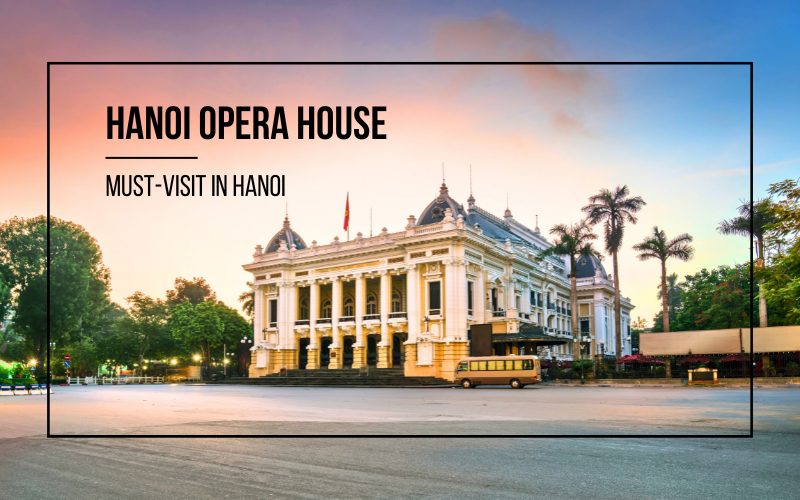
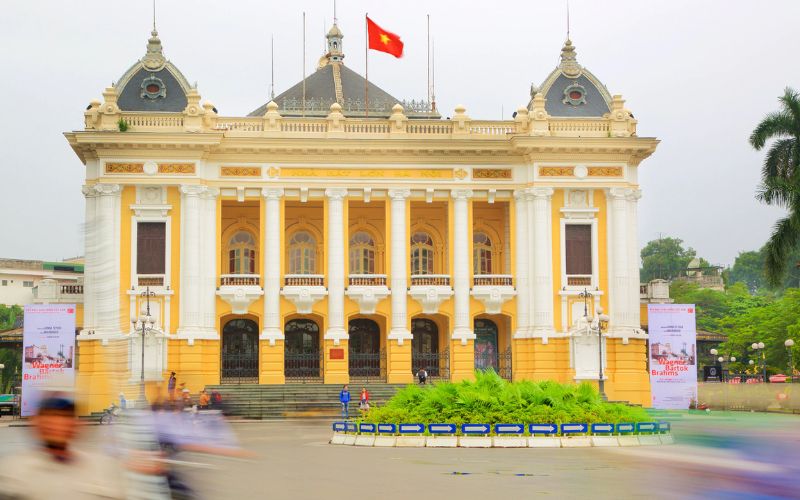
Few buildings in Vietnam stop you in your tracks the way the Hanoi Opera House does. You turn a corner on Trang Tien Street, and suddenly there it is: a pale yellow facade, colonnaded and grand, sitting at the end of a wide square as if it was always meant to anchor this part of the city. Built over a century ago and still hosting performances today, this is one of the most recognizable and well-preserved examples of French colonial architecture in Southeast Asia.
Whether you are planning a Hanoi city tour or putting together a longer Vietnam trip, the Opera House deserves a place on your itinerary.
What Is the Hanoi Opera House?
Known in Vietnamese as Nha Hat Lon Ha Noi (literally “Hanoi Grand Theatre“) and in French as the Opera de Hanoi, the Hanoi Opera House is a functioning performance venue and one of the city’s most visited architectural landmarks.
Hanoi Opera House
It sits in the Hoan Kiem District, at the heart of what locals still call the French Quarter, surrounded by wide boulevards and colonial-era buildings.
The Opera House was built by the French colonial administration, construction beginning on June 7, 1901, and completing in 1911. It was designed by French architects Boyer and V. Harley, with later contributions from Francois Lagisquet, and modeled closely on the Palais Garnier in Paris. It is one of only three opera houses built during the French colonial period in Indochina, alongside Haiphong Opera House and the Municipal Theatre in Ho Chi Minh City. It remains the largest opera house in Vietnam today.
Location of the Hanoi Opera House
- Address: No. 1 Trang Tien Street, Hai Ba Trung Ward, Hanoi, Vietnam (August Revolution Square).
This central location puts it within easy walking distance of Hoan Kiem Lake (roughly 10 minutes on foot) and just steps from the Sofitel Legend Metropole Hanoi and the National Museum of Vietnamese History.
The square in front of the building was constructed in the late 19th century and renamed after the August Revolution of 1945, which marked a turning point in Vietnam’s modern history. Today the area around it is one of the most photographed corners of Hanoi, especially after dark when the building is lit up.
Best Time to Visit Hanoi
Hanoi has a distinct four-season climate, which is worth factoring into any Vietnam holiday planning.
- Spring (March to April): Mild temperatures around 20 to 25°C (68 to 77°F), occasional drizzle, and relatively low humidity. Generally considered the most comfortable time for sightseeing.
- Summer (May to August): Hot and humid, with temperatures reaching 35°C (95°F) or higher, and frequent afternoon rain. The Opera House area can feel uncomfortable in midday heat. Morning and evening visits are best.
- Autumn (September to November): Many locals and experienced travelers consider this the best season. Temperatures around 22 to 28°C (72 to 82°F), lower humidity, and clear skies.
- Winter (December to February): Cool and sometimes cold, dropping to 12 to 15°C (54 to 59°F). The Opera House area is atmospheric in cooler weather. Bring a light jacket.
For attending a performance, the Opera House’s cultural calendar is most active from October through June. The summer months see fewer major international productions.
Hanoi Opera House Tickets and Opening Hours
The theatre is open between Mondays and Fridays, between 10:30 AM and 12:00 PM (visits last approximately 90 minutes). Tours can also be scheduled on other days depending on the management board’s arrangements, so it is worth calling ahead.
Tour options and pricing:
- Tour only: 400,000 VND (~$16) per person (50% discount for students)
- Tour combined with an art performance: Prices vary by show; budget-option packages start around 300,000 VND (~$12) per person
- Maximum group size per visit: 250 people
For general access outside of tours (viewing the exterior, the square, the surrounding area), the Opera House and its grounds are accessible during the day with no admission requirement.
If you are visiting primarily to see the building from outside, the best time is early morning (before 9:00 AM) when the light is good for photography and the square is quiet, or after dark when the facade is lit. Weekday mornings are significantly less crowded than weekends during peak season (October through April).
How to Get There
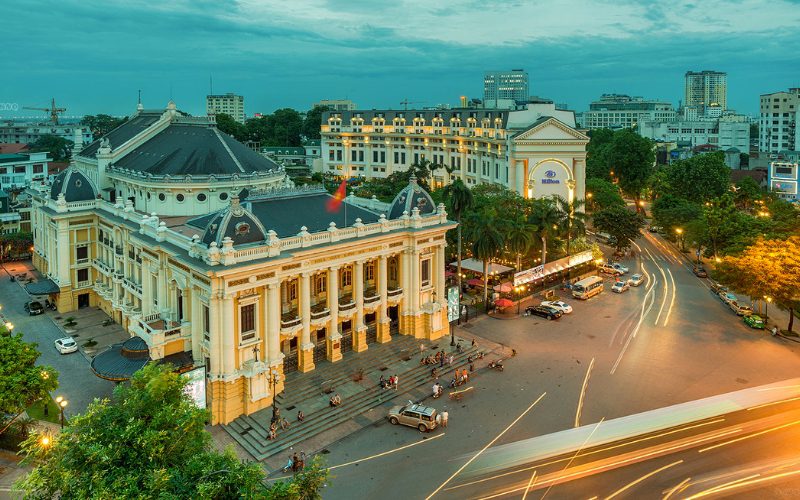
Hanoi Opera House
The Opera House is in the center of Hanoi and straightforward to reach from most hotels in the Old Quarter or French Quarter:
- By taxi or ride-app: The easiest option for most visitors. Use Grab, Be, or Xanh SM. The address in Vietnamese is “1 Trang Tien, Hai Ba Trung Ward” which you can show the driver directly.
- By bus: Several routes pass directly by the Opera House: buses 02, 04, 34, 43, 45, 49, and 86.
- On foot: If you are staying near Hoan Kiem Lake, it is a 10 to 15-minute walk along Hang Bai or Dinh Tien Hoang Street.
- By cyclo: A cyclo ride through the Old Quarter ending at the Opera House is a popular option on Hanoi city tours and gives you a ground-level view of the French Quarter streets along the way.
A Brief History of Hanoi Opera House
After France established colonial control over Vietnam in 1883, authorities in Hanoi wanted a venue that could host classical performances and formal cultural events for the growing French community. Planning for the Opera House began in 1899 at a city council meeting chaired by Hanoi’s Resident Superior Richard, and construction got underway two years later.
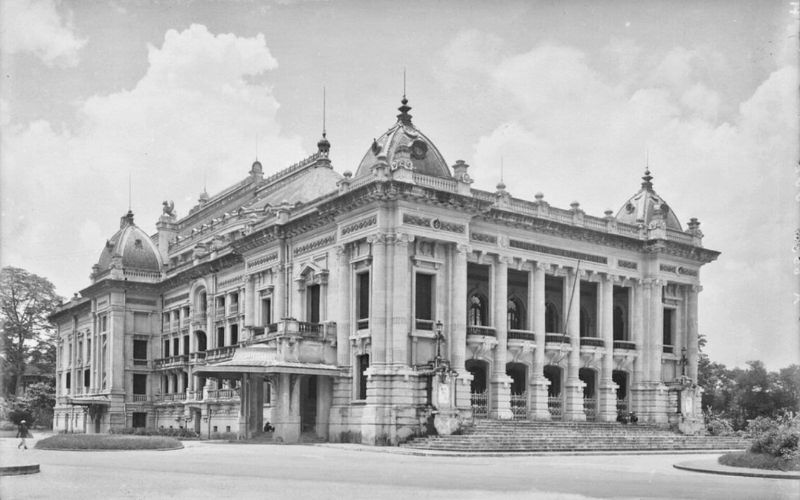
Hanoi Opera House during 1930s
The building officially opened in 1911 and quickly became the social and cultural center of colonial Hanoi. French audiences attended ballet performances, concerts, and pantomimes. For Vietnamese residents, it was largely off-limits during the colonial period.
That changed dramatically in 1945. Following the August Revolution, the Opera House became a meeting place for the new democratic government, hosting the first session of the National Assembly of the Democratic Republic of Vietnam. The building that had once served French colonial society was now the site of a country asserting its independence.
After France withdrew from Hanoi in 1954, the Vietnamese government took over the Opera House and used it as a venue for Vietnamese artists and national cultural programs. By the end of the 20th century, after eight decades of heavy use, the building had deteriorated significantly. A major renovation was carried out in 1995 under the supervision of French-Vietnamese architect Ho Thieu Tri, restoring the original interiors and installing modern air conditioning, sound, and lighting systems. The building has been well maintained since.
Architecture: What Makes It Worth Seeing
The Hanoi Opera House covers 2,600 square meters, measures 87 meters in length and 30 meters in width, and rises to 34 meters at its tallest point. From the outside, the most distinctive features are the T-shaped stone staircase leading to the main entrance, the rows of tall columns, and the ornate balconies.
Hanoi Opera House
What makes the architecture genuinely interesting is how many different European styles are layered into one building. It is not a straightforward copy of the Palais Garnier. The designers drew from several traditions:
- The column system and stone-tiled roof follow Roman Ionic Order.
- The curved balconies and dome over the main entrance reference Italian Baroque architecture of the early 17th century.
- The rooflines flanking the car entrance are in Art Nouveau style.
- The overall composition fits within an Eclecticism-based Neoclassical framework.
Inside, the main auditorium seats 598 people across three tiers of seating designed in 19th-century French style. The dome above is painted with colorful graffiti-style artwork, and the decoration throughout uses Corinthian Order detailing. One room that visitors consistently find memorable is the Mirror Room, which takes its name from the large mirrors placed between the doorways. The floor was restored using mosaic techniques with Italian stone, and the chandeliers and furniture are all in classical French style. This room has been used for signing ceremonies of governmental documents, welcoming guests, and chamber music programs.
The whole interior is a careful combination of color, acoustics, and period detail. If you have the chance to attend a performance here rather than just take a tour, the experience of sitting inside that auditorium is genuinely different from any other venue in Vietnam.
Trang Tien Street and the Surrounding Area
The Hanoi Opera House does not exist in isolation. The street it faces and the area around it are as much a part of the experience as the building itself, and this is where many visitors spend more time than they expected.
Trang Tien Street runs directly in front of the Opera House and connects to Hoan Kiem Lake. It was one of the main commercial streets during the French colonial era and still has an upscale, low-traffic feel compared to the chaotic lanes of the Old Quarter nearby. Walking along Trang Tien gives you a clear sense of the French urban planning that shaped this part of Hanoi: wide pavements, mature trees, and a row of buildings that all share a similar scale and palette.
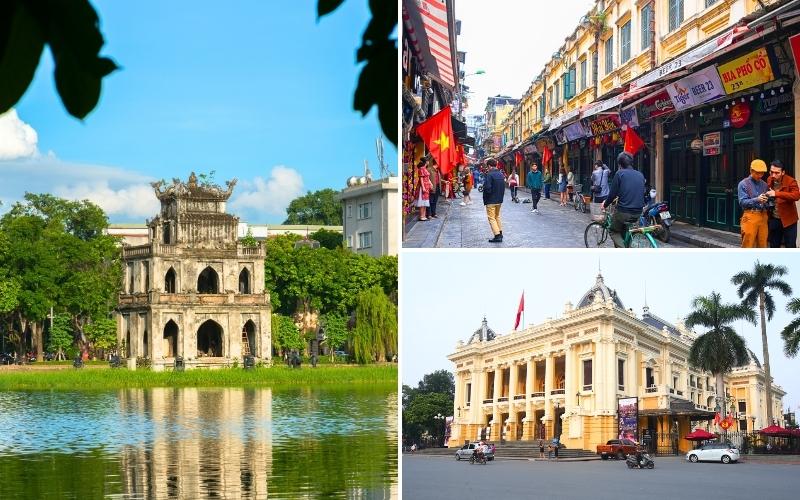
Hoan Kiem Lake – Hanoi Old Quarter – Hanoi Opera House
August Revolution Square in front of the Opera House is worth lingering in, especially in the early morning or at night. During the day, locals use it as a gathering point. After dark, the Opera House is illuminated and the square fills with people taking photos, couples walking, and occasional street performers. During national celebrations and Vietnamese festivals, the square becomes an open-air cultural venue in its own right.
The immediate neighborhood is packed with things worth seeing:
- Sofitel Legend Metropole Hanoi (15 Ngo Quyen Street): One of Southeast Asia’s most historically significant hotels, open since 1901, the same year construction began on the Opera House. Writers, diplomats, and foreign correspondents have passed through it for more than a century.
- Trang Tien Plaza (directly across from the Opera House): A modern shopping center whose glass facade reflects the Opera House facade back at you, creating an interesting visual contrast of old and new.
- National Museum of Vietnamese History (1 Trang Tien Street, Hai Ba Trung Ward): One of Hanoi’s best museums, covering Vietnamese history from prehistoric times through 1945. The French colonial building is worth seeing on its own.
- St. Joseph’s Cathedral (40 Nha Chua Street, about 10 minutes on foot): Built in 1886 and modeled on Notre-Dame in Paris, it is one of the oldest churches in Hanoi and a peaceful stop after the busier streets nearby.
- Hoa Lo Prison Museum (1 Hoa Lo Street): Known to American veterans as the “Hanoi Hilton”, this former colonial prison is now a museum and one of the most visited historical sites in the city. Check our Hoa Lo Prison guide now!
- Hoan Kiem Lake: A short walk from the Opera House, the lake is Hanoi’s most iconic public space. The red Huc Bridge and Ngoc Son Temple on the small island in the middle of the lake are must-sees.
The entire stretch between the Opera House and Hoan Kiem Lake is walkable, flat, and genuinely pleasant. Many visitors find this is the part of Hanoi they end up returning to in the evenings, when the heat drops and the streets take on a different character.
Performances: What to Expect from Opera in Hanoi
The Hanoi Opera House has hosted Vietnamese and international artists for over a century. Today the resident company overlaps with the Vietnam National Symphony Orchestra, and the Hanoi Philharmonic Orchestra from the Hanoi Conservatory also performs here regularly.
The range of performances is broader than the name suggests. On any given month you might find classical Western opera, Vietnamese traditional music, ballet, symphony concerts, drama, and chamber music. The Opera House has seen premieres of operas by Vietnamese composers, including works by Do Nhuan and Luu Huu Phuoc, and continues to host both domestic and international productions.
If you are planning to attend a show, a few things to know. Evening performances typically start around 8:00 PM. Ticket prices for performances start at around 300,000 VND (~$12) per person and go up to 2,000,000 VND (~$80) or more for premium seats at major productions. Prices vary significantly by event and seating category, so it is worth checking the schedule in advance rather than showing up and hoping for the best.
Practical Tips Before You Go
A few things that make a difference:
- Dress modestly if you are attending a performance. The Opera House has a formal atmosphere and the audience tends to dress up more than at typical tourist venues in Vietnam.
- Book performance tickets in advance for any major show, especially during festivals or national holidays. Tickets sell out.
- Photography: The exterior can be photographed freely from the square. Inside, photography rules depend on the specific tour or event.
- Currency: Bring Vietnamese dong (VND) for any entrance fees or nearby street food. Most restaurants and hotels in the area accept cards, but cash is useful for smaller purchases. 10,000 VND is roughly $0.38.
- Weather: If visiting in summer, the walk between the Opera House and Hoan Kiem Lake is short but exposed. Carry water.
The Hanoi Opera House and Your Vietnam Itinerary
For most visitors, the Opera House fits naturally into a morning or afternoon spent in the French Quarter and Hoan Kiem area. A Hanoi city tour that combines the Opera House, the nearby National Museum of Vietnamese History, a walk along Trang Tien to Hoan Kiem Lake, and lunch in the Old Quarter makes for a full and well-paced day.
If you are putting together a longer itinerary for Northern Vietnam, Hanoi is the natural starting point. From here, day trips to Ninh Binh are easy, and the overnight train or bus to Sapa departs from the city. Vietnam tours that cover the full country typically begin or end in Hanoi, giving you at least two days to explore the capital at a relaxed pace.
Attending an evening performance at the Opera House on your first or second night in Hanoi is a good way to get a sense of the city’s cultural life beyond the more tourist-facing experiences. The building’s acoustics are excellent, the productions are often genuinely impressive, and it is a very different kind of evening from a bar in the Old Quarter.
Quick Reference: Hanoi Opera House at a Glance
| Detail | Information |
| Official name | Hanoi Opera House / Grand Theatre of Hanoi (Vietnamese: Nha Hat Lon Ha Noi) |
| Address | No. 1 Trang Tien Street, Hai Ba Trung Ward, Hanoi, Vietnam |
| Tel. | 090 342 56 92 |
| 36phohn@gmail.com | |
| Built | 1901 to 1911 |
| Architects | Boyer, V. Harley, Francois Lagisquet |
| Architectural style | Neoclassicism (with Baroque, Art Nouveau, and Ionic elements) |
| Capacity | 598 seats |
| Area | 2,600 square meters |
| Tour days | Mondays and Fridays, 10:30 AM to 12:00 PM |
| Tour ticket | 400,000 VND (~$16); 50% discount for students |
| Performance tickets | From 300,000 VND (~$12) to 2,000,000 VND (~$80) |
| Nearest landmark | Hoan Kiem Lake (10-minute walk) |
| Best time to visit | March to April, September to November |
If you are organizing a trip to Hanoi or broader Vietnam holidays, IDC Travel can help you put together a private, tailor-made itinerary that includes the Opera House alongside Hanoi’s other major landmarks. With local guides who know the city well and a track record of organized, well-paced tours, it is a practical option for first-time visitors and returning travelers alike.
You can also browse Vietnam tours for ready-made packages that cover both the north and south of the country.
>>> Refer to Nhà hát Lớn Hà Nội – Wikipedia tiếng Việt.
Read more: