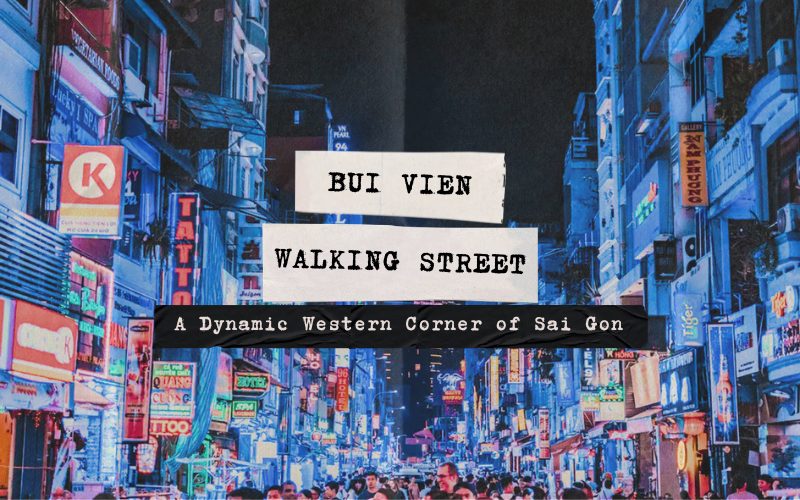
If you are planning a trip to Ho Chi Minh City and wondering where the city truly comes alive after dark, Bui Vien Walking Street is the answer. This 650-meter strip in Saigon is where backpackers, solo travelers, and curious visitors have gathered for years, drawn by cheap beer, loud music, neon lights, and a contagious energy that is hard to find anywhere else in Vietnam. Whether you are staying nearby or just passing through on a southern Vietnam tour, an evening on Bui Vien Street is one of those experiences that tends to stick with you.
What Is Bui Vien Walking Street?
Bui Vien Walking Street is a pedestrian-only street located in the Pham Ngu Lao backpacker district of Ho Chi Minh City. On weekend evenings from around 7:00 PM, the street is closed to motorbikes and becomes a sprawling open-air social space packed with bars, street food vendors, live music stages, and thousands of people from every corner of the world.
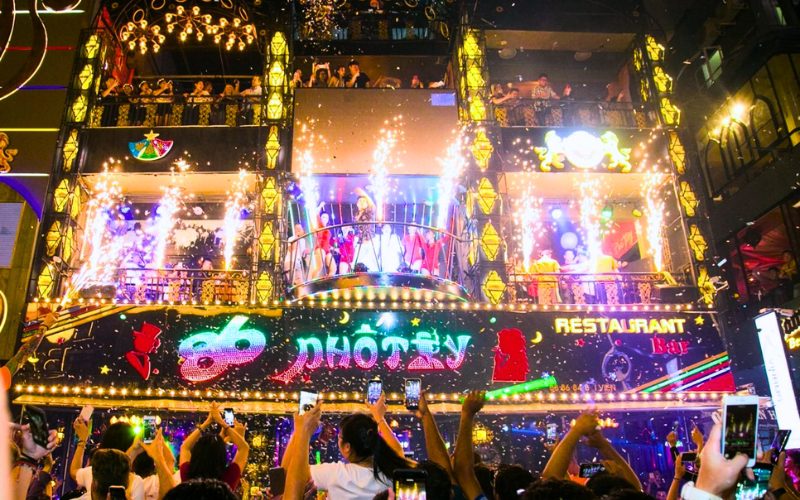
Music Party on Bui Vien Street
The street is named after Bui Vien, a 19th-century Vietnamese mandarin and diplomat known for his travels to the United States during the reign of Emperor Tu Duc. He was one of the first Vietnamese officials to propose opening the country to foreign trade, which makes the street’s international reputation feel oddly fitting.
Since 2017, the city has officially designated it a walking street on Friday, Saturday, and Sunday nights, though the surrounding area buzzes any night of the week.
Where Is Bui Vien Street?
- Address: Bui Vien Street, Ben Thanh Ward, Ho Chi Minh City, Vietnam.
Bui Vien Street sits in the heart of the Pham Ngu Lao backpacker area, roughly 1.5 km southwest of Ben Thanh Market. It runs parallel to De Tham Street and connects with Pham Ngu Lao Street at the northern end.
Getting there is straightforward from most parts of Saigon:
- By taxi or Grab (ride-hailing): about 10 to 15 minutes from the city center. A Grab ride from Ben Thanh Market costs around 30,000 to 40,000 VND (~$1.20 to $1.60).
- On foot: if you are staying in the Ben Thanh area, you are likely already within a 5-minute walk.
- By bus: Route 03 and several others pass nearby, with stops on Pham Ngu Lao Street.
The closest landmarks for navigation are the Pham Ngu Lao bus station, the Sinh Tourist office, and the many guesthouses along De Tham Street. If you get dropped at the intersection of Pham Ngu Lao and De Tham, you are essentially already there.
Best Time to Visit Bui Vien Walking Street
The official walking street hours are Friday, Saturday, and Sunday from approximately 7:00 PM to 2:00 AM. The street is technically open to pedestrians every night, but the full closure and the largest crowds happen on these three nights.
For first-time visitors, Saturday evening between 8 PM and 11 PM is the peak experience. It is the most crowded, loudest, and most visually intense version of Bui Vien. After midnight the character shifts slightly, the food vendors start packing up, and the crowd becomes more bar-focused.
In terms of seasons, Bui Vien runs year-round. Ho Chi Minh City’s dry season (December to April) tends to bring more international tourists, making the street busier. During the wet season (May to November), occasional heavy rain can thin the crowd for an hour or two, but the bars stay open and the atmosphere often gets more relaxed as a result. Some regulars actually prefer a quiet rainy Tuesday in Bui Vien to a packed Saturday.
Highlights of Bui Vien Walking Street
This is where things get interesting. Bui Vien is not really one thing. It is a compressed, chaotic mix of several scenes happening at once, and different people get entirely different experiences from the same street. Here is what actually makes it worth your evening.
1. The Atmosphere After Dark
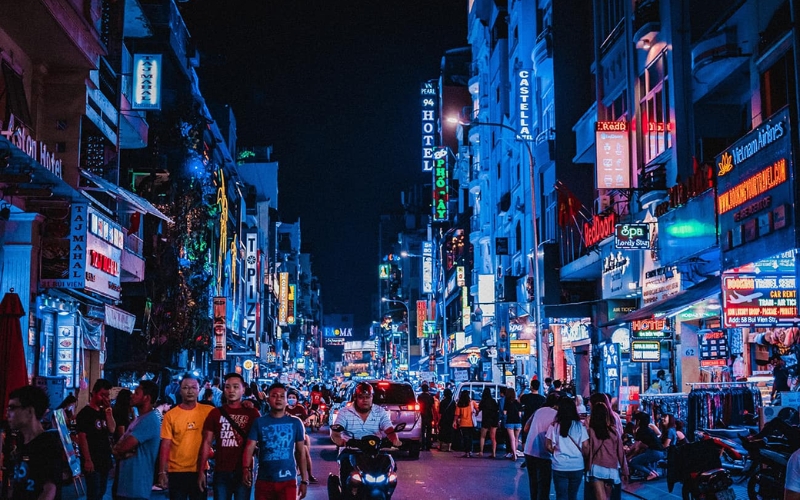
Bui Vien Street provides a bustling atmosphere
There is a specific moment around 8:30 PM on a Saturday when Bui Vien reaches its peak intensity. Both sides of the street are lined with open-fronted bars spilling crowds onto plastic stools. DJs and live bands compete from different venues. Vendors weave through with trays of drinks and grilled snacks. Neon signs in every color reflect off the road. It is genuinely overwhelming in the best way for about the first 20 minutes, after which most people just find a spot and settle in.
The lighting alone is worth seeing. LED displays, laser projections, and custom neon art installations create a visual density that photographs well but is genuinely more impressive in person. Some of the larger bars have invested significantly in their frontages, turning the street into something of an informal open-air art display after dark.
2. Bui Vien Street Bars
The bars on Bui Vien Street range from narrow shoebox venues to multi-story clubs with rooftop terraces. Most follow a similar model: cheap drinks, loud music, and staff actively pulling in guests from the street. Beer prices are the draw for many travelers.
A Bia Saigon or Bia Huda typically runs 20,000 to 25,000 VND (~$0.80 to $1.00) per can at street-level vendors. Bar prices are slightly higher, with draft beers starting around 35,000 to 50,000 VND (~$1.40 to $2.00). Cocktails at most Bui Vien Street bars cost between 80,000 and 150,000 VND (~$3.20 to $6.00), which is still cheap by international standards.
A few bars worth knowing about by category:
- For live music: Several bars on the northern end of the street feature live bands playing Vietnamese pop, rock covers, and occasional jazz from around 8 PM onward.
- For rooftop views: The multi-story venues closer to the Pham Ngu Lao intersection give you a good vantage point to watch the crowd below without being completely submerged in it.
- For a slightly calmer drink: The side streets branching off Bui Vien, particularly toward De Tham, have smaller bars that are noticeably less frantic and better for actual conversation.
One honest note: the quality of cocktails varies significantly. The 50,000 VND (~$2.00) you get at a street stool will taste like it costs 50,000 VND. If you care about what you are drinking, stick to beer or ask for a well-known spirit mixed simply.
3. Street Food on Bui Vien
The food scene on and around Bui Vien is genuinely good, and slightly underrated compared to the bar culture. Vendors move through the crowds with grilled corn, banh mi, fresh spring rolls, and skewered meats throughout the night.
A few things actually worth eating:
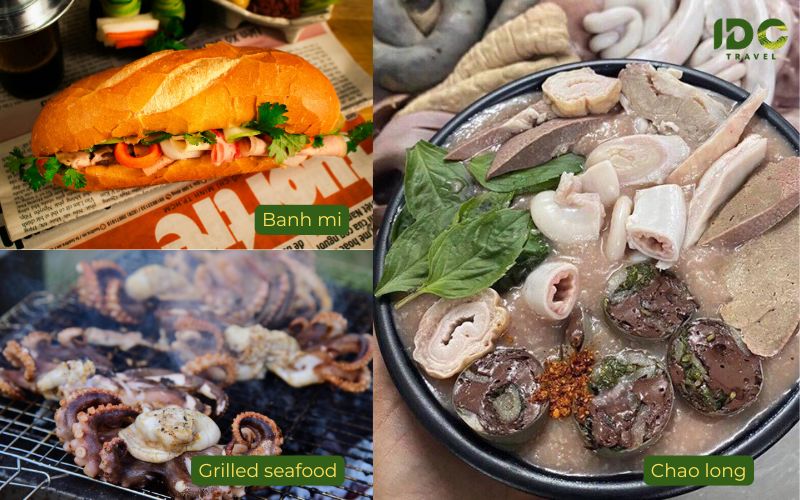
Exploring the delicious variety of local snacks and street food flavors found along the bustling Bui Vien Walking Street.
- Banh mi: Several fixed stalls near the street entrances sell proper banh mi for 25,000 to 35,000 VND (~$1.00 to $1.40). At that price and at 11 PM, they taste exceptional.
- Grilled seafood: The small restaurants on De Tham Street, a one-minute walk from the walking street, offer grilled squid, clams, and scallops that are far better than the tourist prices might suggest. A shared plate of scallops with spring onions and peanuts costs around 80,000 to 120,000 VND (~$3.20 to $4.80).
- Chao long (rice porridge with pork offal): Not for everyone, but a few late-night carts near the southern end of the street sell this for 30,000 VND (~$1.20) and it is one of those things that local regulars swear by.
The food stalls typically set up from around 6 PM and some stay until 2 or 3 AM.
4. Live Music and Street Performances
Live music is genuinely woven into the Bui Vien experience in a way that differs from other nightlife areas. It is not just background noise in one or two bars; it is coming from multiple directions simultaneously. On a busy Friday night you might hear a Vietnamese rock band at one end, a DJ set from the middle, and an acoustic duo at a bar on the corner, all overlapping.
A few of the larger venues have dedicated stages with proper sound systems and lighting rigs. The musicians are often talented, the sets go until 1 or 2 AM, and there is no cover charge for most of it. You pay for your drinks and the music is part of the deal.
Street performers also appear occasionally, including traditional Vietnamese instrument players and acrobats, though these are more common during major holidays and festivals.
5. The Backpacker Community Feel
What sets Bui Vien Walking Street apart from more polished nightlife districts is the crowd mix. On any given night you will find:
- Long-term backpackers on extended Southeast Asia trips
- Groups of Vietnamese university students out for the night
- Digital nomads on their third week of “just passing through”
- Package tourists venturing out from nearby hotels
- Local families eating street food at the edges before things get too loud
That mix creates a social energy that is harder to manufacture than a designed rooftop bar. People talk to strangers. Tables merge. Plans change.
6. The Neon Light Photography Scene
Bui Vien Walking Street photos have become a genre of their own on travel blogs and social media. The combination of dense neon signage, crowd movement, and relatively long streets makes it a good subject for long-exposure photography or video. The best time for photos is roughly 8 PM to 9:30 PM, before it gets too crowded to move freely and while the light-to-dark contrast is still interesting.
If you are shooting on a phone, the alley entrances off the main strip often give better framing than the main street itself, where it can be hard to find a clear line of sight.
7. Hotels in Bui Vien Street Area
The Pham Ngu Lao area around Bui Vien has some of the most affordable accommodation in Ho Chi Minh City, with options from basic dorms to mid-range boutique hotels. The trade-off is noise: if you are staying on or very close to Bui Vien Street itself, expect significant sound until at least 2 AM on weekends.
A few general options by budget:
- Budget (under $20/night): Hostels and guesthouses along De Tham and Bui Vien streets offer dorm beds from around 100,000 to 200,000 VND (~$4.00 to $8.00) and private rooms from 300,000 VND (~$12.00).
- Mid-range ($30 to $70/night): Several 3-star hotels within walking distance offer proper soundproofing, breakfast, and pools. These are a short Grab ride from the street itself, which helps with sleep.
If you prioritize sleep, consider staying in a hotel a few blocks away toward Ben Thanh Market or along Nguyen Trai Street, where you can still walk to Bui Vien in 10 minutes but avoid the late-night noise.
Booking two to three weeks in advance is recommended for weekend stays, especially during Vietnamese public holidays and the December-January peak season.
Getting Around and Practical Tips
A few things that genuinely help:
- Cash is king: Most street vendors and smaller bars only take cash. ATMs are on the main Pham Ngu Lao Street and at several 24-hour convenience stores nearby.
- Watch your belongings: Pickpocketing does happen in crowded areas. A front-pocket wallet or a small crossbody bag that closes properly makes a difference.
- Drink tap water at your own risk: Buy bottled water from convenience stores (7-Eleven and FamilyMart both have branches within 200 meters of the street) or stick to canned drinks.
- Agree on prices before ordering: This applies especially to street vendors and smaller stalls. Most are honest, but confirming the price of grilled skewers before they hit the grill avoids surprises.
- Grab is more reliable than street taxis after midnight: Use the app for any ride after 12 AM.
What to Do Near Bui Vien Street
Bui Vien sits in a neighborhood with more going on than just the nightlife strip itself. Within 15 minutes on foot or a short Grab ride:
- Ben Thanh Market: About 1.5 km away, best visited in the morning or early afternoon for local produce, street food, and souvenirs.
- War Remnants Museum: A sobering but important visit, roughly 2 km from the street. Best in the morning.
- Reunification Palace: About 2 km northeast, open daily. The preserved 1970s interior is genuinely interesting.
- Bui Thi Xuan Street food lane: A quieter, more local food street about 500 meters away, good for a pre-Bui Vien dinner.
If you want to explore Ho Chi Minh City beyond the backpacker district, Ho Chi Minh City tours can be a practical way to cover the major sites with a guide who can add context to places like the War Remnants Museum and Cu Chi Tunnels.
Bui Vien Walking Street as Part of a Vietnam Trip
Most travelers who visit Bui Vien Street are passing through Ho Chi Minh City as part of a broader Vietnam travel itinerary. The city is typically the start or end point of trips that include central Vietnam (Hoi An, Hue, Da Nang), the Mekong Delta, and the north (Hanoi, Halong Bay, Sapa).
If you are putting together a longer trip, a few nights in Ho Chi Minh City at the beginning or end gives you time to see both the daytime cultural sites and the nightlife without feeling rushed. The Mekong Delta is a natural day trip from the city, and can be covered in a single day with an organized tour from southern Vietnam tours operators.
For travelers with more time, combining Ho Chi Minh City with Hoi An, Hue, and Hanoi over 10 to 14 days is one of the classic Vietnam tours routes that covers both the country’s history and its contrasting urban energy.
Conclusion: Is Bui Vien Walking Street Worth It?
| Detail | Information |
| Name | Bui Vien Walking Street |
| Location | Ben Thanh Ward, Ho Chi Minh City |
| Official walking street hours | Friday, Saturday, Sunday from ~7:00 PM to 2:00 AM |
| Best time to visit | Saturday, 8 PM to 11 PM |
| Average price |
|
| Budget accommodation nearby | From 100,000 VND/night (~$4.00) for dorms |
| Nearest landmark | Ben Thanh Market (1.5 km) |
| How to get there | Grab, taxi, bus route 03, or on foot |
| Best for | Backpackers, budget travelers, nightlife seekers, first-time Vietnam visitors |
Bui Vien Walking Street is not a refined experience. It is loud, crowded, and slightly chaotic, and that is entirely the point. It captures something about Ho Chi Minh City’s energy that the museums and temples cannot: the city’s appetite for noise, company, and staying up too late.
Whether you spend one evening there or make it your base for a week, it is a genuine slice of what the Saigon backpacker scene has been for decades. If you are planning a Vietnam trip that includes the south, set aside at least one evening for it. You can always leave early if it is not your thing, but most people end up staying longer than planned.
For help planning your time in Ho Chi Minh City and the rest of Vietnam, the team at IDC Travel specializes in tailor-made Vietnam tours that can be built around your pace, budget, and interests.
>>> Refer to Bui Vien Street – Wikipedia.
Read more: